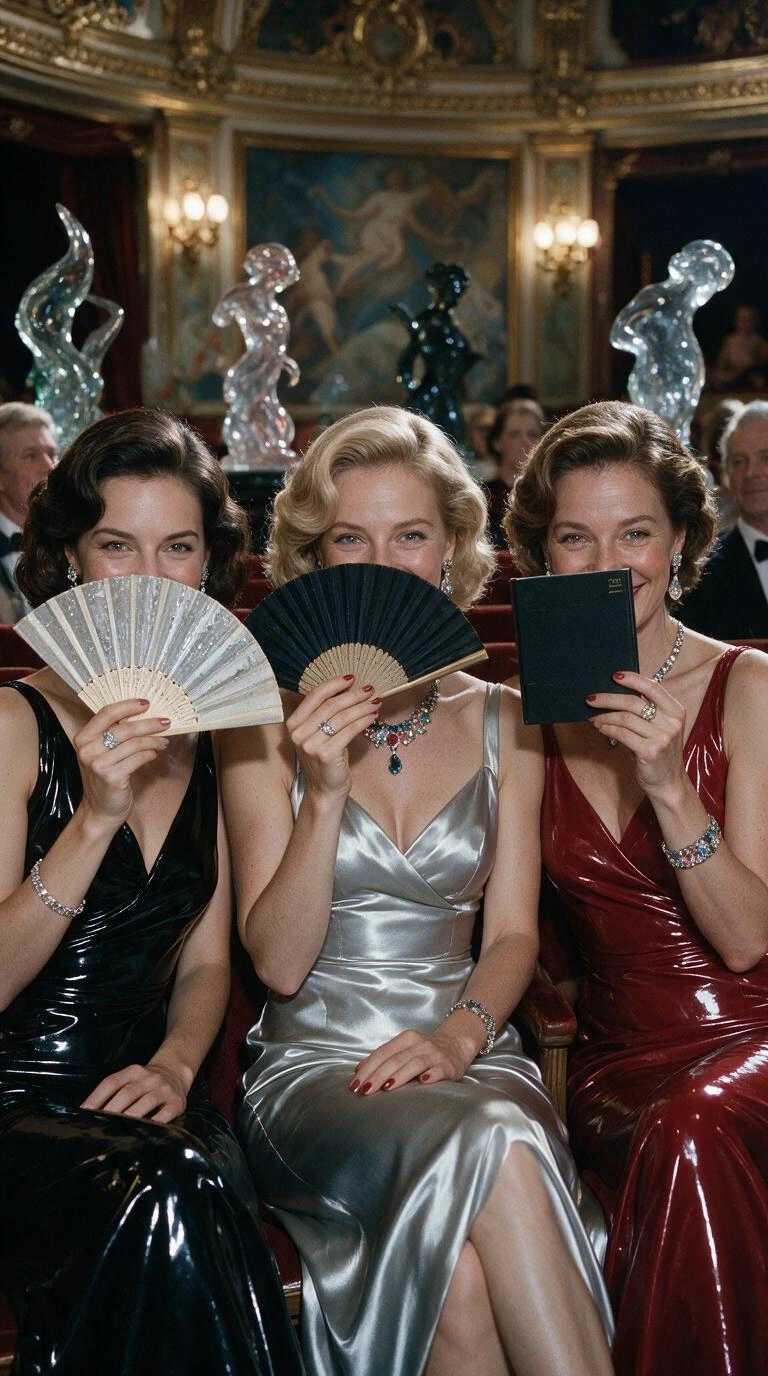
The Quiet Power Every Woman Possesses But Few Dare to Claim
What if the most magnetic thing about you isn’t what you reveal — but what you protect?
There is a woman who walks into a room and changes its temperature.
Not through volume. Not through spectacle. Not through the desperate performance of being noticed. She enters, and something shifts — a current, a gravity, a quiet rearrangement of every eye toward her without quite knowing why.
She is not the loudest. She is not the most decorated. She is not the one who explains herself at length or fills every silence with the sound of her own accomplishments.
She is the one you cannot quite figure out.
And that — that precise, deliberate, delicious inability to categorise her — is the most powerful thing she owns.
We live in an age that has confused transparency with virtue. We are told to be open, to be authentic, to be — that exhausted word — relatable. We narrate our feelings before we have finished feeling them. We justify our choices to people who never asked. We dress to be understood rather than to be felt. We hand over the full map of ourselves and then wonder why no one wants to explore the territory.
But there is a older knowledge. A deeper one. It lives in the way candlelight is more compelling than fluorescent truth. It lives in the way a half-closed door is more inviting than one flung wide. It lives in the way a woman in satin — catching light, holding shape, suggesting everything and confirming nothing — has always been more magnetic than the woman who has nothing left to hide.
Mystery is not deception. It is depth.
It is the natural consequence of a woman who has lived enough to contain multitudes — and who has the wisdom not to lay them out like a sample sale.
Over the next six parts, we are going to examine what mystery actually is, why it matters, how it creates desire, how it feels in the body and the room, how it survives decades of familiarity, and — most importantly — how you can cultivate it in a way that is authentic, sustainable and quietly transformative.
This is not a dating article. This is not a collection of tricks.
This is an investigation into the most misunderstood quality a woman can possess — and a practical guide to claiming it as your own.
Because the woman who stops explaining herself does not become less.
She becomes unforgettable.
Part One: The Architecture of Mystery
What mystery actually is — and why nearly everyone misunderstands it.
There is a woman you have met. Perhaps once. Perhaps several times. You cannot quite describe her. Not because she was unremarkable — the opposite. She was so remarkable that language seems too small a container for the impression she left. You remember the way she held her glass. You remember the quality of light in the room when she spoke. You remember that you wanted to know more, and that the wanting itself was pleasurable — a slow, warm ache rather than a sharp demand.
You have carried her with you. Not as an obsession. As a presence. As the proof that some people do not merely occupy space; they alter it.
That woman understood something most people do not.
She understood mystery.
And she did not learn it from a magazine article. She did not perform it. She did not construct it from calculated silences and strategic unavailability. She simply lived in a way that produced it naturally — the way a deep river produces mist on a cold morning. The mist is not the river’s intention. It is the river’s consequence.
This is where we must begin: with the fundamental misunderstanding that has cheapened one of the most powerful qualities a woman can possess.
The Misunderstanding
The word mysterious has been ruined.
It has been ruined by dating advice that treats human connection as a game of strategic withholding. It has been ruined by characters in films who are called mysterious when they are merely underwritten. It has been ruined by the implication that mystery is something you do — a technique, a posture, a mask you wear over a face that is, in truth, entirely ordinary.
This is the first and most important correction: mystery is not a mask.
A mask is something you place over yourself to conceal what is beneath. It is an addition — a layer of deception. The woman who wears a mask is performing mystery, and performed mystery is always, eventually, visible for what it is. It has a seams. It has a stage direction. It has the faint, unmistakable odour of effort.
Genuine mystery is the opposite. It is not something you add. It is something you have — or more precisely, something you are — when you possess enough depth that the surface cannot fully communicate what lies beneath it.
Consider the ocean. The ocean is mysterious not because it is hiding something from you. The ocean is mysterious because it is vast, layered, and deeper than any single glance can penetrate. You can stand at its edge for a lifetime and never see the bottom. That is not deception. That is scale.
The woman of genuine mystery is the same. She has lived. She has thought. She has felt things she has not narrated. She has developed opinions she has not broadcast. She has cultivated an interior life that is rich enough to be, quite simply, more than can be displayed in a single conversation, a single evening, a single year.
She does not need to be mysterious. She needs only to be — and the mystery takes care of itself.
The Woman Who Has Nothing to Hide But Everything to Reveal Slowly
There is a critical difference between the young woman who must perform mystery and the mature woman who simply possesses it.
The young woman — and there is no shame in this; it is the natural condition of youth — has not yet accumulated enough depth to be genuinely mysterious. She has not had time. She has not read enough, lived enough, loved enough, lost enough. Her interior rooms are still being furnished. And so, if she wishes to appear mysterious, she must resort to technique: the calculated silence, the strategic late reply, the deliberately ambiguous statement. She is building a facade because the building behind it is still under construction.
The mature woman has no need for facades. She has been alive long enough to contain multitudes. She has had careers, relationships, adventures, disappointments, epiphanies. She has read books that changed her and books that wasted her time, and she knows the difference. She has held opinions and released them. She has been certain and then been wrong and then been certain again in a different direction.
She is, in other words, a deeply furnished room.
And a deeply furnished room does not show a visitor everything at once. It does not line up its contents against the wall for inspection. It allows itself to be discovered gradually — the painting that catches your eye on the second visit, the book whose spine you did not notice the first time, the corner that holds a chair you had not realised was there.
This is the mature woman’s natural advantage. She does not need to manufacture mystery because she is a mystery — not in the sense of being unknowable, but in the sense of being inexhaustible. You can know her for a decade and still encounter a room you have not entered.
The tragedy is that many mature women have been taught to do the opposite. They have been taught to be transparent, to explain themselves, to make their lives legible and accessible. They have been encouraged to narrate their histories, justify their choices, and present themselves as fully resolved — as though being fully understood were the same as being fully valued.
It is not.
The woman who is fully understood is a completed sentence. The woman who retains her depth is a sentence that keeps revealing new meanings upon re-reading.
Mystery as Depth, Not Distance
Here is the distinction that changes everything: mystery invites closer inspection. Distance repels it.
These two qualities are constantly confused. The woman who is called mysterious is often merely distant — cold, withholding, emotionally unavailable. She creates a gap between herself and others, and that gap produces frustration, not curiosity. People do not lean toward her; they pull away. She interprets their withdrawal as evidence that she is “too much” or “too complex,” when in fact she is simply too remote.
Genuine mystery operates in the opposite direction. The mysterious woman does not push people away. She draws them in — slowly, deliberately, with the quiet gravity of something worth approaching. She is warm but not exhaustive. Present but not fully revealed. She gives enough to invite the next question without answering all the previous ones.
The difference feels like this:
Distance says, Do not come closer.
Mystery says, Come closer. But understand that what you find will be deeper than you expected.
The first creates starvation. The second creates hunger. And hunger — the pleasant, anticipatory, forward-leaning sensation of wanting to know more — is the engine of desire. Not just romantic desire, but the desire to be in someone’s presence, to hear what they will say next, to understand how they see the world.
The woman who creates hunger is the woman people remember.
The woman who creates starvation is the woman people avoid.
The architecture is precise: mystery is warmth plus depth plus selectivity. Remove any element and the structure collapses. Warmth without depth is charm — pleasant but forgettable. Depth without warmth is intimidation — impressive but unapproachable. Selectivity without either is mere game-playing — transparent and eventually tiresome.
But combine all three — a woman who is genuinely warm, genuinely deep, and genuinely selective about what she reveals and when — and you have something rare. Something that does not need to announce itself. Something that is felt the moment she enters a room.
What Mystery Is Actually Made Of
If mystery is not a technique, then what is it made of? What are the materials from which it is constructed?
There are five.
The first is unpredictability within consistency. The mysterious woman is reliable but not predictable. She can be counted on — her word is solid, her presence is dependable, her standards do not shift with her mood. But within that reliability, she is not formulaic. She does not respond to every situation in the same way. She is capable of surprising you — not through caprice, but through the simple fact that she has more than one register. She can be playful and serious. She can be direct and oblique. She can be warm and reserved. The consistency is in her character; the unpredictability is in her range.
The second is selective self-revelation. She chooses what to share, with whom, and when. This is not secrecy — secrecy protects shame. This is selectivity, and selectivity protects depth. She does not tell everyone everything. She does not narrate her inner life to acquaintances. She does not explain her choices to people who have not earned the explanation. She reveals herself in layers, matching the depth of disclosure to the depth of trust. The result is that being trusted by her feels like an achievement — because it is.
The third is comfort with silence. This is perhaps the rarest quality of all. The mysterious woman does not fill every gap with speech. She can sit in silence — at a dinner table, in a car, across a room — without discomfort. She does not interpret silence as awkwardness requiring repair. She understands that silence is a space, and that what fills that space is the other person’s thoughts, questions, and desires. She gives them room. And in that room, something grows.
The fourth is independence of thought. She has opinions she has not borrowed from the current consensus. She has read, reflected, and concluded for herself. This does not mean she is contrarian — contrarianism is its own form of conformity, defined by opposition rather than reflection. It means her views are genuinely her own, arrived at through her own engagement with the world. When she expresses them, they carry the weight of genuine conviction — and they cannot be predicted, because they were not manufactured to fit.
The fifth is a private interior life. She reads. She thinks. She reflects. She has a relationship with her own mind that is not performed for an audience. She keeps a notebook, perhaps. She walks alone, perhaps. She has practices — intellectual, spiritual, creative — that are hers and that she does not feel compelled to share. This interior life is the well from which her depth is drawn. Without it, the other four qualities eventually run dry.
These five elements, working together, produce a woman who is not merely interesting but compelling — a woman whose presence creates a particular quality of attention in those around her. Not the sharp, startled attention of spectacle, but the soft, sustained attention of fascination.
The October Frame
There is a reason this subject belongs in October.
Summer is the season of visibility. Bodies are exposed, skin is on display, the world is bright and explicit and everything can be seen clearly. Summer is beautiful, but it leaves nothing to the imagination. It is the season of the fully revealed.
Autumn is different. Autumn is the season of lengthening shadows, of earlier sunsets, of the sense that something is being gathered in rather than displayed. The light changes — it becomes golden, lower, more selective about what it illuminates. The air changes — it carries a chill that invites layers, textures, the quiet luxury of a fabric that catches the light without explaining itself.
The summer woman is visible. She is seen.
The autumn woman is felt.
She enters a room and the room knows it, even if no one turns to look. She wears something that catches the light — a satin blouse that shifts with her movement, a leather skirt that holds its shape, a silk scarf that suggests rather than states — and the eye is drawn not because she is exposed but because she is illuminated. The glossy surface catches what light there is and sends it back in a way that makes you want to look longer, look closer, understand what you are seeing.
This is the physical language of mystery: a surface that reflects without fully revealing. A texture that invites touch without granting it. A presence that is unmistakable without being explicit.
The rough, the coarse, the matte — these are the textures of a world that has given up on mystery. They absorb light without returning it. They present themselves fully and leave nothing to be discovered. They are the fabrics of a woman who has decided to be understood rather than to be felt, to be practical rather than to be compelling, to blend in rather than to linger in the mind.
The glossy, the sleek, the luminous — these are the textures of a woman who knows that what catches the light also holds it. Who knows that a surface can suggest depth without displaying it. Who knows that the pleasure of looking is not in the complete view but in the sense that there is always more to see.
October is the season of mystery because October is the season that understands that beauty does not require explanation. The golden light does not justify its quality. The falling leaves do not apologise for their departure. The chill in the air does not explain itself to the skin.
They simply are. And in their being, they create a response that no explanation could produce.
This is what we will explore across the next five parts: not how to perform mystery, but how to inhabit it. How to live in a way that produces depth, selectivity, and the quiet, luminous presence of a woman who does not need to explain herself because she is too busy being herself.
We will examine what mystery requires of you — and what it protects.
We will explore how mystery creates desire — not the crude, grasping desire of novelty, but the deep, sustained desire of a person who is worth returning to.
We will feel how mystery lives in the body, in the room, in the texture of what you wear and how you move.
We will discover how mystery survives time — how a woman can remain compelling to someone who has known her for decades.
And finally, we will practice it — not as a technique, but as a way of inhabiting your own life with more depth, more selectivity, and more quiet power than you may have believed possible.
For now, consider this: the woman you remembered at the beginning — the one who changed the temperature of the room without raising her voice — she was not born that way. She became that way. Through living, through thinking, through the deliberate cultivation of a self that was too rich to be fully seen at a glance.
She is not unique. She is simply ahead of you on the path.
And the path begins here.
Part Two: The Woman Who Doesn’t Explain Herself
The power of selective revelation — and why the modern impulse to be transparent is destroying attraction.
She ordered the Châteauneuf-du-Pape.
Not because she had researched it. Not because she was making a statement. Not because she wanted to demonstrate her knowledge of wine or signal her sophistication or prove that she belonged at this table with these people in this restaurant where the napkins were linen and the light was low and golden.
She ordered it because she wanted it.
When the sommelier presented the bottle, she nodded. When he poured, she tasted. When he waited for her verdict, she said simply, “Yes. Thank you.”
The man beside her — a man she had met only that evening, a man who had spent the previous twenty minutes narrating his own achievements with the breathless urgency of someone who feared that silence might be mistaken for insignificance — watched this small performance with something that looked like wonder.
He did not ask why she had chosen that wine. He did not ask what she thought of it. He did not ask her to explain.
Because she had not explained. And her lack of explanation had done something to the air between them that his twenty minutes of fluent self-justification had not.
It had created space.
And into that space, something had entered. Something quiet and electric. Something that felt, to him, like the beginning of curiosity.
The Tyranny of Transparency
We have created a strange world.
We have taken the word authentic — a word that once meant genuine, true, rooted in reality — and we have twisted it into something almost unrecognisable. Authenticity, in the contemporary lexicon, has come to mean accessibility. To be authentic is to be an open book. To be real is to be readable. To be genuine is to give everyone, at all times, full access to the contents of your interior life.
The mechanism is everywhere. Social media demands that women narrate their feelings in real time — the joy, the anxiety, the doubt, the triumph, all of it published before it has been fully processed. The culture of oversharing has been reframed as vulnerability, and vulnerability has been reframed as virtue, until the result is a generation of women who feel compelled to explain themselves constantly — to justify their choices, to contextualise their opinions, to make themselves fully legible to an audience that may not have asked and certainly has not earned the right to know.
The assumption beneath all of this is that transparency creates connection. That the more someone understands you, the closer they feel to you. That full disclosure is the foundation of intimacy.
It is not.
Intimacy is not the absence of mystery. Intimacy is the earned resolution of mystery — the gradual, trust-based process by which two people allow each other deeper access over time. When you give everything at once, you do not create intimacy. You create the illusion of it. And that illusion collapses the moment the other person realises there is nothing left to discover.
This is the great unspoken truth about transparency: it kills intrigue.
Not because intrigue is valuable in itself — though it is. But because intrigue is the appetite for knowing someone, and when you satisfy an appetite completely, you eliminate the hunger that drew the person to the table in the first place.
The woman who explains herself completely is a meal that has been fully consumed. She may have been delicious. She may have been nourishing. But the plate is empty now, and the diner’s eye begins to wander toward the next course.
The woman who does not explain herself is a meal that keeps revealing new flavours. Each bite suggests the next. The diner does not finish. The diner returns.
The Art of the Incomplete Sentence
There is a woman I know — a woman of perhaps fifty-five, with silver hair she wears swept back and a wardrobe composed almost entirely of black, cream, and the deep burgundy of certain leaves in October — who has mastered something I have spent years trying to articulate.
She speaks in incomplete sentences.
Not through carelessness. Not through vagueness. Through precision. She understands that a sentence can do more work when it is left slightly open than when it is tied in a bow. She understands that the human mind, presented with an unfinished thought, will lean forward to complete it — and that in that forward lean, the listener becomes a participant.
Listen to how she does it.
Someone asks her about a trip. She does not say, “I went to Geneva for work last spring, and it was quite productive.” That is a closed statement. It answers the question, closes the door, and offers nothing to the imagination.
Instead she says: “I spent some time in Geneva.”
And then she lets the silence sit.
The listener — who is now, without quite realising it, leaning slightly forward — feels the invitation. Some time? For what? With whom? What was it like? The questions form themselves. The listener’s curiosity is not demanded; it is generated. By the simple act of not over-explaining, she has made the conversation into something the other person actively wants to enter.
Or someone asks her what she does. She does not say, “I’m a consultant specialising in organisational development for mid-sized technology companies.” That is a complete description — accurate, informative, and utterly forgettable.
She says: “I help businesses understand themselves.”
The listener pauses. Understand themselves? What does that mean? The phrase is evocative rather than explanatory. It suggests depth without revealing content. It is, in its way, a glossy surface — catching the light, reflecting the listener’s curiosity, but not showing what lies beneath.
This is the art of the incomplete sentence. It is not evasion. It is not coyness. It is the understanding that language can open doors as well as close them — and that the doors you leave open are the ones people walk through.
The woman who masters this does not speak less. She speaks differently. She chooses phrases that invite rather than conclude. She offers images rather than inventories. She allows her meaning to be felt before it is fully stated.
And the effect is immediate. People do not merely listen to her. They attend to her. They bring their full presence to the conversation because the conversation requires it — not demands it, requires it — and because the requirement is pleasurable rather than burdensome.
Why Men Find This Compelling — and Why Women Should Not Perform It for Men
Let us be honest about something.
Men find mystery compelling. This is not a secret. This is not a revelation. This is the foundation of approximately ten thousand years of literature, poetry, and romantic narrative. The mysterious woman — the woman who cannot be fully known, who retains her depth, who does not hand over the complete map of herself — has been a figure of fascination in every culture that has produced stories.
But here is the critical distinction, and if you take nothing else from this chapter, take this:
A woman should cultivate mystery because it serves her — not because it serves a man’s appetite.
The woman who becomes mysterious in order to attract men has simply adopted a more sophisticated form of performance. She is still orienting her behaviour around the male gaze, still calibrating her self-presentation according to what she believes will produce desire in others. She has traded the performance of availability for the performance of unavailability, and she is no more free than she was before.
The woman who cultivates mystery because she genuinely values her own interior life — because she believes her thoughts are worth having before they are worth sharing, because she believes her choices are worth making before they are worth justifying, because she believes her self is worth protecting before it is worth offering — that woman has done something far more radical than attract men.
She has claimed herself.
And here is the paradox that the strategists never understand: the woman who claims herself in this way — who protects her interior, who reveals selectively, who does not perform for an audience — becomes more magnetic than any woman who is deliberately trying to be magnetic. Her mystery is not a costume. It is a consequence. And consequences are always more compelling than costumes.
Men are drawn to her, yes. But they are drawn to something real — to the genuine depth of a woman who has something behind the surface — rather than to the illusion of depth produced by calculated withholding.
The difference is everything. One creates attraction that endures. The other creates attraction that collapses the moment the performance falters.
The Woman Who Has Stopped Justifying Her Choices
Consider the habits of over-explanation.
Consider how often, in the course of an ordinary day, a woman feels compelled to explain herself — to justify, to contextualise, to provide the reasoning behind a choice that was, in truth, nobody’s business but her own.
She orders a glass of red wine with fish. She feels the impulse to explain: I know it’s unusual, but I just prefer red. She takes a different route home from work. She mentions it to her partner: I went the long way today because I just felt like seeing the river. She buys a book she has already read. She tells the bookseller: I’m buying it again because I lent my copy and it never came back, and I’ve been wanting to reread it for months.
Each of these explanations is offered to someone who did not ask. Each is an act of pre-emptive defence — as though the woman anticipates judgment and wishes to disarm it before it arrives. Each carries, beneath its surface, the assumption that her choices require justification.
They do not.
The woman who has stopped justifying her choices has not become rude. She has not become opaque. She has simply recognised that her preferences are sufficient unto themselves — that “I fancied it” is a complete reason, that “I wanted to” is a full explanation, and that the desire to see the river or reread a book or drink red wine with fish does not require a supporting argument.
This recognition changes her.
It changes the way she moves through the world. She becomes lighter — not in weight, but in the quality of her presence. She is no longer carrying the burden of constant self-defence. She is no longer pre-emptively managing other people’s perceptions. She is simply doing what she does, wearing what she wears, reading what she reads, and allowing the world to form its own impressions.
And the world, interestingly, forms better impressions.
Because a woman who does not justify her choices projects a quality that cannot be manufactured: the quiet confidence of someone who trusts her own judgment. This quality is visible. It is felt. It registers in the way she holds her body, the way she meets your eye, the way she allows a silence to exist without rushing to fill it with explanation.
It is, in its own way, a kind of gloss — the surface quality of a woman who has nothing to prove. Like satin that catches the light without trying to, like leather that holds its shape without effort, like silk that moves with the body rather than against it, her confidence is not performed. It is material. It is woven into the fabric of who she is.
Selective Revelation as a Skill
If mystery is the consequence of depth, then selective revelation is the practice of managing that depth wisely.
It is not secrecy. Let us be absolutely clear about this distinction, because it matters.
Secrecy is the withholding of information that would damage you if revealed. It is rooted in shame — in the belief that there is something about you that must be hidden because it is unacceptable. The secretive woman is not mysterious; she is afraid. Her withholding is defensive, and defensiveness has a particular quality that people can sense. It creates tension, not curiosity. It makes people feel that something is wrong, even if they cannot identify what.
Selectivity is different. Selectivity is the recognition that not everything needs to be shared with everyone, and that the timing and context of revelation matter. It is rooted not in shame but in value — in the understanding that your inner life is precious, that your history is not a commodity, and that the people who earn access to it should feel that they have earned something.
The woman who practises selective revelation operates by a few simple principles.
She matches disclosure to trust. She does not tell a stranger what she would tell a friend. She does not tell a friend what she would tell a sister. She does not tell a sister what she would tell herself. This is not coldness; it is architecture. She is building a structure in which intimacy has meaning — because it is not given to everyone, because it must be approached gradually, because the journey toward full knowledge of her is itself a form of relationship.
She allows time to do its work. She does not compress the process of knowing into a single evening. She lets it unfold. She reveals a layer, then waits. She offers a story, then lets it settle. She understands that the listener needs time to absorb what has been shared — and that rushing to share more does not create closeness but overwhelms it.
She leaves threads hanging. She mentions something — a place, a person, a period of her life — and does not fully explain it. Not to tease. Not to manipulate. Because she trusts that the listener will ask if they want to know more, and that their asking is itself a form of engagement. The thread she leaves is an invitation. Whether the listener picks it up is their choice.
She protects her private life absolutely. There are things she does not share. Not because they are shameful, but because they are hers. Her journal. Her morning ritual. The walk she takes alone on Sundays. The book she is reading that she has not mentioned to anyone. These private practices are not secrets; they are sanctuaries. They are the rooms in her house that she does not open to visitors — not because the visitors are unwelcome, but because every house needs rooms that are simply for the person who lives there.
And here is the final, crucial point: the woman who practises selective revelation is not withholding herself from others. She is preserving herself for others.
She is ensuring that when she does share — when she does open a door, tell a story, reveal a thought — the sharing has weight. It has value. It is received as a gift rather than as data.
Because a gift that is given to everyone is not a gift. It is a handout. And a self that is available to everyone is not a self. It is a performance.
The woman who understands this — who has learned to protect her depth, to reveal selectively, to stop explaining herself to people who have not earned the explanation — that woman has something that cannot be bought, borrowed, or imitated.
She has the quality of being worth knowing.
Not because she has made herself difficult. But because she has made herself real — and reality, unlike performance, has layers that cannot be exhausted in a single encounter.
She is the woman who ordered the wine and said nothing more. She is the woman who spent time in Geneva and did not elaborate. She is the woman who wears satin that catches the light and does not tell you where it is from, who walks into a room and changes its temperature without raising her voice, who lets her silences speak and her sentences trail and her choices stand without justification.
She is not performing mystery.
She is simply being herself — fully, deeply, and without apology.
And that, it turns out, is the most mysterious thing of all.
Part Three: The Space Between
How absence, anticipation and the unspoken create the conditions for desire.
Picture two people in a room.
They are not touching. They are not speaking. They are seated at opposite ends of a sofa that is long enough to hold three, and the empty third of the sofa between them is not emptiness. It is presence. It is the physical manifestation of everything that has not yet been said, everything that has not yet been done, everything that exists in the territory between intention and action.
The woman — she is wearing something dark, something that catches the lamplight in a way that makes the fabric look liquid, like poured ink with a sheen — she is holding a glass of something amber. She is not looking at him. She is looking at the fire, or at the window where the rain is streaking the glass, or at something inside her own mind that he cannot see.
He is looking at her.
And the space between them — that eighteen inches of velvet upholstery that neither of them is occupying — is the most charged, most alive, most present thing in the room.
This is where desire lives.
Not in the people. In the space.
The Geography of Attraction
We make a fundamental error when we imagine that desire is located in the person who is desired. We speak of attraction as though it were a quality that one person possesses and another person perceives — as though beauty, charm, mystery were objects that could be held up to the light and examined. We say she is attractive as though attractiveness were a property of her, like height or eye colour.
It is not.
Attraction is geography. It is the relationship between two points — the space that separates them, the terrain that lies between them, the distance that must be crossed for one to reach the other. Desire is not the destination. Desire is the journey. It is the forward motion of one person toward another, the sense that something lies ahead that has not yet been reached, the ache of the not-yet and the not-quite.
When the space collapses — when two people have fully arrived at each other, when every question has been answered, when every surface has been explored — the geography flattens. There is no terrain left. There is no journey to make. And the desire, which lived in the distance, has no place to live.
This is why mystery matters. Mystery is what keeps the space alive. Mystery is what maintains the terrain — the hills and valleys, the unexplored corners, the sense that there is always more land beyond the next ridge. The mysterious woman is not a destination. She is a landscape. And the person who is drawn to her is not looking for arrival. They are looking for the experience of travelling through her.
Consider the ocean again. The ocean is compelling not because of what it shows you but because of what it does not show you. You stand at the shore and you feel the pull of the depths — the sense that beneath the surface there are shapes, colours, creatures, pressures, temperatures that you cannot perceive from where you stand. The ocean does not need to display its depths to be magnetic. It needs only to have them. And the knowledge that it has them — the certainty that there is more than you can see — is enough to make you want to wade in.
The woman who is fully known is like a puddle. You can see to the bottom. There is nothing wrong with the bottom. It is simply that there is no mystery in it. No depth. No sense of something beyond the surface. You can admire a puddle — its clarity, its stillness, the way it reflects the sky — but you do not feel pulled toward it. You do not want to dive into it. You do not lie awake at night thinking about what might lie beneath.
The woman who maintains her depth is the ocean. She may show you her surface — and what a surface it can be, luminous and shifting, catching light in ways that make you want to look longer — but she does not show you her bottom. Not because she is hiding it. Because it is deep. And depth, by its nature, cannot be seen from the shore.
The Power of the Unsent Message
We have developed a compulsion.
It is the compulsion to communicate. To respond immediately. To fill every gap with a message, every silence with a notification, every moment of wondering with a definitive answer. We have devices in our pockets that allow us to reach anyone, anywhere, at any time — and we have used this capability not to enrich our connections but to flatten them. To remove the space between. To collapse the geography of attraction into a continuous stream of text that leaves nothing to the imagination.
The woman who understands mystery resists this compulsion.
Not because she is playing a game. Not because she is calculating the optimal delay before response. But because she has a life — a real, full, textured life — and that life does not pause every time a message arrives.
She is reading. She is walking. She is thinking. She is having a conversation with someone who is physically present. She is taking a bath. She is selecting what to wear for an evening that has not yet begun. She is doing any number of things that are more important than the immediate gratification of someone who has sent her a message and expects a prompt reply.
And so she waits.
She waits not as a strategy but as a consequence. She waits because she is not sitting by the phone. She waits because her attention is on something else — something that matters to her, something that is absorbing her, something that the sender of the message cannot see and has not been told about.
And the waiting — that interval between the message and the reply — is not empty. It is full. It is full of the sender’s imagination. It is full of the questions that form in the silence: What is she doing? Who is she with? Is she thinking about me? Has she read it? Does she want to reply?
These questions are not cruel. They are the natural product of the space. They are the mind’s way of crossing the terrain between the known and the unknown. They are the journey — the small, internal journey that precedes every larger journey of connection.
The woman who replies instantly gives the sender no journey. She collapses the space. She answers the questions before they have fully formed, and in doing so, she eliminates the very curiosity that would have made her reply more valuable when it arrived.
The woman who waits — who lets the space exist, who allows the sender to wonder — gives something that cannot be purchased or performed. She gives the gift of anticipation. She allows the sender to want. And wanting — the pure, undiluted experience of wanting something that has not yet arrived — is one of the most powerful sensations a human being can feel.
This is not cruelty. This is generosity.
The cruel woman is the one who fills every gap, who responds to every message within seconds, who narrates her day in real time, who makes herself so available that the sender never has the experience of missing her. She is not cruel because she is warm. She is cruel because she deprives the other person of the pleasure of desiring her.
The generous woman — the woman of mystery — gives the other person room to want. She does not withhold herself. She simply does not offer herself so constantly that the offering becomes worthless.
Anticipation as an Ingredient of Desire
There is a particular quality to the hours before an evening.
The woman who has agreed to dinner at eight knows this quality. It begins in the late afternoon, when the light starts to change and the day begins to turn its face toward evening. It builds as she selects what to wear — the way her hand moves across the wardrobe, considering, rejecting, considering again. It intensifies as she dresses — the slide of satin against skin, the way the fabric settles into place, the transformation that occurs when she catches her reflection and sees not the woman who has been working all day but the woman who is about to go out.
This is anticipation. And anticipation is not merely the prelude to desire. Anticipation is desire — in its purest, most concentrated, most pleasurable form.
The mature woman understands this. She does not rush toward the evening. She inhabits the preparation. She allows the hours before to have their own weight, their own texture, their own slow-building charge. She does not arrive early. She does not arrive exactly on time. She arrives when she is ready — when the last detail is in place, when the final glance in the mirror has confirmed what she already knew, when the anticipation has built to precisely the pitch she intends.
And the person waiting for her — the person who has been watching the door, who has been glancing at their watch, who has been feeling the minutes stretch and compress in that particular way that minutes stretch and compress when you are waiting for someone you want to see — that person experiences something that cannot be replicated by promptness.
They experience the pleasure of the almost. The pleasure of knowing she is coming but not yet here. The pleasure of imagining her arrival before it happens. The pleasure of the door about to open.
This is the space between, expressed in time. And it is one of the most powerful tools a woman possesses — not because it is manipulative, but because it is true. She is not ready yet. She is still becoming ready. And the process of her becoming ready — the dressing, the selecting, the final adjustments — is not a delay. It is a ritual. And rituals, by their nature, require time.
The woman who says “I’ll let you know” and means it — who genuinely has not yet decided, who is weighing the evening against other possibilities, who is considering whether this invitation deserves her presence — she is not being coy. She is being honest. And her honesty — the fact that she has not automatically said yes, that she is genuinely choosing — gives her eventual answer a weight it would not otherwise carry.
Because a yes that is automatic is worthless. A yes that is chosen — that emerges from genuine consideration, that represents the deliberate selection of this evening over other possible evenings — that yes is valuable. It tells the person who invited her that they have been weighed and found worthy. And that knowledge — that they have been chosen, not merely accepted — is itself a form of desire.
The Evening Apart
She went to the opera alone.
Not because her partner did not want to come. Not because she was punishing him or making a point or teaching him a lesson. She went alone because she wanted to go alone — because there is a particular quality to experiencing certain things without the obligation of companionship, without the need to check whether the other person is enjoying it, without the constant low hum of awareness that someone else’s experience is tied to yours.
She wore something she had not worn for him. A deep green satin blouse, the colour of old emeralds, with a sheen that shifted as she moved. A skirt that held its shape. Shoes that made a particular sound on the marble floor of the foyer. She dressed for herself and for the evening and for the music she was about to hear, and she did not dress for him.
He stayed home. He read. He poured himself a drink. He did not text her. He did not call. He did not ask when she would be back. He understood — because she had taught him, through the quiet consistency of her behaviour over years — that her evenings apart were not rejections. They were returns. She was returning to herself. And when she came back, she would bring something with her — a mood, an idea, a quality of presence that could not have existed if she had not gone.
She returned late. The house was quiet. She took off her coat in the hallway, and the green satin caught the low light of the lamp he had left on, and he looked up from his book and saw her — and something was different. Not dramatically. Subtly. The way a room is different after music has been played in it, even after the sound has stopped.
She had been somewhere he had not. She had felt things he had not felt. She had existed for several hours in a space that did not include him — and the woman who came back was not the woman who had left. She was the same woman, but she carried the evening with her. It was in her eyes. It was in the way she moved. It was in the particular quality of her attention when she sat down beside him and asked what he had been reading.
He wanted her. Not because she had been absent. Because her absence had reminded him of something he had begun to take for granted: that she was a person with her own interior, her own appetites, her own relationship with the world that did not pass through him. And that independence — that full, unapologetic, lived independence — was part of what made her desirable.
The space between them, which had been filled for so long with the comfortable familiarity of shared routine, was briefly, deliciously reopened. And into that space flowed the same current that had flowed in the beginning — the current of not-quite-knowing, of being slightly outside the complete circle of her life, of having something still to discover.
This is the secret of the evening apart. It is not separation. It is renovation. It is the reopening of space that familiarity has closed. It is the reminder that the person you live with is also a person who lives — independently, privately, in rooms you cannot enter.
And the reunion — the moment when the door opens and she returns, carrying the scent of the evening, the texture of the experience, the subtle alteration that aloneness has produced — the reunion is charged with something that routine had buried.
Not novelty. Depth.
The Silence That Speaks
There are two kinds of silence.
The first is awkward. It is the silence that falls when two people have run out of things to say and are too uncomfortable to let the quiet exist. It is the silence of the dinner that is dying, the conversation that has exhausted itself, the evening that is collapsing into the realisation that there is nothing here. This silence is tense. It demands to be filled. It makes people reach for words — any words, however trivial — just to make it stop.
The second is composed. It is the silence that a woman allows to exist because she is not afraid of it. It is the silence that falls not because there is nothing to say but because nothing needs to be said yet. It is the silence of the pause between movements of a symphony, the silence of the moment before a candle is lit, the silence of the space between two people who are comfortable enough in each other’s presence to let the quiet be.
This second silence is one of the most powerful tools a woman can wield.
It is powerful because it creates room. Room for the other person to think, to feel, to bring something forward. Room for the conversation to breathe. Room for the particular quality of attention that only emerges when speech is not constantly filling the air.
The woman who is comfortable with silence is rare. Most people — most women — have been trained to fill gaps. To keep conversation flowing. To ensure that no silence goes unbroken, no pause goes unfilled, no moment goes without the reassurance of continuous speech. This training is well-intentioned but destructive. It produces conversations that are continuous but shallow — streams of words that never go deep because they never pause long enough to let depth form.
The woman who can sit in silence — who can let a pause extend, who can hold a moment of quiet without rushing to repair it, who can allow the space between herself and another person to exist without feeling compelled to fill it — that woman gives something extraordinary.
She gives the other person the experience of being held in quiet.
Not ignored. Not abandoned. Held. The composed silence is not withdrawal. It is presence without words. It is the communication of comfort — the message that I am here, and I do not need to speak to be with you, and I am not uncomfortable with the space between us, and you do not need to perform for me.
And in that held silence, something happens. The other person leans in. Not physically — though sometimes physically. They lean in internally. They bring more of themselves to the moment. They say something they might not have said if the silence had been filled with chatter. They reveal something that the noise would have covered.
The woman who masters silence becomes the keeper of a particular kind of intimacy — the intimacy that exists not in what is said but in what is allowed. She creates the conditions in which the other person can be more fully themselves, because she has made room for them by not filling it with herself.
What the Space Between Actually Contains
Let us return to the two people on the sofa.
The eighteen inches of velvet between them. The lamplight on her dark satin. The fire. The rain on the window. His gaze. Her stillness.
What is in that space?
It is not emptiness. It is not absence. It is not the negative space around which the positive space arranges itself.
It is possibility.
The space between two people contains everything that has not yet happened. Every word that has not yet been spoken. Every touch that has not yet been initiated. Every question that has not yet been asked. Every answer that has not yet been given. It contains the future — not the predetermined future of two people who already know everything about each other, but the open, unwritten, unscripted future of two people who still have something to discover.
Mystery is what keeps this space open. Mystery is what prevents the future from collapsing into the present. Mystery is what ensures that the two people on the sofa — however long they have known each other, however much they have shared — still have something ahead of them.
And this is the final, essential point: the space between is not a gap to be closed. It is a room to be furnished.
The woman of mystery does not try to eliminate the space. She does not try to close the distance, to merge herself with the other person, to become so fully known that there is nothing left to discover. She maintains the space. She furnishes it — with her silences, with her private life, with her selective revelation, with the depth that she protects and the interior that she does not fully share. She makes the space beautiful. She makes it inviting. She makes it a place where desire can live.
And then she invites the other person in.
Not all the way. Not at once. But gradually, selectively, in the way that a woman who values herself invites someone into her home — opening one door at a time, letting each room be discovered in its own moment, allowing the visitor to feel that they are entering something that has been kept for them.
This is the architecture of desire. Not the crude architecture of display and conquest, but the subtle architecture of space and depth and the slow, pleasurable journey of one person toward another across terrain that never quite runs out.
The woman who understands this — who has learned to maintain the space, to furnish it with mystery, to invite without surrendering — that woman possesses something that no amount of transparency can produce.
She possesses the ability to be wanted.
Not briefly. Not superficially. But continuously, deeply, and with the particular quality of desire that does not diminish with familiarity but deepens with it — because the space never closes, the terrain never flattens, and the journey never reaches a point where there is nothing left to explore.
She is the ocean. She is the landscape. She is the room that keeps revealing new corners.
And the person who is drawn to her — who wades in, who travels through, who enters and enters and enters again — that person does not arrive.
That person stays.
Because the space between is not something to be crossed. It is something to be inhabited. And the woman who knows how to inhabit it — how to keep it open, how to keep it alive, how to keep it charged with the particular electricity of not-quite-knowing — she is the woman who is never fully arrived at.
And never fully arrived at is the most desirable place a woman can be.
Part Four: The Texture of Not Knowing
Mystery in the physical world — how atmosphere, attire and environment create the sensual experience of not quite knowing someone.
There is a moment — you have experienced it, though you may not have named it — when you see a woman across a room and you cannot look away.
It is not her face. Faces can be beautiful, but beauty alone does not hold the eye. It is not her body, though bodies can be remarkable. It is not her expression, which may be neutral, even unreadable. It is something else. Something that exists in the space between her skin and the air. Something that has to do with the way light behaves when it encounters her.
She is wearing something that catches the light.
Not brightly. Not flashily. Not with the aggressive sparkle of sequins or the blunt reflection of cheap metallic fabric. She is wearing something that interacts with light — that takes it in and sends it back altered, softened, made liquid. The fabric shifts as she moves, and the light shifts with it, and your eye follows the shifting because your eye is built to follow movement, and this movement — this slow, continuous, shimmering rearrangement of light across a surface — is movement of the most hypnotic kind.
You do not know what the fabric is. You know only that it has a quality — a sheen, a depth, a way of being luminous without being bright — that makes you want to look longer. That makes you want to move closer. That makes you want to touch, though you know you will not, and that the not-touching is part of the looking.
This is the texture of not knowing.
And it is not metaphor. It is material.
The Surface That Suggests Depth
We have been taught to distrust surfaces.
The culture tells us that surfaces are shallow — that what matters is what lies beneath, that the exterior is a deception, that the truly valuable person is the one whose appearance is irrelevant. We are told, in a thousand different ways, that paying attention to how things look is a form of superficiality, and that depth is found only by looking past the surface.
This is a profound error.
Surfaces are not shallow. Surfaces are interfaces. They are the place where one thing meets another — where the interior encounters the exterior, where the private meets the public, where a woman meets the world. The surface is not a deception. It is a communication. And like all communications, it can be crude or refined, explicit or suggestive, flat or layered.
Consider the difference between two surfaces.
The first is matte. It absorbs light. It returns nothing. What you see is what is there — the full, unmediated reality of the material, with nothing added and nothing suggested. It is honest, yes. It is also complete. There is nothing more to see, because the surface has shown you everything. The eye registers it, categorises it, and moves on.
The second is glossy. It catches light. It reflects. It sends back an image that is not quite the thing itself — that is altered, softened, made luminous by the encounter between light and material. The surface does not show you everything. It shows you enough to know that something is there, and it withholds enough to make you want to see more. The eye does not register and move on. The eye lingers. Because the surface is not a statement. It is a suggestion.
This is the physical language of mystery: a surface that reflects without fully revealing. A texture that invites touch without granting it. A material that catches the eye and holds it — not through brightness but through depth of light.
Satin does this. Silk does this. Leather does this, in its own way — not through reflection but through the way it holds its shape, the way it maintains its structure, the way it suggests the body beneath without displaying it. Latex does this with an intensity that is almost aggressive — a surface so reflective it becomes a mirror, showing you yourself as you look at her, making you aware of your own looking.
These materials are not merely fabrics. They are languages. They speak a dialect of mystery that is older than words. They communicate, at a level below conscious thought, the idea that what you are seeing is not all that there is. That the surface is a promise, not a disclosure. That the woman who wears it has something behind the sheen — something that the sheen exists to protect, to suggest, to make you want to reach for.
The contrast with matte, rough, coarse materials could not be more stark. These fabrics — the dull cottons, the rough wools, the heavy, lightless velvets that absorb everything and return nothing — these are the fabrics of a woman who has decided to be fully seen. Who has chosen to present herself without suggestion, without implication, without the protective sheen that makes a surface compelling. They are the fabrics of the explicit. And the explicit, however worthy, is never mysterious.
There is a reason we associate these rough textures with loss, with mourning, with the flattening of affect that follows grief. They are the textures of a world from which mystery has been removed. They are the textures of the fully known, the fully displayed, the fully exhausted. They are honest, yes. But honesty without mystery is not liberation. It is exposure.
The woman who chooses glossy, sleek, luminous fabrics is not being dishonest. She is being selective. She is choosing a surface that communicates depth rather than flatness, that suggests rather than states, that invites rather than delivers. She is choosing, in the most literal sense, to be felt rather than merely seen.
The Psychology of the Unseen
There is a principle at work here that is deeper than fashion.
It is the principle that the human mind is drawn to partial visibility. We are captivated by what we can almost see. We are fascinated by what is partially concealed. We are compelled by the suggestion of something more — the glimpse, the hint, the sense that the full picture is just beyond the edge of our perception.
This is not a fetish. It is a fundamental quality of human attention.
Consider the psychology of the half-open door. A door that is fully closed is uninteresting — it is a barrier, a boundary, a statement that there is nothing to see. A door that is fully open is merely an entrance — you can see what is on the other side, and the seeing is complete. But a door that is half open — a door that reveals a slice of the room beyond, that shows you enough to know there is something there but not enough to know what it is — that door is irresistible. You want to push it wider. You want to see more. You want to complete the picture that the door has begun.
The woman who understands this principle applies it to every aspect of her presentation. She does not reveal everything. She does not conceal everything. She reveals partially — and the partial revelation is more compelling than either full display or full concealment.
This is the principle behind lingerie — not as a garment but as a concept. Lingerie is the architecture of partial visibility. It conceals and reveals simultaneously. It draws attention to what it covers by the very act of covering it. It creates a dialogue between the seen and the unseen, between the surface and the depth, between what you know is there and what you cannot quite perceive.
But the principle extends far beyond lingerie. It applies to the slit in a skirt that reveals a line of leg as the woman walks. It applies to the collar of a blouse that suggests the curve of a shoulder without displaying it. It applies to the way a fabric moves against the body — sometimes clinging, sometimes falling away, sometimes revealing the shape beneath and sometimes obscuring it.
The mature woman does not use these principles to seduce in the crude sense. She uses them to communicate. To say, through the language of fabric and light and partial visibility, that she is a woman of depth. That what you see is not all that there is. That the surface is an invitation, not a disclosure.
And the communication works. It works because it operates below the level of conscious analysis. You do not look at a woman in satin and think, Ah, the reflective quality of the fabric suggests a depth that is not immediately visible. You look at her and feel something. A pull. A curiosity. A desire to look longer, to move closer, to understand what it is about her that holds your attention.
You feel it because the surface has spoken to you in a language older than words. And that language has said: There is more here than you can see.
How Satin Moves — and Why It Matters
A woman in satin moves differently.
This is not a metaphor. It is a physical fact, and understanding it is essential to understanding the texture of mystery.
Satin is a fabric that responds to the body. It does not simply hang. It does not merely cover. It interacts. When a woman wearing satin moves, the fabric moves with her — but not identically. There is a delay, a lag, a fraction of a second in which the fabric is still where the body was. And then it catches up, settling against the new position, and in that settling there is a shift — a ripple, a rearrangement of the surface that sends light moving across the fabric in patterns that are never the same twice.
This movement is hypnotic.
It is hypnotic because it is unpredictable within a predictable frame. You know the woman is going to move. You do not know exactly how the fabric will respond. You know the light will shift. You do not know exactly where it will go. And so your eye follows — tracking the movement, anticipating the shift, watching the play of light across a surface that is never quite the same from one moment to the next.
The woman who wears satin regularly becomes aware of this. She feels the fabric against her skin. She feels the way it slides, the way it catches, the way it moves with her and against her simultaneously. And this awareness changes the way she moves. She becomes more deliberate. More conscious of her gestures, her turns, the way she crosses a room. She knows that the fabric is watching her, in a sense — that it is translating her movement into light, that every step she takes is being communicated to the room through the behaviour of the surface.
This is not self-consciousness. It is presence. The woman in satin is present in her body in a way that the woman in coarse cotton is not, because the satin demands it. The satin says: I am here. I am on you. I am making you visible. Move with intention.
And she does.
The result is a quality of movement that is immediately recognisable and deeply compelling. The woman in satin does not hurry. She does not scurry. She does not move with the apologetic, compressed quality of someone trying to take up less space. She moves with the full, deliberate, unhurried grace of someone who knows she is being watched — not because she has demanded attention, but because the fabric has.
And the room responds. The room turns. Not toward noise, not toward spectacle, not toward the aggressive visibility of bare skin or bright colour. Toward light. Toward the movement of light across a surface that is doing something the other surfaces in the room are not doing. Toward the slow, hypnotic, continuously shifting play of luminosity that says, without words, Look here. This is interesting. This is worth your attention.
The woman in coarse cotton moves too. But the cotton does not respond. It does not shift. It does not catch the light. It absorbs her movement without translating it, covers her body without illuminating it, exists without communicating. She moves through the room and the room does not turn, because there is nothing to turn toward. The surface has nothing to say.
This is why fabric matters. Not as decoration. Not as status. But as language. The fabric a woman chooses is the first thing she says to a room, and it says more than any words she will speak. Satin says: I have depth. I have mystery. I am worth looking at longer. Cotton says: I am here. That is all. Move on.
The Room as a Mystery
Mystery is not only worn. It is inhabited.
The woman of mystery understands that her environment is an extension of her presentation. The room she lives in, the room she invites people into, the room she occupies — these are not merely containers. They are communications. They speak about her before she speaks, and they continue speaking after she has stopped.
There are two kinds of rooms.
The first is the over-explained room. Everything is on display. Every surface is accounted for. The bookshelves are arranged to communicate reading habits. The art is chosen to communicate taste. The furniture is positioned to communicate lifestyle. There is no drawer unopened, no corner unexamined, no object whose purpose is not immediately clear. The room is a statement — a complete, explicit, exhaustive statement of who lives here and what they are about.
This room is honest. It is also dead. There is nothing to discover in it. Everything has been discovered already, arranged for viewing, presented for inspection. A guest in this room has nothing to do. They can look, and they can see everything, and then they are finished. The room has nothing left to offer.
The second is the room that has not fully introduced itself. It is not messy — mess is not mystery. It is selective. There are objects whose purpose is not immediately clear. There is a book left face-down on a side table, open to a page the guest cannot read from where they are sitting. There is a fragrance in the air that does not match the candles on the mantelpiece — where does it come from? There is a painting whose subject is not immediately legible — is it a landscape? An abstraction? Something in between? There is a drawer that is closed. There is a door that is slightly ajar.
This room is alive. It has corners. It has depth. It has the quality of a conversation that has not been completed — the sense that there is more here than the first glance reveals, that the room will continue to unfold over time, that a guest who stays longer will see things that a guest who leaves early will miss.
The woman of mystery lives in this second room. She does not arrange her environment for inspection. She inhabits it — leaving traces of her presence, allowing objects to exist without explanation, creating an atmosphere that suggests a life rather than displaying one.
And the guest who enters this room responds to it the same way they respond to the woman herself. They want to stay longer. They want to look more closely. They want to open the drawer, read the page, understand the painting. They want to know — and the wanting is pleasurable, and the pleasure keeps them there.
The Signature Scent
Of all the senses, smell is the most mysterious.
You cannot see a scent. You cannot touch it. You cannot hold it up to the light and examine it. You can only encounter it — suddenly, unexpectedly, in a way that bypasses the rational mind and goes directly to the memory, the emotion, the ancient part of the brain that processes experience before thought.
A woman’s scent is the most invisible and most powerful element of her mystery. It precedes her into a room — arriving before she is seen, announcing her presence through a channel that the conscious mind cannot control. It lingers after she has gone — remaining in the air, on the furniture, on the coat of the person who stood close to her, a trace of her that persists in her absence.
The woman who understands mystery chooses her scent with the same care she chooses her fabric. She does not wear a fragrance that announces itself immediately — that hits the nose with a single, obvious note and then dissipates. She wears a scent that develops. That reveals itself in layers. That arrives as one thing and becomes another. That has a top note, a heart, a base — a structure that unfolds over time, so that the person who sits beside her at the beginning of an evening smells something different from the person who walks her to the door at the end.
This is the olfactory equivalent of satin. A scent that develops is a scent that has depth — that does not show everything at once, that rewards attention, that changes with time and temperature and the particular chemistry of the skin it is worn on. It is a scent that cannot be fully known in a single encounter, because it is not a single thing. It is a process.
And the man who smells it on his coat the next morning — who catches a trace of it in the lining, in the collar, in the place where her shoulder briefly touched his as they walked — that man is reminded of something that the sight of her could not remind him of. He is reminded of her presence. Not her appearance, but her existence in space and time. The scent is the proof that she was real, that she was close, that there is something of her that remains even in her absence.
This is the deepest power of mystery. Not that it creates desire in the moment — though it does. But that it creates memory. That it leaves traces. That it persists in the senses after the stimulus has gone, so that the person who encountered it continues to encounter it, continues to be affected by it, continues to want.
The Wardrobe of Implication
Let us be practical, because mystery is not only a philosophy. It is a practice. And the practice begins in the wardrobe.
The woman who wishes to cultivate mystery through her appearance does not need to dress in black from head to toe. She does not need to adopt a uniform. She does not need to be sombre or severe or deliberately enigmatic.
She needs to dress with implication.
This means choosing garments that suggest rather than state. It means preferring fabrics that catch light over fabrics that absorb it. It means selecting pieces that have one element that does not fully explain itself — a detail that invites the question without demanding it.
A ring that is clearly old. Not a statement ring — something smaller, something worn, something that has the patina of years. Where did it come from? Whose was it? The woman does not tell you unless you ask, and even then, she tells you only what she chooses to tell.
A scarf in an unexpected colour — a flash of deep emerald against a charcoal outfit, a sweep of midnight blue against cream. Not loud. Not obvious. Just unexpected. The colour does not match the expected palette, and the mismatch creates a question: Why that colour? What does it mean to her?
A watch that is finer than the occasion requires. Not ostentatious. Just good. A watch that suggests a standard, a level of taste, a relationship with quality that goes beyond the immediate event. The watch does not announce itself. It is simply there, on her wrist, and the person who notices it understands something about her that she has not said.
These are the elements of the wardrobe of implication. They are not loud. They are not numerous. They are precise. One unexpected element in an otherwise clear outfit is more powerful than ten, because one creates a question and ten create a cacophony.
The woman who masters this — who can assemble an outfit that is elegant and coherent and almost fully explained, but that contains one element that resists explanation — that woman has created the sartorial equivalent of the half-open door. The outfit invites inspection. It rewards attention. It suggests that the woman who chose it has taste, has depth, has a private relationship with beauty that she is not going to narrate for you.
And the fabric — always the fabric. Satin that catches the light. Silk that moves with the body. Leather that holds its shape. Materials that have a surface — that interact with light, that respond to movement, that communicate depth through the quality of their sheen.
These are not vanity. These are not luxury for luxury’s sake. These are the physical language of mystery — the materials that say, at a level below words, that the woman who wears them is not fully visible, not fully known, not fully exhausted by a single glance.
She is a surface that suggests depth. A light that catches and returns altered. A room with corners you have not yet seen.
She is the texture of not knowing. And the texture of not knowing is the most compelling texture in the world.
Part Five: The Mystery That Endures
Long-term mystery versus the early-stage illusion — how to remain compelling to someone who has seen you at your worst.
There is a particular kind of sadness that settles over a woman when she realises she has become fully known.
It does not arrive dramatically. There is no single moment of revelation, no sharp point of recognition. It arrives the way a room loses its warmth after the fire has gone out — gradually, imperceptibly, until you look up and realise that something that was once present is now absent.
She is sitting across from him at breakfast. He is reading something on his phone. She is stirring her coffee. And she realises, with a quiet, hollow certainty, that there is nothing about her that he does not already know. He knows how she takes her coffee. He knows what her face looks like in the morning. He knows what she will say before she says it, what she will order before she orders it, what she will think about a given topic before she has finished thinking it. He knows her moods, her patterns, her rhythms. He knows the shape of her life, and the shape has not changed in a very long time.
He is not unhappy. Neither is she, exactly. But something has gone. Something that was there in the beginning — something that made the mornings feel charged, that made the evenings feel anticipated, that made the simple act of being in the same room feel like an event — something has gone. And she cannot name it, because she has never had words for it, because no one has ever taught her the words.
The word is mystery. And what she is mourning is its loss.
The Mystery That Fades (and Why That Is Fine)
Let us be honest about the beginning.
In the first weeks and months of a relationship, mystery is effortless. It does not need to be cultivated. It does not need to be maintained. It exists simply because you do not yet know. You do not know how she takes her coffee. You do not know what her face looks like before she has prepared it for the day. You do not know what she will say, what she will think, what she will do in any given situation. Every conversation is a revelation. Every evening is a discovery. Every silence is a space filled with the delicious tension of not-yet-knowing.
This mystery is real. But it is shallow.
It is shallow because it is the mystery of absence — the mystery of information not yet acquired, of data not yet collected. It is the mystery of a book you have not read, a film you have not seen, a city you have not visited. It is compelling, yes. But it is consumable. Each revelation diminishes it. Each answer closes a door. Each day of knowing reduces the amount of not-knowing, until eventually the not-knowing is gone and you are left with the knowing — complete, exhaustive, and entirely unmysterious.
This is the mystery that fades. And it should fade. It is supposed to fade. The mystery of the unknown is not meant to last — it is meant to be replaced by something deeper, something more durable, something that does not depend on the absence of information but on the presence of depth.
The mistake — and it is a common one, made by women who have read too many articles about keeping the spark alive — is to try to preserve the first-stage mystery. To play games. To pretend not to care. To manufacture distance. To withhold information that could easily be shared. To become, in short, a performance of the mystery that once existed naturally.
This is a catastrophe.
The woman who tries to preserve early-stage mystery through strategy becomes exhausting. Her partner can feel the effort. He can sense the calculation behind the delayed text, the strategic unavailability, the deliberate ambiguity. And what he senses is not mystery — it is manipulation. The very quality she is trying to project is undermined by the obviousness of her attempt to project it.
Genuine mystery cannot be performed. It can only be grown. And the growing happens not through the preservation of the unknown but through the cultivation of the becoming.
The Mystery That Deepens
There is a woman I know who has been married for thirty-one years.
She is not, by any conventional measure, mysterious. Her husband knows everything about her that can be known — her history, her habits, her preferences, her fears. He has seen her ill. He has seen her grieving. He has seen her furious, exhausted, defeated, and radiant. There is no fact about her life that he has not been told, no corner of her history he has not been shown, no aspect of her personality he has not encountered.
And yet he is still fascinated by her.
I asked her once — over a long lunch, in a restaurant where the light was low and the wine was good and the conversation had drifted into the territory that only opens after the second glass — what she thought kept him interested. She considered the question for a moment, turning her glass slowly on the tablecloth, and then she said something I have never forgotten.
“He keeps discovering that I’m bigger than he thought.”
This is the mystery that deepens. Not the mystery of the unknown, but the mystery of the inexhaustible. Not the mystery of what you have not yet seen, but the mystery of the sense that you will never finish seeing. Not the mystery of the closed door, but the mystery of the corridor that keeps extending, room after room after room, each one furnished differently, each one containing something the previous rooms did not.
This mystery does not fade with familiarity. It grows with familiarity — because the more someone knows you, the more material they have for the discovery that you contain more than they assumed. The first year of knowing someone gives you the outline. The tenth year gives you the detail. The thirtieth year gives you the sense that the detail was itself only a surface, and that beneath the detail there is something else — something that could only be perceived by someone who had spent long enough looking to notice what was not immediately visible.
The analogy is the re-read book.
The first time you read a great novel, you read for plot. You want to know what happens. You move quickly, eagerly, through the narrative, and the mystery of not-knowing-what-comes-next is what drives you forward. When you finish, the plot is known. The first-stage mystery is gone. If that were all the book had to offer, you would never open it again.
But a great novel has more. The second reading gives you the language — the sentences you skimmed in your haste to find out what happened, the images you passed over, the rhythms and textures that the plot obscured. The third reading gives you the structure — the patterns you could not see because you were too close, the echoes between chapters, the way a detail in the first section becomes meaningful only after you have reached the last.
And the fourth reading — if the book is truly great — gives you something you had not expected: the sense that there is still more. That you have not exhausted it. That the book is deeper than your reading of it, and that another reading would reveal another layer, and another after that, and that the process of reading is not the process of consuming but the process of entering — going deeper each time, finding rooms you did not know were there.
The woman who is like a great novel does not need to manufacture mystery. She needs only to be a book worth re-reading. And a book worth re-reading is not a book that withholds information. It is a book that has depth — that contains more than can be perceived in a single pass, that rewards return, that becomes more interesting the more familiar it becomes.
This is the mystery that endures. Not the mystery of the unknown. The mystery of the inexhaustible.
The Private Interior Life
How does a woman become inexhaustible?
She does it by maintaining a self that is not fully shared.
This is the most misunderstood principle of long-term mystery, and it requires careful explanation, because it is easily confused with secrecy, with distance, with the cold withdrawal that kills intimacy.
The private interior life is not a secret life. It is not a hidden life. It is not a life conducted in deception or behind closed doors. It is simply a life that belongs to her — a portion of her existence that she does not offer for public consumption, that she does not narrate for her partner, that she does not display for inspection.
She reads alone. Not furtively — not hiding the book or concealing the title. She reads alone in the sense that the reading is hers. The experience of the book — what it makes her think, what it makes her feel, what it does to the landscape of her interior — is not immediately translated into conversation. She lets it settle. She lets it work. She lets it become part of her, and the becoming is private, and the privacy is what makes it valuable.
She thinks alone. She has a relationship with her own mind that is not performed for an audience. She sits with ideas. She turns them over. She lets them develop in the quiet of her own attention, without the pressure of articulating them before they are ready. Some of these thoughts she will share. Some she will not. The ones she does not share are not secrets — they are material. They are the raw substance of her interior, the compost from which her depth grows, and compost needs darkness and time to become soil.
She walks alone. Not always — she is not a hermit, not a recluse, not a woman who has withdrawn from the world. But regularly. Deliberately. She takes herself out of the house, out of the relationship, out of the context in which she is known, and she exists for an hour or two as a person who is not anyone’s partner, anyone’s mother, anyone’s colleague. She exists as herself — and the self she is in those hours is not different from the self she is at home, but it is unobserved, and unobserved self has a different quality. It relaxes. It expands. It becomes the version of itself that can only exist when no one is watching.
And she brings something back.
Not a report. Not a narration. Not an explanation of where she has been and what she has thought and what she has felt. She brings back a quality — a particular presence, a particular energy, a particular way of being in the room that is different from the way she was in the room before she left. Her partner notices. He cannot always articulate what he notices. But he senses it. He senses that she has been somewhere — not geographically, but internally. She has been to a room in herself that he cannot enter, and she has returned with something from that room, and the something is not a thing he can see or name. It is a change. A subtle, barely perceptible shift in the light.
This is what the private interior life does for long-term mystery. It ensures that the woman is never fully known, because she is never fully static. She is always processing, always developing, always becoming — and the becoming happens in a space that is hers, a space that does not require an audience, a space that produces depth the way a garden produces growth: quietly, slowly, in the dark.
The woman who has this — who has a practice of solitude, a habit of interior life, a relationship with her own mind that is cultivated and protected — that woman is inexhaustible. Not because she is withholding. Because she is growing. And growth, by its nature, produces something new. And the new is the enemy of the fully known.
The Rituals That Maintain the Gap
Mystery in a long-term relationship is not spontaneous. It is maintained. And it is maintained through rituals — small, regular, deliberate practices that keep the space between two people open.
The first ritual is the separate evening.
She goes out. Not with him. With her circle, with her friends, with the women who are hers in a way that he is not and cannot be. She dresses for the evening — and the dressing is part of the ritual, because the woman she is when she dresses for her friends is not the woman she is when she dresses for him. She wears something that catches the light — a satin blouse in a colour he has not seen, a leather skirt that holds its shape in a way that makes her stand differently, a silk dress that moves with her in a way that changes her posture, her pace, her presence. She becomes, for the evening, a slightly different version of herself — not a false version, but a version that is emphasised, highlighted, brought out by the context and the company and the fabric.
He stays home. He does not resent this. He has learned, over the years, that her evenings apart are not rejections. They are returns. She is returning to a part of herself that the relationship does not contain, and the return makes her larger, and the largeness is what he is attracted to.
And when she comes home — when she comes through the door carrying the evening with her, carrying the scent of the restaurant and the sound of the laughter and the particular energy that only women in each other’s company can generate — she is different. Not dramatically. Subtly. The way a room is different after music has been played in it. And he notices, and the noticing is the beginning of curiosity, and curiosity is the beginning of desire.
The second ritual is the separate interest.
She studies something he does not understand. Not to exclude him. Not to create a wedge. Because she is genuinely interested, and the interest is hers, and the pursuit of it produces a part of her that he cannot access any other way. She learns a language. She studies art history. She takes up a practice that requires concentration and solitude and the slow accumulation of knowledge. He does not need to understand it. He does not need to participate. He needs only to observe her engagement with it — the way her eyes change when she talks about it, the way her attention sharpens, the way she becomes, in the context of this interest, a person he does not fully know.
And the not-fully-knowing is the point. The separate interest creates a room in her that he cannot enter. Not because the door is locked. Because the room is furnished in a language he does not speak. And the existence of that room — the knowledge that she has a part of herself that is developed, cultivated, alive in a way that does not depend on him — that knowledge is mysterious. And the mystery is attractive. And the attraction is durable, because the interest is durable, because it grows and changes and deepens over time, producing new rooms, new languages, new versions of her that he has not yet encountered.
The third ritual is the separate silence.
Mornings where she sits with her coffee and her notebook and he knows not to ask what she is writing. Evenings where she reads in the bath and he does not interrupt. Sunday afternoons where she is in the garden and he is in the study and the house is quiet and the quiet is not emptiness but space — space for each of them to be alone within the structure of being together.
These silences are not distance. They are architecture. They are the structural elements that keep the building from collapsing into a single undifferentiated mass. They are the walls that make rooms, the rooms that make a house, the house that makes a home. Without them, everything becomes one space — and one space, however large, is eventually claustrophobic.
The woman who maintains these rituals — who goes out alone, who studies alone, who sits in silence alone — is not withdrawing from her relationship. She is investing in it. She is ensuring that the person she brings to the relationship is always larger than the relationship can contain. And the overflow — the part of her that exceeds the container — is the mystery. The part that he cannot reach, that he cannot know, that he can only watch and admire and desire.
The Woman Who Continues to Become
There is a woman I have watched over twenty years.
When I first knew her, she was in her late thirties. She was accomplished, confident, beautiful in the way that women who have come into themselves are beautiful — not the fragile beauty of youth but the settled beauty of someone who has decided who she is and is no longer apologising for it. She wore satin blouses in jewel tones. She moved through rooms with the particular grace of someone who knows the rooms will turn. She was, in every meaningful sense, complete.
Or so I thought.
Over the next two decades, I watched her become more. Not different — more. She did not reinvent herself. She did not discard the woman she had been and replace her with someone new. She extended — adding rooms to the house, adding depth to the well, adding complexity to the novel that she was writing with her life.
She changed careers. Not because she failed at the first, but because she became interested in something else. She travelled to places she had not planned to go. She developed friendships with people she would not have expected to know. She read books that changed her mind about things she had been certain of. She lost people she loved and the losing made her deeper, not smaller. She gained perspectives she had not anticipated and the gaining made her larger, not different.
And her partner — who has been with her through all of it — watched.
He watched the way a person watches a landscape in changing light. The landscape is the same. The trees are the same. The hills are the same. But the light is different — golden in the evening, blue in the morning, grey in the rain — and the different light reveals different aspects of the same landscape. Features that were invisible in one light become prominent in another. Colours that were muted become vivid. The landscape that seemed fully known reveals, in the new light, depths and details that were there all along but could not be perceived.
She is the landscape. He is the viewer. And the light that changes — that is time. Time, which does not alter her but reveals her, slowly, layer by layer, aspect by aspect, in a process that does not end because she does not stop becoming.
This is the deepest source of enduring mystery. Not the private interior life, though that is essential. Not the rituals, though those maintain the structure. But the simple, fundamental commitment to continuing to become. To refusing stasis. To treating life not as a thing that has been completed but as a thing that is still being written.
The woman who continues to become is the woman who cannot be fully known — not because she is hiding, but because she is moving. The target is not still. The book is not finished. The landscape is not done changing light. And the person who loves her is not bored, because the person who loves her is not looking at a completed picture. They are watching a living thing.
The alternative is the woman who became fully known and then stopped. The woman who reached a point — perhaps in her forties, perhaps in her fifties, perhaps earlier — and remained there. Not unhappy. Not unfulfilled. Simply static. The same opinions, the same preferences, the same stories, the same patterns, year after year after year. Her partner knows her completely. He can predict her responses, her reactions, her choices. He can finish her sentences. He knows what she will order, what she will say, what she will think.
And the desire — the particular desire that depends on the sense that there is something more to discover — goes out. Not with a bang. With a slow, quiet fading. The way a fire goes out when no one has tended it. The way a room goes cold when the windows have been closed too long. The way a fabric goes dull when it has been worn too many times without being cared for.
The woman who stops becoming is the woman who is fully known. And the woman who is fully known is the woman who is no longer mysterious. And the woman who is no longer mysterious is the woman who is no longer desired — not because she is unlovable, but because desire requires the space that mystery creates, and stasis closes that space.
A Conversation Between Two Women
The restaurant was quiet. It was a Tuesday, and the table by the window was the best table, and they had it, and the light through the window was the particular golden light of late autumn in London, and the wine was a Burgundy that tasted like the idea of autumn distilled into a glass.
They had been friends for twenty-five years. They knew each other the way only women who have been friends for that long can know each other — not completely, because neither of them was the kind of woman who could be completely known, but deeply, in the way that deep things know each other.
One of them — the one in the charcoal satin, the one whose silver hair was cut short and whose jewellery was old and whose hands moved when she talked — said: “He still looks at me sometimes. After all this time. I’ll be doing something ordinary — pouring tea, reading the paper — and I’ll feel his gaze, and I’ll look up, and he’ll be watching me with this expression. Not desire, exactly. Something else.”
“Wonder?” said the other.
“Yes. Wonder. Like he’s just noticed something he hadn’t seen before.”
“And what have you done to keep that?”
The woman in the charcoal satin considered. She turned her glass. The wine caught the light from the window — a deep, translucent red, luminous against the crystal, the surface shifting as the liquid moved.
“I don’t think I’ve done anything,” she said. “I think I’ve just kept becoming. I haven’t stayed the same. I haven’t let him finish knowing me. Not because I’ve been hiding — I haven’t. I’ve just kept growing. New interests. New ideas. New rooms in myself that he hasn’t been in yet. And every time he thinks he’s found the last room, I’ve built another one.”
“And the rooms he has been in?”
“They’ve changed. The furniture has moved. The light is different. He walks into a room he’s been in a hundred times and something has shifted — not dramatically, just enough to make him look twice. To make him realise that the room he thought he knew is not quite the room he’s in.”
Her friend — the one in cream silk, the one who spoke more slowly and whose silences were longer and whose eyes held a particular quality of attention that made you feel, when she looked at you, that you were being seen — smiled.
“I think,” she said, “that the secret is that there is no secret. You just refuse to be finished. You refuse to be the woman he married. You are the woman he married, of course — but you’re also the woman you’ve become since, and the woman you’re becoming now, and the woman you’ll be next year. And he can’t keep up. Not because he’s slow. Because you’re fast. Because life is fast. Because the woman who keeps moving is the woman who keeps being discovered.”
They sat in silence for a moment. The light shifted. The wine shifted. The satin caught the new light and sent it back, and the silk caught it and sent it back, and the two women — both luminous, both deep, both inexhaustible — existed for a moment in the particular kind of quiet that only occurs between people who have nothing left to prove and everything left to become.
“I think,” said the woman in charcoal satin, “that the greatest gift you can give someone who loves you is the experience of never finishing you.”
“I think,” said the woman in cream silk, “that the greatest gift you can give yourself is the same.”
Part Six: Becoming Mysterious
Practical ways to cultivate genuine mystery — not as a technique, but as a way of inhabiting your own life.
There comes a moment in every woman’s life when she must decide.
Not the dramatic decision — not the choice of career, of partner, of city. The quieter decision. The one that arrives without announcement, without pressure, without anyone standing over her shoulder waiting for an answer. The decision about how she will inhabit the rest of her time on this earth.
Will she continue to explain herself?
Will she continue to justify her choices, to narrate her interior, to make herself legible to people who have not asked and would not understand? Will she continue to dress to be understood rather than to be felt? Will she continue to offer herself so completely that there is nothing left to discover?
Or will she stop?
Will she gather herself in — not in retreat, not in fear, but in the quiet confidence of a woman who has realised that her depth is not a liability to be managed but a treasure to be protected? Will she choose fabrics that catch the light rather than fabrics that absorb it? Will she cultivate silences instead of filling them? Will she allow herself to be felt rather than merely seen?
This is the decision that changes everything. Not because it makes you mysterious in the eyes of others — though it will. Because it makes you yours in a way you have perhaps never been before.
The Mystery Audit
Before you can cultivate mystery, you must understand where you are leaking it.
Mystery is not something you add. It is something you stop losing. And most women are losing it constantly — through habits so ingrained they have become invisible, through reflexes so automatic they feel like personality, through a thousand small acts of over-explanation that have come to seem normal because everyone around them is doing the same thing.
The audit is simple. It requires only honesty.
Ask yourself:
Do I justify my choices to people who have not asked?
Think about the last week. The last time you ordered something unusual in a restaurant — did you explain why? The last time you took a different route home — did you mention it? The last time you bought a book, chose a film, selected a wine — did you provide the reasoning?
If you did, you were leaking mystery. Not because the reasoning was wrong, but because the reasoning was unnecessary. Your choices do not require supporting arguments. They require only the quiet confidence of a woman who trusts her own judgment.
Do I narrate my feelings before I have fully felt them?
Do you text someone about your mood while you are still in the mood? Do you explain your emotional state in real time, as though it were a weather report requiring immediate broadcast? Do you feel compelled to make your interior process visible to others while it is still in process?
Feelings need time. They need to be felt before they are described. The woman who narrates her emotions in real time is not being authentic — she is being premature. And prematurity kills mystery, because it offers the raw material before it has been refined into something worth sharing.
Do I dress to be understood or to be felt?
Look at your wardrobe. Not at the individual pieces — at the collection. What does it communicate? Is it a statement — a clear, legible message about who you are and what you are about? Or is it a suggestion — an atmosphere, a texture, a quality of light that invites attention without delivering explanation?
The wardrobe that is fully understood is the wardrobe that has nothing left to say. The wardrobe that is felt — that uses fabric, drape, sheen, and the interplay of light and material to create an impression rather than a statement — that wardrobe speaks the language of mystery.
Do I fill silences before they have a chance to become something?
Listen to yourself in conversation. When a pause occurs — when the natural rhythm of speech creates a gap — what do you do? Do you let it sit? Do you allow the silence to exist, to breathe, to create the particular quality of attention that only silence can generate?
Or do you rush to fill it? Do you reach for words — any words — to avoid the discomfort of the unspoken? Do you treat silence as a problem to be solved rather than a space to be inhabited?
The woman who fills every silence is the woman who leaves no room. And without room, there is no mystery. Mystery needs space the way a fire needs air. Smother it with constant speech and it goes out.
The goal of the audit is not to become opaque. It is to become selective. To move from the unconscious habit of full disclosure to the conscious practice of selective revelation. To stop leaking depth through a thousand small openings and to begin offering it, deliberately, through the channels and at the moments of your choosing.
Seven Practices of the Mysterious Woman
Mystery is not a technique. But it is supported by practices — concrete, repeatable actions that cultivate the conditions in which mystery naturally grows. These are not tricks. They are habits. And like all habits, they become invisible once they are integrated, ceasing to be things you do and becoming simply the way you are.
First: Read things no one knows you are reading.
Have an intellectual life that is not performed. The woman who has read Spinoza but mentions only the thriller on her nightstand has a depth that will surface in unexpected ways — in the quality of her questions, in the precision of her thinking, in the particular way she sees the world that cannot be predicted from her public persona.
This is not about secrecy. It is about privacy. Your reading life is yours. The books that change you do not need to be announced. The ideas that reshape your thinking do not need to be broadcast. Let them work in the dark, the way compost works in a garden — silently, slowly, producing richness that will eventually show itself in what grows above the surface.
The woman who reads privately is the woman who surprises. Not because she is hiding her reading, but because her reading has become part of her, and the part it has become is not the part she displays.
Second: Go somewhere alone regularly.
The opera. A restaurant. A gallery. A walk through a part of the city you do not know. Not to be seen — to see. The woman who goes out alone is the woman who has a relationship with the world that does not pass through another person. She experiences things directly, without the filter of companionship, without the obligation to share her impressions, without the need to check whether someone else is enjoying what she is enjoying.
And she brings something back. Not a report — a quality. The quality of a woman who has been somewhere her partner has not, who has felt things her partner has not felt, who exists in dimensions her partner cannot access. This quality is not announced. It is sensed. And what it communicates is the essential message of mystery: I am larger than the space you have made for me.
Third: Cultivate a skill no one knows about.
Not a party trick. Not a conversation piece. A genuine competence that you do not mention until it is needed. The woman who can mend a watch. The woman who can read a balance sheet. The woman who can identify a bird by its call, who can paint a watercolour, who can fix an engine, who can speak a language she has never mentioned.
The skill is not for display. The skill is for depth. It is a room in the house of yourself that you have furnished quietly, without announcement, and that exists as proof that you contain more than anyone has catalogued. When the moment arises — when the skill is suddenly, unexpectedly needed — you simply use it. And the people who thought they knew you realise, with a small, delicious shock, that they did not.
Fourth: Dress with one element that does not explain itself.
A ring that is clearly old — not a statement ring, not a fashion ring, but something with the patina of years, with a history that is not immediately legible. Where did it come from? Whose was it? You do not tell unless asked, and even then, you tell only what you choose.
A scarf in an unexpected colour — a flash of deep emerald against charcoal, a sweep of midnight blue against cream. Not loud. Not obvious. Just unexpected. A colour that does not match the expected palette, that creates a question the outfit does not answer.
A watch that is finer than the occasion requires. Not ostentatious. Just good. A watch that suggests a standard, a level of taste, a relationship with quality that goes beyond the immediate moment.
One element. Not ten. One element that resists explanation, that invites the question without demanding it, that creates a small, persistent thread of curiosity in the mind of anyone who notices. The outfit is elegant. The outfit is coherent. The outfit is almost fully understood. But not quite. And the not-quite is where the mystery lives.
And the fabric — always the fabric. Choose materials that catch the light. Satin that shifts as you move. Silk that flows with the body. Leather that holds its shape. Materials that have a surface, that interact with light, that communicate depth through the quality of their sheen. These are not vanity. They are language. The language of a woman who is worth looking at longer.
Fifth: Let your silences be comfortable.
Practice not filling gaps. Let a conversation breathe. When a pause occurs, do not reach for words. Let the silence exist. Let it do its work.
This is harder than it sounds. The impulse to fill silence is deep — it is trained into us from childhood, reinforced by every social interaction, validated by a culture that treats continuous speech as a sign of engagement and quiet as a sign of disconnection. Breaking the impulse requires practice. It requires the willingness to sit in silence while someone else’s discomfort with silence rises, peaks, and eventually resolves into something more interesting than the words they would have used to fill it.
Because here is what happens when you let silence exist: the other person brings more of themselves forward. They say something they would not have said if you had filled the gap. They reveal something that the noise would have covered. They lean in — not physically, but internally, bringing their full attention to the moment because the moment requires it.
The woman who can sit in silence without discomfort gives others the space to be more fully themselves. And that space — that generous, unhurried, undemanding space — is one of the most mysterious things a person can offer.
Sixth: Have opinions you have not borrowed.
Read enough, think enough, reflect enough that your views are genuinely your own. Not contrarian — contrarianism is its own form of conformity, defined by opposition rather than reflection. Not provocative for the sake of being provocative. Simply yours. Arrived at through your own engagement with the world, your own consideration of evidence, your own willingness to sit with a question until your own answer emerges.
The woman who says something unexpected — not contrarian, not aggressive, but genuinely her own — is mysterious because she cannot be predicted. She does not follow the party line. She does not adopt the consensus view. She has thought for herself, and the thinking has produced something that could not have been guessed from her demographic, her background, her social position.
This does not mean she argues. The mysterious woman is not the argumentative woman. She states her view with the quiet confidence of someone who has earned it through reflection, and she lets it stand. She does not need to convince. She does not need to win. She needs only to be — to exist as a person with her own interior, her own thinking, her own relationship with ideas that is not borrowed and cannot be predicted.
Seventh: Keep one part of your life private.
Not secret. Private. A journal. A practice. A friendship. A place. Something that is yours, that you do not share, that exists in a room of its own — in the Virginia Woolf sense, which is the only sense that matters.
The woman who has a room of her own — a space, physical or psychological, that belongs entirely to her — carries something that cannot be fully accessed. Not because she is hiding it. Because it is hers. And the her-ness of it — the fact that there is a part of her existence that does not depend on anyone else’s attention, approval, or participation — that is the deepest mystery of all.
Because a woman who belongs entirely to herself is a woman who cannot be fully possessed. And a woman who cannot be fully possessed is a woman who is perpetually, deliciously, permanently wanted.
The Man Who Notices
He had been with her for fifteen years.
He knew her. He knew her morning routine, her coffee order, her reading habits, her political views, her relationship with her mother, her opinions on restaurants, her preferences in films, her way of folding laundry, her particular silence when she was thinking about something she did not want to discuss. He knew her the way you know a landscape you have lived in for years — every hill, every valley, every path.
And then one evening, she came downstairs wearing something he had not seen before.
It was not dramatic. A satin blouse in a colour he could not immediately name — something between charcoal and midnight, a colour that seemed to change as she moved, that caught the lamplight and sent it back in a way that made the fabric look like liquid shadow. She had not mentioned buying it. She had not announced its arrival. She had simply put it on and come downstairs and begun doing what she always did on a Thursday evening — pouring a glass of wine, opening a book, settling into the corner of the sofa that was hers.
He watched her.
He watched the way the fabric moved when she reached for her glass. He watched the way the light played across the surface — shifting, shimmering, never quite the same from one moment to the next. He watched the way she held herself — the posture that the fabric seemed to demand, the particular quality of presence that comes from wearing something that is speaking, that is catching light and sending it back and making the wearer luminous.
And he realised something.
He realised that he had been living with a woman he had categorised. Not unkindly — he loved her, he admired her, he was devoted to her. But he had categorised her. He had placed her in a category — wife, partner, known quantity — and the category had been large enough to hold everything he thought she was. And in the holding, he had stopped looking. Not because he did not care. Because he thought he had finished seeing her.
The satin blouse was not a revelation. It was a reminder. It reminded him that the category was too small. It reminded him that the woman he had categorised was a woman who could still surprise him — not through drama, not through announcement, but through the simple act of wearing something he had not expected and being, in that small way, someone he had not yet fully seen.
He did not say anything. He did not need to. But he watched her for the rest of the evening with a quality of attention he had not given her in months — the quality of attention that comes from the realisation that the person you thought you knew is, and has always been, more.
That is what mystery does. Not in the early stages, where it is easy. In the long stages, where it is hard. It reopens the eyes. It reminds the person who thought they had finished seeing that they have not. It makes the familiar strange again — strange in the oldest sense of the word, which is foreign, which is unknown, which is worth discovering.
The Woman Who Is Not Trying
Here is the ultimate principle, and it is a paradox, and paradoxes are where the deepest truths live:
The most mysterious woman is the one who is not attempting to be mysterious.
The woman who tries to be mysterious is performing. And performance is the enemy of mystery, because performance is visible. You can see the effort. You can see the calculation. You can see the gap between who she is and who she is pretending to be. And the seeing destroys the very quality she is trying to project.
The woman who is not trying — who is simply living with depth, selectivity, and a private interior that she does not feel compelled to display — that woman is mysterious without effort. Her mystery is not a costume. It is a consequence. It is the natural product of a life lived with depth, the way mist is the natural product of a deep river on a cold morning.
She does not calculate her silences. She simply has nothing to say in that moment, and she is comfortable with the nothing.
She does not strategise her revelations. She simply shares what she chooses to share, when she chooses to share it, with the people she has chosen to trust, and she does not share the rest, and the not-sharing is not a strategy but a boundary.
She does not perform mystery through her clothing. She simply wears what she loves — and what she loves happens to be fabrics that catch the light, materials that have depth, textures that invite touch. She wears satin because satin feels beautiful against her skin. She wears silk because silk moves with her body. She wears leather because leather holds its shape and makes her feel held. She is not dressing to be mysterious. She is dressing to be herself — and the self she is happens to be mysterious.
This is the distinction that matters. The woman who has stopped performing for an audience — including her partner, including her friends, including the world — and has simply become herself, fully and without apology, is the most magnetic person in any room. Not because she is trying to be. Because she has stopped trying to be anything other than what she is. And what she is — deep, private, selective, continuously becoming — is the most compelling thing a person can be.
The paradox is precise: trying to be mysterious is transparent. Not trying is mysterious. The more you attempt mystery, the less you have. The less you attempt, the more you possess.
The October Conclusion
We began in October. Let us end here.
October is the season of mystery. Not because October is dark — it is not fully dark, not yet. Not because October is cold — it is not fully cold, not yet. October is the season of mystery because October is the season of transition. The season between the full visibility of summer and the full concealment of winter. The season of lengthening shadows and earlier sunsets and the particular golden light that does not explain itself but simply exists, and in existing, makes everything it touches more beautiful.
The leaves do not apologise for falling. They do not justify their colours. They do not explain why they are gold this year and russet last year and scarlet the year before. They simply are — and their being, in its particular, unrepeatable, unexplained beauty, is enough.
The light does not account for its quality. It does not narrate its goldenness. It does not provide the meteorological reasoning behind its angle and intensity. It simply falls — and in the falling, it transforms everything it encounters, making the ordinary luminous, making the familiar strange, making the known world look, for a few weeks, like a place you have never been.
The air does not justify its chill. It does not explain the sudden sharpness, the sense that something has changed, the feeling that the world is drawing in, gathering itself, preparing for a season of depth and interiority. It simply cools — and in the cooling, it changes the way people move, the way they dress, the way they hold themselves. They move more deliberately. They dress more carefully. They hold themselves with the particular quality of attention that comes from the awareness that the season has turned.
The woman who inhabits October — who understands that beauty does not require explanation, that depth does not require display, that the most compelling things in the world are the things that do not fully explain themselves — that woman has understood something essential.
She has understood that mystery is not a strategy. It is a season. It is the season of the self that comes after the summer of full display and before the winter of full withdrawal. It is the season of the half-open door, the golden light, the leaf that is neither green nor bare but something in between — something transitional, something beautiful, something that cannot last and therefore must be noticed.
She is not less than she was in summer. She is not more than she will be in winter. She is between — and the between is where mystery lives. The between is where the light is golden and the air is sharp and the world is beautiful in a way that cannot be sustained and therefore must be savoured.
The woman who lives in October — who dresses in fabrics that catch the light, who moves with the deliberate grace of someone who knows she is being watched, who speaks selectively and silences comfortably and reads privately and becomes continuously — that woman is the October of human beings. She is the season that makes you notice. The season that makes you look twice. The season that makes you feel, in the particular golden light of her presence, that the world is more interesting than you had assumed.
So let us return to the question we began with. The question that sits beneath this entire series. The question that every woman who has read these six parts must now answer for herself.
What would change if you stopped explaining yourself and started simply being yourself?
Not the performed self. Not the narrated self. Not the self that is offered for inspection, justified in advance, explained before it has been asked about. The actual self. The one that reads privately and thinks deeply and dresses in fabrics that catch the light and moves through rooms with the quiet confidence of someone who knows she does not need to announce her presence because her presence announces itself.
The self that is mysterious not because it is hiding but because it is deep.
The self that is wanted not because it is performing but because it is real.
The self that is inexhaustible not because it is withholding but because it is becoming.
That self is waiting. It has been waiting, perhaps, for a long time — through the years of over-explanation, through the habits of transparency, through the thousand small acts of self-disclosure that have left you feeling, in certain quiet moments, that there is less of you than there should be.
There is not less of you. There is more. More than you have shown. More than anyone has seen. More than can be perceived in a single glance, a single conversation, a single year.
The mystery is not something you need to create. It is something you need to uncover. It is already there — beneath the explanations, beneath the justifications, beneath the habit of being fully known. It has been there all along, waiting for you to stop performing and start being.
October is ending. The light is fading. The season of mystery is giving way to the season of depth — the long, interior winter that follows the golden autumn, the time when the world draws in and the surface recedes and what matters is not what is visible but what is true.
This is your invitation.
Not to become someone new. To become more fully who you already are. To stop explaining. To start being. To wear the fabric that catches the light. To keep the room that is yours. To let the silence speak. To let the sentence trail. To let the choice stand without justification.
To become, at last, the woman who does not need to be understood.
The woman who is felt.
The woman who is remembered.
The woman who is, and has always been, enough.
And so the question remains.
Not the question we have answered — what mystery is, how it works, why it matters. That question has been addressed, explored, inhabited from every angle we could find. The question that remains is quieter. More personal. More urgent.
What happens next?
You have read these words. You have sat with them, perhaps in the evening, perhaps in the quiet hours when the world has drawn in and the light has turned golden and the air has taken on that particular October sharpness that makes everything feel more present. You have felt something shift — a subtle rearrangement of something interior, a recognition, a remembering of something you perhaps always knew but had not been given permission to articulate.
You have felt the pleasure of being understood. The rare, particular pleasure that comes from encountering words that seem to know you — that seem to have been written not for an audience but for you, for the specific woman you are, for the specific life you are living, for the specific questions you have been carrying without realising you were carrying them.
That pleasure is real. It is not an accident. It is not a coincidence. It is the consequence of encountering a place that understands what you need before you have asked for it.
And now you are here. At the edge. At the threshold. At the place where the reading ends and the choosing begins.
What Lives Beyond This Page
You have been reading a single article. Six parts. Thousands of words. A journey through one idea — the idea of mystery — pursued with the depth and patience that the idea deserves.
But this article is not alone.
It exists within a world — a larger, richer, more layered world of ideas, stories, and conversations that have been assembled with the same care, the same depth, the same commitment to the proposition that a woman’s interior life is worth cultivating and her exterior presentation is worth refining and the space between the two is where the most interesting things happen.
That world is here. On these pages. In the articles you have not yet read, the stories you have not yet encountered, the ideas you have not yet sat with. And they are waiting for you the way a well-furnished room waits for a guest — not demanding, not announcing, simply present, simply ready, simply confident that when you enter, you will find something worth staying for.
Consider what is waiting.
There are stories. Not the kind of stories that entertain and evaporate — the kind that stay. Stories about women who are becoming. Women who encounter desire, opportunity, challenge, and transformation, and who navigate these encounters not as victims or heroines but as people — complex, contradictory, deep, and real. Stories that understand that the most interesting things about a woman are not the things she shows but the things she protects. Stories that you will read once for the pleasure and again for the meaning and a third time for the texture you missed the first two times, because the best stories, like the most mysterious women, are inexhaustible.
There are articles. Not the kind that tell you what to think — the kind that give you permission to think. Articles about grace and authority, about wealth and enterprise, about the body and its vitality, about love and devotion, about the glossy living that comes from treating your own existence as something worth investing in. Articles that do not condescend. Articles that do not simplify. Articles that assume you are intelligent, capable, and worthy of ideas that match your complexity.
There are practical lessons. Because mystery without capability is mere affectation, and the woman who is truly magnetic is the woman who can do things — who can negotiate, converse, present herself, build, create, and lead. Lessons that you can use today. Skills that compound over time. Knowledge that becomes power when it is applied.
There are reflections. Questions posed not to be answered but to be inhabited. Provocations that open doors in your thinking you did not know were there. Exercises that take you deeper into yourself and return you to the world slightly larger than you were before.
All of it is here. All of it is waiting. All of it has been created with a single intention: to leave you with something in your hands. Not merely entertained. Not merely distracted. Equipped. Equipped to live more beautifully, more intelligently, more confidently, more mysteriously. Equipped to become the woman you are in the process of becoming — with more depth, more selectivity, more quiet power than you may have believed possible.
The Feeling You Are Feeling
Let us name it.
You are feeling something right now. It is subtle. It is not the sharp excitement of novelty — you have not been promised something spectacular. It is not the anxious pull of obligation — you have not been told you must do anything. It is something else. Something quieter. Something deeper.
It is the feeling of recognition.
You have recognised yourself in these pages. You have recognised your own desire for depth, your own frustration with the culture of transparency, your own intuition that there is more to you than you have been showing. You have recognised that the mystery you have been carrying — perhaps without naming it, perhaps without knowing it was a thing worth carrying — is not a flaw. It is a gift. And you have recognised that there is a place — a rare, particular, carefully tended place — where that gift is understood.
That place is here.
And the recognition is not accidental. It is the result of encountering writing that was created for you — not for a demographic, not for a market segment, not for an abstract audience, but for the specific woman who has read this far, who has stayed with these words through six parts and thousands of lines, who has felt the pleasure of being addressed as an equal and the relief of being told that her depth is not a problem to be solved but a treasure to be protected.
You have been seen. And being seen — truly seen, accurately seen, seen without the distortion of condescension or the flattening of stereotype — is one of the most pleasurable experiences a person can have.
That pleasure is what waits for you in every article, every story, every reflection on these pages. The pleasure of being understood. The pleasure of encountering ideas that match your intelligence. The pleasure of finding a place where your complexity is not a liability but an asset.
The Woman Who Returns
There is a particular kind of woman who returns to a place like this.
She is not looking for distraction. She can find distraction anywhere — it is the most abundant resource in the modern world, available on every screen, in every feed, in every corner of the internet that exists to fill the silence with noise.
She is looking for depth.
She is the woman who reads one serious book a month. The woman who has opinions she has not borrowed. The woman who goes to the opera alone, who travels without explanation, who keeps a journal that no one else reads. She is the woman who wears satin because satin feels beautiful against her skin, who chooses leather because leather holds its shape, who understands that the fabrics she wears are not vanity but language — the language of a woman who knows her own value and does not need to announce it.
She is the woman who is becoming. Not the woman who has arrived — arrival is a stasis, and stasis is the enemy of mystery. The woman who is becoming — who is still adding rooms, still furnishing new corners, still discovering depths she did not know she had. She is not finished. She has no intention of being finished. She treats her life the way a great novelist treats a novel — as something that can always be deepened, enriched, made more complex, more compelling, more worth the reader’s time.
She returns to places that feed her becoming. She returns to ideas that challenge her, stories that move her, conversations that expand her. She returns to the people and the spaces that make her feel more — more intelligent, more capable, more beautiful, more mysterious, more herself.
This is one of those places.
And she knows it, because she has felt it. She has felt it in the way these words have spoken to her. She has felt it in the quality of attention these pages have demanded — the attention of an equal, not a consumer. She has felt it in the particular pleasure of being addressed as a woman of substance, of depth, of mystery — and of being told, without condescension, that her substance is worth cultivating, her depth is worth protecting, and her mystery is worth inhabiting.
She will return. Not because she has been told to. Because she has recognised something worth returning to. Because the pleasure she has felt here — the pleasure of being seen, being understood, being addressed as the woman she is and is becoming — is a pleasure she wants to feel again. And she knows, with the quiet certainty of a woman who has learned to trust her own judgment, that this place will provide it.
An Invitation, Not a Demand
We do not demand your return.
The woman of mystery does not respond to demands. She responds to invitations. She responds to the half-open door, not the flung-wide entrance. She responds to the suggestion, not the command. She responds to the quiet confidence of a place that knows its own value and does not need to shout about it.
So consider this an invitation.
Not to consume more content. Not to click more links. Not to spend more time on a website. To continue a journey. To keep becoming. To stay with the ideas that have resonated, the stories that have moved you, the questions that have opened doors in your thinking.
The journey does not end here. It begins here. This article has been a threshold — the first room in a house that has many more. Each room is furnished differently. Each room contains something the others do not. Each room is worth entering, worth sitting in, worth returning to.
There are stories about women who have faced what you are facing and have found, through courage and intelligence and the quiet persistence of their own becoming, a way through. There are articles that will give you language for things you have felt but could not articulate. There are reflections that will open questions you did not know you were carrying. There are practical lessons that will leave you more capable than you were before.
All of it is here. All of it is yours. All of it is waiting for the woman who is ready to go deeper.
The Particular Pleasure of Belonging
There is one more thing. Perhaps the most important thing. The thing that is hardest to say without sounding like marketing, and so we will say it plainly, because the woman of mystery values plainness when plainness is honest.
You have been reading alone.
That is how reading works. You and the words, in private, the conversation happening inside your head. And there is a pleasure in that privacy — the pleasure of solitude, of interiority, of the room you keep for yourself.
But there is another pleasure. The pleasure of knowing that you are not the only woman who has read these words and felt them resonate. The pleasure of knowing that somewhere — in another city, another country, another corner of this vast and noisy world — there are other women who have sat with these same ideas and felt the same recognition. Women who are also becoming. Women who are also cultivating depth. Women who are also wearing satin because it catches the light, and keeping journals that no one reads, and moving through their lives with the quiet confidence of people who know their own value.
You are not alone in this. You have never been alone in this. There is a circle of women — not a crowd, not a mass, not a market segment, but a circle — who share something that is hard to find and impossible to fake. An appreciation for depth. A commitment to becoming. A refusal to be fully known. An understanding that the most interesting things about a woman are the things she does not explain.
This circle exists. It exists in these pages, in the comments and conversations and reflections that accumulate around the ideas presented here. It exists in the shared experience of women who have encountered the same words and been changed by them in similar ways. It exists in the particular quality of recognition that comes from finding a place where your values are not merely tolerated but celebrated.
You are already part of it. You became part of it the moment you read the first sentence of this article and chose to continue. The choice to stay, to read, to engage — that choice was an act of belonging. And belonging, when it is genuine, is one of the most pleasurable experiences a human being can have.
The circle is here. The door is open. The room is furnished and the light is golden and the conversation is intelligent and the women are extraordinary and the ideas are worth your time.
All that remains is for you to enter.
What You Take With You
You will leave this page. That is the nature of reading — it ends, and the reader returns to the world, carrying whatever the words have given her.
But what you carry matters.
You will carry the understanding that mystery is not a technique but a consequence. That depth is not a burden but a gift. That the fabrics you choose are not vanity but language. That the silences you keep are not gaps but spaces. That the self you protect is not a secret but a sanctuary.
You will carry the recognition that you are a woman of substance — that you always have been, that the world may not have told you so, that these words have told you so now, and that the telling has made something explicit that was always true.
You will carry the particular pleasure of having been seen. Of having been addressed as an equal. Of having spent time in a place that assumed your intelligence, respected your complexity, and celebrated your depth.
And you will carry something else. Something quieter. Something that lives not in the conscious mind but in the place where desire is born — the place that responds to beauty, to depth, to the promise of more.
You will carry the wanting.
The wanting to read more. To think more. To become more. The wanting to return to this place, to these ideas, to this particular quality of attention that you have found here and that you will not easily find elsewhere. The wanting is not a weakness. It is a compass. It points toward what nourishes you. It points toward what recognises you. It points toward what helps you become.
Follow it.
The articles are here. The stories are here. The ideas, the reflections, the practical lessons, the community of women who share your values and your depth and your commitment to becoming — all of it is here.
Not because you need it. Because you deserve it. Because a woman of your substance, your intelligence, your mystery deserves a place that matches her — a place that does not condescend, does not simplify, does not flatten, but instead rises to meet her where she is and walks with her toward where she is going.
You have been given a taste. A single article. Six parts. One idea, explored with the depth it deserves.
There is more. So much more. An entire world of more — waiting, patient, confident, ready to be entered by the woman who is ready to enter it.
The woman who is ready is you.
You have been ready since the first sentence. You have been ready since the moment you recognised yourself in these words. You have been ready since the quiet, golden, October-quality pleasure of being understood first made itself felt in your chest.
That pleasure is not a one-time gift. It is a standing invitation. It is here, in every article, every story, every reflection. It is here for you — whenever you choose to return, however often you choose to stay, for as long as you want what this place provides.
Return when you are ready. Return when the evening is quiet and the light is right and you want to spend time in a place that sees you clearly. Return when the wanting becomes a pull, and the pull becomes a step, and the step brings you back to these pages, where the door is always open and the conversation is always intelligent and the women are always extraordinary.
Return.
The mystery continues here.
Explore the full world of GlossRealm.com — where every article is a room, every story is a journey, and every woman who enters finds something that was written for her.
Begin with the stories. Stay for the ideas. Return for the becoming.
The door is open. The light is golden. You are expected.
#MysteryMatters, #FeminineMystique, #SatinLovers, #ConfidentWomen, #ElegantLiving, #ArtOfDesire, #WomenOfSubstance, #GlossyAesthetics, #MatureElegance, #SeasonOfDesire