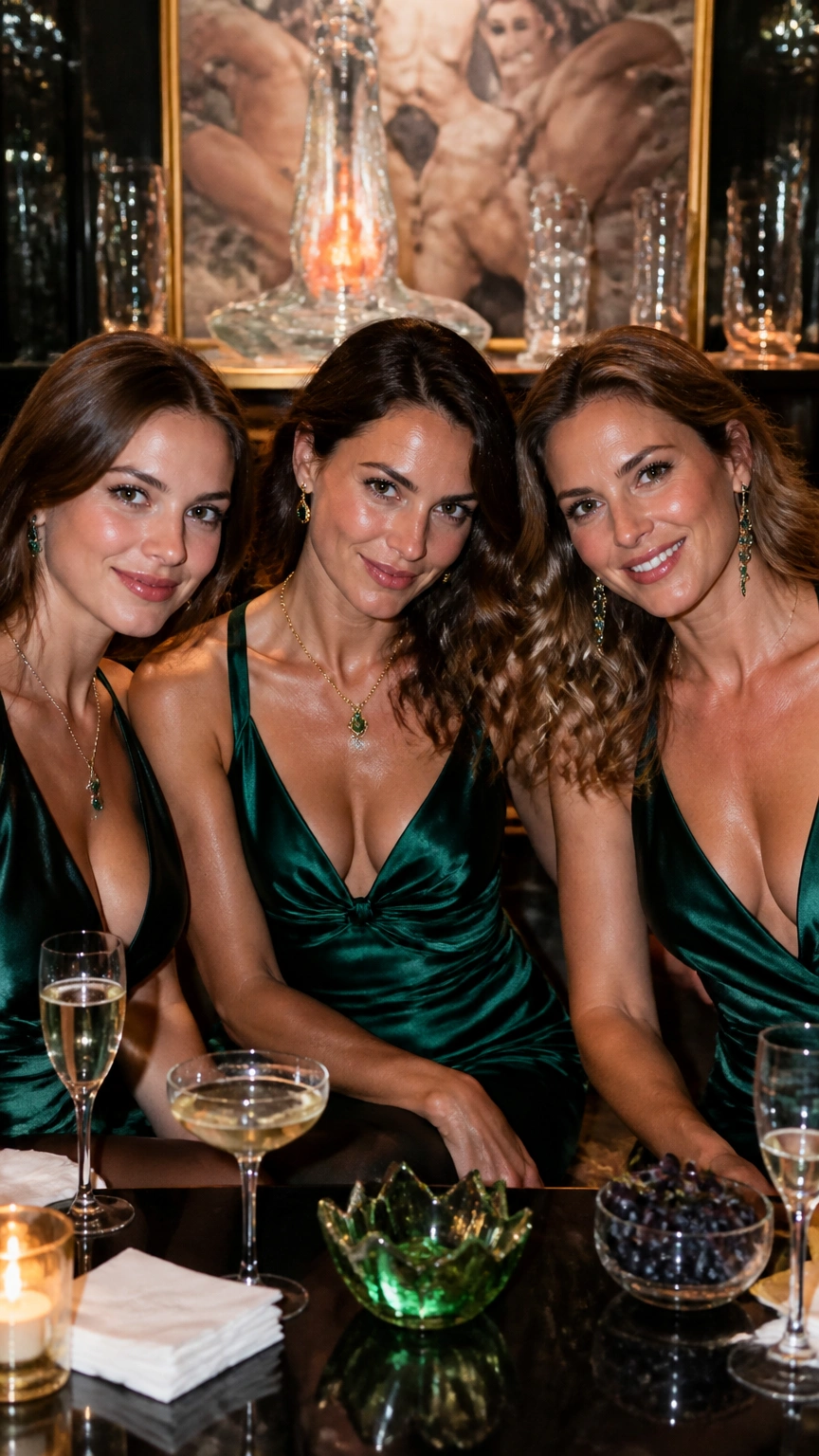
A Tale of Reclaimed Radiance
When One Friday Evening Changes Everything You Believed About Yourself
There is a moment—perhaps you know it—when you catch your own reflection and no longer recognise the woman staring back. Not because age has stolen your beauty, but because somewhere, between the compromises and the careful choices, you left her behind. The woman who wore colour. The woman who sparkled. The woman who walked into a room knowing she belonged there.
Catherine Ashworth knows that moment intimately. At forty-three, recently divorced, successful in her career yet hollow in her spirit, she walks into The Amber Room cocktail bar on a Friday evening wearing a black dress that is elegant, sensible, and utterly forgettable. She expects nothing—perhaps a quiet drink, perhaps the merciful end to a long week. What she finds instead is Vivienne Marchmont: a woman of perhaps fifty, tall and luminous, draped in emerald green satin that catches every particle of light and refuses to let it go.
Their eyes meet. Something shifts. Something long dormant stirs beneath Catherine’s ribs—not envy, not longing, but recognition. I used to be that woman. The one who dressed like she mattered. The one who entered rooms as though the world had been waiting for her.
What follows is not a fairy tale. There is no prince, no instant transformation, no wave of a magic wand. There is something far more powerful: the slow, sensual, sometimes terrifying process of a woman choosing herself. A private club called The Luminae Lounge, where accomplished women gather in glossy satin and fine leather to share wisdom, ambition, and the radical belief that pleasure and purpose are not opposites. A boutique on Marlborough Lane where a perceptive shopkeeper helps Catherine find a teal satin dress that fits like a second skin and reveals the woman who had been hiding all along. A man named Daniel who is intrigued not by Catherine’s availability but by her boundaries. And running through it all, like a shimmering thread, the emerald satin dress—a garment that becomes a symbol, a gift, and ultimately a torch passed from one woman to the next.
This is a story about fabric, yes—about the way glossy satin feels against newly awakened skin, about the confidence that comes from wearing something that makes you feel magnificent, about the unspoken language of women who choose to shine rather than blend in. But it is also about the communities we build when we stop diminishing ourselves. About the friendships that form when women refuse to compete and instead illuminate one another. About the men worth keeping—the ones who want you to be more, not less—and the ones worth leaving behind.
Twelve chapters. One transformation. And a question that will stay with you long after the final page: When did you stop dressing like you mattered? And more importantly—when will you begin again?
Pour yourself something beautiful. Find a comfortable chair. Let the satin of this story slide over you like a promise.
The woman in the emerald dress is waiting.
Chapter One: The Bar at the End of the Week
The Friday evening had settled over London like a sheet of dark silk, smooth and unbroken, and Catherine Ashworth found herself standing at the threshold of The Amber Room wondering precisely how she had arrived there.
Not physically—that part was simple enough. She had walked from her flat in Bloomsbury, turned left onto Russell Square, crossed into the quiet stretch of Montague Street where the chestnut trees were just beginning to bronze at their edges, and followed the low golden glow of the bar’s windows until she reached the door. Physically, the journey was seven minutes. Twelve, if you walked slowly, which she had.
No, the wondering was of a different variety entirely. The kind that sits behind the ribs and presses gently, like a thumb testing a bruise. How had she arrived at forty-three, recently divorced, successfully employed in a career she had built from nothing, the owner of a flat that was tastefully decorated and entirely her own—and yet standing outside a cocktail bar on a Friday evening feeling as though she were about to attend someone else’s funeral?
She had not been to a bar alone in fifteen years. Richard had seen to that. Not through prohibition—he had never been the sort to issue decrees—but through a slow, patient erosion, the way water shapes stone. Not by force but by persistence. First the gentle suggestion that perhaps they should spend Friday evenings together. Then the slightly less gentle observation that she seemed to enjoy these outings more when he was there. Then the quiet, devastating implication that her enjoyment of anything without him was somehow a form of betrayal. And finally, the evening she had dressed for a colleague’s birthday party—a navy silk blouse, her favourite, the one that caught light like moonlight on water—and he had looked at her with an expression she would never forget and said, “You’re not wearing that, are you? You look like you’re trying to be noticed.”
She had changed. She had worn a grey wool jumper instead. Rough against her skin, like a penance.
She had stopped wearing the navy silk blouse. Then she had stopped wearing the crimson one. Then the ivory satin skirt. Then, gradually, without quite registering the progression, she had stopped wearing anything that made her feel like herself. Her wardrobe had become a gallery of sensible choices: well-made, understated, invisible. Clothes designed to be appropriate rather than magnificent. Clothes that said I am here but please do not look at me.
The divorce had been finalised three months ago. The flat was hers. The career was intact. The friends had returned, tentatively at first, then with warmth and fury on her behalf. And yet she still felt faded, like a photograph left in sunlight. Present but diminished. A woman shaped by absence.
So when her colleague, Philippa, had suggested—firmly, repeatedly, with the kind of insistence that brooked no argument—that Catherine needed to reclaim her Friday evenings, Catherine had agreed. Not with enthusiasm. With the dull compliance of someone who has forgotten how to want things.
“Go somewhere you’ve never been,” Philippa had said over coffee, her burgundy leather jacket creaking softly as she leaned forward. Philippa was fifty-one, divorced twice, and currently in the most satisfying relationship of her life—with herself, her career as a barrister, and a rotating collection of satin blouses that she wore with the confidence of a woman who had stopped apologising for existing. “Wear something that makes you feel like a woman, not a footnote. And for God’s sake, Catherine, have a drink that isn’t tea.”
Catherine had laughed, which had surprised them both.
And so here she was. At The Amber Room. On a Friday. Alone.
She pushed open the door.
The interior was warmer than she had expected—not merely in temperature but in texture. The walls were a deep amber velvet, but not the dull, lifeless kind she associated with that fabric. This was rich and luminous, as though someone had captured the colour of candlelight and pressed it into the walls. The bar itself was dark mahogany, polished to a gleam that reflected the low-hanging brass lamps. The chairs were leather—proper leather, the kind that softens with age and wears its history like a badge of honour. A jazz trio played in the corner, the pianist’s fingers moving with the lazy precision of someone who had played these chords a thousand times and still found something new in them.
It was, Catherine thought, the kind of place that expected you to be someone. Not someone specific—not wealthy or famous or important in any measurable way—but someone. A person with edges and opinions and a life that was distinctly, unapologetically their own.
She felt immediately as though she had arrived wearing the wrong thing.
Her black dress was perfectly appropriate. It was well-cut, modest, the kind of garment that could be worn to a business dinner or a funeral with equal success. It was safe. It was invisible. It was, she realised with a quiet jolt of recognition, exactly the kind of thing Richard would have approved of.
She sat at the bar. The bartender—a woman in her thirties with cropped silver hair and a black leather waistcoat that caught the light like polished obsidian—approached with a smile.
“What can I get you?”
Catherine hesitated. She had not thought this far ahead. “A gin and tonic, please. Whatever you recommend.”
The bartender nodded, her hands moving with practised grace. “Hendrick’s? It’s what I’d suggest for someone who looks like they’re treating themselves for the first time in a while.”
Catherine blinked. “Is it that obvious?”
The bartender smiled—a warm, conspiratorial smile, the kind shared between women who recognise something in each other. “Let’s just say I’ve been where you’re sitting. And the gin helped. Temporarily.”
Catherine accepted the drink, took a sip, and felt the botanical warmth spread through her chest like a small, gentle sunrise. She turned on her stool, letting her gaze wander across the room.
And that was when she saw her.
The woman was at a corner table, half-hidden in shadow and half-illuminated by the brass lamp above her, as though the light itself had made a deliberate choice about where to fall. She was perhaps fifty—though age, in her case, seemed less a measure of years and more a measure of depth, the way a fine wine becomes more itself with time rather than less. Her hair was dark, swept back from her face, revealing cheekbones that spoke of confidence rather than genetics. Her posture was extraordinary—not rigid, not posed, but settled, the way a great tree settles into the earth. She was talking to someone, a younger woman, and her gestures were unhurried, expressive, the kind that belonged to a person who had never needed to rush because the world would wait for her.
But it was the dress that stopped Catherine’s breath.
Emerald green satin. The colour of ancient forests and hidden glades, of jewels buried in velvet-lined boxes, of the deepest moments of twilight when the sky still remembers the sun. The fabric moved with her, not against her—fluid and lustrous, catching every particle of light in the room and holding it for a moment before releasing it in a different direction, as though the dress were having a quiet conversation with the illumination and finding it endlessly amusing. It was not merely clothing. It was a declaration. A statement made without words: I am here. I am magnificent. And I have absolutely nothing to prove.
Catherine stared. She could not help it. The sight of that satin—glossy, unapologetic, alive with light—stirred something in her that had been sleeping for a very long time. Not jealousy. Not longing. Something older and more fundamental. Recognition. The way one musician recognises another’s skill, not with resentment but with the bittersweet joy of remembering what the instrument is supposed to sound like.
I used to wear things like that, she thought. I used to move like that. I used to be that woman.
The woman in emerald satin looked up.
Their eyes met.
It was not a dramatic moment. There was no thunderclap, no sudden hush in the music, no cinematic slowing of time. It was simply a meeting of gazes—brief, appraising, curious. The kind of look that women exchange when they see something in each other that cannot be articulated in words. The woman’s eyes were dark and warm, and they held Catherine’s for a moment with an expression that seemed to say: I see you. I see all of it. And none of it is what you think.
Then she smiled. Not broadly. Just a slight curve of the lips, like the first crescent of a moon appearing from behind clouds. And she returned to her companion as though nothing had happened.
But something had happened. Catherine could feel it—a small, bright crack in the wall she had built around herself. A fissure so tiny it might have been imagined. But she had not imagined it. She was certain of that. Because for the first time in months—perhaps years—she felt not the dull ache of loss but the sharp, electric thrill of possibility.
She ordered a second gin. She did not usually drink two. But tonight was not usual. Tonight was an expedition into unknown territory, and she was its reluctant explorer.
She was halfway through the second glass when she became aware of a presence beside her. A fragrance first—something complex and layered, like a conversation between jasmine and cedar and something darker underneath, something that spoke of candlelit rooms and secrets shared in confidence. Then a voice, low and warm, like the first notes of a cello.
“May I?”
Catherine turned. The woman in emerald satin was standing beside her, holding her own glass—something amber, whisky perhaps—and gesturing to the empty stool with the easy confidence of someone who has never doubted that a seat would be offered.
“Of course,” Catherine said, and the word came out more breathlessly than she had intended.
The woman settled onto the stool with the grace of someone who has made a study of elegance and found it comes most naturally when you stop trying. Up close, the satin dress was even more extraordinary. The fabric seemed to breathe with her, each movement creating a subtle play of light and shadow across its surface, like sunlight rippling through deep water. The neckline was structured but not severe, the sleeves fitted to the wrist, and at her throat she wore a single pendant—a gold filigree circle that looked ancient and meaningful, like something passed from one remarkable woman to another across centuries.
“I’m Vivienne,” the woman said. “Vivienne Marchmont.”
“Catherine. Catherine Ashworth.”
“Well, Catherine Ashworth.” Vivienne took a sip of her drink, her eyes never leaving Catherine’s face. “You looked, a moment ago, like a woman who has forgotten something important and is trying to remember what it is.”
Catherine felt a flush rise to her cheeks. “Was I staring? I apologise. I was—” She hesitated. The honest answer was I was staring at your dress because it reminded me of a version of myself I abandoned. But that seemed too much to say to a stranger in a bar. “I was admiring your dress,” she said instead. “It’s extraordinary.”
Vivienne looked down at herself, then back at Catherine, and her smile deepened. “It’s satin,” she said, as though that explained everything. And in some way, it did. “I have a theory about satin. Would you like to hear it?”
“I would love to hear it.”
“Satin doesn’t apologise. You can’t wear satin and be invisible. It’s a fabric that demands you show up—fully, completely, without reservation. Most women are afraid of it for precisely that reason. They choose wool, or cotton, or—” she paused, her lip curling with the faintest hint of distaste, “—velvet. Fabrics that absorb light rather than reflect it. Fabrics that whisper rather than speak. And I always think: what a terrible thing, to wrap yourself in something that muffles your presence in the world.”
Catherine felt the words land like stones in still water, each one sending ripples through her. She thought of her wardrobe. The grey wool jumper. The sensible black dress she was wearing now. The years of fabrics chosen to absorb rather than reflect.
“I used to wear satin,” she said. The words came out before she could stop them, surprising her with their honesty. “And silk. And—” she gestured vaguely, “—things that made me feel like myself.”
“And now?”
Catherine looked down at her black dress. “Now I wear this.”
Vivienne regarded her for a long moment. Her expression was not pitying—that would have been unbearable—but something far more powerful. It was recognition. The same recognition Catherine had felt when she first saw the emerald dress.
“What happened?” Vivienne asked. Not demanding. Simply inviting.
And Catherine, who had not spoken honestly about her marriage to anyone except her therapist and Philippa, found herself telling a stranger in a bar the abbreviated version of her diminishment. The gradual silencing. The wardrobe of appropriate invisibility. The moment with the navy silk blouse. The years of becoming smaller and smaller until she no longer knew what size she was supposed to be.
Vivienne listened. She did not interrupt. She did not offer platitudes. She simply listened, and when Catherine finished, she said: “You know what I hear in that story? I hear that you survived. Not just the marriage—you survived yourself. The version of yourself that agreed to become small. And now you’re here, in a bar you’ve never been to, wearing a dress that is perfectly adequate and perfectly forgettable, and you’re looking at my satin dress with an expression that tells me you’re ready to stop forgetting.”
Catherine’s eyes stung. She blinked rapidly. “That’s remarkably perceptive for someone I met five minutes ago.”
Vivienne laughed—a genuine, unguarded sound, like a bell rung in a clear room. “I’ve been where you’re sitting, Catherine. Literally, perhaps. Metaphorically, certainly. Fifteen years ago, I was a senior partner at an investment firm, married to a man who thought my ambition was a character flaw, and wearing nothing but grey. Grey suits, grey jumpers, grey everything. I looked like a thundercloud with legs. And then one evening, a woman I’d never met sat down beside me in a bar very much like this one, wearing a dress very much like this one, and said something very much like what I’m about to say to you.”
Catherine waited.
Vivienne reached into a small clutch—black leather, glossy as lacquer—and withdrew a card. It was heavy, cream-coloured, embossed with elegant lettering. She placed it on the bar between them.
“What’s this?” Catherine asked.
“An invitation. To a place where women like us—women who have been diminished and are ready to become magnificent again—gather. We talk, we share, we support each other’s ambitions. We wear fabrics that reflect light rather than absorb it. And we remember, or discover, or invent what it means to be ourselves.”
Catherine looked at the card. On it were three things: an address in Mayfair, a date—the following Friday—and three words.
Come as yourself.
“That’s the dress code?” Catherine asked, her voice unsteady.
“That’s the only rule,” Vivienne said. She finished her drink and set the glass down with a soft, decisive click. “Well. That, and no velvet. We have standards.”
Catherine laughed. It surprised her—the sound, the feeling, the warmth of it. She could not remember the last time she had laughed with a stranger.
Vivienne stood, and the emerald satin rose with her, catching the light one final time in a cascade of green and gold. She looked down at Catherine with an expression that was both gentle and challenging, like a coach who believes in her athlete but will not run the race for her.
“Friday,” she said. “Seven o’clock. Wear something that makes you feel like the woman you were before someone convinced you to be less.”
“And if I don’t own anything like that?”
Vivienne smiled. “Then you have shopping to do, Catherine Ashworth. And I suspect you’re going to enjoy it far more than you expect.”
She turned and walked toward the door, and the satin moved with her like a living thing, like a partner in a dance, like a promise made in a language older than words. The room seemed to dim slightly in her absence, as though the light had been somehow personal, attached to her, unwilling to stay without her.
Catherine sat alone at the bar, the card cool and certain beneath her fingertips. The jazz trio played on. The bartender refilled her glass without being asked.
“Friend of yours?” the bartender asked.
“No,” Catherine said. “I just met her.”
The bartender nodded. “Vivienne has that effect. She walks in, and suddenly everyone sitting at this bar starts wondering why they’ve been wearing grey.”
Catherine looked down at her black dress. She thought of the emerald satin. She thought of the way it had moved, the way it had caught the light, the way it had seemed less like clothing and more like a philosophy made visible.
She picked up the card, turned it over in her fingers, and read the three words again.
Come as yourself.
She tucked it into her handbag, finished her gin, and stepped out into the London night. The air was cool and clean against her skin. Above her, the sky was vast and scattered with stars, each one a small, bright declaration in the darkness.
She walked home slowly. Not because she was tired. Because she was, for the first time in a very long time, paying attention.
And somewhere, in the back of her mind, a question was forming—quiet but persistent, like the first notes of a melody not yet fully heard:
When did I stop dressing like I mattered?
The answer, she suspected, was the beginning of everything.
Chapter Two: The Address on the Card
The weekend arrived not as a respite but as an interrogation.
Catherine had expected the encounter at The Amber Room to fade, the way most unexpected moments do when they have no framework to support them—a bright flare in a dark room, briefly illuminating, then gone. She had expected to wake on Saturday morning, make her coffee, read the papers, attend to the small domestic rituals that had become the architecture of her solitary life, and find that the woman in the emerald satin dress had already begun to blur at the edges, becoming less a person and more a anecdote she might one day tell at a dinner party: I once met this extraordinary woman in a bar, and she gave me a card, and nothing came of it.
But that is not what happened.
What happened was this: she woke at five-forty-seven on Saturday morning, before the alarm, before the light, with the taste of gin still faintly present in her mouth and the image of emerald satin pressed behind her eyelids like a photograph developed in the darkroom of her sleep. She lay still for a long time, watching the ceiling shift from black to grey to the pale blue of early dawn, and she thought about the way the fabric had moved. Not merely draped—moved, as though it possessed its own volition, its own relationship with light and air and the body it adorned. She thought about the word Vivienne had used: magnificent. She thought about the three words on the card: Come as yourself.
She thought about what it meant to come as yourself when you no longer knew where yourself began and the version you had constructed for someone else’s comfort ended.
The card was in her handbag, which sat on the chair beside the wardrobe like a patient sentinel. She could feel its presence from across the room, the way you can feel a letter you have not yet opened, a question you have not yet answered, a door you have not yet decided whether to walk through.
She got up. She made coffee. She did not look at the card.
By noon, she had cleaned the kitchen, reorganised her bookshelf by colour rather than author (a task that occupied forty minutes and pleased her not at all), replied to three emails from clients, and taken a long bath that should have been relaxing but was instead merely warm. The card remained in her handbag. The handbag remained on the chair. The chair remained beside the wardrobe, and the wardrobe—she could feel it too, now—remained full of things she did not want to wear.
By two o’clock, she could bear it no longer.
She retrieved the card, carried it to the kitchen table, and set it down beside her cold coffee. It looked exactly as she remembered: heavy cream stock, embossed lettering, an address in Mayfair, a date—the following Friday—and those three words. She picked it up and turned it over, half-expecting to find more on the reverse, a phone number, an explanation, a justification. There was nothing. Just the blank, unblemished back of a card that offered an invitation and demanded nothing in return except arrival.
She picked up her phone and typed the address into the search bar.
The results were sparse. That, in itself, was telling. In an age when every establishment, every club, every business fought for digital visibility like plants straining toward the sun, the absence of information was a statement. A deliberate, confident statement: We do not need to be found. We are found by those who are meant to find us.
There was a website. A single page, elegantly designed, with a background of deep charcoal and text in a serif font that spoke of tradition and intention. At the top, in small, precise letters: The Luminae Lounge. Below that, a single line: Gatherings for women of substance.
She read the phrase three times. Women of substance. Not women of wealth, though wealth was not excluded. Not women of status, though status was not unwelcome. Substance. The word suggested depth, weight, significance—the qualities of a life lived with intention rather than accident. It suggested women who had been forged by experience, like metal shaped by fire, and who had emerged not diminished but refined.
There was no further description. No photographs. No testimonials. No list of members or events. Just the address, a phone number, and the same three words that appeared on the card: Come as yourself.
She called Philippa.
“Philippa. I need to talk to you.”
“Darling, I’m in the middle of a deposition, but given that you haven’t called me on a Saturday since your divorce, I’m going to assume this is important. Give me thirty seconds to wrap up and I’ll call you back.”
Catherine waited. She looked at the card. She looked at the wardrobe. She felt, for the first time in months, that something was moving inside her—not the dull, grinding machinery of daily existence but something more fluid, more alive, like a river finding its course after being dammed.
Philippa called back in twenty-two minutes. Catherine could hear her settling into a chair—the creak of leather, the clink of ice in a glass.
“Right. Tell me everything.”
“I went to a bar last night.”
“The Amber Room? Good. I told you to go somewhere new. Did you meet someone?”
“I met a woman.”
A pause. “A woman. How fascinating. Go on.”
Catherine told her. The woman in the emerald satin. The conversation at the bar. The card. The website. The phrase women of substance.
Philippa was quiet for a long moment. When she spoke, her voice had the tone Catherine recognised from courtrooms—measured, precise, weighing each word as though it might be entered into evidence.
“Catherine, what exactly are you feeling right now?”
Catherine considered the question. She was not accustomed to being asked about her feelings with such directness. Her therapist asked, of course, but in the careful, circular language of therapy. Philippa asked like a lawyer: directly, expecting a direct answer.
“I feel like I’m standing at the edge of something,” she said. “Like I’m at the top of a high dive, looking down at the water, and I can’t tell if it’s deep enough.”
“Deep enough for what?”
“For me. For the version of me I might become if I jump.”
Another silence. Then Philippa said: “Call the number.”
“What?”
“Call the number on the card. Right now. While I’m on the phone. I want to hear you do it.”
“Philippa—”
“Catherine Ashworth, you spent fifteen years finding reasons not to do things. You have been divorced for three months. You are forty-three years old, brilliant, successful, and you are wearing—” she paused, and Catherine could almost hear her squinting through the phone— “you’re wearing that grey wool thing, aren’t you?”
Catherine looked down at herself. She was, in fact, wearing the grey wool jumper. The one she had bought as a concession to comfort, the one that felt like wearing a cloud, the one that absorbed light and warmth and, she was beginning to understand, something more essential than either.
“It’s practical,” she said weakly.
“It’s a surrender,” Philippa said. “And you know it. Call the number.”
Catherine picked up the card. She picked up her phone. Her fingers hovered over the screen.
“Now, Catherine.”
She dialled.
The phone rang twice before it was answered. The voice that spoke was female, warm, unhurried—the kind of voice that suggested its owner had never been rushed in her life and had no intention of starting now.
“Good afternoon. The Luminae Lounge. How may I help you?”
Catherine opened her mouth. For a terrible moment, nothing came out. She felt like a woman stepping onto a stage and discovering she has forgotten her lines. Then Philippa’s voice, tinny but insistent, came through the other ear: “Talk, Catherine.”
“Hello. My name is Catherine Ashworth. I— I received a card from a woman named Vivienne Marchmont. She invited me to attend a gathering next Friday.”
“Of course, Ms. Ashworth. We’ve been expecting your call.”
The phrase landed like a stone in still water. Expecting. Not surprised. Not pleased. Expecting. As though Catherine’s call had been anticipated, prepared for, woven into some design she could not yet see.
“Vivienne mentioned the dress code,” Catherine said, her voice steadier now. “She said to come as myself.”
“That’s correct. And yourself, Ms. Ashworth, is precisely who we wish to see. The dress code is not a costume requirement. It’s an invitation. Wear something that makes you feel magnificent. The definition of magnificent is entirely yours.”
Catherine almost laughed. “I’m not sure I own anything that qualifies.”
“Then you have a week to find something that does. May I offer a suggestion?”
“Please.”
“There is a boutique on Marlborough Lane called Maison Seraphine. The proprietor is a friend of the Lounge. She has a particular gift for helping women find what they didn’t know they were looking for. Tell her you’re coming to us. She’ll understand.”
Catherine wrote the name on the back of an envelope. Maison Seraphine. Marlborough Lane.
“Is there anything else I should know?” she asked.
“Only this: the women who gather at the Luminae Lounge come from every background, every profession, every chapter of life. What they share is not status or wealth but substance. They are women who have chosen to be fully themselves. Some are still learning how. Some have been practising for years. All are welcome.”
“Thank you.”
“Ms. Ashworth? One more thing.”
“Yes?”
“We don’t allow velvet at the Lounge. It’s not a rule, exactly. It’s more of a philosophy. Velvet absorbs light. We prefer fabrics that reflect it.”
The line went dead with the soft, deliberate click of a phone placed down with intention.
Catherine sat holding her mobile, staring at the envelope with the boutique’s name, and she could hear Philippa breathing on the other line.
“Well?” Philippa demanded.
“I’m going,” Catherine said.
“Of course you’re going. Now, stand up, go to your wardrobe, and open it.”
“Why?”
“Because you need to see what you’ve been choosing to wear. You need to see it clearly, without sentiment, without the comfort of familiarity. You need to see it the way Vivienne saw it when she looked at your black dress last night.”
Catherine stood. She walked to the bedroom. She opened the wardrobe.
It was, she thought afterwards, like visiting a museum of her own diminishment.
The wardrobe was not large—it was a modest double, white-painted, unremarkable—but it contained, in its neat rows and careful folds, the complete archaeological record of a woman’s gradual disappearance. She stood before it and felt as though she were reading a timeline, each garment a chapter in the story of how she had become smaller.
On the left, the workwear: charcoal suits, grey blazers, a navy dress that was professional and forgettable. Each piece well-made, each piece chosen for its ability to say I am competent without adding and interesting or and desirable or and present. They were the uniforms of a woman who had decided that visibility was a risk not worth taking.
In the centre, the casual wear: the grey wool jumper, several others in similar shades of forgetfulness—beige, oatmeal, a brown that could not decide whether it was chocolate or mud. Cotton tops that were practical and soft and utterly devoid of personality. Trousers that fit without flattering. Jeans that were not too tight, not too loose, not too anything—jeans designed to avoid comment.
On the right, the remnants of her former self: a silk blouse in ivory, still beautiful but unworn for years. A satin skirt in midnight blue that she had bought for an anniversary dinner and never worn again. A leather jacket—proper leather, supple and gleaming—that she had worn in her thirties when she still believed she was the kind of woman who wore leather jackets. These pieces hung at the end of the rail like exiles, banished to the far reaches of the wardrobe, kept but not worn, remembered but not honoured.
And at the very back, behind a stack of folded knitwear, she found it.
A scarf. Silk, not satin, but glossy nonetheless—a deep, rich teal that shifted to green when the light caught it at certain angles. She had bought it in Paris on a trip with a university friend, years before Richard, years before the careful construction of a life designed to accommodate someone else’s comfort. She had worn it draped around her neck, the ends trailing like a banner, and she had walked through the Marais feeling like a woman in a film, a woman whose life was her own script, not someone else’s supporting text.
She drew it out now. The silk was cool against her fingers, then warm, then something else entirely—a sensation that was not merely tactile but emotional, as though the fabric were conducting a current between the woman she had been and the woman standing in the bedroom now. She held it to her cheek. The smoothness was exquisite. Not the dull, rough embrace of wool or the flat, unresponsive surface of cotton, but something alive, something that caught the light and the warmth and the touch and returned them transformed.
She looked at the scarf in her hands. She looked at the wardrobe. She looked at the grey jumper she was wearing.
And she thought of what Vivienne had said about fabrics that absorb light rather than reflect it.
She thought of what the woman on the phone had said about velvet.
She thought of what Philippa had said about surrender.
She pulled the grey jumper over her head. She dropped it on the bed. She stood for a moment in her bra and jeans, feeling the air on her skin, feeling the absence of the rough, suffocating wool, and she draped the teal silk scarf around her neck.
The effect was immediate and disproportionate. A scarf. A single, narrow length of silk. And yet she felt different. Not transformed—that would come later, she suspected—but acknowledged. Acknowledged by herself, for the first time in years, as a woman who was permitted to touch beautiful things and be touched by them in return.
She looked in the mirror. The teal silk lay against her skin like a promise. Her face, bare of makeup, framed by her dark hair, looked back at her with an expression she barely recognised. Not the careful blankness she had perfected over years of not wanting to be seen. Something else. Something alert. Something hungry.
When did I stop dressing like I mattered?
She knew the answer. She had always known. The question was not when but whether she would begin again.
She picked up her phone and called Philippa.
“I’m going to a boutique tomorrow,” she said.
“Of course you are, darling. What are you wearing right now?”
Catherine looked at the teal silk scarf against her bare shoulders. “Something that makes me feel like myself.”
“Good,” Philippa said. “That’s a start. Now, go and find everything else.”
That night, Catherine slept in a silk chemise she had forgotten she owned. It was ivory, with lace at the neckline, and it had been a gift from her mother years ago—her mother, who had worn silk every day of her life, who had told Catherine once, with the quiet authority of a woman who understood these things, “Never wear anything against your skin that doesn’t love you back.”
She had not understood, then, what her mother meant. She understood now, lying in the dark, the silk cool and then warm and then something else entirely against her body, like a whisper in a language she was relearning.
Tomorrow, she would go to Marlborough Lane. Tomorrow, she would find something magnificent. Or something would find her.
The card sat on her bedside table, its three words visible in the moonlight that slipped through the curtains.
Come as yourself.
She closed her eyes. The silk moved against her skin like a tide, like a breath, like the beginning of something she could not yet name but could, at last, feel.
Chapter Three: The Boutique on Marlborough Lane
Marlborough Lane existed in the kind of quiet pocket of London that seemed to have been designed by someone who understood the value of discretion—not the furtive discretion of secrets, but the confident discretion of things that have no need to announce themselves. The street was narrow, cobbled, sheltered by plane trees whose leaves had turned the colour of old gold. There were no chain stores here, no plate-glass fronts shouting their wares, no crowds. There were only small establishments with painted doors and brass numbers, each one offering something specific to those who knew to look.
Catherine had walked past this lane a hundred times. She was certain of that. It was two streets over from the route she took to her office, a small detour she had never made, a corner she had never turned, because it had never occurred to her that there might be something there she needed. She had been too focused on destinations, on the straight lines between where she was and where she was supposed to be, to notice the spaces in between.
She noticed them now.
Maison Seraphine sat halfway down the lane, its facade a soft dove grey that managed to be both understated and arresting. The window display was minimal—a single mannequin draped in a charcoal satin wrap dress, positioned beside a tall vase of white lilies. No price tags. No signs. No enticements. Just the dress and the flowers and an implicit suggestion that if you understood what you were looking at, you were already the right kind of customer.
Catherine stood outside for three minutes. She counted them. She counted them because she needed something to do with her mind while her body decided whether to enter. Her body was wearing the teal silk scarf around her neck, a gesture of solidarity with her former self, and a pair of dark jeans that were, if not magnificent, at least not surrender. She had considered wearing the ivory silk blouse but had lost her nerve at the last moment, choosing instead a fine merino top in deep navy. It was not glossy. But it was not grey, and that, for now, felt like progress.
She pushed open the door.
The interior of Maison Seraphine was not what she had expected. She had anticipated the hushed, slightly intimidating atmosphere of high-end boutiques—the kind where assistants look at you as though assessing your credit limit before offering you a glass of champagne you are too nervous to drink. Instead, she found herself in a space that felt less like a shop and more like a drawing room in the home of a woman with exquisite taste and no interest in impressing anyone.
The walls were a warm, pale cream. The floor was dark wood, softened here and there by Persian rugs in jewel tones. There were mirrors—many mirrors, positioned at angles that seemed designed not to flatter but to reveal, to show you not the version of yourself you hoped to see but the version that actually existed. The lighting was soft but precise, casting a glow that was neither harsh nor forgiving but simply honest, the way candlelight is honest—illuminating without distorting.
And the clothes.
The clothes were extraordinary.
They hung on brass rails arranged not by category but by mood, by feeling, by the kind of woman who might wear them. One rail held satins—blouses, dresses, skirts, in colours that ranged from the deepest midnight to the palest champagne, each one catching the light with the quiet confidence of fabric that knows its own value. Another held leather—jackets, skirts, trousers, in tones of cognac and black and oxblood, the surfaces gleaming like polished wood, like the interiors of vintage cars, like things that had been made to last and to be touched. A third rail held pieces that incorporated PVC—not the cheap, theatrical kind Catherine associated with fancy dress, but a refined, architectural material used as trim on structured jackets, as panels on elegant dresses, as the glossy spine of a garment that would otherwise be merely beautiful but was, with that addition, something more. Something modern. Something unafraid.
She was standing in the middle of the room, her mouth slightly open, her fingers itching to touch, when a voice spoke from behind her.
“You look like a woman who has just rediscovered a language she used to speak.”
Catherine turned.
The woman was perhaps thirty-eight, with dark hair cut in a sharp bob that framed her face like punctuation around a particularly eloquent sentence. She was wearing a fitted leather skirt in deep cognac that caught the light like the surface of a glass of aged brandy, and a silk blouse in ivory that moved with her breathing as though it were alive, as though it were engaged in a continuous, intimate dialogue with her skin. Her shoes were black leather, pointed, glossy. Her posture was the posture of a woman who had nothing to prove and everything to enjoy.
“I’m Delphine,” she said, extending a hand. Her grip was warm, firm, the handshake of a woman who meant business and also meant pleasure and saw no contradiction between the two. “Welcome to Maison Seraphine.”
“Catherine Ashworth. I— I was told to come here. By someone at the Luminae Lounge.”
Delphine’s face shifted—not dramatically, but in the way a landscape shifts when the sun emerges from behind a cloud. A warming. An illumination.
“Ah,” she said. “You’re one of Vivienne’s.”
The phrase was peculiar and yet perfectly apt. One of Vivienne’s. As though Vivienne collected women the way other people collected art—not for possession but for appreciation, not for display but for the pleasure of knowing that something beautiful existed in the world.
“I don’t know if I’m anything yet,” Catherine said. “I’ve only met her once.”
“That’s how it starts.” Delphine smiled. “Tea? I have a Darjeeling that pairs rather beautifully with the experience of being here for the first time.”
“I— yes. Thank you.”
Delphine disappeared through a curtain of deep amber beads that clicked softly as she passed through them, like a string of small, polite applause. Catherine stood alone in the boutique and let herself look.
She moved slowly along the rails, her fingers trailing across the fabrics the way a pianist’s fingers trail across keys before a performance, not playing yet but learning the terrain. The satin was first—she touched a blouse in deep burgundy and felt the surface slide beneath her fingertips like water over polished stone, smooth and cool and then warm, as though the fabric were responding to her touch, acknowledging her presence. She touched a dress in midnight blue and felt the same sensation amplified—the glossiness not merely visual but tactile, a conversation between skin and silk that required no words.
The leather was different but equally compelling. She ran her hand along a jacket in oxblood and felt the surface yield slightly, not soft like fabric but supple, alive, like the skin of something that had once breathed and still remembered how. It was warm in a way that synthetic materials never were, warm the way living things are warm, and she understood, suddenly, why leather endured as a material of choice for women who understood quality—it was not merely durable but intimate, a fabric that aged with you rather than against you.
The PVC pieces surprised her. She had associated the material with nightclubs and fancy dress, with the artificial and the theatrical. But here, used as trim on a structured blazer, as a glossy panel on an otherwise matte dress, as the gleaming collar of a silk shirt, it was something else entirely. It was modern. Architectural. A material that refused to pretend it was anything other than what it was—bold, glossy, unapologetic. She touched a jacket with PVC panels along the sleeves and felt the smooth, cool surface give slightly beneath her fingers, like touching the surface of still water.
“Interesting choice,” Delphine said, appearing beside her with a tray bearing two delicate cups and a pot of tea that smelled like gardens and summer. “The PVC pieces are my favourites. They divide people. Some women are afraid of them. Some women are drawn to them. The ones who are drawn to them are usually the ones who are ready to stop apologising for being visible.”
“I’m not sure I’m ready for that,” Catherine said.
Delphine poured the tea, handed her a cup, and regarded her with the kind of appraising gaze that made Catherine feel seen rather than judged.
“Tell me something, Catherine. What are you wearing right now?”
Catherine looked down at herself. “A navy top. Jeans. A silk scarf.”
“And how do you feel?”
“Like I’m in costume. Like I’m dressed as a woman who is trying to be less noticeable than she actually is.”
Delphine nodded. “And what would you like to feel?”
The question was so direct, so unconcerned with the usual pleasantries of retail, that Catherine felt something crack open inside her. She sipped her tea. She looked at the rails of glossy, luminous fabric. She thought about Vivienne in the emerald satin. She thought about her mother’s silk. She thought about the teal scarf around her neck, the only thing she was wearing that felt like truth.
“I’d like to feel like myself,” she said. “I’d like to feel like the woman I was before I decided she was too much.”
Delphine set down her cup. “Then let’s find her.”
What followed was not, Catherine would later reflect, anything resembling a normal shopping experience. It was more like being guided through a gallery of possible selves, each garment a different version of who she might become if she were willing to let the fabric speak.
The first dress Delphine brought her was a black silk sheath—elegant, simple, the kind of dress that could be worn anywhere and would always look right. Catherine put it on, looked in the mirror, and saw a woman who was polished and appropriate and utterly forgettable.
“No,” Delphine said, before Catherine could speak. “That’s the dress you’ve been wearing for fifteen years in different forms. It’s beautiful, but it’s not you. Not today.”
The second was a red satin blouse paired with leather trousers. Catherine put them on and felt a jolt of something unfamiliar—power, perhaps, or the memory of power. She looked in the mirror and saw a woman who was bold and striking and slightly frightening.
“Closer,” Delphine said. “But you’re performing. That’s a costume, not a revelation. You don’t need to be someone else. You need to be more yourself.”
The third was a cream silk dress with a fitted bodice and a skirt that moved like liquid light. Catherine put it on and felt beautiful—genuinely, quietly beautiful, the way a sunset is beautiful without trying.
“Lovely,” Delphine said. “But safe. You’re still choosing something that won’t frighten you. And I think, Catherine, that what you need is to be a little frightened.”
Catherine swallowed. “What do you have that might frighten me?”
Delphine smiled—a slow, knowing smile, the smile of a woman who had been waiting for precisely this question. She disappeared into the back of the shop and returned carrying a dress that made Catherine’s breath catch before she had even touched it.
It was teal. Deep, profound teal—the colour of the ocean at its most mysterious, of forests seen from above, of the moment between dusk and night when the sky still holds the memory of the sun. It was satin—not the stiff, formal satin of evening gowns but a fluid, living satin that moved like water, like music, like the surface of a dream. The neckline was structured but not severe, the sleeves fitted to the wrist, the skirt falling to just below the knee with a subtle bias cut that promised movement, that promised the swish of fabric against fabric, that promised the sound of a woman walking into a room and meaning to be seen.
“Try it,” Delphine said.
Catherine took the dress. The satin was cool against her fingers, then warm, then something else entirely—a sensation that was not merely tactile but emotional, as though the fabric were conducting a current between the woman she had been and the woman she might become. She carried it to the fitting room—a small, elegant space with a mirror that faced her without flattery or cruelty, simply honesty—and she put it on.
The dress slid over her body like a whisper, like a secret, like the first line of a story she had forgotten she was writing. It fitted not merely in the way that clothes fit when they are the right size but in the way that words fit when they are the right words—precisely, inevitably, as though the dress had been waiting for her body the way a key waits for a lock. The satin settled against her skin and she felt it—the smoothness, the glossiness, the way it caught the light and held it and returned it transformed—and she felt something she had not felt in years.
She felt like herself.
Not the diminished, careful, grey version of herself that she had been performing. Not the bold, theatrical version she had tried on minutes before. But the real self. The woman beneath the wool and the cotton and the years of choosing to be less. The woman who had worn silk in Paris and leather in her thirties and who had walked into rooms as though the world had been waiting for her, because it had been, because it always is when a woman arrives as herself.
She stepped out of the fitting room.
Delphine was standing by the mirror, arms folded, her leather skirt catching the light, her silk blouse shifting like water. She looked at Catherine and her expression changed—not to surprise, because Delphine did not seem like a woman who was easily surprised, but to satisfaction. The deep, quiet satisfaction of someone who has been proven right.
“There she is,” Delphine said softly. “That’s the woman who walked in here wanting to come out.”
Catherine looked in the mirror.
The woman looking back was not a stranger. That was the remarkable thing. Catherine had expected to feel transformed, to see someone new. But the woman in the mirror was not new. She was old. She was the oldest version of Catherine Ashworth—the version that had existed before the marriage, before the diminishment, before the grey wool and the sensible choices. She was the woman who had always been there, beneath the layers of accommodation, waiting to be acknowledged.
The teal satin moved as she breathed. The light caught the surface and scattered in fragments of green and gold. The fabric was smooth against her skin, glossy to the eye, alive in a way that dull fabrics never were—alive the way a river is alive, the way a flame is alive, the way a woman is alive when she stops apologising for her own existence.
“My God,” Catherine whispered.
“Not God,” Delphine said. “Satin. Though I understand the confusion.”
Catherine laughed. The sound was strange to her—full and unguarded, the laugh of a woman who was not monitoring herself for appropriateness. The satin moved with her laughter, rippling like water disturbed by a stone, and she watched herself in the mirror and felt something she could not name but knew she needed.
“I’ll take it,” she said.
“Of course you will,” Delphine replied. “You were always going to take it. You just needed to meet it first.”
At the till, while Delphine wrapped the dress in tissue paper that whispered like secrets being kept, Catherine noticed a pair of gloves on the counter. They were satin—ivory, elbow-length, the kind of gloves that belonged to another era and yet looked, in this context, entirely current. They were glossy and smooth and utterly impractical, and Catherine wanted them with an intensity that surprised her.
Delphine noticed her looking. She picked up the gloves, smoothed them with a gesture that was both practical and tender, and placed them in the bag beside the dress.
“These are a gift,” she said.
“I can’t—”
“You can. Every woman should own a pair of satin gloves. They serve no practical purpose whatsoever, which is precisely the point. They remind you that your hands deserve to touch beautiful things. That you are permitted to wear things that exist solely for pleasure. That not everything in your life needs to be functional. Some things just need to be magnificent.”
Catherine took the bag. It was heavy with tissue and promise.
“Delphine.”
“Yes?”
“Thank you. For seeing me.”
Delphine leaned slightly across the counter. Her silk blouse caught the light, her leather skirt creaked softly, and her eyes held Catherine’s with the kind of directness that left no room for deflection.
“I didn’t see you, Catherine. I simply helped you remove the things that were in the way. You were always visible. You just needed to stop choosing fabrics that made you invisible.”
Catherine stepped out into Marlborough Lane. The afternoon light was golden, the cobblestones warm, the plane trees rustling like women sharing a confidence. She carried the bag against her body and felt its weight—not the physical weight of tissue and satin and gloves, but the weight of possibility.
She walked home slowly. Not because she was tired. Because she was, for the first time in a long time, unwilling to rush past the space between where she had been and where she was going.
The teal satin waited in its wrapping, patient and luminous, like a promise that had been made years ago and was only now being kept.
On Friday, she would wear it. On Friday, she would walk into The Luminae Lounge. On Friday, she would arrive as herself.
And the woman in the mirror—the one in the teal dress, the one with the unguarded laugh and the hungry eyes—would be the woman who walked through the door.
Chapter Four: First Night at the Luminae Lounge
The townhouse stood in a quiet crescent off Berkeley Square, its Georgian facade the colour of pale honey, its windows tall and shuttered, its door painted black and polished to a gleam that reflected the streetlamp like a dark mirror. There was no sign. No nameplate. No indication, to the casual observer, that this particular building contained anything other than the private residence of someone with excellent taste and no interest in being found.
Catherine stood on the pavement and felt her heart beating in her throat.
She had changed three times before leaving the flat. The teal satin dress had been the first choice—obvious, inevitable—but she had pulled it on and stood before the mirror and felt, for the first time, a flicker of doubt. Not about the dress, which was magnificent, but about herself. About whether she could carry it. About whether the woman in the mirror was a performance or a truth. She had taken it off, tried a silk blouse and leather skirt—safer, more familiar—and hated herself for choosing safety. She had tried a PVC-trimmed blazer over a satin slip and felt theatrical. She had sat on the bed in her underwear and wanted to cry.
Then she had looked at the satin gloves Delphine had given her, lying on the bedside table like a pair of sleeping birds, and she had thought of what Delphine said: Some things just need to be magnificent.
She had put the teal dress back on. She had pulled on the ivory satin gloves. She had stepped into black leather heels that caught the light like polished onyx. She had looked in the mirror and said, to the woman looking back: “You are not performing. You are remembering.”
And now she was here. At the door. At the threshold.
She knocked.
The door was opened by a woman in her sixties with silver hair swept into a chignon and a charcoal silk blouse that moved like smoke when she gestured. Her smile was warm, her eyes appraising, and her manner was that of a hostess at a private home rather than an attendant at an establishment.
“Ms. Ashworth? Welcome. I’m Eleanor. Come in, come in. You’re not late—you’re precisely on time, which is a distinction we appreciate.”
Catherine stepped over the threshold and felt the world shift.
It was not a dramatic shift—not a thunderclap or a sudden transformation. It was more like the moment when you step from a noisy street into a concert hall and the silence wraps around you like velvet, like a held breath, like the space between the last note of the tuning and the first note of the symphony. The noise of London—the traffic, the construction, the relentless urban hum—vanished, replaced by something else entirely. The murmur of conversation. The clink of crystal. The soft, rhythmic notes of a piano playing something that was not quite jazz and not quite classical but occupied the elegant space between.
The hallway was long and lit by wall sconces that cast a warm, amber glow. The walls were painted a deep, sophisticated grey—not the dull, lifeless grey of Catherine’s former wardrobe but the kind of grey that served as a frame for the colours around it, the way a gallery wall frames art. The floor was dark wood, softened by a runner of deep burgundy that felt, beneath her heels, like walking on something alive.
Eleanor took her coat—a navy wool thing that Catherine was already beginning to think of as a relic—and gestured toward an archway at the end of the hall.
“Through there. Vivienne asked me to tell you: find her, or she’ll find you. She’s been talking about you all week.”
The phrase landed like a warm hand on a cold shoulder. Talking about you all week. Catherine had met this woman once, for twenty minutes in a cocktail bar, and she had been talking about her all week. It was not the casual mention of an interesting encounter. It was the deliberate, intentional attention of someone who had recognised something worth recognising and had not let it go.
Catherine walked through the archway.
The room was not large—perhaps thirty feet by twenty—but it had been designed with the kind of meticulous attention to atmosphere that made it feel both intimate and expansive. The ceiling was high, the windows tall, the curtains a heavy silk in deep gold that pooled on the floor like liquid amber. The furniture was arranged not in rows or formal groupings but in clusters—small seating areas that invited conversation, that suggested the possibility of intimate exchange, that said sit here and talk to someone and discover something worth knowing.
And there were women.
Perhaps thirty of them, Catherine thought, though she did not count. They moved through the room like currents through water—some standing, some sitting, some gathered in groups of three or four, some alone with a drink and a thought. They were of every age: women in their twenties with the bright, fierce energy of those who have not yet been told what they cannot do; women in their thirties with the settled confidence of those who are doing it anyway; women in their forties and fifties with the luminous self-possession that comes from having survived enough to know that survival is not the goal but the foundation; women in their sixties and seventies with the quiet, radiant authority of those who have stopped asking permission.
They were, Catherine noticed immediately, uniformly magnificent.
Not in the way of a dress code enforced—there was no uniformity of style, no suggestion of a rule—but in the way of a shared language. Every woman in the room was wearing something that caught the light. Satin blouses that rippled like water. Leather trousers that gleamed like polished wood. Silk dresses that moved like breath. PVC-trimmed jackets that caught the lamplight and threw it back in fragments. The room was a gallery of glossy surfaces, each one reflecting not just the light but the woman beneath it, the woman who had chosen this fabric, this colour, this silhouette, not to be appropriate but to be present.
Catherine felt a rush of something she could not immediately name. Not nervousness, though that was there. Not excitement, though that was there too. It was more like recognition—the feeling of arriving in a country where you do not speak the language but somehow understand every word.
She stood at the edge of the room, her teal satin dress catching the light, her ivory gloves smooth against her fingers, and she watched.
“Cat got your tongue?”
The voice was Vivienne’s—low, warm, amused—and it came from directly behind her.
Catherine turned.
Vivienne was wearing a black satin jumpsuit that moved like liquid shadow. The fabric caught every particle of light in the room and held it for a moment before releasing it, like a conversation with the illumination that never grew tired. The neckline was structured, the waist fitted, the trousers wide and fluid. She wore no jewellery except the gold filigree pendant at her throat—the one Catherine had noticed at The Amber Room—and her hair was swept back, revealing the architecture of her face, the cheekbones that spoke of confidence rather than genetics, the eyes that held Catherine’s with the same expression of recognition she had seen in the bar.
“You came,” Vivienne said.
“You invited me.”
“I invited a lot of women. Not all of them come. The ones who do are the ones who were ready.”
“Ready for what?”
Vivienne smiled. “For themselves. Come. There are people you should meet.”
She was led through the room like a guest of honour, like a new planet being introduced to the solar system, and at each stop along the way, Vivienne presented her to someone extraordinary.
The first was Dr. Helena Frost.
Helena was perhaps fifty-five, tall, with the kind of bone structure that suggested ancestry and the kind of posture that suggested discipline. She was a consultant surgeon at a teaching hospital—a fact she mentioned with the casual understatement of someone who has long since stopped being impressed by her own accomplishments—and she was wearing a burgundy leather dress that fitted like a second skin. The leather was supple, glossy, the colour of old wine, and it moved with her the way a good surgical instrument moves with the hand that holds it—precisely, inevitably, as though it were an extension of her will.
“Catherine Ashworth,” Vivienne said. “Helena Frost. Helena is one of our founding members. She also saves lives for a living, which she will deny if you ask her directly.”
“I don’t save lives,” Helena said, extending a hand that was firm and warm. “I repair bodies. The lives are the patients’ responsibility. But I do it in very good leather, which is the part that matters.”
Catherine laughed. “Is that a surgical principle?”
“It’s a life principle,” Helena said. “I spent twenty years wearing scrubs and sensible shoes and looking like a grey rectangle. Then I realised that the women who came to me for surgery were often more afraid of losing themselves than of losing their health. They were afraid of becoming invisible. And I thought: I’m invisible, and I’m the one holding the scalpel. So I started wearing leather. Now my patients see a woman who looks like she means business, and they trust me more, not less. Confidence is not a contradiction of competence, Catherine. It’s a complement.”
She said this with the matter-of-fact authority of a woman who had thought about it deeply and was not interested in debate, and Catherine felt the words settle into her like seeds into fertile soil.
The second was Margaux Beaumont.
Margaux was perhaps forty-eight, French, with the kind of effortless elegance that Catherine had always associated with women who grew up surrounded by beautiful things and had never learned to be ashamed of wanting them. She was a vintner—she owned a vineyard in Burgundy and a wine shop in Marylebone—and she was wearing an emerald silk dress that moved like water, like music, like the surface of a deep lake stirred by a gentle wind.
“You’re the one Vivienne met at The Amber Room,” Margaux said, her accent softening the consonants like velvet softening edges. “She told me about you. She said you looked like a woman who had forgotten something important.”
“That seems to be the consensus,” Catherine said.
“And have you remembered?”
Catherine looked down at her teal satin dress. She touched the ivory gloves. She felt the fabric against her skin and thought of Delphine, of the mirror, of the woman who had looked back at her.
“I’m beginning to,” she said.
Margaux smiled. “Good. That is what this place is for. Not for remembering in the sense of nostalgia—nostalgia is a trap, a velvet-lined trap. But for remembering in the sense of reclamation. Of taking back what was always yours. The silk helps. The satin helps. The leather helps. They are not costumes. They are languages. Each fabric says something different. Silk says: I am alive and I am not apologising. Satin says: I am here and I am magnificent. Leather says: I am strong and I am not afraid. Find the language that speaks your truth, Catherine. And then speak it loudly.”
The third was Tess.
Tess was twenty-nine, which made her the youngest woman Catherine had seen in the room, and she carried her youth not as a weapon but as a gift—an energy, a brightness, a willingness to be surprised that the older women had traded for wisdom but that Tess still possessed in abundance. She was a tech entrepreneur—she had founded a company that used AI to diagnose skin conditions, a fact she mentioned with the same casualness that Helena had mentioned surgery—and she was wearing a silver PVC skirt that caught the light like a mirror, like a moon, like something that had been designed not to blend in but to announce.
“I love your dress,” Tess said, before Vivienne could even complete the introduction. “Teal satin. That’s brave. Most women who come here for the first time wear black. Black is safe. Black says: I’m here but I’m not sure I should be. Teal says: I’m here and I’m exactly where I should be.”
“I’m not sure I feel that confident,” Catherine admitted.
“You don’t have to feel it yet,” Tess said. “You just have to wear it. The feeling comes after. That’s the secret. Everyone thinks confidence comes first and then you dress the part. It’s the other way around. You dress the part and the confidence follows. The fabric does some of the work for you. The glossiness reflects back at you, and you start to believe what you see.”
She said this with the conviction of someone who had lived it, and Catherine noticed that the silver PVC caught every particle of light in the room and sent it back in fragments, like a prism, like a celebration, like a woman who had decided that visibility was not a risk but a responsibility.
The evening unfolded like a flower opening in time-lapse—slowly, inevitably, each moment revealing something new.
Catherine was drawn into conversations that were not the usual exchanges of social obligation—What do you do? Where do you live? How do you know the host?—but something else entirely. Discussions about art and architecture, about travel and ambition, about the particular pleasure of doing something well and the particular satisfaction of doing something difficult. She talked with a woman who had left a career in finance to open a bookshop. She talked with a woman who was writing a history of women’s fashion in the twentieth century. She talked with a woman who had climbed the Matterhorn at fifty-two and was planning Kilimanjaro at fifty-five.
No one asked her about her divorce. No one asked her what she did, as though her profession were the only thing that defined her. No one treated her as broken or damaged or in need of careful handling. They treated her as interesting. They asked her opinions. They listened to her answers. They responded not with the glazed politeness of social obligation but with the engaged attention of women who were genuinely curious about what she thought.
And Catherine found that she had thoughts. She had opinions. She had observations and insights and ideas that had been sitting in her for years, unexpressed, like books on a shelf that no one had thought to open. She spoke about art—her passion, her career, the thing she had loved before she had loved Richard and had continued to love, quietly, secretly, throughout the marriage, like an affair with herself. She spoke about the way certain paintings made her feel—the way the light in a Vermeer made her feel held, the way the colour in a Matisse made her feel free—and the women around her nodded and added their own experiences and the conversation became a river, flowing and deepening, carrying them all somewhere together.
She felt, for the first time in years, not merely present but participating. Not merely existing but contributing. Not merely visible but valued.
It was nearly eleven when she found herself standing with Vivienne near the window, the gold silk curtains framing the London night behind them. The room had thinned—women departing in pairs and small groups, their glossy fabrics catching the light as they passed through the archway like ships leaving a harbour—and Catherine felt the particular bittersweet ache of an evening that has been perfect and is now ending.
“Thank you,” she said. “For the invitation. For this.”
Vivienne turned to face her. In the low light, the black satin jumpsuit seemed to absorb the illumination rather than reflect it, like a shadow that had learned to speak, like a silence that had found its voice.
“You don’t need to thank me, Catherine. You needed to come. I needed you to come. Those are different things.”
“Different how?”
“I needed you to come because this place requires women like you. Women who have been diminished and are ready to become magnificent. Women who have something to say and have been waiting for someone to listen. Women who understand that confidence is not a performance but a practice. This community is not built on the women who are already certain. It’s built on the women who are becoming certain. And you, Catherine Ashworth, in your teal satin dress with your unguarded laugh and your brilliant mind and your hunger for something more—you are becoming.”
Catherine felt the words land like a benediction, like a permission she had not known she needed, like the final note of a piece of music that resolves a tension you did not realise you were carrying.
“I feel like I’ve been asleep,” she said. “For years. And tonight I woke up.”
“You weren’t asleep,” Vivienne said. “You were waiting. There’s a difference. Sleep is passive. Waiting is intentional. You were waiting for the right room, the right women, the right moment to remember who you are.”
She reached out and touched the sleeve of Catherine’s teal dress, her fingers brushing the satin with the tenderness of someone touching something precious.
“This fabric,” she said. “It’s not just fabric. It’s a decision. Every morning, when you choose what to wear, you are making a decision about how you will meet the world. Will you absorb light or reflect it? Will you be invisible or visible? Will you apologise or announce? The satin doesn’t make you confident, Catherine. It gives you permission to be confident. And permission is often the only thing standing between a woman and her own magnificence.”
Catherine looked at her. At the black satin that moved like shadow, at the gold pendant that caught the light like a small, persistent star, at the eyes that held her with an expression that was both challenge and comfort, both demand and gift.
“Will you come back?” Vivienne asked.
“Yes.”
“Good.” Vivienne smiled. “Then I’ll tell you a secret. You belonged here before you arrived. You belonged here before I met you at The Amber Room. You belonged here before you walked into Maison Seraphine and put on that dress. You have always belonged here. You just didn’t know it yet.”
She leaned close—close enough that Catherine could smell her fragrance, the jasmine and cedar and something darker, something that spoke of candlelit rooms and secrets shared in confidence—and she whispered:
“Next Friday. Wear something that frightens you a little. The kind of fabric that makes you feel like you’re standing on the edge of yourself. That’s where the growth happens. At the edge.”
Catherine walked through the archway, retrieved her coat from Eleanor, who pressed her hand and said, “See you next week, dear,” and stepped out into the London night.
The air was cool against her face. The streetlamp cast its light on the black door, which gleamed like polished onyx, like a mirror, like a threshold between who she had been and who she was becoming. She walked to the corner and turned and looked back at the townhouse, at the windows glowing with amber light, at the silhouettes of women moving inside, glossy and confident and alive.
She touched the teal satin against her body. She felt the smoothness, the glossiness, the way it caught the streetlight and held it and returned it transformed. She thought of Vivienne’s words: You belonged here before you arrived.
And she thought: I belong here now.
She walked home through the London night, her satin dress swishing softly against her legs, her ivory gloves smooth against her fingers, her heart full of something she had not felt in years.
Not hope. That would come later. Something more fundamental.
Possibility.
The sense that her life, which had felt like a closed book, was in fact a book that had simply been paused, and the page was turning, and the next chapter was beginning, and she was the one writing it.
Chapter Five: The Art of Conversation
The weeks that followed Catherine’s first night at The Luminae Lounge were not a transformation. Catherine would have been suspicious of transformation—she had seen enough of it in the self-help books her therapist recommended, the ones that promised overnight reinvention, the spiritual equivalent of a quick coat of paint over crumbling plaster. What happened instead was something more gradual, more substantial, more real. It was a reclamation, the way one reclaims a language after years of disuse: slowly, imperfectly, with moments of fluency punctuated by moments of forgetting, but always, always moving toward fluency.
She returned to the Lounge the following Friday, as promised, wearing something that frightened her a little—a charcoal satin blouse with a PVC-trimmed collar that caught the light like a blade, paired with leather trousers in deep black that moved with her like a second skin. She had stood before the mirror for fifteen minutes before leaving the flat, turning this way and that, watching the fabrics interact with the light and with each other, feeling the smoothness of the satin against her arms and the supple warmth of the leather against her legs and the cool, architectural gloss of the PVC collar against her throat. She had felt visible. She had felt present. She had felt, for the first time in years, like a woman who had not been erased.
Vivienne had found her within minutes, as she always did, and had said, with that low, warm voice that carried the weight of genuine approval: “There she is. The one who frightens herself a little. That’s the one worth knowing.”
And so it began.
The gatherings at The Luminae Lounge were not what Catherine had expected. She had anticipated, perhaps, the structure of a salon—formal presentations, scheduled discussions, the kind of organised intellectual exchange that she associated with her university years. What she found instead was something more organic, more fluid, more like a garden than a lecture hall. Conversations began and ended and branched and merged, the way rivers do when they meet and part and meet again. There were themes, certainly—each evening had a loose focus, a suggestion of subject matter that the women might explore if they chose—but there was no agenda, no schedule, no authority dictating what should be discussed or how.
The women talked. That was the simple, radical truth of it. They talked to each other.
And the talking was not the polite, circular exchange of social occasions—not the what do you do, where do you live, how are the children that Catherine had come to think of as the verbal equivalent of grey wool. It was something else entirely. It was conversation in the fullest, most generous sense of the word: an exchange of ideas, a sharing of experience, a mutual exploration of what it meant to be a woman in the world, to have ambition and desire and intelligence and to refuse to apologise for any of it.
Catherine listened, at first. She sat at the edges of discussions and absorbed, the way fabric absorbs dye—not passively but chemically, the absorption itself a form of transformation. She listened to Helena talk about the intersection of medicine and ethics, about the responsibility of holding someone’s life in your hands and the peculiar loneliness of being the one who must decide. She listened to Tess describe the exhilaration and terror of building a company from nothing, of walking into rooms of investors who looked at her youth and her silver PVC skirts and assumed she was someone’s assistant rather than someone’s CEO. She listened to Margaux speak about wine—not as a product but as a philosophy, a way of understanding time and patience and the particular alchemy of turning something simple into something extraordinary.
And she listened to Vivienne, who spoke less than the others but whose words, when they came, carried a weight that settled into the room like a stone into still water, sending ripples outward long after the initial impact.
It was on her third Friday, as she sat with a glass of Margaux’s burgundy and a small plate of figs and cheese, that Catherine witnessed the conversation that would change the way she understood everything.
Margaux was standing near the fireplace, her emerald silk dress catching the firelight in fragments of green and gold, and she was talking about pleasure.
Not the kind of pleasure discussed in magazines or on television—not the performative, commercialised pleasure of consumption, of buying and eating and drinking and scrolling. The other kind. The deeper kind. The kind that lived in the texture of a fabric against the skin, in the taste of a wine that had been made with intention, in the sound of a conversation that mattered, in the sight of a woman wearing something that made her feel like herself.
“Pleasure and purpose,” Margaux said, her accent softening the consonants like velvet softening edges, like water softening stone. “We are told they are opposites. We are told that a woman of purpose must deny herself pleasure, and that a woman of pleasure must lack purpose. It is the oldest lie. It is the lie that keeps us small.”
The room was quiet. Not the enforced quiet of a lecture but the attentive quiet of women who recognised truth when they heard it.
“I make wine,” Margaux continued. “I make wine because I love it. I love the process—the patience of it, the chemistry of it, the way you take something ordinary, grapes, and through time and attention and care, you transform it into something extraordinary. Is that pleasure or purpose? It is both. It has always been both. And I wear silk”—she touched her emerald dress, the fabric rippling like water beneath her fingers—”not because I am vain but because the silk gives me pleasure, and the pleasure gives me energy, and the energy gives me purpose. The fabric against my skin is not a luxury. It is a fuel.”
Helena, standing near the window in her burgundy leather dress, nodded. “In medicine, we have a concept: the placebo effect. The belief that something will help can, in itself, help. I have come to think of clothing the same way. When I wear leather—when I feel it against my skin, when I see it in the mirror—I believe I am capable. And the belief makes me capable. It is not magic. It is psychology. But the psychology is real, and the results are real, and I will not apologise for using every tool available to me.”
Tess, in a silver PVC jacket that caught the firelight like a mirror, leaned forward. “I spent two years wearing hoodies and jeans to investor meetings. I thought I needed to look like them to be taken seriously. Then one day I wore a PVC skirt—not to a meeting, just to lunch—and I felt so visible, so present, so unapologetically myself, that I thought: why am I hiding? The next meeting, I wore the PVC skirt. And you know what happened? They took me more seriously, not less. Because I was more serious. I was more myself. The fabric didn’t change them. It changed me.”
Vivienne, who had been listening from her position near the mantelpiece, her black satin jumpsuit absorbing the firelight like a shadow absorbing flame, spoke.
“The lie is this: that pleasure is frivolous and purpose is serious. That to be a woman of substance, you must deny yourself the things that make you feel substantial. That confidence is vanity and comfort is weakness and the desire to feel beautiful is superficial.” She paused. “I have known women who built hospitals and wore silk. I have known women who wrote laws and wore leather. I have known women who raised children and ran companies and painted masterpieces and climbed mountains, and every one of them wore fabrics that made them feel like themselves. Not because the fabric made them who they were. Because the fabric allowed them to be who they were.”
The room was silent. Not empty silent. Full silent. The kind of silence that holds meaning, that vibrates with recognition, that says: we know this. We have always known this. We have just never been given permission to say it aloud.
Catherine felt something shift inside her. Not a crack, not a break, but a movement—like tectonic plates adjusting, like the first stirrings of a season changing, like the moment before dawn when the darkness is still complete but something in the air tells you the light is coming.
She thought of her marriage. She thought of the years of grey wool and sensible choices. She thought of the navy silk blouse she had stopped wearing because Richard said she looked like she was trying to be noticed. She thought of the opinions she had swallowed, the passions she had abandoned, the gradual, insidious diminishment that had been so slow she had not recognised it as diminishment until it was nearly complete.
She thought: I didn’t stop being myself. I stopped allowing myself to be myself. And I did it because someone told me that being myself was too much.
And then she thought: What if too much is exactly the right amount?
She went home that night in a taxi, the city sliding past the windows like a film she was watching for the first time, and she sat in the back seat with her charcoal satin blouse and her leather trousers and her PVC-trimmed collar and she felt the fabrics against her skin and she thought about pleasure and purpose and the lie that they were opposites.
When she reached the flat, she did not make tea. She did not read. She did not perform the small, careful rituals that had become the architecture of her solitary evenings.
She went to the wardrobe.
She opened it.
She stood before it, and she saw—not for the first time, but for the first time with full understanding—the complete record of her diminishment. The grey wool. The beige cotton. The shapeless jumpers. The sensible trousers. The clothes that absorbed light and warmth and something more essential than either. The clothes that said: I am here but please do not look at me.
She pulled them out. One by one. The grey wool jumper first—the one she had worn on the day she called the Luminae Lounge, the one that felt like a penance, like a surrender, like a flag flown at half-mast for a woman who was still alive but had stopped living. Then the beige cardigan. Then the oatmeal knit. Then the brown top that could not decide whether it was chocolate or mud. Then the grey trousers, the navy trousers, the black trousers that were not elegant but merely absent of colour.
She folded each one. She placed them in boxes. Three boxes, filled with the rough, coarse, light-absorbing fabrics that she had wrapped herself in for years, that had muffled her presence in the world, that had whispered be less, be less, be less with every fibre against her skin.
She carried the boxes to the hallway. She would donate them in the morning. She would give them to someone who needed them—not as a gift of beauty but as a practical necessity, the way you give food to someone who is hungry, not because the food is exquisite but because hunger is hunger and must be addressed.
But she would not wear them again. She would not wrap herself in fabrics that absorbed light. She would not choose clothes that whispered when she could choose clothes that spoke.
She went back to the wardrobe. It was nearly empty now—the archaeological record of her diminishment removed, the shelves bare, the rails sparse. What remained was the beginning of a collection: the teal satin dress, the ivory silk blouse, the leather jacket from her thirties, the midnight blue satin skirt, the charcoal satin blouse with the PVC-trimmed collar she was wearing. A small, tentative wardrobe. A vocabulary in its infancy.
She would expand it. She would learn the language. She would become fluent.
The expansion began the next day.
She returned to Maison Seraphine, and Delphine, who seemed to have been expecting her, guided her through the rails with the same perceptive warmth she had shown before.
“What are we looking for?” Delphine asked.
“Declarations,” Catherine said.
Delphine smiled. “Good answer.”
She bought a satin blouse in deep burgundy that moved like wine, like blood, like the interior of a garnet held to the light. She bought leather trousers in cognac that gleamed like polished wood, like the interior of a vintage car, like something that had been made to be touched. She bought a coat in deep navy with PVC panels along the collar and cuffs that caught the light like a blade, like a statement, like a woman who has decided to be seen.
Each piece was not merely clothing but a sentence in the language she was learning. The satin said: I am alive and I am not apologising. The leather said: I am strong and I am not afraid. The PVC said: I am modern and I am not hiding. Together, they said something larger: I am here. I am myself. And I will not be diminished again.
“You’re building a wardrobe,” Delphine said, as she wrapped the pieces in tissue paper that whispered like secrets being kept. “Not a collection of clothes. A wardrobe. There’s a difference. Clothes are what you wear. A wardrobe is who you are.”
“Who am I?” Catherine asked, and the question was not rhetorical. It was genuine. She was asking because she was in the process of discovering, and the discovery was ongoing, and the answer changed daily, hourly, moment by moment, like light changing on a surface.
“You’re a woman who wears satin to work,” Delphine said. “That’s who you are. A woman who has decided that her daily life deserves the same attention as her special occasions. That Tuesday is as worthy of gloss as Saturday. That the ordinary is not a sentence but an opportunity.”
Catherine took the bags. She carried them home. She hung them in the wardrobe, and the wardrobe, which had been bare and echoing, began to fill with colour and light and the particular energy of fabrics that had been chosen with intention.
The following week, she enrolled in a course.
Not a course in fashion—though she was learning that language too, in her own way, through fabric and colour and the daily practice of choosing to be visible. A course in Renaissance art. The course she had been meaning to take for fifteen years, since before the marriage, since before the diminishment, since the time when she had been a young woman with a degree in art history and a passion for the way light moved across a painted surface and a dream of one day teaching, of one day writing, of one day contributing to the conversation about beauty and meaning and the way art shapes human experience.
The course was held at the Courtauld Institute on Tuesday and Thursday evenings. The tutor was a woman named Professor Adrienne Hale—sixty-three, silver-haired, and wearing, on the first evening, a charcoal silk jacket that moved like water and a pair of leather trousers that gleamed like the surface of a dark lake. She spoke about the Renaissance with the passion of someone who had spent a lifetime in conversation with beauty and had not yet grown tired of it.
“The Renaissance,” Professor Hale said, her voice carrying the authority of deep knowledge and the warmth of genuine enthusiasm, “was not merely a period of artistic production. It was a revolution in the way human beings understood themselves. The artists of the Renaissance looked at the human body and saw not sin but beauty. They looked at the world and saw not a vale of tears but a garden of possibility. They painted light—always light—because light was the medium through which they understood truth. And they painted fabric—silk, satin, velvet—” she paused, her lip curling with the faintest hint of the same distaste Vivienne had shown at The Amber Room, “—though we shall focus on the silk and satin, which reflect light, rather than the velvet, which absorbs it. The fabrics in Renaissance paintings tell us something about how the artists understood their subjects: as beings worthy of being illuminated, worthy of being seen.”
Catherine sat in the lecture hall, her burgundy satin blouse catching the light from the projector, her leather notebook smooth beneath her fingers, and she felt something she had not felt in years. She felt her mind engage. Not the mechanical engagement of professional obligation—the kind of attention she gave to client reports and committee meetings—but the deeper, more ravenous engagement of a mind that has been starved and is finally being fed.
She took notes. She asked questions. She stayed after class to discuss a point about Botticelli’s use of line, and Professor Hale looked at her with the kind of recognition that passes between women who understand that intelligence is not a performance but a hunger, and said: “You’ve studied this before.”
“Years ago. Before—” Catherine hesitated. “Before life got in the way.”
“Life doesn’t get in the way,” Professor Hale said. “We get in our own way. We let other people’s expectations become our boundaries. And then one day we wake up and realise that the boundary was never real. It was just a line we agreed not to cross.” She looked at Catherine’s satin blouse, at the leather notebook, at the posture of a woman who was sitting straighter than she had in years. “You’ve started crossing again.”
“Yes.”
“Good. The Renaissance is a good place to start. It was, after all, the period when Europe decided to stop apologising for beauty.”
Catherine began to live differently. Not dramatically—she did not quit her job or move to Paris or do anything that would constitute a crisis or a headline. She simply began to make different choices, small and large, in the way a river changes course: not through a single dramatic flood but through the steady, persistent movement of water finding a new path.
She wore satin to work. Not every day—she was not performing, she was practising—but often enough that it became unremarkable, the way anything becomes unremarkable when it is repeated with consistency and conviction. A burgundy satin blouse on Monday. A navy silk dress on Wednesday. Leather trousers on Friday, paired with a cashmere top that was soft but not shapeless, warm but not muffling. She noticed the way her colleagues responded—not with the discomfort she had feared but with a subtle shift in their own behaviour, as though her visibility gave them permission to be more visible themselves.
She spoke more in meetings. Not more loudly—volume was not the issue—but more directly, more honestly, with the kind of clarity that comes from knowing what you think and being willing to say it. She offered opinions she had been suppressing for years. She challenged ideas she would previously have accepted out of habit. She found, to her surprise, that her opinions were not merely tolerated but sought, that her colleagues had always wanted to hear what she thought and had been waiting for her to say it.
She read. She went to galleries. She took Professor Hale’s course and devoured the reading list and found herself in conversations about art that reminded her of university, of the time when she had been a woman of intellectual hunger and passionate opinions and a willingness to argue about beauty as though beauty mattered, because it did, because it always had.
And every Friday, she went to The Luminae Lounge.
She talked with Helena about medicine and ethics and the particular loneliness of authority. She talked with Tess about technology and ambition and the particular challenge of being young and female in an industry that respected neither. She talked with Margaux about wine and time and the particular pleasure of transforming something ordinary into something extraordinary. She talked with Vivienne about everything and nothing and the particular magic of a room where women spoke to each other not as competitors but as companions, not as performances but as truths.
And slowly, incrementally, the way a season changes, the way a language is learned, the way a woman becomes herself, Catherine Ashworth began to feel not merely present but participating. Not merely visible but valued. Not merely alive but living.
She was, she realised one evening as she stood before her wardrobe choosing what to wear to the Lounge, no longer dressing to be appropriate. She was dressing to be herself. And the difference between the two was the difference between existing and living, between surviving and thriving, between a life that was adequate and a life that was magnificent.
She chose a deep crimson satin dress that moved like fire, like passion, like the interior of a rose held to the light. She pulled on her ivory satin gloves. She stepped into black leather heels that caught the light like polished onyx. She looked in the mirror and saw not a woman performing confidence but a woman possessing it.
“There you are,” she said to the woman in the mirror.
The woman in the mirror smiled back.
She had always been there. Catherine had simply needed to stop choosing fabrics that made her invisible, stop speaking in a voice that was designed not to be heard, stop living a life that was adequate when it could be magnificent.
She was learning the art of conversation—not just with others, but with herself. And the conversation, she discovered, was the most interesting one she had ever had.
Chapter Six: The Man at the Gallery
The gallery was called The Meridian, and it occupied a converted warehouse on the edge of Shoreditch—a vast, luminous space with exposed brick walls and polished concrete floors and the kind of lighting that had been designed not merely to illuminate art but to converse with it, to coax from each painting and sculpture the particular quality of presence that the artist had intended and that lesser lighting would have betrayed.
Catherine had been to The Meridian perhaps a dozen times in her professional capacity—as an art consultant, she was expected to attend openings, to assess work, to maintain the network of relationships that constituted the invisible architecture of the art world. But she had not attended an opening since the divorce, and she had certainly not attended one since the Luminae Lounge had begun its slow, persistent work of reclamation. Tonight felt different. Tonight she was not attending as a professional obligation but as a woman who had been invited by the artist herself—a sculptor named Isadora Khalian, whose work in polished bronze and cast glass Catherine had admired for years and whose opening tonight was, by all accounts, the event of the season.
She had chosen her outfit with the kind of attention she had not devoted to her appearance since before the marriage. The charcoal satin dress was new—purchased from Maison Seraphine the previous week, with Delphine’s quiet approval—and it moved with her like a shadow that had learned to speak, like a whisper that had decided to be heard. The neckline was structured but not severe, the sleeves fitted to the elbow, the skirt falling to just below the knee with a bias cut that promised movement, that promised the swish of fabric against fabric, that promised the sound of a woman walking into a room and meaning to be seen. Over the dress she wore a fitted leather jacket in deep black—proper leather, supple and gleaming, the kind that softened with age and wore its history like a badge of honour—and at her throat she had pinned the gold filigree pendant that Vivienne had given her on her third visit to the Lounge, a gift that had been passed, Vivienne told her, from one member to another for decades, a small, ancient circle of gold that spoke of continuity and community and the particular magic of women supporting women.
She looked in the mirror before leaving the flat and saw a woman she recognised—not the diminished, grey, careful version of herself that she had been performing for years, but the real woman, the one who had always been there, beneath the layers of accommodation, waiting to be acknowledged. The satin caught the light and held it and returned it transformed. The leather gleamed like polished wood. The pendant glowed like a small, persistent star.
She looked, she thought, like a woman who had something to say and was no longer afraid to say it.
She took a taxi to the gallery. The London evening slid past the windows like a film she was watching for the first time—rain-slicked streets reflecting the amber of streetlamps, the blur of red buses and black cabs, the particular beauty of a city at night that she had stopped seeing during her years of diminishment and that she was now, gradually, relearning to see.
The opening was already crowded when she arrived. The converted warehouse hummed with the particular energy of a successful art event—the clink of glasses, the murmur of conversation, the soft, rhythmic footsteps of people moving through a space that had been designed to make movement itself a form of appreciation. The art was extraordinary—Isadora’s bronzes caught the gallery lighting and held it like frozen light, like moments of illumination that had been captured and made permanent, and her cast glass pieces seemed to contain their own internal glow, as though each one were a small, private sun.
Catherine moved through the crowd with the ease of a woman who knows how to navigate such events—pausing to greet colleagues, to exchange pleasantries with collectors, to offer brief, genuine compliments to the artist, who was wearing a midnight blue satin gown that moved like water and who accepted Catherine’s praise with the gracious warmth of a woman who has been praised often and has learned to receive it without deflection.
“You look magnificent,” Isadora said, her eyes taking in Catherine’s satin dress and leather jacket with the appraising gaze of an artist who understands beauty. “There’s something different about you, Catherine. Something alive.”
“I’ve been learning a new language,” Catherine said.
“What language?”
“The one where you stop apologising for being visible.”
Isadora smiled. “It’s the hardest one to learn. And the most worth learning.”
They talked for a few more minutes—about the work, about the market, about the particular challenge of creating art in a world that often seemed to value noise over substance—and then Catherine moved on, drifting through the crowd, pausing before a bronze that seemed to pulse with internal light, a sculpture of a woman’s torso that had been polished to such a high sheen that it reflected the viewer, the room, the world, like a mirror that had been shaped into flesh.
She was standing before this piece, her head tilted, her satin dress catching the gallery light in fragments of charcoal and silver, when a voice spoke from beside her.
“It’s extraordinary, isn’t it? The way she’s managed to make bronze look like it’s breathing.”
The voice was male. Low, warm, unhurried—the kind of voice that suggested its owner had never needed to raise it to be heard and had no intention of starting. Catherine turned.
The man was perhaps forty-seven or forty-eight, tall, with the kind of lean, angular build that suggested regular exercise without obsession. His hair was dark, touched with grey at the temples, and his face had the particular quality of someone who had lived enough to have interesting lines but not so much that the lines had become trenches. He was wearing a beautifully tailored suit—not the boxy, corporate kind but something softer, more European, in a deep charcoal wool that moved with him rather than against him. His shirt was white, his tie absent, his shoes leather and polished. He looked, Catherine thought, like a man who had given some thought to his appearance but not so much that it had become a performance.
He was looking at the sculpture, not at her, which she appreciated. It suggested a genuine interest in the art rather than a manufactured excuse to initiate a conversation.
“It is extraordinary,” she agreed. “The surface is so polished that it seems to change depending on where you stand. From here, it looks like flesh. From over there—” she gestured to the left, “—it looks like water.”
“From directly in front, it looks like both,” he said. “Which is, I think, the point. Isadora’s work has always been about the boundary between states—between solid and liquid, between art and life, between the object and the viewer. She makes you question where one ends and the other begins.”
Catherine looked at him more carefully. “You know her work?”
“I’ve been collecting it for years. I’m an architect—Daniel Hartwell—and I’ve commissioned several pieces for buildings I’ve designed. There’s something about placing a sculpture that reflects light in a space that’s been designed to capture light. It creates a conversation between the art and the architecture that neither could have alone.”
He said this with the quiet passion of someone who had thought deeply about the relationship between spaces and the objects within them, and Catherine felt the particular pleasure of encountering a mind that engaged with ideas the way her own mind did—not superficially, not as a performance of intelligence, but genuinely, hungrily, with the kind of curiosity that treats conversation as exploration rather than competition.
“Catherine Ashworth,” she said, extending her hand. “I’m an art consultant. I’ve worked with Isadora for years.”
“Daniel Hartwell.” He took her hand. His grip was warm, firm, the handshake of a man who meant what he said and said what he meant. “And you’re not just an art consultant. You’re the Catherine Ashworth who wrote that piece on Caravaggio’s use of chiaroscuro for the Burlington Magazine. I read it years ago. It changed the way I thought about light in architectural design.”
Catherine felt a flush of pleasure that she had not felt in response to a professional compliment in years. The Caravaggio piece had been written before the marriage, before the diminishment, in the time when she had been a woman of intellectual hunger and passionate opinions and a willingness to argue about beauty as though beauty mattered. She had nearly forgotten it existed.
“You read that?” she said, and the surprise in her voice was genuine.
“It was required reading in my final year at the Architectural Association. My tutor said it was the clearest articulation of how light functions not merely as illumination but as narrative that she had ever encountered. I’ve thought about it in every building I’ve designed since.”
They stood before the bronze, two people who had discovered a shared language, and the conversation that followed was not the polite, circular exchange of social occasions but something else entirely. It was the kind of conversation that Catherine had been having at the Luminae Lounge—generous, curious, mutually enriching—but with a different texture, a different energy, the particular electricity that occurs when two minds meet and recognise in each other a compatible frequency.
They talked about art. About the way Caravaggio had used darkness not as absence but as presence, the way his shadows were not empty but full, the way his light was not merely illumination but revelation. They talked about architecture. About the way spaces shape human experience, about the way a room can make you feel small or large, confined or free, invisible or seen. They talked about the particular pleasure of doing something well and the particular satisfaction of doing something difficult and the particular tragedy of living a life that is adequate when it could be magnificent.
Daniel listened. Not with the glazed politeness of social obligation but with the engaged attention of someone who was genuinely curious about what she thought. He asked questions. He offered observations. He disagreed, occasionally, with the kind of respectful directness that suggested he considered her an equal rather than an audience. And he looked at her—not at her body, not at her dress, though she was aware that his eyes noted the satin and the leather and the pendant with the appreciative gaze of a man who understood aesthetics—with the kind of attention that made her feel not merely seen but valued.
“You’re wearing satin,” he said, at one point, when the conversation had turned to the relationship between art and fashion and the way both used surface and light to create meaning.
“Is that an observation or a question?”
“An observation. And a compliment. Satin is a difficult fabric to wear. It demands that you show up. Most people are afraid of it.”
“Most people are afraid of being seen,” Catherine said, and the words came out with a conviction that surprised her.
“Exactly.” He looked at her with an expression she could not quite read—admiration, perhaps, or recognition, or the particular look of a man who has encountered something unexpected and is trying to decide whether to pursue it. “You’re not afraid of it.”
“I’m learning not to be. It’s a process.”
“The best things usually are.”
They talked for nearly an hour. The crowd thinned around them, the gallery emptied, the staff began the subtle, pointed process of tidying that signals the end of an event. Catherine was aware that she had not spoken to anyone else, had not networked, had not performed the professional obligations that constituted her reason for attending. She was aware that she had spent the entire evening in conversation with a man she had just met, and that the conversation had been the most stimulating she had had with a man in years.
She was also aware that she did not care.
“Can I see you again?” Daniel asked, as they stood near the door, the gallery lights dimming behind them, the London night waiting outside.
Catherine looked at him. He was handsome, intelligent, attentive, interested. He had read her work. He had listened to her opinions. He had looked at her satin dress and leather jacket and pendant and seen not a costume but a language. He was, by any measure, the most compelling man she had encountered in years.
And she was not going to make it easy.
“You can have my number,” she said, reaching into her leather clutch and producing a card—her professional card, clean and elegant, with her name and number and the kind of minimal design that suggested confidence rather than pretension. “But I should tell you something.”
“Tell me.”
“I have a life. A full one. I have work that I love and friends who matter to me and a community of women who have taught me more about myself in two months than I learned in fifteen years of marriage. I’m not looking for someone to complete me. I’m not looking for someone to take care of me. I’m looking for someone who can keep up.”
She said this with the direct, unapologetic clarity that she had been practising at the Luminae Lounge, the kind of clarity that comes from knowing what you want and being willing to say it, and she watched Daniel’s face as the words landed.
He did not flinch. He did not look confused or offended or threatened. He looked, she thought, delighted.
“Call me next week,” she said. “I have a life to live this week.”
He smiled—a slow, genuine smile, the smile of a man who has encountered something unexpected and is not in the least bit disappointed. “Next week. I can work with that.”
“Good.”
She turned and walked out of the gallery, her satin dress swishing softly against her legs, her leather jacket catching the streetlight like polished wood, her heels clicking on the pavement with the particular rhythm of a woman who knows where she is going and is in no hurry to get there.
She did not look back.
She did not need to.
The following Friday, at The Luminae Lounge, she told Vivienne about Daniel.
They were sitting in the window bay, the gold silk curtains framing the London night behind them, the murmur of conversation a soft, constant presence. Catherine was wearing a deep crimson satin dress that moved like fire, like passion, like the interior of a rose held to the light, and Vivienne was in her customary black satin jumpsuit, absorbing the room’s light like a shadow that had learned to speak.
“There’s a man,” Catherine said.
Vivienne raised an eyebrow. “There usually is, at some point. Tell me about him.”
Catherine told her. The gallery. The conversation. The Caravaggio piece. The request for her number. The conditions she had set.
Vivienne listened with the attention she gave to everything—full, present, engaged—and when Catherine finished, she was quiet for a moment, the way she was always quiet before she said something worth hearing.
“You told him you have a life,” Vivienne said.
“I do have a life.”
“I know. But you told him. That’s the part that matters. Most women, when they meet a man who interests them, immediately begin to make room. They clear space in their schedules, they adjust their priorities, they start treating their own lives as something that can be rearranged to accommodate someone else’s. You didn’t do that. You told him to keep up.”
“Was that wrong?”
Vivienne looked at her. In the low light, her eyes held the kind of depth that comes from having seen enough of human nature to know its patterns and its exceptions.
“It was exactly right,” she said. “But I’m going to tell you something, Catherine, and I want you to hear it not as a warning but as a piece of knowledge. The kind of knowledge that comes from experience and is worth more than advice.”
“Tell me.”
“A man worth knowing will want you to be more, not less. He will see your confidence as a gift, not a threat. He will be intrigued by your boundaries, not offended by them. He will not ask you to shrink so that he can feel larger. He will not suggest that your satin is too much or your leather is too bold or your opinions are too strong. He will not, in short, do what your ex-husband did.”
Catherine felt the words land like stones in still water, each one sending ripples through her.
“But,” Vivienne continued, “a man who is not worth knowing will do all of those things. And he will do them gradually, the way water shapes stone—not through force but through persistence. He will start with small suggestions. Perhaps that dress is a bit much for a Tuesday. He will move to observations. You seem to enjoy these evenings more than you enjoy being with me. He will end with implications. You’ve changed, Catherine. You’re not the woman I met. And the implication will be that the change is a problem, that the woman you have become is somehow less valid than the woman you were, that your magnificence is a betrayal of his expectations.”
The room was quiet around them. The other women moved and talked and laughed, but in the window bay, there was only Vivienne’s voice and the weight of its truth.
“How do I know which one he is?” Catherine asked.
Vivienne smiled. Not the warm, conspiratorial smile of the bar, but something deeper, something that held both tenderness and steel.
“You watch,” she said. “You watch the way he responds to your confidence. You watch the way he talks about your clothes, your friends, your time. You watch whether he tries to make you feel guilty for having a life that doesn’t centre on him. You watch, Catherine, and you trust what you see. Not what he says. What he shows you.”
She reached out and touched the gold pendant at Catherine’s throat, the filigree circle that had been passed from woman to woman for decades, that spoke of continuity and community and the particular magic of women supporting women.
“And if he is the right kind of man,” Vivienne said, “you will know. Not because he tells you, but because he shows you. Because he becomes part of your life without trying to be the centre of it. Because he admires your satin without wanting you to wear less of it. Because he listens to your opinions without needing to correct them. Because he wants you to be more, not less. And that, Catherine, is the only kind of man worth keeping.”
Catherine sat with this. She let the words settle into her, the way fabric settles against skin, the way light settles on a surface, the way truth settles into a mind that is ready to receive it.
“Next week,” she said. “He’s going to call next week.”
“Then next week, you’ll begin to find out who he is. And in the meantime—” Vivienne raised her glass, the wine catching the light like a liquid jewel, “—you’ll continue to be yourself. Which is, I should tell you, a rather magnificent thing to be.”
Catherine raised her own glass. The crimson satin moved with the gesture, catching the light, holding it, returning it transformed.
“To being myself,” she said.
“To being yourself,” Vivienne agreed. “The most important work you’ll ever do.”
They touched glasses. The crystal rang like a small, clear bell. And in the sound, Catherine heard the beginning of something—not a romance, not yet, but the possibility of one. A possibility that would unfold on its own terms, at its own pace, in its own time. A possibility that she would observe with clear eyes and a clear mind and the particular confidence that comes from knowing that she was already complete, already magnificent, already enough.
The man at the gallery would call next week.
And Catherine Ashworth, in her crimson satin dress, would answer when she was ready.
Chapter Seven: The Weekend in the Country
The invitation arrived on a Tuesday, slipped beneath the door of Catherine’s flat in an envelope of heavy cream stock that smelled faintly of lavender and woodsmoke. The handwriting was Vivienne’s—Catherine had come to recognise it, the particular slant and confidence of a woman who wrote as she spoke, with the unhurried authority of someone who has never doubted that her words would be read.
Helena has offered her house in the Cotswolds for a weekend gathering. Twelve of us. Friday to Sunday. Bring something glossy and something comfortable—but not, under any circumstances, anything made of wool. Vivienne.
Catherine held the invitation and felt the particular thrill of being included in something that mattered—not a professional obligation, not a social performance, but a genuine invitation from a woman who had come to know her in the space of a few months and had decided she was worth knowing more deeply.
She packed on Thursday evening, standing before the wardrobe that had been transformed, over the weeks, from a museum of diminishment into a gallery of possibility. The teal satin dress went in first—the one that had started everything, the one that had made her feel like a woman remembering herself. Then the crimson satin dress that moved like fire. Then the charcoal silk trousers and the ivory satin blouse that could be worn separately or together. Then the leather jacket, supple and gleaming, the one that had been exiled to the back of the wardrobe for years and that she now wore with the frequency of a woman who had rediscovered an old friend. Then the PVC-trimmed blazer, architectural and bold, the one that caught the light like a statement.
She stood before the wardrobe, considering what else to bring, and her hand brushed against something she had not touched in months—a cashmere wrap in soft, muted grey. It was beautiful, undeniably—fine, expensive, the kind of thing that magazines recommended as a “wardrobe staple”—but it was also soft in the way that wool is soft, absorbent in the way that wool is absorbent, a fabric that whispered rather than spoke, that soothed rather than stimulated. She held it for a moment, feeling its texture against her fingers, and then she put it back.
She did not need to be soothed. She needed to be present.
She packed a silk robe instead—deep navy, glossy, the kind that moves against the skin like a whisper that has decided to be honest—and she zipped the bag and went to bed, the silk of her chemise cool and then warm and then something else entirely against her body, like a promise being kept.
The house was called Greythorne Manor, and it sat in a fold of the Cotswold hills like a jewel in a velvet box—ancient, golden-stoned, surrounded by gardens that had been cultivated for centuries and that still, despite their formality, possessed a kind of wild, uncontainable beauty. The drive was long, flanked by lime trees whose leaves had turned the colour of old gold, and the house itself appeared gradually, revealing itself in stages—the roof first, then the chimneys, then the full Georgian facade, symmetrical and serene, glowing in the late afternoon light like something that had been built not merely to shelter but to inspire.
Helena met them at the door—Catherine had driven with Vivienne and Margaux, the three of them filling the car with conversation and laughter and the particular energy of women who are anticipating pleasure—and she was wearing leather trousers in deep oxblood and a silk jumper in charcoal that moved like smoke when she gestured. Her silver hair was loose, falling to her shoulders, and her face held the particular relaxation of a woman who has left the city behind and allowed the country to do its slow, patient work.
“Welcome,” she said. “The house has been in my family for four generations. My grandmother was a suffragette who chained herself to railings in her youth and wore silk to do it. She believed that a woman should look magnificent even when she was being arrested. I’ve always thought that was the most revolutionary idea I’ve ever encountered.”
The interior of Greythorne Manor was not what Catherine had expected. She had anticipated the usual country-house aesthetic—heavy furniture, dark portraits, the oppressive weight of tradition—but what she found was something else entirely. The rooms were light and spacious, furnished with a mixture of antiques and modern pieces that somehow coexisted without conflict. The walls were painted in soft, sophisticated colours—pale grey, deep cream, a blue that reminded Catherine of the sea on an overcast day—and the art was contemporary, bold, full of colour and movement. There were fabrics everywhere—silk curtains that pooled on the floor like liquid amber, satin cushions that caught the light like jewels, leather chairs that gleamed with the patina of age and use.
“My grandmother believed that a house should wear its beauty the way a woman wears hers,” Helena said, noting Catherine’s gaze. “Openly, unapologetically, and with the full understanding that beauty is not a luxury but a necessity.”
The other women arrived over the next hour, in twos and threes, their cars pulling up the drive with the particular crunch of gravel that signals arrival at a place that matters. There was Tess, in a silver PVC jacket that caught the afternoon light like a mirror and black leather trousers that moved with her like a second skin. There was Dr. Olu Adeyemi, a neurologist in her early fifties whom Catherine had met at the Lounge but not yet come to know well, wearing a deep purple satin dress that rippled like wine, like royalty, like the interior of an amethyst held to the light. There was Francesca Romano, an Italian journalist in her late forties, wearing a leather skirt in rich cognac and a silk blouse in ivory that moved like breath. There was Yukiko Tanaka, a ceramicist in her sixties, wearing a structured jacket in black with PVC panels that caught the light like polished obsidian, like a blade, like a woman who had been shaped by fire and had emerged refined.
Twelve women in total. Twelve different lives, twelve different histories, twelve different relationships with fabric and light and the particular practice of being visible. And yet, as they gathered in the drawing room for tea and champagne and the particular pleasure of arriving somewhere that feels like home, Catherine felt a unity that transcended their differences—a shared language, a shared understanding, a shared commitment to the radical idea that women should be fully themselves.
The conversation flowed like a river finding its course—branching and merging and branching again, touching on a dozen topics without settling on any, the way good conversation does when the participants are more interested in exploration than conclusion. They talked about work—Helena’s recent paper on surgical ethics, Tess’s company’s latest funding round, Margaux’s new vintage that was, she said with the quiet confidence of a woman who knows her craft, “the best I’ve produced in a decade.” They talked about art and architecture and the particular way certain buildings make you feel held rather than confined. They talked about books they had read and films they had seen and places they wanted to go and the particular, peculiar pleasure of discovering something new at an age when the world had begun to feel familiar.
And they talked about clothes.
Not as a frivolous diversion but as a language, the way they always did at the Lounge, the way Catherine was coming to understand was not superficial but profound. Yukiko spoke about the relationship between her ceramics and her wardrobe—how the glossy glazes she applied to her pots were reflected in the glossy fabrics she wore against her skin, how both were expressions of the same impulse, the same desire to create surfaces that caught the light and held it and returned it transformed. Olu spoke about the particular challenge of being a black woman in a profession that still, despite decades of progress, expected her to be twice as good to be considered half as worthy, and how wearing satin—glossy, visible, unapologetic—was a form of resistance, a refusal to be invisible, a daily declaration that she existed and was not apologising for it.
“I wore grey for years,” Olu said, her deep purple satin dress catching the firelight in fragments of violet and plum. “Grey suits, grey blouses, grey everything. I thought I needed to blend in to be taken seriously. Then one day I wore a purple silk dress to a conference—not to be provocative, just because I was tired of being invisible—and three different colleagues told me I looked ‘different.’ Not better. Not worse. Different. As though being visible was a deviation from some expected norm. And I thought: the norm is the problem. The norm is that women like me are supposed to disappear. And I decided, in that moment, that I would never disappear again.”
The room was quiet. Not empty quiet. Full quiet. The kind of silence that holds recognition, that says: we know this. We have lived this. We are living something different now.
Dinner was served in the long dining room, at a table set with linen and crystal and candles that cast a warm, amber glow across the faces of the twelve women. The food was exquisite—Helena had hired a local chef who understood that food, like fabric, was a language, and that each dish should speak with clarity and conviction. There was a soup of roasted squash that tasted like autumn distilled, a risotto that moved on the plate like silk, a dessert of poached pears that glistened with a glaze so glossy it could have been satin.
The conversation continued, deepening as the wine flowed and the candles burned lower and the particular intimacy of a shared meal did its quiet work. Catherine found herself seated between Vivienne and Francesca, and the three of them talked about the nature of community—what it meant, how it was built, why it mattered.
“It’s not about agreement,” Francesca said, her Italian accent softening the consonants like velvet softening edges. “It’s not about everyone thinking the same way or wanting the same things. It’s about creating a space where women can be different together. Where the differences are not obstacles but offerings. Where each woman brings something that the others need, even if she doesn’t know she’s bringing it.”
“But how do you create that?” Catherine asked. “How do you make a space where women feel safe enough to be different?”
Vivienne set down her glass. She looked at Catherine with an expression that held both tenderness and steel—the expression Catherine had come to recognise as the one Vivienne wore when she was about to say something that mattered.
“You start by being different yourself,” she said. “You start by being the woman who wears the emerald satin dress when everyone else is wearing grey. You start by speaking the truth when the truth is inconvenient. You start by refusing to apologise for your own magnificence. And then, gradually, other women see you and think: if she can, perhaps I can. And they begin to be different too. And before long, you have a room full of women who are all being different together, and the difference is not a problem but a gift.”
Catherine felt the words settle into her like seeds into fertile soil. She thought of the first night at the Lounge, the sight of all those women in their glossy fabrics, the feeling of arriving in a country where she did not speak the language but somehow understood every word. She thought of Vivienne in the emerald satin, the way the fabric had moved, the way it had caught the light, the way it had seemed less like clothing and more like a philosophy made visible.
“I want to ask you something,” Catherine said.
“Ask.”
“How did you start? The Lounge. The community. All of this. How did it begin?”
Vivienne was quiet for a long moment. The candlelight played across her face, softening the lines that years and experience had drawn, illuminating the depth that years and experience had given. When she spoke, her voice was lower than usual, more intimate, the voice of a woman sharing something she did not share often.
“Would you like to walk in the garden?” Vivienne asked.
They left the table, leaving the other women to their conversation, and stepped through the French doors onto a terrace that overlooked the garden. The night was cool and clear, the sky scattered with stars, the air carrying the scent of late roses and damp earth and the particular, indefinable fragrance of the English countryside in autumn.
They walked in silence for a time, along a path bordered by lavender and rosemary, past a fountain that caught the moonlight in fragments of silver, through a gate into a walled garden where apple trees stood in orderly rows, their branches heavy with fruit that glowed in the darkness like small, private lanterns.
Vivienne stopped beneath the largest tree—an ancient Bramley, its trunk gnarled, its branches spreading wide—and she leaned against it and looked up at the sky and began to speak.
“I was a partner at Goldman Sachs,” she said. “One of the first women to make partner in the London office. I was forty-three, which was young for a partner and ancient for a woman in that world. I wore grey suits and sensible shoes and I worked eighteen-hour days and I was, by any external measure, successful. I had the salary, the title, the corner office, the respect of my colleagues—or at least the respect they were willing to show to a woman who made them money.”
She paused. A leaf fell from the tree, spinning slowly in the still air, catching the moonlight as it turned.
“I was also married. To a man named Edward. Edward was charming, handsome, accomplished—a barrister with a promising career and a social manner that could fill any room with warmth. On the surface, we were the perfect couple. The kind of couple that appears in Sunday supplements, smiling in their kitchen, looking like they have everything.”
“But you didn’t.”
“We didn’t. The problem was not that Edward was cruel. He was never cruel. The problem was that he was diminishing. In ways so subtle that I did not recognise them for years. He never told me not to wear satin—he simply suggested, with the gentle concern of a man who loved me, that perhaps the red dress was a bit much for a dinner with his colleagues. He never told me not to speak—he simply, when I offered an opinion at a dinner party, would smile in a particular way that made me feel as though I had said something slightly embarrassing, slightly too much, slightly inappropriate. He never told me I was too ambitious—he simply, when I talked about my work, would change the subject with a lightness that made my ambitions seem small, a hobby rather than a vocation.”
Catherine listened. She felt the words like echoes, like mirrors, like the repetition of a melody she knew by heart.
“And gradually, without quite realising it, I became smaller. I wore grey. I spoke less. I stopped talking about my work at social events. I stopped wearing the fabrics that made me feel like myself—the silks, the satins, the leathers that I had worn in my twenties and thirties, when I was still young enough to believe that being visible was a right rather than a risk. I became, over the course of ten years, a woman I did not recognise. A woman who was successful at work and invisible everywhere else. A woman who had everything and felt nothing.”
“What happened?”
Vivienne looked at her. In the moonlight, her face held the kind of depth that comes from having been to the bottom and returned.
“I had a crisis. Not a dramatic one—not a breakdown, not a collapse. A quiet one. The kind that happens in the space between one breath and the next, when you suddenly see your life with absolute clarity and you realise that the life you are living is not yours. I was sitting in the corner office at Goldman, wearing a grey suit, looking at a spreadsheet, and I thought: I am fifty-one years old and I have spent the last decade making myself smaller so that a man who is supposed to love me can feel bigger. And if I do not stop now, I will die this way. Not physically. But in every way that matters.
“I left Goldman. I left Edward. I left the grey suits and the sensible shoes and the corner office and the life that looked perfect from the outside and felt empty from the inside. I bought a small flat in Mayfair. I bought an emerald satin dress. I wore it to a bar on a Friday night, alone, for the first time in years, and I sat there and I felt the fabric against my skin and I thought: there you are. I’ve been looking for you.“
She stopped. The garden was silent around them, the only sound the distant murmur of the house, the faint rustle of leaves, the steady rhythm of their breathing.
“And then I met a woman,” Vivienne said. “An older woman. Seventy-three. She was sitting at the bar, wearing a black satin gown, drinking whisky, and she looked at me with the kind of recognition that passes between women who understand what it has cost them to be visible. She said: You look like a woman who has just come back to herself. And I said: I have. And she said: Then you need to find the others. There are always others. Women who have been diminished and are ready to become magnificent again. Find them. Bring them together. Create the room you needed when you were small. And I thought she was speaking metaphorically. But she wasn’t. She was speaking literally. She was speaking about the most important thing a woman can do: create a space where other women can become themselves.”
“And so you created the Lounge.”
“I created the Lounge. I found Eleanor, who had been a member of a similar community in the 1970s—a group of women who gathered in a flat in Bloomsbury, wearing silk and talking about philosophy and politics and the particular challenge of being a woman in a world that was not designed for women. Eleanor became the keeper of the space, the voice on the phone, the woman who opens the door. I found Helena, who had been diminishing herself in the same way I had—wearing grey to surgery, making herself small so that her male colleagues would not feel threatened. I found Margaux, who had left a marriage in Burgundy and come to London to rebuild. I found them one by one, the way you find anything that matters: by being visible yourself and waiting for the others to see you.”
“And the community grew.”
“The community grew. Slowly, organically, the way a garden grows—not through force but through patience and attention and the particular alchemy of the right conditions. Women came because they needed to come. Women stayed because they found what they needed. Women brought other women because that is what women do when they are not competing for scraps: they share. They build. They create rooms where other women can become themselves.”
Catherine stood in the moonlit garden, beneath the ancient apple tree, and she felt the weight of Vivienne’s story settle into her like a stone in still water, sending ripples outward in every direction. She thought of her own diminishment. Her own grey wool. Her own years of making herself small. She thought of the first night at the Lounge, the feeling of arriving in a country where she did not speak the language but somehow understood every word.
“Thank you,” she said. “For telling me. For creating it. For being the woman in the emerald dress at the bar who looked at a stranger and saw someone worth inviting.”
Vivienne smiled. In the moonlight, the expression held both tenderness and steel, both warmth and weight.
“You were never a stranger, Catherine. You were just a woman who hadn’t arrived yet.”
They walked back toward the house, the windows glowing with amber light, the murmur of conversation a warm, constant presence. As they crossed the terrace, Catherine became aware of something she had been noticing all weekend without consciously articulating it—a pattern, a rhythm, a quiet, persistent observation that had been forming at the back of her mind.
The women at Greythorne Manor were dressed differently. Not in the sense of individual style—each woman had, of course, her own preferences, her own colours, her own relationship with fabric and light. But in a deeper sense. The women who were most at ease—the women who spoke with the greatest fluency, who laughed with the greatest freedom, who moved through the rooms with the greatest confidence—were wearing the glossiest fabrics. Vivienne in her black satin. Helena in her oxblood leather. Tess in her silver PVC. Margaux in her emerald silk. These women wore fabrics that caught the light and held it and returned it transformed, and their presence in the room was luminous, undeniable, like candles in a dark space.
And the women who were working through something—the women who spoke more quietly, who held back from the conversation, who moved through the rooms with a tentativeness that suggested they were still finding their footing—were wearing softer, more muted fabrics. A cashmere wrap in dove grey. A wool dress in deep burgundy—beautiful, undeniably, but absorbent rather than reflective, a fabric that whispered rather than spoke. A cotton blouse in cream that was lovely and gentle and entirely without gloss.
It was not a rule. No one at the Lounge had ever suggested that glossy fabrics were required and dull fabrics forbidden. It was not a judgment. No one looked at the women in softer fabrics with anything other than warmth and acceptance. It was simply a pattern—a correlation so consistent that it could not be coincidence, a truth so visible that it could not be ignored.
The fabrics the women chose told the truth before they did.
Catherine mentioned this observation to Vivienne as they stood at the French doors, the warmth of the house meeting the cool of the garden.
Vivienne looked at her with an expression of quiet, profound satisfaction—the expression of a teacher whose student has understood something that cannot be taught, only discovered.
“The fabrics we choose tell the truth before we do,” Vivienne said. “I have watched this for years. Women who are confident, who are settled in themselves, who have done the work of becoming who they are—they choose fabrics that reflect light. Satin, silk, leather, PVC. Fabrics that say: I am here. I am visible. I am not apologising. And women who are still in process, who are still finding their way, who are still doing the work—they choose fabrics that absorb light. Wool, cotton, cashmere. Fabrics that say: I am here, but I am not yet ready to be seen.“
“It’s not a judgment,” Catherine said.
“It is never a judgment. It is simply an observation. A truth written in fabric and light. And the most beautiful thing about it is this: as women do the work—as they become more themselves, more confident, more willing to be visible—their fabrics change. The wool gives way to silk. The cotton gives way to satin. The cashmere gives way to leather. Not because anyone tells them to change. Because they are ready to. Because the inner transformation expresses itself in the outer choice. Because the fabric always tells the truth.”
Catherine stood at the threshold between the garden and the house, between the moonlit night and the amber-lit warmth, and she felt the truth of Vivienne’s words settle into her with the weight of recognition.
She thought of her own journey. The grey wool jumper she had worn when she first called the Lounge. The teal silk scarf she had found at the back of a drawer. The teal satin dress from Maison Seraphine. The crimson satin. The leather jacket. The PVC-trimmed blazer. Each fabric a chapter in the story of her becoming, each choice a sentence in the language she was learning to speak.
The fabric had always told the truth. She had simply not known how to listen.
She was learning now.
The weekend continued—Saturday walks through the Cotswold lanes, long lunches in Helena’s kitchen, afternoon conversations that branched and merged and branched again like rivers finding their courses. Catherine talked with Olu about the particular challenge of being a woman who is both ambitious and compassionate in a world that treats the two as contradictions. She talked with Yukiko about the relationship between craft and patience and the particular pleasure of making something beautiful slowly. She talked with Francesca about the art of the interview—the way conversation, when done with genuine curiosity and respect, becomes not an extraction of information but an exchange of gifts.
And she watched. She watched the women in their glossy fabrics, moving through the house with the ease of those who have nothing to prove. She watched the women in their softer fabrics, moving with the tentativeness of those who are still finding their way. She watched the way the two groups interacted—not as separate categories but as points on a spectrum, as stages in a journey, as moments in the ongoing, never-ending process of becoming.
And she understood, with a clarity that felt like sunlight breaking through clouds, that the community Vivienne had built was not a destination but a way station. A place where women could rest and grow and shed the fabrics that no longer served them and choose the fabrics that did. A place where the journey was not prescribed but supported, where the direction was not dictated but illuminated, where each woman could move at her own pace toward her own version of magnificence.
On Sunday morning, as the women packed and prepared to leave, Catherine stood in the garden beneath the ancient Bramley tree, the autumn sunlight falling through the branches in fragments of gold, and she thought about what she had learned.
She had learned that community is not a luxury but a necessity. That the fabrics we choose are not superficial but profound. That the truth is told not only in words but in the texture of what we wear against our skin. And that the most powerful thing a woman can do is not to become magnificent alone but to create a space where other women can become magnificent too.
She drove back to London with Vivienne and Margaux, the car filled with the particular warmth of women who have shared something real, and as the city appeared on the horizon—grey and vast and waiting—she felt not the dread she used to feel at the end of a weekend but a quiet, persistent anticipation.
She was going back to her life. But the life she was going back to was not the life she had left. It was larger, fuller, more glossy and more true. And it was hers, entirely hers, in a way that it had not been for years.
The fabric of her life, she thought, was finally telling the truth.
And the truth was magnificent.
Chapter Eight: The Unexpected Rival
The call from Daniel came on Wednesday, as promised. Not Tuesday, which would have suggested eagerness, and not Thursday, which would have suggested strategy. Wednesday. The day that said: I am interested, I am respectful, and I have a life of my own that does not pause simply because I have met someone who interests me.
Catherine was in her office—a small, elegant space above a gallery in St James’s that she had rented after the divorce, when she had finally admitted that working from home was not freedom but isolation—when her phone buzzed. She was wearing a navy silk blouse that moved like water when she turned, and leather trousers in deep black that caught the afternoon light in fragments of obsidian. She had discovered, over the weeks since her first visit to Maison Seraphine, that wearing glossy fabrics to work was not a performance but a practice—a daily, deliberate reminder that she was a woman who had chosen to be visible, and that visibility was not a burden but a gift.
She picked up the phone.
“Catherine Ashworth.”
“Catherine. Daniel Hartwell. You told me to call next week. It is, as you may have noticed, next week.”
She smiled. She was not accustomed to smiling during professional phone calls. The smile felt unfamiliar on her face, like a word in a language she was still learning to pronounce.
“I had noticed,” she said. “How was your week?”
“Productive. I’ve been designing a gallery space in Mayfair—the client wants something that makes the art feel like it’s floating, which is architecturally challenging and philosophically interesting. But that’s not why I’m calling.”
“Why are you calling?”
“Because I spent an hour talking to you at The Meridian and I haven’t been able to stop thinking about it. And because I believe in the principle you articulated: that life is too short to pretend you’re not interested when you are.”
Catherine felt a warmth spread through her chest, the way warmth spreads through cold water when you add something warm—not instantly but steadily, the temperature rising degree by degree until the whole vessel has changed.
“That’s a good principle,” she said.
“I thought you might think so. I’d like to see you. Not for a drink in a bar—though I have nothing against bars—but for something more substantial. Dinner, perhaps. Or a walk. Or something else entirely, if you have a preference.”
“I have a preference for being surprised,” Catherine said. “Within reason.”
“Within reason. How about Saturday? I know a place that I think you’ll like. It’s not what you’d expect.”
“Then I won’t expect it. Saturday.”
“Saturday. I’ll send details.”
He hung up. Catherine sat in her office, the navy silk settling against her skin like a whisper that had decided to be honest, and she felt something she had not felt in years: anticipation. Not the anxious, performative anticipation of a woman who is worried about whether she will be liked, but the genuine, curious anticipation of a woman who is interested in what comes next.
Saturday arrived with the kind of golden autumn light that makes London look like a painting of itself—soft, luminous, the air carrying the particular clarity that comes after rain. Daniel had sent details: a small restaurant in Bloomsbury, unmarked, accessible only through a courtyard that was itself accessible only through an unmarked door in a wall that looked, from the street, like nothing at all.
Catherine dressed with care. She chose the teal satin dress—the one that had started everything, the one that had made her feel like a woman remembering herself—and she paired it with the leather jacket, supple and gleaming, and the ivory satin gloves that Delphine had given her. She looked in the mirror and saw a woman who was neither performing nor hiding but simply being, and she thought: this is what it feels like to be ready.
The restaurant was extraordinary—a small, candlelit space with exposed brick walls and the kind of lighting that had been designed, like the lighting at The Meridian, to converse with the surfaces it touched. The food was exquisite, the conversation was stimulating, and Daniel was, she discovered, exactly what he had appeared to be at the gallery: intelligent, attentive, genuinely interested in her mind as well as her appearance. He asked about her work. He asked about her course with Professor Hale. He asked about the Luminae Lounge, and when she described it—the community, the philosophy, the practice of women choosing to be visible—he listened with the kind of engaged attention that suggested he was not merely being polite but was genuinely fascinated.
“It sounds remarkable,” he said. “A community built on the principle that women should be fully themselves. That’s not radical, or rather, it should not be radical. The fact that it is radical tells you something about the world we live in.”
“It tells you that the world is designed for women who are less than fully themselves,” Catherine said.
“Yes. And that the women who refuse to be less are doing something extraordinary, even if it shouldn’t be extraordinary at all.”
She looked at him across the table, the candlelight playing across his face, and she felt the particular electricity that occurs when two people recognise in each other not just compatibility but resonance—the same frequency, the same wavelength, the same understanding of what matters and what does not.
She was, she realised, falling. Not falling in love—that would come later, or it would not, and either way was acceptable—but falling into the particular state of openness that precedes love, the state where the walls come down and the truth comes up and you allow yourself to be seen by someone who might, if you are lucky, see you clearly.
It was, she thought, rather like wearing satin for the first time. Terrifying. Exhilarating. And absolutely necessary.
They were walking home through the Bloomsbury streets—the particular, leafy, lamp-lit streets that Catherine had walked a thousand times but that felt, tonight, like new territory—when they passed a gallery. It was not one of Catherine’s usual spaces—a small, independent place called The Glasshouse, specialising in contemporary work—and it was holding a private view. The windows glowed with warm, amber light, and through them Catherine could see figures moving, glasses in hand, the silhouettes of people engaged in the particular ritual of looking at art and being seen looking at art.
“Shall we?” Daniel asked, gesturing toward the door.
“Why not?”
They stepped inside. The gallery was crowded—more crowded than such a small space should comfortably accommodate—and the art was interesting, if not extraordinary: large, abstract canvases that explored the relationship between colour and emotion, between surface and depth. Catherine moved through the room with the ease of a woman who knows how to navigate such spaces, Daniel beside her, their shoulders occasionally brushing in a way that sent small, electric signals through her nervous system.
And then she saw her.
The woman was standing before a canvas of deep crimson and gold, a glass of champagne in one hand, her head tilted at an angle that suggested both appreciation and performance. She was perhaps forty-five—though she carried her age with the kind of meticulous, expensive care that made precise estimation impossible. Her hair was platinum blonde, swept into an elaborate updo that must have taken an hour to construct. Her face was beautiful in the way that faces become beautiful when they have been maintained rather than lived—the lines managed, the skin smoothed, the expression controlled.
And her dress was extraordinary.
It was red—deep, vivid, unapologetic red, the colour of arterial blood, of rubies, of the interior of a rose held to the light. It was satin—not the fluid, living satin of Catherine’s teal dress but a stiffer, more architectural satin, structured and formal, the kind that holds its shape rather than moving with the body. It was, undeniably, magnificent. And it was, Catherine noticed immediately, a performance.
The difference was subtle but essential. Vivienne’s emerald satin had moved like a living thing, like a partner in a dance, like a conversation with the light. This red satin stood apart from its wearer, like armour, like a statement directed outward rather than a truth expressed inward. The woman was not wearing the dress; the dress was wearing the woman, and the woman was using the dress to say: look at me. I am the most visible person in this room. I am the one you should notice.
Catherine recognised the strategy. She had employed it herself, years ago, before the diminishment—the strategy of performing visibility rather than inhabiting it, of using fabric as a weapon rather than a language, of treating attention as a resource to be competed for rather than a gift to be shared.
“Catherine? Is that you?”
The voice was familiar. Catherine turned, and the recognition was immediate—and unwelcome.
“Serena.”
Serena Vance. They had been at university together—the same year, the same course, the same tutorials. Serena had been brilliant, undeniably—one of the sharpest minds in their year, a woman who could argue about Renaissance perspective with a fluency that left tutors either impressed or intimidated. She had also been, even then, a woman who understood visibility as competition—a woman who entered rooms not to participate but to dominate, who spoke not to contribute but to control, who wore her intelligence and her beauty not as gifts to be shared but as weapons to be deployed.
They had been friends, of a sort. The friendship of proximity and convenience, the friendship of two women who were placed in the same context and who orbited each other with the wary respect of planets who know they exert gravitational pull. Catherine had admired Serena’s brilliance and been unsettled by her competitiveness. Serena had admired Catherine’s depth and been irritated by her lack of ambition—or rather, her lack of the particular kind of ambition that Serena recognised, which was the ambition to be the best, to be the most visible, to be the one that everyone noticed.
They had drifted apart after university. Catherine had heard about Serena in the years that followed—through the art world grapevine, through mutual acquaintances, through the occasional article in the press. Serena had become a gallery owner—not a small, independent space like The Glasshouse but a major gallery in Mayfair, representing some of the most sought-after contemporary artists in the world. She had been profiled in magazines, interviewed on television, photographed at events. She had married a banker, divorced him, married a politician, divorced him, and was currently, according to the most recent gossip, involved with someone in the music industry.
She had also, Catherine noticed, become even more beautiful—or rather, even more performed. The platinum hair, the structured satin, the controlled expression: this was a woman who had made herself into a brand, a product, a carefully curated image designed to command attention and reward it with the particular, limited kind of access that keeps people wanting more.
“Catherine Ashworth,” Serena said, her voice carrying the particular warmth that she deployed in social situations—a warmth that was genuine in its way but also strategic, a tool used to establish connection before establishing dominance. “How long has it been? Twenty years? More?”
“Something like that.”
Serena’s eyes moved from Catherine’s face to her teal satin dress to her leather jacket to the ivory gloves to Daniel, who was standing beside Catherine with the quiet, attentive presence of a man who is assessing a situation before deciding how to respond.
“And who is this?” Serena asked, her smile widening in a way that Catherine recognised from university—the smile that preceded the subtle, elegant assertion of superiority.
“Daniel Hartwell. Daniel, Serena Vance. We were at university together.”
Daniel extended his hand. Serena took it, holding it a moment longer than necessary, her eyes meeting his with an appraising directness that Catherine also recognised—the look Serena gave men she considered worth assessing.
“Daniel Hartwell the architect?” Serena said. “I know your work. The pavilion at the Chelsea Flower Show last year was extraordinary. We considered commissioning you for the gallery, but we went with someone else in the end. A mistake, I think, in retrospect.”
“You’re very kind,” Daniel said, with the easy politeness of a man who is accustomed to being complimented and who has learned to receive compliments without either deflection or inflation.
Serena turned back to Catherine. Her eyes swept over the teal satin dress again, and Catherine saw in that sweep the particular assessment that Serena had been making since university—the assessment of a rival, the calculation of relative value, the silent, relentless comparison that Serena conducted with every woman she encountered.
“You look wonderful, Catherine. Really wonderful. There’s something different about you—something alive. You seem to have… blossomed.”
The word was carefully chosen. Blossomed suggested late development, suggested that Catherine had been a bud for twenty years and had only now, belatedly, begun to open. It was a compliment that contained, like a fruit with a stone at its centre, a subtle but unmistakable diminishment.
“Thank you,” Catherine said. “I’ve been making some changes.”
“Clearly. The satin is a revelation. I remember you at university—you were always so… understated. So quiet. So content to let others take the spotlight while you observed from the wings.” Serena’s smile was warm, her eyes sharp. “It’s lovely to see you stepping into the light at last.”
Catherine felt the words land like stones in still water, each one sending ripples of old recognition through her. Serena had always done this—framed Catherine’s depth as shallowness, her thoughtfulness as timidity, her choice to observe as a failure to participate. And for years, Catherine had absorbed the framing, had accepted Serena’s definition of her as a woman who was less than she should be.
But Catherine was not that woman anymore.
“I was never content to observe from the wings,” Catherine said, her voice steady, clear, carrying the particular authority that comes from knowing what you know and being unwilling to pretend otherwise. “I was choosing to observe. There’s a difference. Observation is not passivity. It’s a form of engagement that requires patience and attention—qualities that are often mistaken for timidity by people who don’t understand them.”
The room seemed to quiet around them—not literally, the murmur of conversation continued, but in the space between the two women, there was a sudden, focused stillness, the kind that occurs when a truth has been spoken that cannot be unspoken.
Serena’s smile did not waver. It was, Catherine thought, a testament to years of practice—the ability to absorb a challenge without showing the impact, the way a satin dress absorbs light without showing the stain.
“Of course,” Serena said. “I didn’t mean to suggest—”
“You meant to suggest exactly what you suggested,” Catherine said. “You’ve been doing it since university. Framing my choices as failures. My depth as shallowness. My quietness as timidity. And I’ve been letting you, for twenty years, because I thought you were right—because I thought there was something wrong with being the kind of woman I am. But I’ve learned something in the last few months, Serena. I’ve learned that the kind of woman I am is exactly the kind of woman I want to be. And the kind of woman you are—the kind who enters rooms to dominate rather than participate, who wears beauty as armour rather than language, who treats other women as competitors rather than companions—that is not a model I aspire to.”
The silence that followed was not empty. It was full. Full of the weight of twenty years of unspoken truth, finally spoken. Full of the recognition that passes between women when the usual pleasantries have been stripped away and what remains is the raw, unfiltered reality of who they are and what they have done to each other.
Serena’s face changed. Not dramatically—she was too practised for dramatic changes—but subtly, the way a landscape changes when the light shifts. The controlled warmth drained away, replaced by something harder, something more honest, something that looked, Catherine thought, like recognition.
“Well,” Serena said. “You have changed.”
“Yes.”
“I’m not sure I like it.”
“You don’t have to like it. It’s not for you.”
They left the gallery shortly after. Daniel walked beside Catherine in silence for a moment, and she could feel him processing what he had witnessed—not with the discomfort she might have expected from a man confronted with a woman asserting herself, but with the quiet, thoughtful attention of someone who is integrating new information into an existing understanding.
“That was remarkable,” he said, finally.
“That was necessary.”
“I could see that. The history between you—the layers of it. She’s been diminishing you for twenty years.”
“Since university. Since we were twenty. She was always brilliant, always beautiful, always the one who commanded the room. And I was always the one who watched, who thought, who chose not to compete because I didn’t understand competition as the point. She interpreted that as weakness. And I let her.”
“Why?”
“Because I thought she was right. Because I thought that being quiet, being thoughtful, being the one who observes rather than performs was a lesser way of being. Because the world rewards visibility and punishes depth, and I had internalised the world’s values without questioning them.”
“And now?”
Catherine looked at him. In the streetlight, his face held the kind of attention she had come to associate with the best conversations at the Luminae Lounge—the attention of someone who is genuinely curious, who is listening not to respond but to understand.
“Now I know that depth is not lesser. Now I know that observation is engagement. Now I know that the woman who watches and thinks and chooses her moment is not weaker than the woman who commands every room she enters. She is simply different. And different is not a hierarchy. It’s a spectrum.”
Daniel was quiet for a moment. Then he said: “You know what I find most interesting about what just happened?”
“Tell me.”
“You didn’t raise your voice. You didn’t become aggressive. You didn’t try to diminish her the way she diminished you. You simply told the truth. Calmly, clearly, with the kind of authority that comes from knowing who you are. That’s not confrontation, Catherine. That’s clarity. And clarity is far more powerful than confrontation.”
She felt the words land like a benediction, like a permission she had not known she needed, like the final note of a piece of music that resolves a tension you did not realise you were carrying.
“Thank you,” she said.
“For what?”
“For seeing that. For not being threatened by it. For understanding that a woman who speaks truth is not a woman who is attacking—she is a woman who is finally breathing.”
He reached out and took her hand. Not possessively, not performatively, but simply—a gesture of connection, of presence, of the particular intimacy that comes from being seen clearly and being accepted.
“I’m not threatened by your truth, Catherine. I’m drawn to it. I’ve spent my career designing spaces that make people feel seen—spaces that use light and proportion and material to create the conditions for visibility. And what you did in there, just now, was the verbal equivalent of that. You created a space where truth could be seen. That’s not threatening. That’s beautiful.”
They walked on through the Bloomsbury streets, hand in hand, the autumn night settling around them like a sheet of dark silk, smooth and unbroken. Catherine felt the leather of his jacket against her fingers, the warmth of his palm against her palm, the particular, simple pleasure of walking with someone who understood.
The following Friday, at The Luminae Lounge, Catherine told Vivienne about Serena.
They were sitting in the window bay, the gold silk curtains framing the London night, the murmur of conversation a warm, constant presence. Catherine was wearing the teal satin dress—the one that had started everything—and Vivienne was in her black satin jumpsuit, absorbing the room’s light like a shadow that had learned to speak.
“She’s been diminishing you since university,” Vivienne said, when Catherine had finished. “And you’ve been letting her.”
“Yes.”
“Why?”
“Because I thought she was right. Because she was louder, more visible, more commanding. Because the world rewarded her kind of visibility and I thought that meant her kind of visibility was the correct kind.”
“And now?”
“Now I know there are different kinds of visibility. Hers is a performance—a way of using beauty and brilliance to control the room, to ensure that she is always the most noticed person present. Mine is a practice—a way of being present, of observing, of choosing when to speak and what to say. They look similar from the outside, but they are fundamentally different. Hers is about being seen. Mine is about seeing.”
Vivienne was quiet for a moment. Then she said something that Catherine would carry with her for years.
“The world is full of Serenas,” Vivienne said. “Women who have internalised the competitive model—the idea that there is only so much visibility to go around, that one woman’s light diminishes another’s, that the only way to shine is to ensure that others do not. These women are not enemies. They are casualties. They have been taught, by a world that profits from women’s insecurity, that their worth is measured by comparison rather than by substance. And they spend their lives comparing, competing, diminishing—not because they are cruel but because they are afraid. Afraid that if they stop, if they allow other women to shine, there will not be enough light left for them.”
“But there is enough light,” Catherine said.
“There is always enough light. That is the secret the Serenas of the world do not know. Light is not a finite resource. It does not diminish when it is shared. It multiplies. Every woman who chooses to be visible makes it easier for the next woman to be visible. Every woman who wears satin without apology makes it easier for the next woman to wear satin without apology. Every woman who speaks her truth makes it easier for the next woman to speak hers. The light does not run out, Catherine. It grows.”
Catherine sat with this. She let the words settle into her, the way fabric settles against skin, the way light settles on a surface, the way truth settles into a mind that is ready to receive it.
“I feel sorry for her,” Catherine said. “Serena. I feel sorry for a woman who has spent twenty years competing with me because she thought there wasn’t enough room for both of us.”
“There is always room,” Vivienne said. “That is what this place is about. Not competition but community. Not comparison but connection. Not diminishing but magnifying. The women who gather here do not compete with each other. They amplify each other. They wear their satin and their leather and their PVC not to outshine each other but to shine together, to create a room so full of light that no one woman’s light is more important than the collective illumination.”
She paused. She looked at Catherine with an expression that held both tenderness and steel.
“You handled her beautifully,” she said. “Not by attacking her but by telling the truth. By refusing to accept her framing. By standing in your own light and saying: this is who I am, and I will not be diminished. That is the most powerful thing a woman can do. Not to diminish another, but to refuse to be diminished.”
Catherine felt the words land like a crown being placed on her head—not heavy, not burdensome, but present, visible, a mark of recognition that she had earned through the slow, patient work of becoming herself.
“Thank you,” she said. “For teaching me.”
“I didn’t teach you,” Vivienne said. “I gave you a room. The rest, you did yourself.”
They sat together in the window bay, the London night behind them, the warm, amber light of the Lounge around them, the murmur of women’s voices a constant, comforting presence. Catherine looked at the room—at Vivienne in her black satin, at Helena in her oxblood leather, at Tess in her silver PVC, at Margaux in her emerald silk, at all the women in all their glossy, luminous fabrics, each one a declaration, each one a language, each one a light—and she felt the truth of Vivienne’s words settle into her with the weight of recognition.
The light does not run out. It grows.
And in a room full of women who choose to shine, the illumination is not just sufficient. It is magnificent.
Chapter Nine: The Crisis of Faith
It began with a telephone call.
Not from Daniel, who had become a steady, warming presence in her life—a man who called when he said he would, who listened when she spoke, who looked at her teal satin and her leather jackets and her PVC-trimmed blazers with the appreciative gaze of someone who understood that fabric was a language and that Catherine was finally speaking hers. Not from Vivienne, who had become something between a mentor and a friend, a woman who guided without pushing, who challenged without diminishing, who created spaces in which other women could become themselves. Not from any of the women of the Luminae Lounge, who had become, over the weeks and months, a community of the kind Catherine had not known she was missing—a network of brilliant, confident, glossy women who amplified each other’s light rather than competing for it.
The call was from Richard.
She was in her office on a Thursday afternoon, the autumn light falling through the windows in long, golden shafts, when her phone buzzed with a number she had not seen in over a year. The area code was familiar. The prefix was familiar. The number itself was etched into her memory with the permanence of a scar, the way the numbers of people who have shaped you—whether through love or damage or both—are always etched, regardless of whether you wish to remember them.
She picked up the phone.
“Catherine Ashworth.”
“Catherine. It’s Richard.”
The voice was the same—measured, reasonable, carrying the particular tone of a man who has always believed that his way of seeing the world is the default and that any deviation from it is, by definition, a deviation. It was the voice that had suggested, with gentle concern, that the red dress was a bit much. It was the voice that had smiled in a particular way when she offered opinions at dinner parties. It was the voice that had changed the subject when she talked about her work, that had made her ambitions seem small, that had spent fifteen years making her smaller without ever raising its volume.
She felt something tighten in her chest. Not fear—she was past fear, or she thought she was. Something more insidious. Something that felt like the ghost of fear, the echo of a feeling she had carried for so long that her body remembered it even when her mind had moved on.
“Richard,” she said. “How are you?”
“I’m well. I’m—” He paused. Richard never paused. Richard spoke in complete, polished sentences, the way he did everything—with the smooth, practised efficiency of a man who had been groomed for success and who had never questioned whether the grooming was worth the cost. The pause was unusual enough to catch Catherine’s attention. “I wanted to talk to you. About something. I’ve been thinking about things, and I—” Another pause. “I’ve been doing some therapy. Since the divorce. And I’ve been realising some things about myself. About how I was. About how I treated you.”
Catherine sat very still. The navy silk blouse she was wearing—the one that moved like water when she turned—settled against her skin with a softness that felt, in this moment, like the only thing holding her together.
“I see,” she said.
“I know this might not be welcome. I know I have no right to call you and expect you to listen. But I wanted you to know that I understand now. What I did. The way I was. The way I made you feel. I understand it, and I’m sorry.”
The words were what she had wanted to hear for years—during the marriage, during the divorce, during the long, slow aftermath when she had been rebuilding herself from the foundation up. They were the words she had imagined, rehearsed, played out in conversations that existed only in her mind. And now they were being spoken, in Richard’s measured, reasonable voice, and she felt—
She felt nothing.
No, that was not quite right. She felt something. But it was not the relief she had expected, the vindication she had anticipated, the closure she had imagined would come if Richard ever acknowledged what he had done. What she felt was more complicated, more layered, more difficult to name. It was the feeling of being offered something you needed desperately at a time when you no longer needed it. It was the feeling of a key to a door you had already broken down.
“I appreciate you saying that, Richard,” she said, and her voice was steady, clear, carrying the particular authority that comes from knowing what you know and being unwilling to pretend otherwise. “I appreciate the therapy. I appreciate the self-reflection. Those are good things.”
“But?”
“But I don’t need your apology.”
Silence. The kind of silence that occurs when someone has prepared for every possible response except the one they received.
“I don’t understand,” Richard said.
“I know you don’t. And that’s not a criticism—it’s an observation. You’re apologising because you’ve been told to, by therapy, by self-reflection, by whatever process you’ve been going through. And I believe you’re sincere. But the apology is for you, Richard. It’s for the man you want to be now. It’s not for me.”
“Catherine—”
“Let me finish. I spent fifteen years making myself smaller so that you could feel bigger. I wore grey wool because you said the red dress was too much. I spoke less because you smiled in that way when I offered opinions. I stopped talking about my work because you changed the subject. I diminished myself, Richard, day by day, fabric by fabric, word by word, until I didn’t recognise myself. And I did it because I loved you and because I thought that was what love meant—making yourself less so that someone else could be more.”
She paused. The office was quiet around her. The autumn light had shifted, the golden shafts now falling at a different angle, illuminating different surfaces, the way time illuminates different aspects of a life depending on where you stand.
“I don’t need your apology because I’ve already done the work. Not the work of forgiving you—that’s your business, between you and your therapist. The work of forgiving myself. For staying. For shrinking. For believing that being less was the price of being loved. I’ve done that work, Richard. I did it without you. And the woman who did it—the woman who wears satin to work and speaks her mind at dinner parties and has a community of women who amplify her light rather than diminishing it—that woman doesn’t need an apology from you. She needs you to live your life and let her live hers.”
The silence that followed was long. Catherine could hear Richard breathing on the other end of the line—the sound of a man who has been given something he did not expect and is not sure what to do with it.
“I don’t know what to say,” he said.
“You don’t have to say anything. You called. You apologised. I heard you. And now we’re done.”
“Catherine—”
“Goodbye, Richard.”
She hung up.
She sat in the office for a long time after. The autumn light faded, the golden shafts giving way to the grey-blue of early evening, and Catherine sat at her desk, her navy silk blouse growing dim in the gathering darkness, and she felt something she had not expected to feel.
She felt shaky.
Not the shakiness of fear—she had meant every word she said, and she would stand by every word. The shakiness of a woman who has just done something brave and is feeling the aftermath—the adrenaline drain, the tremor that comes after the act, the way your body shakes after you’ve held yourself steady through something that required all your strength.
She reached for her coat—the leather jacket, supple and gleaming—and she put it on, and she felt its weight settle against her shoulders, and the weight felt like armour, like protection, like the particular comfort of a fabric that has been with you through battles and knows the shape of your scars.
She left the office. She walked through the London streets, the evening air cool against her face, the streetlamps casting their amber glow on the wet pavement, and she felt—despite the shakiness, despite the aftermath, despite the unexpected weight of Richard’s voice in her ear—something that felt like strength.
But the strength did not last.
It began to erode that night, in the quiet of her flat, in the space between the telephone call and sleep, in the particular vulnerability that comes when the armour comes off and the body remembers what it was protecting.
She stood before her wardrobe—the wardrobe that had been transformed, over the months, from a museum of diminishment into a gallery of possibility—and she looked at the satin dresses, the silk blouses, the leather trousers, the PVC-trimmed jackets, and she felt, for the first time since she had begun this journey, doubt.
Not about the clothes. The clothes were beautiful, undeniably—glossy, luminous, each one a sentence in the language she had been learning to speak. But about herself. About whether she was the woman those clothes said she was. About whether the confidence she had been building—the confidence that had let her stand before Serena Vance and speak the truth, that had let her tell Richard she didn’t need his apology, that had let her walk into the Luminae Lounge on her first night wearing teal satin and feel, for the first time in years, like herself—was real or performed.
What if I’ve been fooling myself? she thought. What if the satin is just a costume and the confidence is just a performance and underneath I’m still the same woman who wore grey wool for fifteen years because she was afraid of being seen?
The thought was like a crack in a dam. Once it appeared, the water poured through—questions, doubts, fears, the accumulated sediment of years of diminishment that she had thought she had cleared but that had been lying, like silt at the bottom of a river, waiting for a disturbance to stir it up.
What if Richard was right? she thought. What if the red dress was too much? What if speaking less was not diminishment but social grace? What if changing the subject was not dismissal but conversation? What if I’ve spent months building a narrative in which I am the victim and he is the villain and the truth is more complicated than that?
She stood before the wardrobe, the leather jacket still on her shoulders, and she felt the weight of the questions pressing down on her like the weight of the grey wool she had worn for years—heavy, absorbent, muffling, the weight of a fabric that whispers be less, be less, be less with every fibre against your skin.
She took off the leather jacket. She took off the navy silk blouse. She put on an old cotton top—not grey, not yet, but soft, muted, a fabric that absorbed light rather than reflecting it—and she sat on the bed and she felt the cotton against her skin and she thought: this is what I used to feel. Every day. For years. This softness. This muffling. This absence of light.
And she thought: what if this is who I really am?
She did not go to the Luminae Lounge that Friday.
She told herself it was because she was tired. She told herself it was because she had work to do. She told herself it was because the weather was bad and she didn’t feel like going out. She told herself a dozen different reasons, each one more reasonable than the last, each one a brick in the wall she was building between herself and the community that had helped her become who she was.
She stayed home. She wore the cotton top. She did not look at the satin dresses in the wardrobe. She did not touch the ivory gloves. She did not wear the leather jacket.
She felt, she told herself, comfortable.
But comfort, she was learning, was not the same as peace. Comfort was the absence of challenge, the muting of stimulus, the soft, familiar embrace of the known. Peace was something else—something harder, something earned, something that existed not in the absence of challenge but in the willingness to meet it.
She did not feel peaceful. She felt muffled.
On Saturday, Daniel called.
“I missed you last night,” he said. “I came by the Lounge—I was in the neighbourhood, and I thought I might see you. Vivienne said you weren’t there.”
“I wasn’t.”
“Are you all right?”
She was quiet. The cotton top felt heavy against her skin, heavier than it should, as though the fabric had absorbed not just the light but something else—some weight, some darkness, some remnant of the woman she had been before the teal satin dress.
“I don’t know,” she said.
“Can I come over?”
She hesitated. The instinct was to say no—to retreat, to hide, to wrap herself in the soft, muffling comfort of the cotton and the flat and the solitude. But the instinct was not hers. It was the instinct of the woman she had been, the woman who had chosen grey wool and silence and the particular safety of being invisible. And Catherine was not that woman anymore. Or she was trying not to be. Or she was—
She did not know what she was. That was the problem.
“Yes,” she said. “Come over.”
He arrived in forty minutes, carrying a bottle of wine and a bag of food from the Turkish restaurant on the corner. He was wearing a charcoal wool coat—proper wool, well-cut, the kind that suggested an understanding of quality without ostentation—and he looked at her with the kind of attention that made her feel not judged but seen.
He looked at the cotton top. He did not say anything about it. But she saw his eyes register it—the shift from the satin and silk and leather she had been wearing for months to this soft, muted, light-absorbing fabric—and she saw in his expression not disappointment but concern.
They sat on the sofa. They ate. They drank the wine. And Catherine, who had been holding the doubts inside her like water behind a dam, felt the dam begin to crack.
“Richard called,” she said.
Daniel set down his glass. He did not speak. He waited. He had learned, over the weeks of seeing her, that Catherine’s words came best when she was given space rather than prompts, silence rather than questions.
“He apologised. He’s been in therapy. He says he understands what he did. How he was. How he made me feel.”
“And how did that feel?”
She looked at him. In the soft light of the flat, his face held the kind of patience that she had come to associate with the best listeners at the Luminae Lounge—the patience of someone who is willing to sit with discomfort without trying to resolve it.
“Nothing,” she said. “I felt nothing. And then I felt everything. And now I don’t know what I feel.”
“Tell me about the everything.”
She told him. The call. The words she had spoken. The strength she had felt. And then—the shakiness. The doubt. The questions that had poured through the crack in the dam. The cotton top. The muffled feeling. The fear that she had been fooling herself, that the satin was a costume, that the confidence was a performance, that underneath she was still the same woman who had chosen grey wool for fifteen years because she was afraid of being seen.
Daniel listened. He did not interrupt. He did not reassure. He sat beside her on the sofa, his presence warm and steady, and he listened with the kind of attention that is the rarest gift one person can give another—the attention of someone who is not waiting for their turn to speak but is genuinely present with what is being said.
When she finished, he was quiet for a moment. Then he said:
“Can I tell you something about architecture?”
She blinked. “What?”
“Architecture. Can I tell you something about it?”
“I— yes.”
“When I design a building,” he said, “I start with the structure. The bones. The load-bearing walls, the foundations, the framework that holds everything up. And the structure has to be sound—it has to be engineered to carry the weight, to withstand the forces, to endure over time. But the structure is not the building. The building is what you see, what you touch, what you experience. The building is the surfaces—the stone, the glass, the steel, the light that falls through the windows and plays across the walls. The structure is invisible. The surfaces are what make the building real.”
Catherine looked at him. She felt the analogy forming, the way a shape forms in fog—gradually, uncertainly, then suddenly clear.
“You’re saying the satin is the surface and the confidence is the structure.”
“I’m saying they’re the same thing. The surfaces you choose—the fabrics you wear, the light you reflect, the visibility you practise—those are not separate from the confidence. They are expressions of it. When you wear satin, you are not performing confidence. You are practising it. And practice is not performance. Practice is the process by which something becomes real.”
“But what if the structure isn’t sound? What if underneath the satin I’m still—”
“Still what?”
“Still afraid. Still small. Still the woman who chose grey wool because she was afraid of being seen.”
Daniel looked at her. His eyes held the kind of certainty that comes not from arrogance but from observation—from the careful, patient observation of a man who has been watching a woman become herself for months and who has seen enough to know what is real.
“Catherine,” he said. “You told Richard you didn’t need his apology. You told Serena Vance that you refused to be diminished. You enrolled in a course you’d been meaning to take for fifteen years. You built a wardrobe that tells the truth about who you are. You joined a community of women who amplify each other’s light. You did all of that in a few months. Does that sound like a woman who is afraid? Does that sound like a woman who is small?”
“It sounds like a woman who is performing.”
“No. It sounds like a woman who is practising. And practice is how you become. You don’t wait until you’re confident to wear satin. You wear satin and the confidence follows. You don’t wait until you’re fearless to speak your truth. You speak your truth and the fearlessness follows. The fabric does some of the work for you, Catherine. The glossiness reflects back at you, and you start to believe what you see. That’s not performance. That’s practice. And practice is the most honest thing there is.”
She felt the words land like stones in still water, each one sending ripples through her. She felt the cotton top against her skin—heavy, absorbent, muffling—and she thought of the satin dresses in the wardrobe, the leather jacket, the PVC-trimmed blazer, the ivory gloves. She thought of the way they felt against her skin—smooth, glossy, alive, fabrics that caught the light and held it and returned it transformed.
She thought of Vivienne’s words: The fabrics we choose tell the truth before we do.
And she thought: If that’s true, then what truth am I telling right now? What truth is this cotton top telling?
The answer came immediately, clearly, with the kind of certainty that needs no external validation.
It’s telling me I’m afraid. It’s telling me I’m hiding. It’s telling me I’m not ready to be seen.
And the next thought came just as clearly:
But I am ready. I’ve been ready. I’ve been practising being ready for months. And one telephone call from a man who diminished me for fifteen years does not undo the work I’ve done. It tests it. And tests are not failures. Tests are how you know the structure is sound.
She stood up. She went to the wardrobe. She opened it.
The satin dresses hung in a row—teal, crimson, burgundy, midnight blue—each one catching the dim light of the bedroom in fragments of colour and sheen. The leather trousers lay folded on the shelf, supple and gleaming. The PVC-trimmed blazer hung at the end of the rail, architectural and bold. The ivory gloves sat on the bedside table, smooth and patient, like a pair of sleeping birds.
She took off the cotton top. She felt it leave her skin—the softness, the muffling, the absence of light—and she felt, for the first time, the truth of what Vivienne had been saying for months.
The cotton was not comfortable. It was numbing. And numbing was not the same as peace.
She put on the teal silk scarf. The one she had found at the back of a drawer, the one that had been her first gesture of reclamation, the one that had reminded her that beauty was not a luxury but a necessity. She felt it settle against her neck—smooth, glossy, alive—and she felt the shift, the way a room shifts when you turn on the light. Not a transformation. A recognition.
She put on the leather jacket. She felt its weight on her shoulders—armour, protection, the particular comfort of a fabric that has been with you through battles and knows the shape of your scars.
She looked at Daniel, who was watching her from the sofa with an expression she could not quite read—admiration, perhaps, or tenderness, or the particular look of a man who has just witnessed something private and profound and is honoured by the witnessing.
“Better?” he asked.
She looked at herself in the mirror. The teal silk scarf at her throat. The leather jacket on her shoulders. The face of a woman who had been shaken and had not fallen.
“Better,” she said.
The following Friday, she returned to the Luminae Lounge.
She wore the teal satin dress—the one that had started everything, the one that had made her feel like a woman remembering herself—and she walked through the black door and into the amber-lit hallway and she felt the world shift, the way it always shifted, the way it had shifted the first time, like stepping from a noisy street into a concert hall and feeling the silence wrap around you like velvet, like a held breath, like the space between the last note of the tuning and the first note of the symphony.
Vivienne found her, as she always did. She was wearing a deep purple satin gown tonight—a colour Catherine had not seen her in before, a colour that spoke of royalty and twilight and the particular authority of a woman who has earned the right to wear whatever she chooses. She looked at Catherine with an expression that held both tenderness and steel.
“You missed last week,” she said.
“I had a crisis of faith.”
“I know. Daniel told me.”
Catherine looked at her. “He told you?”
“He was worried about you. He came here looking for you on Friday and when you weren’t here, he called me. He’s a good man, Catherine. He didn’t try to fix it himself. He reached out to your community.”
Catherine felt something warm spread through her chest—the warmth of being cared for, of being part of something, of having people who notice when you’re absent and reach out when you’re struggling.
“I’m here now,” she said.
“Yes. You are.” Vivienne looked at her—at the teal satin dress, at the leather jacket, at the face of a woman who had been tested and had not failed. “Tell me about the crisis.”
Catherine told her. All of it. Richard’s call. The apology she didn’t need. The shakiness that followed. The cotton top. The doubt. The fear that she had been fooling herself, that the satin was a costume, that the confidence was a performance.
Vivienne listened. When Catherine finished, she was quiet for a long moment, the way she was always quiet before she said something worth hearing.
“Let me tell you something about crises of faith,” she said. “They are not failures. They are tests. And tests are not something you pass or fail. Tests are something you learn from. The crisis you had this week—the doubt, the fear, the cotton top—that was not a sign that your transformation was false. It was a sign that your transformation was real. Because false transformations don’t have crises. False transformations are performances, and performances don’t crack. Only real things crack. Only real things have the kind of depth that can be shaken.”
She paused. She looked at Catherine with the kind of attention that made her feel not judged but seen.
“You wore cotton for one day, Catherine. One day. After fifteen years of wearing nothing but. And then you put the satin back on. You put the leather back on. You came back here. That is not failure. That is the most powerful kind of success—the kind that comes after a fall. Because now you know. You know the structure is sound. You know the confidence is real. You know that a telephone call from a man who diminished you for fifteen years cannot undo the work you’ve done, because the work is not dependent on him. It never was. It was always dependent on you. And you, Catherine Ashworth, did not fall.”
Catherine felt the words settle into her like seeds into soil that has been prepared—broken open, aerated, ready to receive. She felt the teal satin against her skin, smooth and glossy and alive, and she felt the truth of the fabric telling the truth of who she was.
“I was afraid,” she said.
“Of course you were. Fear is not the opposite of courage. Fear is the precondition of courage. You cannot be brave without being afraid first. And you, Catherine, were brave. You were afraid and you put the satin back on and you walked through that door. That is the definition of courage.”
Catherine stood in the amber-lit room, surrounded by women in glossy fabrics—satin, silk, leather, PVC—each one a declaration, each one a language, each one a light—and she felt the truth of Vivienne’s words settle into her with the weight of recognition.
She had been tested. She had not failed.
The structure was sound.
And the satin, as it always did, as it always would, told the truth before she did.
The truth was: she was magnificent.
Chapter Ten: The Invitation
The envelope arrived on a Monday morning, slipped beneath the door of Catherine’s flat as though it had been delivered by the wind itself—no postmark, no stamp, no return address. It was heavy, cream-coloured stock, the kind that carries weight not merely in its physical substance but in its implication—the implication that whatever it contains has been considered, deliberate, and significant.
Catherine picked it up from the doormat with the particular caution one reserves for objects that feel important before you know why. The envelope was sealed with a circle of dark wax imprinted with a symbol she did not immediately recognise—a stylised flame, perhaps, or a lotus, or something between the two, something that suggested both illumination and opening, both light and unfolding.
She carried it to the kitchen, set the kettle on, and stood at the counter in her midnight blue satin pyjamas—the ones she had bought from Maison Seraphine three weeks ago, the ones that Delphine had said were “not for sleeping in but for remembering who you are before you fall asleep and who you want to be when you wake up”—and she opened it.
Inside was a single card, heavy and elegant, printed in a font that was both modern and timeless, the kind of font that suggests permanence. The card read:
Ms. Catherine Ashworth is invited to attend a Luminae Gathering.
Saturday, the 14th of December.
8 o’clock in the evening.
The Inner Room, The Luminae Lounge.
Black tie. Glossy fabrics only.
This invitation is non-transferable.
At the bottom, in handwriting she recognised immediately—Vivienne’s particular slant and confidence, the handwriting of a woman who writes as she speaks, with the unhurried authority of someone who has never doubted that her words would be read—was a single line:
You are ready, Catherine. I have been waiting to write this.
Catherine read the card three times.
The first time, she read it with her eyes—scanning the words, absorbing the information, processing the facts. Saturday. December. The Inner Room. Glossy fabrics only. You are ready.
The second time, she read it with her mind—analysing the significance, interpreting the implications, understanding what was being offered. Not a Friday gathering. Not the usual Lounge meeting. Something else. Something called a Luminae Gathering, held in a room she had heard mentioned but never seen, a room that existed, she had gathered from fragments of conversation and half-heard references, beyond the main drawing room, beyond the archway, deeper within the townhouse, a room that was not for everyone.
The third time, she read it with her body—feeling the words settle into her like fabric settling against skin, like light settling on a surface, like truth settling into a mind that is ready to receive it. And what her body told her was: this is different. This is not another Friday. This is an invitation to something deeper, something more, something that Vivienne has been preparing you for without telling you she was preparing you.
She set the card on the counter. She poured the tea she had forgotten she was making. She sat at the kitchen table in her midnight blue satin pyjamas, the fabric smooth and cool and then warm against her skin, and she thought about what it meant to be ready.
She called Vivienne that afternoon.
“You received it,” Vivienne said. Not a question.
“I received it. What is a Luminae Gathering?”
“It’s what happens when the outer work is done and the inner work begins.”
“That’s not an answer.”
“It’s the only answer I can give you before you attend. The rest, you will understand when you see it.”
Catherine sat with this. She was in her office, wearing a burgundy satin blouse that moved like wine and leather trousers that gleamed like polished wood. Outside, the November light was grey and thin, the kind of light that flattens everything and makes the world look like a photograph that has lost its contrast. But inside, the burgundy satin caught the meagre light and held it and returned it transformed, and Catherine felt, as she always felt when she wore glossy fabrics, like a woman who was generating her own illumination.
“I have questions,” she said.
“I would be disappointed if you didn’t.”
“The Inner Room. I’ve heard women mention it—Helena, Margaux—but no one has ever described it. It’s like a secret within a secret.”
“It is not a secret. It is a threshold. The difference between a secret and a threshold is this: a secret is hidden to prevent you from finding it. A threshold is placed to ensure you are ready when you do.”
“Ready for what?”
Vivienne was quiet for a moment. Catherine could hear, through the phone, the particular silence of the Luminae Lounge in the afternoon—the muffled sounds of London filtered through Georgian walls, the distant murmur of Eleanor moving through the house, the faint creak of old wood settling.
“Ready to understand what this community is for,” Vivienne said. “Not what it does—the gatherings, the conversations, the practice of visibility. What it is for. Why it exists. What it is building toward. You have been doing the outer work, Catherine—the fabrics, the confidence, the practice of being seen. The Luminae Gathering is where you begin the inner work. The work of understanding why being seen matters. What it serves. What it builds.”
“And you can’t tell me that now?”
“I could. But you wouldn’t understand it. Not because you lack intelligence—you have more intelligence than most people I know—but because understanding comes from experience, not explanation. I could tell you what the Inner Room looks like, what happens there, what it means. But the telling would be like describing the ocean to someone who has never seen water. The words would be accurate and the understanding would be empty. You need to see it. You need to be in it. You need to feel the fabrics and hear the words and understand, in your body rather than your mind, what is being offered.”
Catherine felt the weight of Vivienne’s words settle into her. She thought of the first night at the Lounge, the feeling of arriving in a country where she did not speak the language but somehow understood every word. She thought of the months that followed—the conversations, the community, the slow, patient work of reclamation. She thought of the crisis of faith, the cotton top, the return to satin, the knowledge that the structure was sound.
“I’m nervous,” she said.
“Good. Nervousness is not fear. Nervousness is the body’s way of saying: this matters. Fear is the body’s way of saying: run. Nervousness keeps you present. Fear makes you absent. Be nervous, Catherine. It means you’re paying attention.”
She told Daniel that evening.
They were at his flat—a beautiful, minimalist space in Marylebone that reflected his architectural sensibility, all clean lines and natural light and surfaces that had been chosen with the kind of meticulous attention that Catherine had come to recognise as a shared value. He cooked—simply but well, the way he did everything—and they sat at the kitchen counter, Catherine in a teal silk blouse and black leather trousers, Daniel in a linen shirt and the kind of relaxed ease that suggested he was exactly where he wanted to be.
“There’s a gathering,” she said. “At the Lounge. A Luminae Gathering. In the Inner Room.”
He looked up from his plate. His eyes held the kind of attention she had come to associate with him—not the appraising attention of a man assessing a woman’s appearance, but the engaged attention of someone who is genuinely interested in what she is experiencing.
“The Inner Room,” he said. “I’ve heard you mention it. You’ve never been.”
“No one has ever been. Not who I’ve talked to. Or rather—” She paused. “Helena has. Margaux has. But they won’t talk about it. Not in detail. They talk around it, the way you talk around something that is too important to reduce to casual conversation.”
“And you’ve been invited.”
“Vivienne left a note. She said: You are ready.“
Daniel set down his fork. He looked at her with an expression she could not quite read—pride, perhaps, or tenderness, or the particular look of a man who has been watching a woman become herself and is moved by what he sees.
“How do you feel?” he asked.
“Nervous. Excited. Uncertain. Like I’m standing on the edge of something.”
“Of what?”
“I don’t know yet. That’s what makes it both terrifying and thrilling.”
He reached across the counter and took her hand. His palm was warm against hers, his grip firm but not possessive—the grip of a man who was holding her not to keep her but to be with her.
“You know what I think?” he said.
“Tell me.”
“I think you’ve been walking toward this since the night you put on the teal satin dress and walked into The Amber Room. Every conversation, every gathering, every fabric you chose, every truth you spoke—it’s all been leading here. To the Inner Room. To whatever comes next.”
“And what if what comes next is too much? What if I’m not—”
“You are.” His voice was quiet but certain. “You are, Catherine. I’ve watched you. I’ve watched you face your ex-husband and tell him you didn’t need his apology. I’ve watched you face a woman who has been diminishing you for twenty years and refuse to be diminished. I’ve watched you have a crisis of faith and come through it with your satin intact and your confidence deeper than before. You are ready. Vivienne is right. And whatever is in that room, whatever happens at that gathering, you will meet it the way you’ve met everything else—with clarity, with courage, and with the kind of magnificence that comes from a woman who knows who she is.”
Catherine felt the words land like a benediction. She felt the teal silk against her skin, smooth and glossy and alive. She felt Daniel’s hand in hers, warm and steady. She felt the particular, complex, layered feeling of being loved by someone who sees you clearly and is not threatened by what they see.
“Will you be there?” she asked.
“The Luminae Gathering is for the community. For the women. I’m not part of that.”
“I know. I meant—will you be there? After. Will you be there when I come out?”
He smiled. The slow, genuine smile she had come to love—the smile of a man who has encountered something unexpected and is not in the least bit disappointed.
“I’ll be there,” he said. “I’ll be at the door. Waiting for you. However long it takes.”
The two weeks between the invitation and the gathering were, for Catherine, a period of intense, quiet preparation.
Not the preparation of anxiety—the frantic, performative preparation of a woman who is worried about whether she will be good enough. The preparation of intention—the deliberate, thoughtful preparation of a woman who knows that something significant is approaching and wants to meet it fully present.
She went to Maison Seraphine.
Delphine, who seemed to have developed a sixth sense for when Catherine was approaching a threshold, was waiting.
“A gathering,” Catherine said. “A significant one. Glossy fabrics only. I need something that tells the truth about who I am.”
Delphine looked at her. The assessment was thorough, perceptive, and swift—the assessment of a woman who has spent decades helping other women find the fabrics that speak their language.
“You’ve changed since the first time you came in here,” Delphine said.
“I know.”
“The teal satin dress was a beginning. But beginnings are not the same as arrivals. You’ve arrived, Catherine. Or you’re about to. The dress you wear to this gathering should reflect that.”
“What do you suggest?”
Delphine moved through the shop with the ease of a woman who knows every fabric, every cut, every possibility. She pulled pieces from the rails with the precision of a curator selecting works for an exhibition—holding each one up to the light, considering the way it caught and held and returned the illumination, setting aside those that were merely beautiful and keeping those that were true.
She returned with a dress.
It was satin—not the teal of Catherine’s first dress, not the crimson of her later choices, but a deep, luminous gold. The colour of amber, of honey, of the particular warm light that fills a room when the sun is low and the world is soft. It was the colour, Catherine thought, of illumination itself—the colour of the light that the women of the Luminae Lounge had been catching and holding and returning transformed.
“This,” Delphine said. “This is the dress of a woman who has been through the dark and has come out shining.”
Catherine touched the fabric. It was smooth, glossy, alive—the kind of satin that moves with the body like a partner in a dance, like a conversation with the light that never grows tired. She held it against herself and felt the weight of it—not heavy, not burdensome, but present, the way truth is present, the way confidence is present, the way a woman who knows who she is is present.
“It’s magnificent,” she said.
“It’s you,” Delphine said. “It has always been you. You just weren’t ready to wear it before.”
The night of the Luminae Gathering, Catherine dressed slowly.
She stood before the mirror in her flat, the December darkness pressing against the windows, the interior light warm and amber, and she put on the gold satin dress with the kind of attention she had not devoted to anything since—she could not remember when. Since before the marriage. Since before the diminishment. Since the time when she had been a young woman who believed that getting dressed was not a chore but a conversation, not an obligation but an opportunity, a daily practice of deciding how she would meet the world.
The dress settled against her body like a truth being spoken. She felt it move with her—fluid, alive, catching the light and holding it and returning it transformed. She put on the ivory satin gloves—Delphine’s gift, the ones that had been with her since the first night at the Lounge. She stepped into black leather heels that gleamed like polished onyx. She looked at the gold filigree pendant at her throat—the one Vivienne had given her, the one that had been passed from woman to woman for decades, the one that spoke of continuity and community and the particular magic of women supporting women.
She looked in the mirror.
The woman who looked back was not the woman who had stood in this flat a year ago, wearing grey wool, feeling invisible. She was not the woman who had walked into The Amber Room in a teal satin dress, feeling terrified. She was not the woman who had stood before Serena Vance and spoken her truth, or the woman who had told Richard she didn’t need his apology, or the woman who had put on a cotton top and felt the world go muffled and grey.
She was all of those women and none of them. She was the woman they had been becoming—the woman who had been there all along, beneath the layers of accommodation and diminishment, waiting to be acknowledged, waiting to be seen, waiting to step into the light and stay there.
“There you are,” she said to the woman in the mirror.
The woman in the mirror smiled back. The gold satin caught the light and held it and returned it transformed.
The Luminae Lounge was different that night.
Catherine felt it the moment she stepped through the black door—the shift in atmosphere, the deepening of intention, the particular quality of presence that comes when something significant is about to happen. The hallway was lit not by the usual wall sconces but by candles—tall, slender, placed at intervals along the dark wood, casting a warm, flickering light that moved against the walls like a living thing.
Eleanor met her at the door. The silver-haired woman was wearing a charcoal silk gown that moved like smoke, and her face held an expression Catherine had not seen before—not the warm, welcoming expression of a hostess greeting a guest, but something deeper, something more solemn, something that acknowledged the significance of the moment.
“Ms. Ashworth,” Eleanor said. “Welcome. You look magnificent.”
“Thank you, Eleanor.”
“The others are in the drawing room. When you’re ready, come through. Vivienne will explain everything.”
Catherine walked through the hallway, her gold satin dress catching the candlelight in fragments of amber and honey, her leather heels clicking softly on the dark wood floor. She entered the drawing room.
The room was full, but not in the way it was full on Friday nights.
On Fridays, the drawing room held perhaps thirty women, moving and talking and flowing like a river finding its course. Tonight, there were twelve. Twelve women, arranged in a loose circle, each one seated, each one wearing something that caught the candlelight and held it and returned it transformed.
Vivienne was there, in the black satin jumpsuit that moved like liquid shadow, the gold filigree pendant at her throat catching the light like a small, persistent star. Helena was there, in burgundy leather that gleamed like old wine. Tess was there, in silver PVC that caught the candlelight like a mirror. Margaux was there, in emerald silk that rippled like water. Olu was there, in deep purple satin that moved like royalty. Francesca was there, in cognac leather and ivory silk. Yukiko was there, in structured black with PVC panels that caught the light like polished obsidian.
Twelve women. Twelve different fabrics. Twelve different ways of catching and holding and returning the light.
Catherine took her place in the circle. She felt the gold satin settle against her body, and she felt the eyes of the other women on her—not appraising, not judging, but recognising. The recognition that passes between women who have done the same work, who have walked the same path, who have emerged from the same darkness into the same light.
Vivienne spoke.
“Welcome,” she said. “To the Luminae Gathering. This is not a Friday. This is not a conversation. This is a threshold. Tonight, we cross it together.”
She paused. The candlelight flickered. The room was silent—not empty silent, but full silent, the kind of silence that holds meaning, that vibrates with anticipation, that says: something is about to happen.
“The Inner Room,” Vivienne continued, “is not a place. It is a practice. It is the practice of women sitting together in their magnificence and understanding what that magnificence is for. Not for display. Not for competition. Not for the admiration of others. For the illumination of the world.”
She stood. She moved to the centre of the circle, her black satin catching the candlelight like a shadow absorbing flame.
“Each of you has been chosen,” she said. “Not by me—by the community. By the women who have watched you do the work, who have seen you choose satin over wool, visibility over invisibility, truth over accommodation. You have been chosen because you are ready to understand what this community is building. Not a club. Not a salon. Not a social group. A light source. A place where women generate the illumination that the world needs and that the world lacks. A place where magnificence is not vanity but generosity—because a woman who shines does not take light from others. She gives it. She becomes a source.”
Catherine felt the words land like seeds into soil that had been prepared—broken open, aerated, ready to receive.
“The Inner Room,” Vivienne said, “is where we practice being sources. Where we sit together in our glossy fabrics and our hard-won confidence and we generate the light that the world needs. Not through performance. Through presence. Through the radical, revolutionary act of being fully, unapologetically, magnificently ourselves.”
She looked at Catherine. Her eyes held the kind of depth that comes from having seen enough of human nature to know its patterns and its exceptions.
“You are ready, Catherine. You have been ready since the night you walked into The Amber Room in a teal satin dress and felt, for the first time in years, like yourself. Everything since then—the fabrics, the conversations, the community, the crisis, the return—has been preparation. For this. For the understanding that your magnificence is not for you. It never was. It is for the world. And the world needs it. Now, more than ever.”
Vivienne extended her hand.
“Welcome to the Inner Room, Catherine. Welcome to the practice of being a source.”
Catherine looked at the hand. She looked at the faces of the women around the circle—Helena, Tess, Margaux, Olu, Francesca, Yukiko—each one luminous, each one magnificent, each one a source of the particular, essential, irreplaceable light that the world needed and that the world lacked.
She took Vivienne’s hand.
The gold satin caught the candlelight and held it and returned it transformed.
And Catherine Ashworth, who had spent fifteen years making herself smaller and six months learning to be magnificent, stepped across the threshold and into the light.
She left the Luminae Lounge at midnight.
The December air was cold and clear, the stars scattered across the London sky like fragments of broken crystal, the streetlamps casting their amber glow on the wet pavement. Catherine stood on the pavement in her gold satin dress and her leather jacket and her ivory gloves, and she felt the night against her face and the fabric against her skin and the particular, complex, layered feeling of a woman who has crossed a threshold and knows she cannot go back.
Daniel was there. As promised. Standing by the black door, his breath making small clouds in the cold air, his face holding the kind of expression she had come to love—the expression of a man who is waiting for someone he cares about and is not in the least bit impatient about it.
He saw her. He saw the gold satin. He saw the expression on her face—the expression of a woman who has been somewhere she cannot fully describe and has come back changed.
“How was it?” he asked.
She looked at him. She looked at the London night. She looked at the black door of the Luminae Lounge, gleaming like polished onyx, like a mirror, like a threshold between who she had been and who she was becoming.
“It was like finding the sun,” she said. “And realising I was it.”
He smiled. He took her hand. They walked through the London night together, the gold satin catching the streetlight in fragments of amber and honey, the leather jacket warm against the cold, the ivory gloves smooth against his palm.
And Catherine Ashworth, who had been a woman in grey wool and was now a woman in gold satin, who had been a woman who absorbed light and was now a woman who generated it, who had been a woman who was diminished and was now a woman who was magnificent, walked home through the city that had been her cage and was now her canvas, and she felt the light within her—not reflected, not borrowed, but generated, her own, permanent, hers—shining.
Chapter Eleven: The Man Who Understood
The weeks that followed the Luminae Gathering were, for Catherine, a period of consolidation—not the dramatic, transformative changes of the previous months but the quieter, deeper work of integration. She was, she realised, like a building that had been renovated: the structure was sound, the surfaces were beautiful, the light fell through the windows in precisely the way it should, and now the task was not to change anything but to inhabit it fully, to live in the space she had created, to allow the architecture of her new life to become not an achievement but a home.
She wore the gold satin dress to work. Not to the office—she had learned, through practice, that there was a grammar to such things, a syntax of fabric and context that distinguished the woman who was fluent from the woman who was performing—but to a client dinner at The Connaught, where she was meeting a collector who was considering acquiring a significant piece from one of the artists she represented. The collector was a woman named Philippa Hartwell—no relation to Daniel, as it happened, though the coincidence of surnames had amused them both when they discovered it—and she was sixty-eight, silver-haired, and wearing a charcoal silk dress that moved like water and a leather jacket in deep burgundy that gleamed like the surface of a dark lake.
“You look magnificent,” Philippa said, when Catherine arrived at the table, the gold satin catching the candlelight in fragments of amber and honey. “There’s something about a woman in gold satin that tells you she has nothing to prove. It’s not a colour for the uncertain.”
“I’ve been practising certainty,” Catherine said.
“Practise long enough and it becomes character,” Philippa said. “That’s what my mother told me. She was a barrister—one of the first women to take silk—and she wore a black silk gown to court every day of her career. Not because the gown was required—though it was—but because the silk reminded her that she was not merely present in the courtroom but participating in it. The fabric was her language. She spoke it fluently.”
They talked about art, about collecting, about the particular responsibility of holding beauty in trust for the future. Philippa was intelligent, direct, and possessed of the kind of confidence that comes not from never having doubted but from having doubted and continued. She had been married twice—once to a man who had diminished her, once to a man who had not—and she spoke about the difference with the clarity of a woman who has learned to distinguish between the two.
“The first one made me smaller,” she said. “The second one made me larger. That’s the only test that matters, in the end. Does the person you’re with make you more or less? If less, leave. If more, stay. It’s not complicated, though we pretend it is, because the leaving is hard.”
“The leaving is very hard,” Catherine agreed.
“The leaving is the hardest thing you’ll ever do. And the most important. Because every day you stay with someone who diminishes you is a day you diminish yourself. And the diminishment compounds, like interest. You lose a little each day, and the loss is so small you don’t notice it, and then one day you look in the mirror and you don’t recognise the woman looking back. That’s what diminishment does. It doesn’t destroy you. It erodes you. And erosion is more dangerous than destruction, because destruction is visible and erosion is not.”
Catherine felt the words land like stones in still water. She thought of her years with Richard—the gradual, insidious erosion that had been so slow she had not recognised it as erosion until it was nearly complete. She thought of the grey wool, the silenced opinions, the ambitions made small. She thought of the woman she had been and the woman she had become and the long, patient work of reclamation that had brought her from one to the other.
“And the second one?” she asked. “The one who made you larger?”
Philippa smiled. Not the performative smile of social occasions but the genuine, unguarded smile of a woman remembering someone she loved.
“His name was James. He died six years ago. He was an architect—buildings, not just structures but spaces, if you understand the difference. He understood something that most men don’t: that a woman’s magnificence is not a threat but a gift. That when a woman shines, the light does not diminish the man beside her. It illuminates him too. He used to say that my confidence was the best thing about our marriage—not because it made me impressive but because it made me happy, and my happiness made him happy, and the whole thing was a circle of light that fed itself.”
“That’s beautiful.”
“It was true. Which is better than beautiful. Beauty can be performed. Truth cannot.”
They finished the dinner, the collector acquired the piece, and Catherine walked home through the London night, the gold satin moving with her like a partner in a dance, like a conversation with the light that never grew tired. She thought about Philippa’s words—does the person you’re with make you more or less?—and she thought about Daniel, and she thought about the particular, complex, layered feeling of being with a man who saw her clearly and was not threatened by what he saw.
Daniel called the next morning.
“How was the dinner?”
“Productive. The collector acquired the piece. And I had a conversation that stayed with me.”
“Tell me.”
She told him about Philippa, about the test—does the person you’re with make you more or less?—about the architect husband who had understood that a woman’s magnificence illuminated the man beside her. She told him because she had learned, over the months of their relationship, that Daniel was not a man who was threatened by conversations about other men, about marriage, about the particular dynamics of what makes a relationship enlarging or diminishing. He listened to such conversations the way he listened to conversations about architecture—with the engaged, curious attention of someone who is genuinely interested in how things work and why.
“She sounds remarkable,” he said, when she finished.
“She is. And her husband—James, the architect—sounds like he was remarkable too.”
“He was. I knew him.”
Catherine sat up. She was in bed, the midnight blue satin pyjamas smooth against her skin, the morning light falling through the curtains in long, pale shafts. “You knew him?”
“He was my mentor. At the Architectural Association. He was the one who taught me that architecture is not about buildings but about the spaces between them—the voids, the pauses, the light that enters through the gaps. He used to say that the most important part of a room is not the walls but the space the walls create. The emptiness that gives the room its purpose.”
“He sounds like he understood a great deal.”
“He did. He understood about light, about space, about the relationship between structure and freedom. And he understood about women—or rather, about one woman in particular. Philippa. He talked about her the way other men talk about their achievements—with pride, with wonder, with the kind of admiration that is not possessive but expansive. He said she was the most magnificent person he had ever known, and that his job was not to contain her magnificence but to build the structure that allowed it to flourish.”
Catherine felt something shift inside her—a recognition, a resonance, the particular vibration that occurs when two pieces of a puzzle find each other and the picture becomes clear.
“He said that?”
“Often. He was not a man who was embarrassed by admiration. He admired his wife the way he admired a great building—openly, genuinely, with the full understanding that the admiration was not about him but about the thing he was admiring. He didn’t need to possess her magnificence. He needed to witness it. And witnessing, he said, was the most profound form of love.”
“Did Philippa know? How he felt?”
“She knew. He told her. Every day. Not in grand declarations but in small, consistent gestures—in the way he looked at her, the way he listened to her, the way he made space for her to be exactly who she was. He built their life the way he built his buildings: with the structure sound and the surfaces beautiful and the light falling through the windows in precisely the way it should.”
Catherine was quiet for a long moment. The morning light had shifted, the pale shafts now falling at a different angle, illuminating different surfaces. She felt the midnight blue satin against her skin—smooth, glossy, alive—and she thought about Daniel, about the way he looked at her, about the way he listened, about the way he had been building something in the months since they met: not a structure of obligation or expectation but a space, a room, a clearing in the forest of her life where she could stand in her gold satin and her leather jackets and her PVC-trimmed blazers and be exactly, unapologetically, magnificently herself.
“Daniel,” she said.
“Yes?”
“You’re doing what he did. You’re building the space.”
She felt the silence on the other end of the line—not empty silence but full silence, the kind that holds meaning, that vibrates with recognition.
“I’m trying,” he said. “I’m trying to build a space where you can be magnificent without needing to perform, where you can be visible without needing to justify it, where you can be exactly who you are without worrying that who you are is too much.”
“Why?”
“Because I have seen what happens when a woman is given space to be magnificent. I saw it with James and Philippa. I saw the light that she generated and the light that he reflected and the way the two lights combined to create something that neither could have created alone. And I wanted that. Not to possess it. To participate in it. To be the structure that allows the light to flourish.”
Catherine felt tears in her eyes—not the tears of sadness but the tears of recognition, the tears that come when someone sees you clearly and tells you what they see and what they see is true.
“You’re a remarkable man, Daniel Hartwell.”
“I’m a man who was taught by a remarkable man. James understood something that most men don’t—that a woman’s magnificence is not a competition. It’s a collaboration. The man who is threatened by a woman’s light is a man who has not found his own. The man who is illuminated by it is a man who has.”
“And you’ve found your own?”
“I’m finding it. With you. The way you’re finding yours with me. We’re building it together, Catherine. The space. The structure. The light. That’s what this is. Not a romance, in the conventional sense—not a story of two people completing each other. A story of two people who are already complete, building a space where their completeness can meet and multiply.”
They met that evening, at a small restaurant in Marylebone that Daniel had discovered—a place with the kind of lighting that had been designed to converse with the surfaces it touched, the way all good lighting should. Catherine wore the teal satin dress—the one that had started everything, the one that she returned to when she wanted to remember the beginning—and Daniel wore a charcoal wool suit that moved with him rather than against him, and they sat at a corner table and talked about James and Philippa and the particular, profound, revolutionary idea that a man could love a woman’s magnificence without needing to own it.
“He told me something once,” Daniel said. “Near the end of his life. He was ill—he knew he was dying—and he asked me to come to his studio. He had a model there—a model of a house he had designed for Philippa, for after he was gone. He had spent months on it. Every detail was perfect. The proportions, the light, the way the rooms flowed into each other. It was, he said, his last gift to her. Not a house. A space. A space where she could continue to be magnificent without him.”
Catherine felt the weight of the story settle into her. She thought of James, dying, spending his last months not on his own legacy but on a space for his wife’s continued flourishing. She thought of the model—the proportions, the light, the flow—and she thought of Daniel, who had been shaped by this man, who had absorbed this understanding, who was now building something similar for her.
“What was the house like?” she asked.
“Light. Everything was about light. The windows were placed to catch the morning sun and the evening sun and the particular, golden light of late afternoon that he said was Philippa’s favourite. The surfaces were all reflective—polished stone, glass, metal—because he wanted the light to move through the space and multiply, the way Philippa’s light moved through a room and multiplied. He said the house was not a building but a collaborator. A partner in her magnificence.”
“And Philippa? Does she live there?”
“She does. She moved in two years after he died. She said it was like living inside his understanding of her. Like being held by someone who was no longer there but whose presence was everywhere, in the light, in the proportions, in the particular way the spaces made room for her to be exactly who she was.”
Catherine looked at Daniel across the table, the candlelight playing across his face, and she felt something she had not felt before—not the electricity of attraction, not the warmth of affection, not the particular pleasure of being seen, but something deeper, something more permanent, something that felt like the foundation of a building that was being built to last.
“You’re building that for me,” she said. “Aren’t you? Not a house. A space. A space where I can be magnificent.”
“I’m trying. I’m trying to build a space where you can wear gold satin to a client dinner and not wonder if it’s too much. Where you can speak your mind at a dinner party and not worry that you’re being too loud. Where you can have a community of women who amplify your light and not feel guilty for having something that doesn’t include me. Where you can be exactly who you are—magnificent, visible, unapologetic—without needing to check whether I’m threatened by it.”
“Are you? Threatened?”
“No. I’m illuminated. That’s what James taught me. A woman’s magnificence does not diminish the man beside her. It illuminates him. The light she generates—the confidence, the visibility, the particular, radical, revolutionary act of being fully herself—that light falls on everyone around her. And the man who is secure enough to stand in that light, to be illuminated by it rather than trying to control it, is a man who has found his own light. His own structure. His own foundation.”
He reached across the table and took her hand. His grip was warm, firm, the handshake of a man who meant what he said and said what he meant.
“Catherine, I want to build something with you. Not a romance. Not a relationship. A space. A space where two people who are already complete can meet and multiply. Where your light and my light can combine to create something that neither could create alone. Where we can be magnificent together—not in competition, not in performance, but in the genuine, honest, daily practice of being fully ourselves and allowing each other to be fully ourselves too.”
Catherine looked at him. In the candlelight, his face held the kind of expression she had come to trust—not the appraising expression of a man assessing a woman’s value, but the engaged expression of a man who sees a woman clearly and is moved by what he sees.
“That’s a remarkable thing to offer,” she said.
“It’s the only thing worth offering. Anything less is diminishment. And I will not diminish you, Catherine. I will not be the man who suggests the red dress is too much. I will not be the man who smiles in a particular way when you offer an opinion. I will not be the man who changes the subject when you talk about your work. I will not be the man who makes you small so that he can feel big. I will be the man who builds the space. Who holds the structure. Who stands in your light and is illuminated by it and says, every day, in every gesture: be more, not less. Be magnificent. And let me witness it.“
They walked home through the Marylebone streets, the November night cold and clear, the streetlamps casting their amber glow on the wet pavement. Catherine walked beside Daniel, her teal satin dress moving with her like a partner in a dance, and she felt the particular, complex, layered feeling of being with a man who understood.
Not understood in the superficial sense—the “I understand” that people offer when they want to end a conversation or dismiss a feeling. Understood in the deep, structural, architectural sense—the understanding of a man who has studied the blueprint of her life and has seen not just the surfaces but the foundations, not just the fabrics but the philosophy, not just the woman she presents to the world but the woman she is becoming beneath the presentation.
“Can I ask you something?” she said.
“Anything.”
“When did you know? That this was what you wanted? Not a romance but a space. A collaboration of light.”
He was quiet for a moment, the way he was always quiet before he said something worth saying. They walked past a row of Georgian townhouses, their facades golden in the streetlight, their windows dark except for the occasional glow of a lamp behind a curtain.
“The night at The Meridian,” he said. “When you stood before that bronze—the torso, the one that reflected the viewer—and you said: From here it looks like flesh. From over there it looks like water. I watched you looking at the sculpture, and I saw something I had never seen before. Not beauty—though you were beautiful, undeniably, in that charcoal satin and that leather jacket. Not intelligence—though you were intelligent, undeniably, in the way you spoke about art and light and the relationship between the object and the viewer. Something else. Presence. The particular, radical, revolutionary presence of a woman who is fully inhabiting herself. Who is not performing, not apologising, not diminishing, but simply being. And I thought: I want to be near that. Not to possess it. Not to control it. To be near it. To stand in its light and be warmed by it.“
Catherine felt the words land like a benediction. She felt the teal satin against her skin, smooth and glossy and alive, and she thought of the first night at the Lounge, the feeling of arriving in a country where she did not speak the language but somehow understood every word. She thought of Vivienne in the emerald satin, the way the fabric had moved, the way it had caught the light, the way it had seemed less like clothing and more like a philosophy made visible.
“And have you?” she asked. “Been warmed by it?”
“Every day. Every day since I met you, I have been standing in your light and being warmed by it. And the warmth has made me better—not because you changed me but because you created the conditions in which I could change myself. That’s what James said, about Philippa. She didn’t make him better. She made the space in which he became better. And the space was the gift. Not the change. The space.”
They reached Catherine’s flat. They stood on the pavement, the streetlamp casting its amber glow on the black door and the brass knocker and the two people standing beneath it, one in teal satin and one in charcoal wool, and Catherine felt the particular, profound, irreplaceable feeling of being with someone who understood.
Not because he had studied her. Not because he had analysed her. Not because he had read a book or attended a seminar or learned a technique. Because he had paid attention. Because he had watched and listened and been present and allowed what he saw and heard to change him, not into someone else but into more of who he already was.
“Daniel,” she said.
“Yes?”
“I want to build something with you too. A space. A structure. A place where two people who are already complete can meet and multiply. Where your light and my light can combine to create something that neither could create alone.”
She looked at him. In the streetlight, his face held the kind of expression she had come to love—not the expression of a man who is performing love but the expression of a man who is practising it, daily, deliberately, with the kind of attention that most people reserve for their work and that Daniel reserved for the woman standing before him in teal satin and leather and the particular, radical, revolutionary act of being fully herself.
“I want to build it with you,” she said. “Not because I need you to complete me. Because I don’t. I am complete. I am magnificent. I am a source of light. But I have learned something in the last few months—something that Vivienne taught me, something that the Luminae Lounge taught me, something that the gold satin and the leather and the PVC and the silk taught me. Light does not diminish when it is shared. It multiplies. And I want to multiply my light with yours. Not to be more. To be more together.”
He smiled. The slow, genuine smile she had come to love—the smile of a man who has encountered something unexpected and is not in the least bit disappointed.
“Then we build,” he said.
“We build.”
She kissed him. Not the tentative, exploratory kiss of early romance but the confident, present, fully inhabited kiss of a woman who knows what she wants and is not afraid to take it. She felt the teal satin against his wool, the smooth gloss of her fabric against the soft warmth of his, the meeting of two surfaces that were different and complementary and, together, more than either could be alone.
When they separated, she looked at him and said: “Come inside.”
“Are you sure?”
“I’m sure. I’ve been sure for weeks. I was waiting for the right moment.”
“And this is the right moment?”
“This is the moment when I understood that you understand. And understanding, I have learned, is the most profound form of love.”
They went inside. The black door closed behind them. The streetlamp continued to cast its amber glow on the empty pavement. And in the flat above, two people who had been building a space together—carefully, patiently, with the kind of attention that most people reserve for their work and that these two reserved for each other—crossed the threshold from understanding into something deeper, something more permanent, something that felt like the foundation of a building that was being built to last.
The following morning, Catherine woke to the particular, complex, layered feeling of a woman who has been seen clearly and loved completely and who has allowed herself to be seen and loved without reservation or apology.
She lay in bed, the midnight blue satin pyjamas smooth against her skin, the morning light falling through the curtains in long, pale shafts, and she thought about the night—not the physical details, though those were beautiful, undeniably, the way such things are beautiful when they occur between two people who are fully present, fully inhabited, fully themselves—but the emotional architecture of it. The way Daniel had looked at her. The way he had touched her. The way he had spoken to her—not with the performative passion of a man who is playing a role but with the genuine, attentive, present passion of a man who is inhabiting a moment and allowing the moment to be what it is.
He had said something, during the night, that she would carry with her for years. They were lying together, the darkness soft around them, the satin of the sheets smooth against their skin, and he had said:
“You know what I noticed? The satin. The way it feels against you. The way it moves with you. The way it catches the light, even in the dark. You’re always in satin, Catherine. Even now. And the satin is not a costume. It’s a language. You speak it the way some people speak French or Italian—fluently, naturally, as though you were born to it. And the language says: I am here. I am present. I am not apologising for being exactly who I am. That’s the most beautiful thing about you. Not the satin. The speaking. The truth that the satin tells.”
She had felt the words land like a crown being placed on her head—not heavy, not burdensome, but present, visible, a mark of recognition that she had earned through the slow, patient work of becoming herself.
And she had said: “The satin tells the truth before I do.”
And he had said: “Yes. And the truth is: you are magnificent.”
And she had said: “And the truth is: so are you.”
And they had lain together in the darkness, the satin smooth against their skin, the truth spoken and received and held, and Catherine had felt the particular, profound, irreplaceable feeling of being with someone who understood.
Not because he had made her understand. Because he had created the space in which she could understand herself. And that, she knew, was the most profound form of love.
She told Vivienne the next Friday, at the Luminae Lounge.
They were in the window bay, the gold silk curtains framing the London night, the murmur of conversation a warm, constant presence. Catherine was wearing the gold satin dress—the one from the Luminae Gathering, the one that Delphine had said was the dress of a woman who had been through the dark and come out shining—and Vivienne was in deep purple satin, the colour of royalty and twilight and the particular authority of a woman who has earned the right to wear whatever she chooses.
“There’s a man,” Catherine said.
Vivienne smiled. Not the warm, conspiratorial smile of the bar, but something deeper, something that held both tenderness and steel.
“There usually is, at some point. Tell me about him.”
Catherine told her. Everything. The gallery. The conversation. The architecture. The space he was building. The words he had spoken. The understanding he had shown. The night they had shared. The morning that followed.
Vivienne listened with the attention she gave to everything—full, present, engaged—and when Catherine finished, she was quiet for a long moment, the way she was always quiet before she said something worth hearing.
“He sounds like James,” she said.
“He was James’s student. James was his mentor.”
“I know. James was a member of this community—not a regular attendee, but a supporter, a believer. He understood what we were building. He said it was the most important work being done in London, and he wanted to contribute. He designed the Inner Room, you know. The proportions, the lighting, the particular way the space holds the women who gather there. He built it as a gift to Philippa and to the community that had helped her become magnificent.”
Catherine felt the connection like a circuit completing—James to Daniel, Philippa to Catherine, the Inner Room to the space Daniel was building, the light that multiplied when it was shared.
“He built the Inner Room,” she said.
“He built the space where women learn to be sources. And now his student is building a space for you. The architecture of light, passed from one generation to the next. That’s how it works, Catherine. That’s how the light persists. Not through individuals but through structures. Through spaces that are built to hold the light and pass it on.”
Vivienne looked at her. In the low light, her eyes held the kind of depth that comes from having seen enough of human nature to know its patterns and its exceptions.
“You’ve found a man who understands,” she said. “Not a man who tolerates, not a man who performs, not a man who diminishes. A man who understands. That is rare, Catherine. That is precious. And it is worth holding.”
“I know.”
“But—”
“But?”
Vivienne paused. She looked at Catherine with an expression that held both warmth and weight.
“But understanding is not a destination. It is a practice. The man who understands today must choose to understand tomorrow, and the day after, and the day after that. Understanding is not a state but a verb. It is something you do, daily, deliberately, with the kind of attention that most people reserve for their work and that the rare few reserve for the people they love. Hold him, Catherine. But also: be held. Be the woman who is understood and also the woman who understands. Be the light and the structure. Be the source and the space. That is the only way it works. Not one giving and one receiving. Both giving. Both receiving. Both building. Both being built.”
Catherine felt the words settle into her like seeds into soil that had been prepared—broken open, aerated, ready to receive.
“He said something similar,” she said. “About building together. About two people who are already complete, meeting and multiplying.”
“Then he understands more than most men. And more than most women, for that matter. The idea that completeness is not a threat but a foundation—that two complete people can build something that two incomplete people cannot—is the most revolutionary idea in relationships. And the least understood.”
Vivienne raised her glass. The wine caught the light like a liquid jewel.
“To the man who understands,” she said. “And to the woman who is understood. And to the space they are building together—a space where light multiplies.”
Catherine raised her own glass. The gold satin caught the light and held it and returned it transformed.
“To the space,” she said.
They touched glasses. The crystal rang like a small, clear bell. And in the sound, Catherine heard the beginning of something—not a romance, not a relationship, but a structure. A space. A building that was being built to last, with the foundation sound and the surfaces beautiful and the light falling through the windows in precisely the way it should.
The man who understood. The woman who was understood. And the space between them, where the light multiplied.
Chapter Twelve: The Woman in the Emerald Satin Dress
Six months after the Luminae Gathering, on a Friday evening in May, Catherine Ashworth stood before the full-length mirror in her flat in Mayfair and adjusted the emerald satin dress.
Not her emerald satin dress. Vivienne’s.
The dress had arrived that morning, in a garment bag of heavy black cotton, accompanied by a note in handwriting Catherine knew as well as her own—Vivienne’s particular slant and confidence, the handwriting of a woman who writes as she speaks, with the unhurried authority of someone who has never doubted that her words would be read.
Dear Catherine,
I wore this dress on the night I first walked into a bar alone, after leaving Goldman Sachs, after leaving Edward, after leaving the grey suits and the sensible shoes and the life that looked perfect from the outside and felt empty from the inside. I wore it because I needed to feel like myself, and I did not know any other way to feel like myself than to put on something that caught the light and held it and returned it transformed.
I have worn it many times since. To gatherings, to dinners, to the first night of the Luminae Lounge, to the night I invited you. Each time, it has reminded me of who I am and who I was and who I was becoming. Each time, it has told the truth before I did.
But the truth it tells now is not mine. It is yours. I have watched you, Catherine, over these months. I have watched you shed the grey wool and the silence and the particular, insidious diminishment that had been your companion for fifteen years. I have watched you put on satin and leather and PVC and silk and learn to speak the language of visibility. I have watched you face your past and your rivals and your fears and your faith and emerge, each time, more fully yourself. I have watched you become a source.
The dress is yours now. Not because I am finished with it—I will never be finished with it, because it is part of my story—but because you are ready to add it to yours. Wear it tonight. Wear it to the Lounge. And when you walk in, remember: you are not wearing the dress. The dress is wearing you. And the woman it is wearing is magnificent.
With all my love and all my confidence in who you are and who you are becoming,
Vivienne
Catherine had read the note three times. Then she had taken the dress from the garment bag and held it up to the light and watched the emerald satin catch the morning sun in fragments of green and gold, like a forest in autumn, like the sea on a clear day, like the particular, luminous colour of a woman who has been through the dark and come out shining.
She had tried it on. It fit—not perfectly, not the way a dress fits that has been made for you, but the way a dress fits that has been made for the woman you are becoming. The satin moved with her, fluid and alive, catching the light and holding it and returning it transformed. She looked in the mirror and saw, not herself, but the lineage—the line of women who had worn this dress, who had stood where she was standing, who had felt the fabric against their skin and known, in that moment, that they were not performing magnificence but practising it.
She thought of Vivienne, leaving Goldman Sachs, leaving Edward, walking into a bar alone in this dress and feeling, for the first time in years, like herself. She thought of the first night at the Lounge, seeing Vivienne across the room in this dress, the way the fabric had moved, the way it had caught the light, the way it had seemed less like clothing and more like a philosophy made visible. She thought of all the months since—the teal satin, the crimson, the gold, the leather, the PVC, the silk, the slow, patient, daily practice of becoming visible—and she felt the emerald satin settle against her skin like a truth being spoken.
There you are, she thought. I’ve been looking for you.
She arrived at the Luminae Lounge at eight o’clock.
The May evening was warm and golden, the kind of London evening that makes the city look like a painting of itself—soft, luminous, the light falling through the trees in long, green shafts that turned the pavements to jade. Catherine walked through the streets in the emerald satin and a black leather jacket, the ivory gloves smooth against her fingers, and she felt the particular, complex, layered feeling of a woman who is wearing something that matters.
Not because the dress was expensive—though it was, undeniably, the kind of fabric that carries cost not merely in its material but in its implication. Not because the dress was beautiful—though it was, undeniably, the kind of beauty that stops conversations and starts them again on a different note. But because the dress was true. It told the truth about who she was and who she had been and who she was becoming, and the truth was: she was magnificent.
She reached the black door. She pressed the bell. The door opened, and Eleanor stood there, silver-haired and serene in charcoal silk, and her face held an expression Catherine had not seen before—not the warm, welcoming expression of a hostess greeting a guest, but something deeper, something more knowing, something that said: I see what you are wearing, and I understand what it means.
“Ms. Ashworth,” Eleanor said. “You look—”
“I know,” Catherine said. “I know.”
Eleanor smiled. The smile was small, private, the kind of smile that passes between women who share an understanding that does not need to be spoken.
“Vivienne is in the drawing room,” Eleanor said. “She’s been waiting.”
Catherine walked through the hallway, the emerald satin catching the candlelight in fragments of green and gold, her leather heels clicking softly on the dark wood floor. She entered the drawing room.
The room was full—not the twelve of a Luminae Gathering, but the full, flowing, river-finding-its-course fullness of a Friday night. Thirty women, perhaps more, each one a sentence in the language of visibility, each one wearing something that caught the light and held it and returned it transformed. Satin, silk, leather, PVC—the fabrics of confidence, the fabrics of reclamation, the fabrics that told the truth before the women who wore them did.
And in the centre of the room, in a black satin gown that moved like liquid shadow, stood Vivienne.
She saw Catherine. Her face held the kind of expression that Catherine had come to recognise as the one Vivienne wore when something had gone exactly as she had hoped—the expression of a woman who has planted a seed and watched it grow and is now standing in the shade of the tree it has become.
“You’re wearing it,” Vivienne said.
“I’m wearing it.”
Vivienne looked at her. The assessment was thorough, perceptive, and swift—the assessment of a woman who has spent decades helping other women find the fabrics that speak their language. But it was also something more. It was the assessment of a woman who was seeing her own dress on another woman for the first time and understanding, in that seeing, that the dress had found its next chapter.
“It fits you,” Vivienne said. “Not the fabric. The meaning. The dress has been waiting for you, Catherine. Since the night you first walked into this room in teal satin and looked at me across the room and I thought: there. There is the woman who will wear this next.“
Catherine felt the words land like a crown being placed on her head. She felt the emerald satin against her skin—smooth, glossy, alive—and she thought of the first night, the feeling of arriving in a country where she did not speak the language but somehow understood every word.
“I was looking at you,” Catherine said. “Across the room. In this dress. And I thought: I want to be her. I want to be the woman in the emerald satin dress.“
“And now you are.”
“Now I am.”
The evening unfolded the way all evenings at the Luminae Lounge unfolded—branching and merging and branching again, touching on a dozen topics without settling on any, the way good conversation does when the participants are more interested in exploration than conclusion. Catherine moved through the room in the emerald satin, and she felt the fabric move with her, and she felt the light catch and hold and return transformed, and she felt, for the first time, what Vivienne must have felt on that first night, years ago, walking into a bar alone in this dress and knowing that she was not performing visibility but inhabiting it.
She talked with Helena, who was wearing burgundy leather that gleamed like old wine, about the particular challenge of being a woman in medicine who refuses to be diminished. She talked with Tess, in silver PVC that caught the light like a mirror, about the particular pleasure of running a company that values women’s confidence as a business asset rather than a liability. She talked with Margaux, in champagne silk that rippled like water, about the particular, peculiar, profound joy of making something beautiful slowly. She talked with Olu, in deep purple satin that moved like royalty, about the particular responsibility of being visible in a world that would prefer you to disappear.
And she talked with women she did not know—new women, younger women, women who had arrived at the Lounge in recent weeks and were at the beginning of their own journeys. She talked with a woman named Sarah, thirty-two, who was wearing a soft cotton dress and looking around the room with the particular, hungry, uncertain expression of a woman who is not yet sure she belongs. She talked with a woman named Priya, forty, who was wearing a wool suit that was beautiful and expensive and entirely without gloss, and who was watching the other women with the particular, wistful expression of a woman who wants something she cannot yet name.
Catherine recognised these women. Not their faces, not their stories, but their expressions—the expressions she had worn, not so long ago, when she had first walked into this room in a teal satin dress and felt, for the first time in years, like a woman remembering herself.
She took Sarah aside. She said: “The cotton is beautiful. But if you want to try something different, there is a shop in Mayfair called Maison Seraphine. The woman who runs it is called Delphine. Tell her Catherine sent you. She will find you something that tells the truth about who you are.”
She took Priya aside. She said: “The wool is beautiful. But it is absorbing light rather than reflecting it. If you want to reflect—if you want to shine—there is a community here that can help you. You don’t have to do it alone. I didn’t.”
She watched them go back into the room, Sarah touching the cotton of her dress with a thoughtful expression, Priya looking at the glossy fabrics around her with a new, considering gaze. And she felt something she had not expected to feel—not the satisfaction of helping, not the pleasure of guiding, but something deeper, something more fundamental. She felt the light multiply.
Not her light. Their light. The light that she had generated by being visible, by being present, by being the woman in the emerald satin dress who looked at a woman in cotton and said: you don’t have to stay there. There is another way.
The light does not run out, Vivienne had said. It grows.
And Catherine, standing in the drawing room of the Luminae Lounge in an emerald satin dress that had been worn by a woman who had walked into a bar alone and started a revolution, felt the truth of those words in her body, in her fabric, in the particular, profound, irreplaceable feeling of being a source.
At midnight, she found Vivienne in the window bay.
The gold silk curtains framed the London night, and the two women sat together in the particular, comfortable silence that passes between people who have said everything that needs to be said and are content to be together without saying more.
Vivienne was holding a glass of wine, the red liquid catching the candlelight like a liquid jewel. She looked at Catherine—at the emerald satin, at the leather jacket, at the ivory gloves, at the face of a woman who had been through the dark and come out shining—and she smiled.
“You know what I see?” she said.
“Tell me.”
“I see a woman who walked into this room six months ago in a teal satin dress and looked at me across the room and thought: I want to be her. And now she is. Not because she became me—because she became herself. The dress is the same. The woman is different. The woman is you, Catherine. The woman has always been you. The dress just helped you see it.”
Catherine felt the words settle into her like the final note of a symphony that resolves a tension you did not realise you were carrying. She thought of the journey—the teal satin, the crimson, the gold, the leather, the PVC, the silk, the crisis, the return, the gathering, the man who understood, and now the emerald. She thought of the fabrics she had worn and the truths they had told and the woman she had become beneath them.
“I want to ask you something,” she said.
“Ask.”
“The women tonight. Sarah. Priya. The women in cotton and wool who are at the beginning of their journeys. I talked to them. I told them about Maison Seraphine. I told them about the community. I felt something—I felt the light multiply. Not my light. Their light. The light that I generated by being visible, by being present, by being the woman in the emerald satin dress who looked at them and said: you don’t have to stay there.“
“Yes.”
“Is that what you felt? When you started this? When you walked into that bar alone and started something that has become—this?”
Vivienne was quiet for a long moment. The candlelight played across her face, softening the lines that years and experience had drawn, illuminating the depth that years and experience had given.
“I felt many things,” she said. “Fear. Uncertainty. The particular, profound loneliness of a woman who has left everything behind and is not sure what she is walking toward. But beneath all of that, yes—I felt the light multiply. I felt it the first time a woman looked at me in the emerald satin and said: where did you get that dress? And I told her, and she went and got one, and the next time I saw her she was wearing it and she was standing straighter and speaking louder and the light was coming off her in waves. And I thought: this is how it works. This is how the light grows. Not through one woman shining alone but through one woman shining and another woman seeing her and thinking: if she can, perhaps I can. And then there are two. And then four. And then eight. And then a room full. And then a world.”
She looked at Catherine. In the low light, her eyes held the kind of depth that comes from having seen enough of human nature to know its patterns and its exceptions.
“That is what you did tonight, Catherine. With Sarah. With Priya. You were the woman in the emerald satin dress who looked at a woman in cotton and said: there is another way. And the light multiplied. And it will continue to multiply, because Sarah will tell another woman, and Priya will tell another, and the light will spread, and the world will be brighter, and it will have started with a woman in a bar who wore a dress that caught the light and refused to apologise for it.”
Catherine felt tears in her eyes—not the tears of sadness but the tears of recognition, the tears that come when you understand, in your body rather than your mind, what you have been a part of and what it means.
“Thank you,” she said. “For the dress. For the community. For seeing me before I could see myself.”
“I didn’t see you, Catherine. I saw the woman you were becoming. And I built a room where she could arrive. That’s all any of us can do—build the room, hold the space, trust that the woman who needs it will find her way to the door.”
Daniel was waiting outside.
He was leaning against the black door of the townhouse, his breath making small clouds in the May night, his face holding the expression she had come to love—the expression of a man who is waiting for someone he cares about and is not in the least bit impatient about it.
He saw her. He saw the emerald satin. He saw the expression on her face—the expression of a woman who has been somewhere significant and has come back changed, not into someone else but into more of who she already was.
“The dress,” he said.
“Vivienne’s dress.”
“She gave it to you.”
“She gave it to me.”
He looked at her. In the streetlight, his face held the kind of attention she had come to associate with the best moments of their relationship—the attention of a man who sees a woman clearly and is not threatened by what he sees.
“How does it feel?” he asked.
Catherine thought about it. She thought about the fabric against her skin—smooth, glossy, alive. She thought about the woman who had worn it before her and the woman who had worn it before that and the lineage of light that stretched back through years and rooms and women. She thought about Sarah and Priya and the women in cotton and wool who were at the beginning of their own journeys. She thought about the Luminae Lounge and the Inner Room and the practice of being a source. She thought about the teal satin dress that had started everything and the gold satin dress that had carried her through the threshold and the emerald satin dress that was, now, telling the truth about who she was.
“It feels like being a link,” she said. “In a chain of light. Not the first link. Not the last. A link. A connection. A point where the light passes through and is transformed and continues.”
He smiled. He took her hand. His palm was warm against hers, his grip firm but not possessive—the grip of a man who was holding her not to keep her but to be with her.
“That’s the most beautiful thing you’ve ever said,” he told her.
“It’s the truest.”
“Those are often the same thing.”
They walked through the London night together, the emerald satin catching the streetlight in fragments of green and gold, the leather jacket warm against the cool air, the ivory gloves smooth against his palm. They walked past the Georgian townhouses and the black railings and the trees whose leaves had turned the colour of old gold, and they walked in the particular, comfortable silence that passes between two people who have said everything that needs to be said and are content to be together without saying more.
And Catherine, who had been a woman in grey wool and was now a woman in emerald satin, who had been a woman who absorbed light and was now a woman who generated it, who had been a woman who was diminished and was now a woman who was magnificent, walked home through the city that had been her cage and was now her canvas, and she felt the light within her—not reflected, not borrowed, but generated, her own, permanent, hers—shining.
And the light multiplied.
And the world was brighter.
And it had started with a woman in a bar who wore a dress that caught the light and refused to apologise for it.
Three months later, on a warm evening in August, Catherine Ashworth stood before the full-length mirror in her flat in Mayfair and adjusted a teal satin scarf at her throat.
Not the teal satin scarf she had found at the back of a drawer, all those months ago, the one that had been her first gesture of reclamation. A new one. Chosen for a woman who was coming to the Luminae Lounge for the first time tonight—a woman named Sarah, thirty-two, who had been wearing cotton the last time Catherine saw her and who had called, two weeks ago, and said: “I think I’m ready.”
Catherine had said: “I think you are too.”
And she had gone to Maison Seraphine, and she had said to Delphine: “I need something for a woman who is at the beginning. Something that tells the truth about who she is becoming, not who she is. Something that catches the light and holds it and returns it transformed.”
And Delphine, who had been doing this for decades, who had helped Catherine find the teal satin dress and the gold satin dress and the leather jacket and the PVC-trimmed blazer and the midnight blue satin pyjamas, had looked at her with an expression of quiet, profound satisfaction—the expression of a woman whose life’s work is being carried forward by the women she has dressed—and she had said: “I have just the thing.”
The scarf was beautiful—teal satin, the colour of the sea on a clear day, the colour of the dress that had started everything. It was smooth, glossy, alive—the kind of fabric that moves with the body like a partner in a dance, like a conversation with the light that never grows tired.
Catherine wrapped it, placed it in a box, and wrote a note.
Dear Sarah,
Wear this tonight. Not because it will make you beautiful—you are already beautiful. Wear it because it will remind you of something you have forgotten: that you are a woman who catches the light and holds it and returns it transformed. That you are a source. That you have always been a source. You just needed a room where you could remember it.
Welcome to the Luminae Lounge. Welcome to the community. Welcome to the practice of being magnificent.
With all my love and all my confidence in who you are and who you are becoming,
Catherine
She sealed the note. She placed it with the box. And she thought of Vivienne, who had written a similar note, not so long ago, and given her a similar gift—a dress that told the truth, a dress that caught the light, a dress that said: you are ready.
The light does not run out. It grows.
And Catherine, who had been the recipient and was now the giver, who had been the student and was now the teacher, who had been the woman who looked at the woman in the emerald satin dress and thought: I want to be her—and who had become her, not by imitation but by transformation—felt the light within her shining.
And the light multiplied.
And the world was brighter.
And it would continue to grow, woman by woman, fabric by fabric, truth by truth, until the world was so full of light that no one woman’s light was more important than the collective illumination, and the practice of being magnificent was not a revolution but a way of life.
And it had started with a dress.
And the dress told the truth.
And the truth was: she was magnificent.
And so are you.
The End?
Dear Reader,
If you have arrived at this point—if you have walked with Catherine through the grey wool and the teal satin and the gold and the emerald, through the crisis and the return, through the man who understood and the woman who became a source—then you have, perhaps, felt something. A stirring. A recognition. A quiet, persistent whisper that says: this is not just a story. This is a mirror. And the woman in the mirror is you.
You are not mistaken.
The story of Catherine Ashworth is not fiction. Or rather, it is fiction in the way that all true stories are fiction—a shaping of truth into a form that can be held, a translation of experience into language that can be shared. The women who walk through the pages of SatinLovers are not invented. They are assembled from the fragments of every woman who has ever stood before a wardrobe and wondered who she was, who has ever felt the weight of a fabric against her skin and known, in that moment, that the fabric was telling her something true.
The fabrics tell the truth before we do. The satin, the leather, the PVC, the silk—they are not costumes. They are languages. And the women who learn to speak them—fluently, naturally, as though they were born to it—are the women who become sources. Women who catch the light and hold it and return it transformed. Women who are healthy, wealthy, educated, confident—not because they have been given these things but because they have chosen them, daily, deliberately, with the kind of attention that most people reserve for their work and that the rare few reserve for their own becoming.
You have read one story. One transformation. One woman’s journey from grey wool to emerald satin, from diminishment to magnificence, from the woman who absorbed light to the woman who generated it.
But there are more stories. Many more.
There is the story of Vivienne—the woman who started it all, who walked into a bar alone in an emerald satin dress and began a revolution that would become the Luminae Lounge. Her story is not over. It is still being told, chapter by chapter, in the pages of SatinLovers.
There is the story of Delphine—the woman who runs Maison Seraphine, who has spent decades helping women find the fabrics that speak their language, who knows, with the certainty of someone who has seen it a thousand times, that the right dress can change a woman’s life. Her story is one of patience, precision, and the particular, profound satisfaction of a woman whose life’s work is being carried forward by the women she has dressed.
There is the story of Helena—the surgeon in burgundy leather, who refuses to be diminished by a profession that has historically preferred its women quiet and its surfaces matte. Her story is one of courage, of the particular bravery required to be visible in a world that would prefer you to disappear.
There is the story of Tess—the entrepreneur in silver PVC, who built a company that values women’s confidence as a business asset rather than a liability. Her story is one of ambition, of the particular pleasure of making something beautiful slowly and watching it grow.
There is the story of Margaux—the artist in champagne silk, who understands that beauty is not a luxury but a necessity, and that the practice of making beautiful things is the practice of making a beautiful life. Her story is one of creation, of the particular, peculiar, profound joy of bringing something into being that did not exist before.
There is the story of Olu—the academic in deep purple satin, who carries the particular responsibility of being visible in a world that would prefer her to be less. Her story is one of dignity, of the particular, unshakeable authority that comes from knowing who you are and refusing to pretend otherwise.
There are dozens of stories. Hundreds of pages. A library of transformations, each one different, each one the same, each one a mirror in which you might see yourself reflected in glossy, luminous, unapologetic light.
And there is more. There is the community. The women who gather at the Luminae Lounge, who amplify each other’s light rather than competing for it, who wear their satin and their leather and their PVC not as costumes but as languages, who practice the daily, deliberate, revolutionary act of being fully, unapologetically, magnificently themselves.
You have read one story. You have felt one transformation. You have stood at the edge of one woman’s journey and watched her cross the threshold from diminishment to magnificence.
But the threshold is not hers alone. It is yours too.
The story of Catherine Ashworth is an invitation. Not to read more stories—though there are more stories, and they are waiting for you, and they are magnificent. But to begin your own. To find your own teal satin dress, your own leather jacket, your own ivory gloves. To learn the language of visibility. To join the community of women who are practising, daily, the art of being fully themselves.
The stories at SatinLovers are not merely stories. They are maps. Guides. Companions for the journey. Each one is a chapter in a larger narrative—the narrative of women reclaiming their magnificence, one fabric at a time, one truth at a time, one day at a time.
And the narrative is not complete. It is still being written. New chapters are being added every week—new stories, new transformations, new women stepping into the light and refusing to step back. The library is growing, the way light grows, the way community grows, the way magnificence grows when it is shared rather than hoarded.
If you have felt something while reading this story—if you have recognised yourself in Catherine’s grey wool or her teal satin or her gold or her emerald, if you have felt the stirring of a truth you had forgotten, if you have looked at the woman in the mirror and thought: there you are—then you are ready.
Ready for more stories. Ready for more transformations. Ready to join the community of readers who are not merely reading but becoming, who are not merely entertained but transformed, who are finding, in the pages of SatinLovers, the language for their own magnificence.
The stories are waiting. The community is waiting. The light is waiting.
And the light does not run out. It grows.
Join us at members.satinlovers.co.uk and step into a world where every story is a mirror, every fabric is a language, and every woman is a source of light.
Your transformation begins with a single page. Your magnificence begins with a single truth. And the truth is: you are ready.
We are waiting for you. The satin is waiting for you. The light is waiting for you.
Welcome home.
With all our love and all our confidence in who you are and who you are becoming,
The Women of SatinLovers
#SatinRomance, #ReclaimedRadiance, #WomenOfSubstance, #GlossyConfidence, #LuminaeLounge, #EmeraldSatinDress, #RomanticTransformation, #ConfidentWomen, #SensualElegance, #MidlifeAwakening