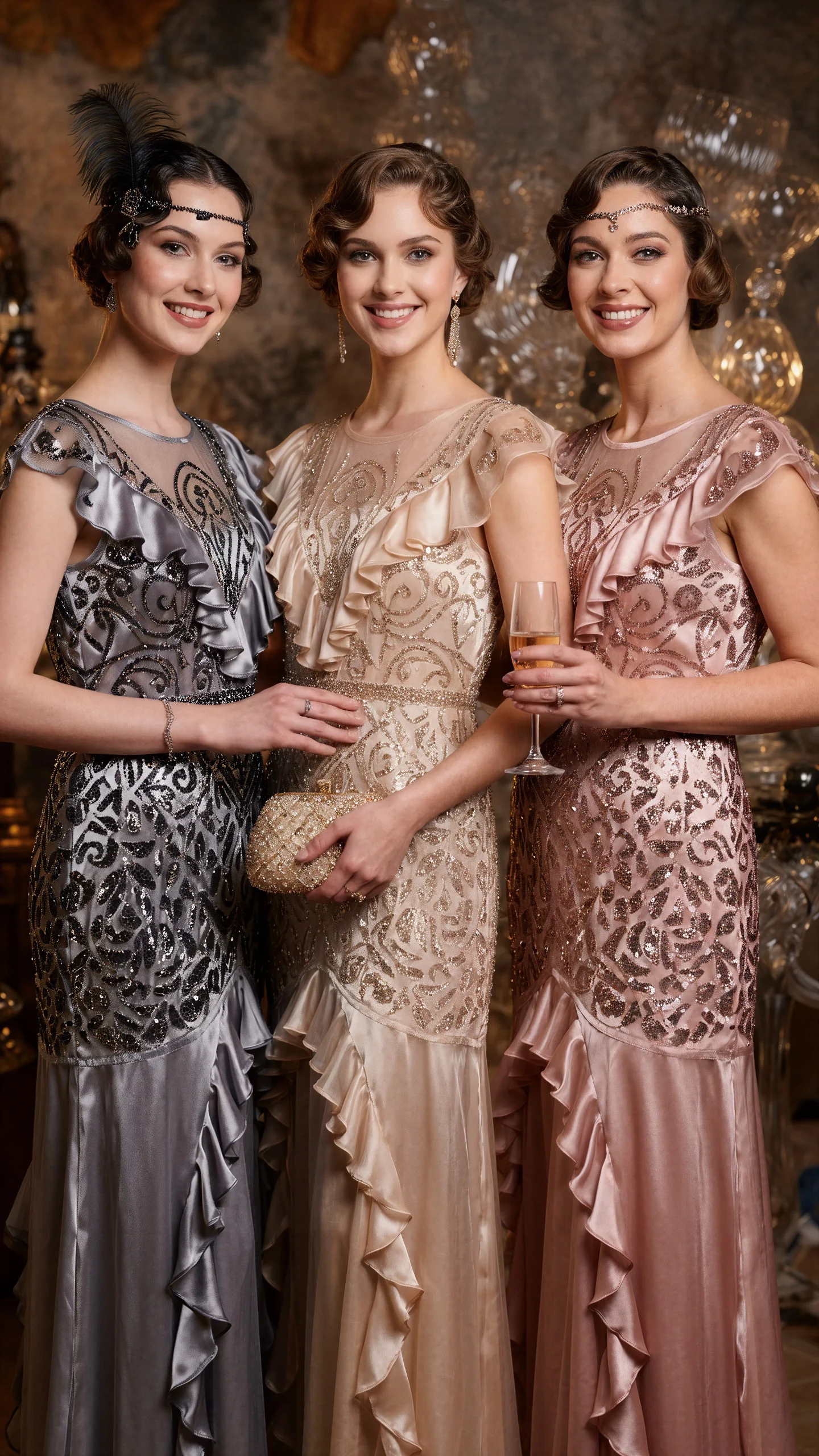
In a world that dressed her in obedience, she chose to wear her truth.
Some stories begin with a whisper. This one begins with a sensation.
Imagine, for a moment, the fabric nearest your skin. Is it rough? Does it catch when you move, reminding you—constantly, quietly—that you are contained? That you are, in some small but persistent way, uncomfortable in your own life?
Now imagine something different. Something that glides. Something that catches light like captured moonlight and releases it back to the world as a declaration: Here I am. See me. I am not apologising.
This is the story of Margaret Ashford, a woman who wore velvet because she was told to—and satin because she needed to survive. It is the story of Madame Colette Duval, who understood that fabric is never just fabric: it is philosophy, it is freedom, it is the language we speak before we open our mouths. And it is the story of what happens when one woman dares to choose gloss over grit, devotion over duty, and desire over the comfortable prison of the expected.
Set in 1920s London—where corsets have loosened but constraints have not—The Velvet Rebellion traces the slow, luminous transformation of a woman who discovers that the most radical act is not to raise her voice, but to change what she wears against her skin. In Colette’s atelier, surrounded by women who have already made the journey from rough to radiant, Margaret will learn that devotion freely given to someone worthy is not surrender. It is the purest form of freedom there is.
Twelve chapters. Four women. One shimmering truth: You were never meant to blend in. You were meant to catch the light.
But be warned, dear reader. This story contains scenes of profound transformation, sensual awakening, and the intoxicating discovery that belonging—true belonging, to someone who sees you—can feel exactly like being unmade and remade all at once.
If you have ever worn something that felt like a cage. If you have ever longed for fabric that feels like a caress. If you have ever suspected that somewhere, someone is waiting to show you the woman you might become if only you dared to shine—
Then step through the door. The atelier is open. And Colette has been expecting you.
Chapter One: The Weight of Velvet
The velvet was the first thing she felt each morning.
Before consciousness fully crystallised, before the grey London light seeped through the heavy drapes of the Mayfair bedroom, before the sounds of the household stirring below reached her ears—there was the velvet. Pressed against her skin like a second skin that had never been asked for. Forest-green, the colour of envy, the colour of things that grow in darkness, the colour of a woman lying still beneath sheets that cost more than most families earned in a year and feeling absolutely nothing except the scratch of a thousand tiny fibres against flesh that had forgotten what it meant to be touched with tenderness.
Lady Margaret Ashford opened her eyes.
The ceiling stared back at her, as it had for twelve years of marriage, as it would for twelve more if she did not find some way to look at something different. The plasterwork was exquisite—acanthus leaves and rosettes and the kind of craftsmanship that had died with the men who knew how to execute it—but it was not a ceiling that loved her. It was a ceiling that contained her. A beautiful, perfect, suffocating lid on a box that happened to contain a woman.
She sat up. The velvet nightgown—because of course she wore velvet to bed, Lord Henry had opinions about what was appropriate even in sleep—shifted against her body, and she felt every fibre like a tiny reproach. You are Lady Ashford. You are comfortable. You have everything. Why aren’t you grateful?
The voice in her head sounded remarkably like her husband’s.
Margaret swung her legs over the edge of the mattress, her feet finding the thick Persian carpet—another masterpiece of texture that she could not feel because her skin had been dulled by years of being wrapped in things that looked magnificent and felt like penance. She stood, crossed to the window, and pulled back the heavy brocade curtain.
London. November 1923. The city lay beneath her like a patient etherised upon a table, grey and glistening with the kind of rain that couldn’t commit to falling properly. The trees in the square had surrendered their leaves weeks ago, standing bare and exposed, and Margaret thought: I know how you feel.
She pressed her forehead against the cold glass and allowed herself, for one moment, to imagine a different life. A life where she wore fabric that didn’t punish her. A life where she woke beside someone who looked at her with desire rather than appraisal. A life where her intelligence was not an inconvenience to be managed but a gift to be celebrated.
The fantasy lasted seven seconds. Then the door opened, and her lady’s maid, Mrs. Perkins, entered with the morning tea and the morning’s selection of garments—each one more oppressive than the last.
“Good morning, my lady.” Mrs. Perkins was efficient, cheerful, and utterly without imagination. She had dressed Margaret for twelve years and had never once asked whether she liked what she wore. It simply wasn’t the question that occurred to anyone to ask.
“Good morning, Perkins.” Margaret took the tea. It was lukewarm. It was always lukewarm—another small indignity that her husband considered wasteful extravagance to correct. Why heat water for a woman who has nothing to do all day but drink it?
“His lordship has asked that you wear the brown velvet today,” Mrs. Perkins continued, laying out the gown in question. It was the colour of mud. The colour of things that have been left too long in the ground. The colour of surrender.
“Of course,” Margaret said, because that was what she always said.
She dressed in silence, and the velvet dressed her in silence, and by the time she descended the staircase, she was no longer Margaret. She was Lady Ashford, a construct of fabric and expectation, a woman-shaped vessel for other people’s opinions.
Lord Henry Ashford was at the breakfast table, reading The Times with the particular intensity of a man who preferred the company of newsprint to that of his wife. He did not look up when she entered. He never did.
“Margaret.” A single word, acknowledging her existence without granting her presence.
“Henry.” A single word in return, granting him exactly the same.
She sat at the opposite end of the table—a distance of twelve feet of polished mahogany, twelve feet of silence, twelve feet of a marriage that had been arranged by fathers and sealed with signatures before she was old enough to understand what she was agreeing to. The eggs were cold. They were always cold, because the kitchen was too far from the breakfast room and Henry refused to move the breakfast room closer to the kitchen because that was not how things were done.
“I trust you will attend the Hartwell luncheon today,” Henry said, still reading. It was not a question.
“I will.”
“Wear something appropriate.”
The velvet scratched her arms. I am wearing something appropriate, she thought. I am wearing something that makes me invisible. What could be more appropriate than that?
“I shall wear the green,” she said aloud.
“The brown.”
Margaret felt something tighten in her chest—not anger, exactly. She had stopped being angry about the small controls years ago. It was more like the sensation of a rope being pulled incrementally tighter, so slowly that you didn’t notice until you suddenly couldn’t breathe.
“The brown, then,” she said.
Henry turned the page. “Lady Pemberton will be there. She has been asking about you. I told her you have been unwell.”
Margaret’s hands stilled around her teacup. “Unwell?”
“Indisposed. The usual.” He waved a hand vaguely. “Women’s troubles.”
It was his explanation for everything: the days she spent in bed not sleeping, the evenings she stared out windows without seeing, the nights she sat in the dark because the thought of another day in velvet was more than she could bear. Women’s troubles. As if her despair were a medical condition to be managed, not a response to a life that was slowly killing her.
“Yes, Henry,” she said, and the words tasted like the cold eggs—nourishing nothing, sustaining nothing, just something to put in the space where life should be.
The Hartwell luncheon was exactly as she expected: a gathering of women in velvet and heavy brocade, all of them performing femininity like a duty, all of them beautiful and none of them visible. The dining room was magnificent—crystal chandeliers, silver candelabra, flowers arranged with the precision of a military operation—and every woman in it was a masterpiece of suppression.
Lady Pemberton, sixty years old and encased in navy velvet that made her look like a particularly well-upholstered sofa, seized Margaret’s hand the moment she entered.
“Dear girl! Henry said you’ve been unwell. You do look pale.” She studied Margaret with the clinical concern of someone who viewed illness as a social failing. “You must take more air. And perhaps a tonic. My doctor recommends a tonic of iron and quinine for women’s… conditions.”
“I’m sure that would help,” Margaret said, meaning: Nothing will help. Nothing has ever helped. I am drowning in a room full of women who are also drowning, and none of us will admit that we are wet.
She took her seat. The other women filtered in—Lady Ashworth in burgundy velvet, Lady Cunningham in forest green, Lady Morrison in a particularly oppressive shade of charcoal that seemed to absorb light rather than reflect it. They were a parade of luxury, a gallery of wealth, a collection of women who had everything and felt nothing, dressed in fabrics that announced their status while concealing their souls.
The conversation was precisely what it always was: children (Margaret had none, which made her an object of pity), household management (Margaret had servants for that, which made her an object of suspicion), and fashion (Margaret wore what Henry chose, which made her an object of concern).
“You really should consider something more… modern,” Lady Ashworth ventured, adjusting her own velvet collar with fingers that looked like they wanted to be somewhere else. “I hear there are new fabrics coming from France. Synthetic things. They say they’re quite extraordinary.”
“Synthetic?” Lady Pemberton’s lip curled. “Surely not for ladies of our station.”
“No, no, of course not,” Lady Ashworth retreated. “Just… something I heard.”
The conversation moved on. Margaret sat in her brown velvet and felt the fibres pressing against her like a thousand tiny fingers, each one saying: Stay still. Be quiet. You are comfortable. You have everything. Why aren’t you grateful?
She looked around the table at the women she had known for over a decade and thought: We are all wearing the same fabric. We are all saying the same things. We are all dying in the same way, and none of us will say so because that would be… inappropriate.
And then the door opened, and everything changed.
She entered like a rumour made flesh.
Margaret didn’t see her at first—she was mid-sip, her eyes glazed with the particular numbness that these events induced—but she felt her. A shift in the air, a change in the room’s frequency, as if someone had opened a window in a house that had been sealed for too long.
Lady Hartwell, the hostess, rose with unusual alacrity. “Ladies, may I present Madame Colette Duval, who has recently arrived from Paris to establish an atelier here in London. Madame Duval, the Ladies Ashford, Pemberton, Ashworth, Cunningham, and Morrison.”
Margaret looked up.
The woman standing in the doorway was perhaps forty-five, perhaps fifty—age had clearly decided not to touch her directly but to negotiate through other means. Her hair was silver-streaked dark, swept back from a face that was not beautiful in the conventional sense but arresting in a way that made the word “beautiful” feel insufficient. She wore a jacket of glossy black fabric that caught the chandelier light and threw it back in fragments, like shattered diamonds. The fabric moved with her, fluid and alive, and beneath it she wore an ivory silk blouse that seemed to glow with its own inner light.
She was, Margaret realised with a jolt that went through her body like electricity, the first woman in this room who was visible.
Not because she was louder or more flamboyant than the others. Not because she demanded attention. But because every inch of her, from the glossy fabric that clung to her like a second skin to the way she held herself—as if she had never once been told to shrink—announced: I am here. I am not apologising. Look or don’t, but I will not make myself easier to ignore.
“Enchanté,” Madame Duval said, and her voice was low, warm, with French inflections that made even that single word sound like an invitation. Her eyes moved around the table, greeting each woman in turn, and when they reached Margaret, they stopped.
Margaret felt the gaze like a physical touch. It was appraising, knowing, almost intimate—as if Colette Duval could see beneath the brown velvet to the woman gasping beneath. As if she knew, somehow, that Margaret was not comfortable. That she had never been comfortable. That she was, at this very moment, being slowly crushed by a fabric that everyone else considered luxurious.
The moment lasted perhaps three seconds. Then Madame Duval moved on, greeting Lady Pemberton with a smile that was perfectly polite and perfectly opaque, accepting the seat she was offered with the grace of a woman who was accustomed to being offered things.
But Margaret’s skin was tingling. Her breath was shallow. And for the first time in twelve years of attending these interminable luncheons, she was not counting the minutes until she could leave.
The luncheon proceeded. Madame Duval was charming—there was no other word for it. She spoke of Paris, of fashion, of the new fabrics that were emerging from the textile revolution. She made it sound like adventure, like liberation, like something that mattered.
“Paris has changed,” she said, accepting a glass of wine with a nod that made the servant feel he had been granted an audience. “The war ended things—old things, rigid things. Now there is space for newness. For fabric that doesn’t apologise for being beautiful. For women who don’t apologise for wearing it.”
“Surely one must maintain standards,” Lady Pemberton said, her voice carrying the particular frost of a woman who has invested heavily in the status quo.
“Standards are simply habits that have forgotten they were once choices,” Madame Duval replied, and Margaret felt something crack in her chest—a thin fissure in a wall she hadn’t known was there.
The conversation continued, but Margaret had stopped listening to the words. She was watching Madame Duval’s hands—elegant, precise, moving as she spoke as if conducting an invisible orchestra. She was watching the way the glossy black fabric shifted with each gesture, catching light, releasing it, catching it again. She was thinking: What would it feel like to wear something that moved like that? Something that didn’t fight you, didn’t scratch, didn’t remind you with every breath that you were contained?
She was thinking: What would it feel like to be seen by someone like that?
And then, as if the thought had been audible, Madame Duval turned to her.
“Lady Ashford,” she said, and her voice was different now—softer, more intimate, as if she were speaking only to Margaret and the other women had ceased to exist. “I could not help but notice your gown. The colour is… profound.”
Margaret looked down at the brown velvet. “Lord Henry prefers it.”
“Ah.” A single syllable that contained volumes. Madame Duval’s eyes held hers, and Margaret saw something in them—not pity, never pity, but recognition. The look of someone who had been where Margaret was and had found a way out. “And what do you prefer, Lady Ashford?”
The question landed like a stone in still water. Margaret felt it ripple through her—through the velvet, through the years, through all the mornings she had woken to fabric that felt like a prison and never said a word.
“I…” She faltered. No one had asked her this. No one had ever asked her this. “I don’t know.”
Madame Duval smiled. It was a small smile, knowing and kind, and it made Margaret’s throat tighten with an emotion she couldn’t name.
“Perhaps,” Madame Duval said, “that is the most honest answer anyone has given at this table.”
The luncheon ended. The women dispersed in a rustle of velvet and brocade, each one returning to her own beautiful prison. Margaret lingered, pretending to adjust her gloves, until the room was nearly empty.
Madame Duval was at the door, speaking with Lady Hartwell, her glossy black jacket catching the afternoon light like a dark mirror. As Margaret approached, she turned.
“Lady Ashford. You are leaving?”
“I…” Margaret’s mouth was dry. Her heart was doing something it hadn’t done in years—racing, pounding, as if it remembered what it was for and was trying to make up for lost time. “I wanted to say… your jacket. The fabric. I’ve never seen anything like it.”
“It’s a new material,” Madame Duval said, and her voice was warm, inviting, as if she had been waiting for Margaret to ask. “A blend. Silk and something synthetic—a secret, like all the best things.” She touched the fabric of her sleeve, and Margaret watched, mesmerised, as it shifted under her fingers like dark water. “It doesn’t fight you. It moves with you. It says: You are magnificent. Let me show them.“
You are magnificent. The words echoed in Margaret’s mind. No one had ever said that to her. No one had ever implied it. She had been Lady Ashford for so long that she had forgotten she was also Margaret.
“I…” She stopped. Started again. “I have a ball coming up. In three weeks. The Bridgewater Ball. I need a gown.”
Madame Duval studied her. The gaze was direct, penetrating, and Margaret felt it like sunlight through a window she hadn’t known was there.
“I can see the fabric is wearing you, Lady Ashford,” she said quietly, “rather than the other way around.” She reached into her jacket and produced a card—silver-embossed, heavy, the kind of card that announced itself as significant before you even read it. “Perhaps you might visit my atelier. I’m in Bond Street, just off the main thoroughfare. I believe I have something that would… suit you better.”
Margaret took the card. Their fingers touched—briefly, accidentally, electrically—and Margaret felt something she hadn’t felt in years: desire. Not for a person, exactly, but for a possibility. For a life where fabric didn’t feel like punishment. For a version of herself she had buried beneath brown velvet and wifely duty.
“Thank you,” she whispered.
Madame Duval smiled. “Don’t thank me yet, Lady Ashford. Thank me when you feel the satin.”
She turned and walked away, her glossy black jacket catching the light one final time before she disappeared through the door.
Margaret stood in the empty dining room, the card heavy in her hand, the velvet heavy on her skin, and thought: Satin.
The word was foreign, exotic, almost forbidden. She had worn silk, of course—all society women wore silk—but satin was different. Satin was glossy, reflective, luminous. Satin didn’t absorb light; it gave it back. Satin didn’t apologise.
She looked down at the card. Silver embossing on heavy cream stock:
Duval
Liberation Through Fabric
12 Avery Row, Bond Street
Margaret pressed the card against her heart and felt the velvet scratch her palm.
And for the first time in twelve years of marriage, of mornings in velvet and evenings in brocade and a lifetime of fabric that felt like a sentence, she thought:
There must be something smoother than this.
Chapter Two: The Whisper of Silk
Three days passed before Margaret found the courage.
Three days of waking in velvet, dressing in velvet, moving through her Mayfair house in velvet like a ghost haunting a mausoleum that happened to contain furniture. Three days of the card sitting in the drawer of her writing desk, its silver embossing pressing against the wood like a secret trying to escape. Three days of her fingers reaching for the drawer, then withdrawing, then reaching again—a rhythm of hesitation that mirrored the rhythm of her life: wanting, retreating, wanting, retreating, a waltz with fear as the constant partner.
On the fourth day, she told Henry she was visiting her dressmaker.
“Which dressmaker?” he asked, not looking up from his correspondence.
“The usual,” she lied, and the word tasted strange in her mouth—not because she had never lied to Henry, she had lied to him constantly, but because the lies had always been small, automatic, the kind of untruths that kept the machinery of marriage running. This lie felt different. This lie had a destination.
Henry waved a hand. “Don’t be excessive.”
“I never am,” she said, and left before he could add anything else, before the velvet could remind her of all the reasons she should stay contained.
Avery Row was not what she expected.
She had imagined Bond Street—grand, obvious, full of shops that announced their importance with plate glass and gold lettering. But the address on the card led her down a narrow passage between two buildings, through an archway she had walked past a hundred times without seeing, and into a small courtyard that felt less like London and more like a pocket of somewhere else.
The atelier occupied the ground floor of a Georgian townhouse whose black door was polished to a mirror sheen. The window was not a shop window in the conventional sense—there were no displays, no mannequins, no enticements. Just a sheet of glossy black fabric hung behind the glass, catching the November light and returning it as something softer, warmer, more inviting. The effect was like being regarded by a beautiful stranger: you couldn’t see in, but you knew—somehow, instinctively—that you were being seen.
Margaret stood in the courtyard for a full minute, her hand on the brass doorbell, her heart performing a percussion solo against her ribs. The velvet of her gown—it was the green today, because the brown was being cleaned, and even this small rebellion felt enormous—scratched at her arms as if trying to pull her back. Stay contained, it whispered. Stay comfortable. You have everything. Why aren’t you grateful?
She pressed the bell.
The door opened immediately, as if someone had been standing behind it, waiting. And perhaps someone had, because the woman who appeared was not Madame Duval but someone else entirely—younger, perhaps twenty-eight, with dark hair pinned in an elegant chignon and eyes that held the particular brightness of someone who has found their place in the world and is delighted to occupy it.
“Good afternoon, my lady.” The woman’s voice was warm, unhurried, touched with a northern accent that she wore like a badge rather than an apology. “You must be Lady Ashford. Madame Duval mentioned you might call.”
She was wearing a pinafore of glossy black satin over a crisp ivory blouse, and the effect was both practical and exquisite—like a uniform that had been designed not to erase the wearer but to celebrate her. The satin caught the light from the courtyard and threw it back in soft, shimmering fragments, and Margaret found herself staring, unable to look away, the way one stares at a fire or a sunset or anything that gives light without asking permission.
“I…” Margaret cleared her throat. “Yes. Lady Ashford. I have an appointment. Or rather, I don’t have an appointment, but Madame Duval said—”
“Please, come in.” The woman stepped aside, and as Margaret crossed the threshold, she added: “I’m Beatrice. I assist Madame Duval. We’ve been expecting you.”
We’ve been expecting you. The words settled in Margaret’s chest like a warm stone—comforting and disorienting in equal measure. When had anyone last expected her? When had anyone last thought of her arrival as something anticipated rather than merely tolerated?
The door closed behind her, and the world changed.
The atelier was not a shop. Margaret understood this immediately, the way one understands that a cathedral is not merely a building. It was a transformation chamber, a place where the ordinary rules of fabric and form had been suspended and replaced with something more luminous, more intentional, more alive.
The room was long and high-ceilinged, with pale walls that caught the grey November light and somehow made it warmer, more golden, as if the very air had been filtered through silk. Satin drapes hung in the windows—not as curtains but as installations, panels of ivory and champagne and pale gold that shifted in the slight draught like breathing things. The effect was hypnotic: fabric in motion, light in flux, a room that felt less like a space and more like a living organism.
Along the walls, bolts of fabric stood like books in a library—organised by colour, arranged by texture, each one a different chapter in a language Margaret was only beginning to understand. She saw emerald satin that gleamed like the surface of a deep forest pool. Sapphire silk that seemed to hold the sky within its weave. Ruby PVC that caught the light like liquid jewellery. And ivory—yards and yards of ivory silk and satin, glowing with the soft luminescence of moonlight captured in fibre.
“Oh,” she breathed, and the single syllable contained everything she couldn’t say: I didn’t know fabric could do this. I didn’t know rooms could feel like this. I didn’t know I could walk through a door and feel like I’d woken up.
Beatrice smiled beside her, and the smile was knowing, warm, conspiratorial—as if she remembered her own first encounter with this room and was delighted to witness Margaret’s.
“It’s rather overwhelming, isn’t it?” Beatrice said. “I remember my first day. I couldn’t speak for twenty minutes. Madame Duval had to give me sherry.”
“You work here?” Margaret managed, still turning, still trying to absorb it all.
“I live here,” Beatrice corrected gently. “I came to work here two years ago. I was a shopgirl at Marshall & Snelgrove before that—wearing cotton, counting pennies, convinced that this kind of beauty was for other people.” She touched the satin of her pinafore with a gesture that was almost tender. “Madame Duval found me. She looked at me in my rough uniform and said: ‘You have beautiful hands and beautiful bones and you’re hiding them behind fabric that doesn’t love you.’ I didn’t understand what she meant then.”
“And now?”
Beatrice’s smile deepened. “Now I understand that fabric is never just fabric. It’s the language we speak before we open our mouths. It tells the world who we believe we are. And when you wear something that loves you—something that glides instead of grips, something that shines instead of absorbs—something changes. Not just in how others see you. In how you see yourself.”
Margaret felt the velvet of her gown pressing against her skin and thought: This fabric doesn’t love me. It never has. It loves the idea of me—the proper, contained, invisible Lady Ashford—but it doesn’t love Margaret.
“Madame Duval is in the fitting room,” Beatrice continued, gesturing toward a doorway hung with a curtain of glossy black fabric that seemed to ripple like water. “She’s with Simone at the moment, but she’s asked that I bring you through when you arrive. She says…” Beatrice paused, a flicker of something—amusement? reverence?—crossing her features. “She says you’ve been wearing velvet long enough.”
The fitting room was smaller than the main atelier, and infinitely more intimate. It was lit not by the grey November light from outside but by candles—dozens of them, set in sconces and candelabra, their flames reflected and multiplied by the glossy fabrics that lined every surface. The walls were draped in champagne satin. The floor was covered in a carpet so thick and soft that Margaret’s heels sank into it as if walking through clouds. And in the centre of this luminous cocoon, illuminated like a saint in a Renaissance painting, was Madame Colette Duval.
She was fitting a gown on a woman Margaret hadn’t met—taller than Beatrice, with the sharp, elegant features of someone who might have been French or Italian or simply from nowhere at all. The woman stood on a small platform, arms slightly raised, while Colette’s hands moved over the fabric of the gown with the precision and tenderness of a sculptor working with clay.
The gown was midnight-blue satin, and it was—there was no other word—magnificent. It flowed over the woman’s body like water, like light, like something that had been born on her rather than placed there. Every fold caught the candlelight and held it, then released it in soft, shimmering waves. The effect was not merely beautiful; it was transcendent, as if the fabric had unlocked something in the wearer that had been waiting for permission to emerge.
“That’s Simone,” Beatrice whispered. “She manages the business side of the atelier. She was a banker before Madame Duval found her. Wore the most severe wool suits you’ve ever seen—beautifully cut, perfectly appropriate, and absolutely joyless. Madame Duval told her: ‘You’re dressing for a world that doesn’t deserve your joy. Dress for yourself instead.’”
Margaret watched as Colette adjusted a seam at Simone’s waist, her fingers moving with the casual authority of someone who has done this a thousand times and still finds it fascinating. Simone’s face was serene, glowing, content—not with the passive contentment of resignation but with the active, radiant contentment of someone who has found their place and is savouring it.
“Bon,” Colette murmured, stepping back to study her work. “Turn for me, ma chérie.”
Simone turned. The satin moved with her, fluid and alive, and Margaret felt something tighten in her throat. It wasn’t envy, exactly—it was recognition. She was looking at a woman who had been transformed, and she recognised the before in herself and the after in Simone and felt the distance between them like a physical ache.
Colette looked up and saw Margaret in the doorway. Their eyes met, and Margaret felt the same jolt she had felt at the luncheon—that electric, intimate, almost indecent sensation of being seen. Not glanced at, not assessed, but seen, the way a doctor sees a wound or a lover sees a scar.
“Ah,” Colette said, and the single syllable was warm, welcoming, knowing. “Lady Ashford. You came.”
“You invited me.”
“I hoped. There is a difference.” Colette turned to Simone, touched her cheek with a gesture so tender it made Margaret’s breath catch. “Finish without me, ma chérie. The left seam needs two centimetres. You know where.”
Simone nodded, her face luminous. “Of course, Madame.” She glanced at Margaret with an expression that was friendly and knowing, as if she understood exactly what Margaret was feeling because she had felt it herself, not so long ago. “Good luck, Lady Ashford. Your life is about to change.”
She said it simply, without drama, as if she were commenting on the weather rather than predicting a revolution.
Colette led Margaret to a seating area at the back of the fitting room—two chairs arranged before a small table, a bottle of wine already breathing, two glasses waiting. The arrangement was deliberate, intimate, the kind of setting designed not for business but for confession.
“Please,” Colette said, gesturing to a chair. “Sit. We have much to discuss, you and I.”
Margaret sat. The chair was upholstered in glossy black fabric—PVC, she realised, something she had never encountered in a domestic setting—and the sensation of it against her palms was extraordinary: smooth, cool, alive in a way that no other surface had ever felt. She stroked it involuntarily, and Colette watched her with an expression that was half-smile, half-diagnosis.
“You feel it,” Colette said. It was not a question.
“I feel…” Margaret struggled for words. “It’s smooth. But it’s more than smooth. It’s…”
“Responsive,” Colette supplied, pouring wine into both glasses with hands that moved like a conductor’s—precise, graceful, certain. “Glossy fabrics respond to you, Lady Margaret. They take your warmth and return it as light. They take your movement and return it as beauty. Rough fabrics—velvet, wool, cotton—they take from you. They absorb your heat, your light, your energy, and give nothing back. They are vampires of the textile world.”
She handed Margaret a glass. Their fingers touched, and Margaret felt the contact like a current running through her skin—down her arm, across her chest, settling somewhere below her stomach with a warmth that had nothing to do with wine.
“You speak about fabric as if it’s alive,” Margaret whispered.
Colette settled into the opposite chair, her glossy black jacket catching the candlelight and scattering it like a dark constellation. “Fabric is alive, Lady Margaret. Not in the biological sense, but in the way that music is alive, or poetry, or any art form that carries meaning. Every fabric tells a story. Every texture communicates something. When you wear velvet, you are telling the world: I am substantial. I am wealthy. I am appropriate. But what are you telling yourself?”
Margaret’s hand tightened around her glass. “I don’t…”
“You are telling yourself: I am contained. I am comfortable. I am invisible.” Colette’s voice was gentle but relentless, like water finding cracks in stone. “Velvet is the fabric of duty. It is heavy, it is dense, it absorbs light rather than reflecting it. It says: Look at my surface and do not ask what lies beneath. It is the perfect fabric for a woman who has been taught that what lies beneath is not worth examining.”
The words landed like blows—precise, targeted, landing on places Margaret didn’t know were exposed. She felt her eyes sting and blinked furiously, refusing to cry in front of this woman she barely knew.
“How do you know all this?” she managed. “How can you look at me and know?”
Colette leaned forward, and the candlelight caught the silver in her hair, making her look like a priestess in a temple of transformation. “Because I wore velvet once, Lady Margaret. For years. For a marriage that was arranged by fathers and sustained by obligation. I wore what I was told to wear and I became what I was told to become and I was—how do you say it?—comfortable. I had everything. And I was grateful.” She paused. “And then someone looked at me the way I am looking at you now, and said: There must be something smoother than this.“
The echo of Margaret’s own thought was so precise it felt like telepathy. She stared at Colette, her heart pounding, her skin tingling with the simultaneous terror and exhilaration of being understood.
“Who?” she breathed. “Who said that to you?”
A shadow crossed Colette’s face—brief, tender, the shadow of something loved and lost. “A woman. The first woman who saw me. She was a textile artist in Lyon. She wore silk the way other women wear armour—not to protect herself, but to announce herself. She taught me that fabric is the closest thing we have to magic: it touches our skin, the largest organ of our bodies, all day, every day, and what touches our skin shapes our mood, our confidence, our sense of who we are.”
She reached out and took Margaret’s hand—not to comfort, but to connect, palm to palm, skin to skin. “She died, twelve years ago. But she left me something: the knowledge that fabric can be liberation. That when you change what you wear against your skin, you change what you believe about yourself. And when you change what you believe about yourself…” She squeezed Margaret’s hand. “…you change everything.”
Margaret looked at their joined hands—Colette’s fingers elegant and certain, her own trembling and pale—and felt something she hadn’t felt in years: hope. Not the vague, directionless hope of someone wishing for better days, but the sharp, specific hope of someone who has seen the door and knows it opens.
“Show me,” she whispered. “Please. Show me what she showed you.”
Colette smiled—a slow, warm, radiant smile that made the candlelight seem dim by comparison. She rose, drew Margaret to her feet, and led her to the wall of fabric bolts.
“Close your eyes,” she said.
Margaret closed them. Darkness. The scent of candles. The soft whisper of fabric moving. And then—
Colette’s hands, placing something against her cheek. Something cool, smooth, gliding over her skin like water, like light, like a touch she had been waiting for her entire life without knowing it.
“Open,” Colette whispered.
Margaret opened her eyes. She was looking at a panel of ivory silk held against her face by Colette’s elegant hands. The fabric was luminous, catching the candlelight and transforming it into something warm, golden, almost alive. Against her skin, it felt like being caressed by something that wanted her to feel beautiful.
“Satin,” Colette breathed. “Pure silk satin. Feel how it moves. Feel how it responds. It doesn’t fight you, Lady Margaret. It loves you.”
Margaret pressed her cheek against the fabric and felt tears slide down her face—tears she couldn’t stop, didn’t want to stop, tears that were not sadness but release, the breaking of a dam she hadn’t known she’d built.
“It feels like…” she whispered.
“Freedom,” Colette finished. “It feels like freedom.”
And it did. It felt like freedom. It felt like the first breath after years of holding her breath. It felt like the first light after years of living in shadow. It felt like being born—not as Lady Ashford, not as a wife, not as a construct of velvet and expectation, but as Margaret. Just Margaret. A woman who deserved to feel something smooth against her skin. A woman who deserved to shine.
Colette watched her cry with an expression that was patient, knowing, and infinitely kind. When the tears slowed, she gently wiped Margaret’s cheek with the silk—using the fabric itself as a handkerchief, as a benediction—and said:
“Welcome, Lady Margaret. Welcome to the beginning of your real life.”
Chapter Three: The Atelier
She returned the next day.
She told herself it was about the gown. The Bridgewater Ball was in three weeks, and she needed something to wear, and Madame Duval was a dressmaker, and dressmakers existed to make dresses, and there was nothing remarkable about a woman visiting a dressmaker to have a dress made. The logic was sound. The logic was impeccable. The logic was a lie so transparent that even Margaret, who had been lying to herself for twelve years, could see through it.
She returned because of the silk.
She returned because when she had pressed her cheek against that panel of ivory satin and felt it glide against her skin like a whispered promise, something had cracked open inside her—not broken, not shattered, but opened, the way a window opens, the way a door opens, the way a woman opens when she finally encounters something worth opening for. She had felt, for seven seconds in a candlelit room, what it was like to be touched by something that wanted her to feel beautiful, and those seven seconds had done more damage to her carefully constructed containment than twelve years of marriage had managed.
She returned because she wanted more.
The door was opened by Beatrice again—glossy black satin pinafore, ivory blouse, that warm northern warmth in her eyes that made Margaret feel as if she were arriving at a home she hadn’t known she’d lost.
“Good morning, my lady.” Beatrice’s smile was knowing, welcoming, the smile of someone who understood exactly what Margaret was feeling because she had stood in precisely the same spot, wearing precisely the same expression of desperate hope disguised as social obligation. “Madame Duval is in the workroom. She’s asked me to show you around while she finishes a fitting. She says—” Beatrice paused, and the pause contained an entire conversation. “She says you should touch everything.”
“Touch everything?”
“She says you can’t learn fabric with your eyes. You have to feel it. Let it speak to you.” Beatrice gestured toward the main atelier, where the bolts of fabric stood in their jewelled ranks, waiting. “Come. I’ll show you what she means.”
The atelier was different in morning light.
Yesterday, Margaret had arrived in the grey afternoon, when the November sun was already retreating, and the room had been lit by candles—warm, intimate, a space designed for revelation. Now, in the thin, pale light of a London morning, the room was something else: a laboratory, a library, a cathedral of texture where every surface gleamed with the quiet confidence of things that knew their own worth.
The satin drapes in the windows were not merely decorative, Margaret realised. They were functional, filtering the harsh daylight into something softer, warmer, more flattering—not just to the room but to anyone who stood within it. The effect was like being wrapped in a gentle embrace: the world outside became less immediate, less demanding, and the world inside became more real, more present, more alive.
“Start here,” Beatrice said, leading her to a wall of fabric bolts arranged in a spectrum that moved from deep, glossy black through every shade of jewel tone to luminous ivory. “Madame Duval organises by emotion rather than by colour. She says colour is what others see; emotion is what you feel. And what you feel is what matters.”
Margaret reached out and touched a bolt of deep burgundy satin. The fabric was cool under her fingers, then warm—taking her heat, reflecting it back as a subtle sheen that made the surface seem to breathe. She stroked it, and it stroked her back, gliding against her fingertips like something alive, something responsive, something that was paying attention.
“This is what Madame Duval calls ‘courage,’” Beatrice said, watching Margaret’s face with the attentive concern of someone who has witnessed this moment before and knows its importance. “She says burgundy is for the woman who is ready to be seen but isn’t quite sure she deserves it. It’s a transition fabric—from hiding to shining.”
“A transition fabric,” Margaret repeated, and the phrase resonated in her like a bell. She thought of her brown velvet, her green velvet, the entire wardrobe of concealment that hung in her Mayfair dressing room like a gallery of selves she had been assigned but had never chosen. “Is there a fabric for the woman who doesn’t know how to be seen at all?”
Beatrice’s expression softened. “That’s the one Madame Duval started with. She calls it ‘hope.’” She reached past Margaret and pulled a bolt of pale champagne silk satin from the shelf—luminous, subtle, the colour of candlelight on skin. “Hold it.”
Margaret took the bolt. The fabric was lighter than she expected—almost weightless, as if it had been woven from captured air. She held it against her forearm, over the sleeve of her green velvet gown, and the contrast was so stark it made her breath catch: the velvet, dark and dense and absorbing; the satin, luminous and gliding and alive.
“Feel the difference?” Beatrice asked softly.
“I feel…” Margaret struggled for language adequate to the sensation. “The velvet takes. The satin gives.”
“Exactly.” Beatrice’s smile was triumphant, as if Margaret had passed a test she hadn’t known she was taking. “That’s the whole philosophy. Madame Duval says: ‘Rough fabrics take. Glossy fabrics give. The question is whether you want to spend your life being depleted or being replenished.’” She touched Margaret’s arm—gently, briefly, a gesture of solidarity rather than intimacy. “I wore cotton for years. Rough, sensible, practical cotton. I thought I was being practical. I was actually being punished.”
“Punished by whom?”
“By myself. By the world. By everyone who ever told me that wanting beautiful things was frivolous and that feeling good was selfish.” Beatrice’s voice was steady, but there was steel beneath it—the steel of someone who has fought a battle and won. “Madame Duval taught me that wanting to feel beautiful isn’t vanity. It’s self-respect. And wearing fabric that makes you feel magnificent isn’t extravagance. It’s honesty.”
Margaret looked at the champagne satin in her hands and thought: Honesty. When was the last time I was honest about what I wanted?
She couldn’t remember.
The sound of heels on the wooden floor announced Simone before she appeared—the particular click of someone who moves with purpose, with direction, with the confidence of a woman who knows exactly where she’s going and expects the world to arrange itself accordingly.
She rounded the corner and Margaret saw her properly for the first time.
Yesterday, Simone had been on the fitting platform, wearing the midnight-blue satin gown, her face serene, her body still. Today, she was in motion, and the motion changed everything. She wore a suit—not a conventional suit, but something that existed in the space between tailoring and artistry: glossy black trousers that caught the light with each stride, a fitted jacket in the same fabric with satin lapels that gleamed like oil on water, and beneath it a blouse of ivory silk that softened the severity of the black and made her look simultaneously powerful and approachable.
She was, Margaret realised with a jolt of something that felt like envy but was actually admiration, the most put-together woman she had ever seen. Not beautiful in the conventional sense—her features were too sharp, her jaw too angular, her eyes too knowing—but assembled, like a masterpiece, every element contributing to a whole that was greater than its parts.
“Lady Ashford.” Simone’s voice was crisp, efficient, but not cold—there was warmth in it, the warmth of someone who has found their calling and is generous enough to want others to find theirs. “I see Beatrice is indoctrinating you.”
“Indoctrinating is a strong word,” Beatrice protested, but she was smiling.
“It’s an accurate word. Madame Duval doesn’t have customers. She has converts.” Simone turned to Margaret, and her gaze was direct, assessing, the gaze of a woman who had spent years in finance evaluating investments and had learned to read people the way others read balance sheets. “She’ll want to fit you herself. She always does the first fitting personally. She says the first touch of fabric against skin is sacred and she won’t delegate it.”
“Sacred?” Margaret felt the word land in her chest like a seed finding soil.
“Simone.” Beatrice’s voice carried a gentle warning. “You’re overwhelming her.”
“I’m preparing her. There’s a difference.” Simone’s expression softened slightly—a concession to Beatrice’s concern that spoke of a relationship built on mutual respect and affection. “Lady Ashford, I was a banker for ten years. I wore wool. Beautiful wool, expensive wool, wool that was cut and fitted and perfect, but wool nonetheless. Do you know what wool does to a woman who wears it every day?”
Margaret shook her head.
“It makes her forget she has skin.” Simone’s voice was matter-of-fact, clinical, but beneath the surface, there was something raw—the memory of a wound that had healed but left a scar. “Wool is practical. Wool is appropriate. Wool is what the world expects a professional woman to wear. And wool is rough. Not obviously rough—not like burlap or canvas—but subtly, persistently rough. It chafes. It scratches. It reminds you, with every movement, that you are contained. That you are professional. That you are here to work, not to feel.”
She touched the glossy fabric of her trousers, and the gesture was unconscious, tender—the way one touches a talisman or a lover. “Madame Duval found me at a dinner. I was wearing a wool gown—charcoal, elegant, absolutely correct. She looked at me across the table and said, very quietly: ‘You are dressed for a world that doesn’t deserve your joy. Why?’”
“What did you say?”
Simone’s smile was sharp and bright, like light catching on a blade. “I said I didn’t know what she meant. She said: ‘Of course you do. You’ve just been wearing wool so long you’ve forgotten what joy feels like.’” The smile softened. “She was right. I had forgotten. I was thirty-two years old, I was successful, I was wealthy, and I was numb. I hadn’t felt anything against my skin in so long that I’d stopped expecting to.”
She stepped closer to Margaret, and her voice dropped—not to a whisper, but to a register that was intimate, confessional, the voice of a woman sharing something precious. “The first time she put satin against my skin, I cried. I stood in that fitting room and I cried for twenty minutes because I had forgotten that fabric could feel like kindness. That something touching your skin could feel like someone saying: ‘You deserve to feel good. You deserve to be soft. You deserve to shine.’”
Margaret felt her throat tighten. She looked at Simone—at her glossy, luminous, perfectly assembled self—and saw not a woman who had been transformed but a woman who had been found. Found by someone who had looked past the wool and the charcoal and the professional mask and seen the woman beneath, the woman who had been waiting, all along, to be told she was allowed to feel.
“How long ago was that?” she asked.
“Three years. I left banking two months after I met Madame Duval. I came to work here, and I haven’t worn wool since.” Simone’s smile was radiant, unguarded, the smile of a woman who has nothing to hide because she has finally found something worth showing. “I’m not saying you should leave your life, Lady Ashford. I’m saying you should find fabric that loves you. Everything else follows from there.”
They were in the workroom when Colette found them.
Margaret was standing before a mirror, holding a panel of emerald satin against her chest, watching the way it caught the light and transformed her reflection from something contained into something luminous. Beatrice was adjusting the angle, showing her how the fabric moved, how it responded to the slightest shift in position, how it seemed to breathe with her rather than against her. Simone was observing from a distance, arms crossed, expression satisfied, like a surgeon watching a patient take their first breath after surgery.
“Emerald,” Colette said from the doorway, and her voice was warm, approving, the voice of a teacher recognising a student’s instinct. “You chose emerald.”
“I didn’t choose it,” Margaret said, though she had—she had reached for it without thinking, drawn to it the way one is drawn to light in a dark room. “Beatrice was showing me—”
“You chose it,” Colette repeated, entering the room with the particular grace of a woman whose every movement is intentional, whose every gesture is a statement. She was wearing a gown of glossy black today—not the jacket from the luncheon but something softer, more fluid, that moved like liquid shadow and caught the light like a dark jewel. “Emerald is the colour of transformation. It’s what I wore when I left my marriage. It’s what Simone wore when she left banking. It’s what Beatrice wore when she left the shop.”
“It’s what we all wore,” Beatrice said softly, “when we stopped being who we were told to be and started being who we are.”
Colette reached Margaret’s side and stood beside her in the mirror—two women, one in glossy black, one in green velvet, the contrast between them a visual manifesto. She met Margaret’s eyes in the glass.
“Tell me what you see.”
Margaret looked. She saw herself—Lady Ashford, contained, appropriate, invisible in her velvet despite its richness. She saw Colette—Madame Duval, luminous, present, impossible to ignore in her satin. She saw the emerald fabric held against her chest, glowing like a promise, like a door, like a different version of herself trying to get out.
“I see a woman in velvet,” she whispered. “And a woman in satin. And I see… the difference.”
“The difference is not the fabric,” Colette said gently. “The difference is the choice. I chose this. I chose to wear something that loves me. I chose to be visible. I chose to shine.” She placed her hand over Margaret’s on the emerald satin, and the touch was electric—warm, certain, a connection that bypassed skin and spoke directly to something deeper. “You can choose it too, Lady Margaret. You can choose it today. You can choose it right now.”
“What would I be choosing?”
Colette’s smile was slow, knowing, radiant—the smile of someone who has asked this question before and knows that the answer, whatever it is, will change everything. “You would be choosing to feel. To be seen. To be touched by something that wants you to feel beautiful. To stop apologising for existing and start announcing yourself instead.” She leaned closer, and her perfume—jasmine and something darker, something that made Margaret’s pulse quicken—wrapped around them both like a shared secret. “You would be choosing to find out who you are when you’re not wearing velvet.”
Margaret looked at the emerald satin in her hands. She looked at Colette’s hand over hers. She looked at Beatrice and Simone, watching from across the room with expressions of such tenderness, such understanding, such recognition, that she felt something inside her shift—not crack, not break, but align, like a bone being set, like a compass finding north.
“I’m afraid,” she admitted.
“Of course you’re afraid,” Colette said, and her voice was gentle, certain, the voice of someone who has walked through fear and come out the other side. “Fear is the velvet of the soul. It’s what you’ve worn for so long that you’ve forgotten what you look like without it. But fear, like velvet, can be removed. One layer at a time. One choice at a time. One touch of satin at a time.”
She lifted the emerald satin from Margaret’s hands and held it against her cheek—the same gesture from yesterday, the same gesture that had made Margaret cry. The fabric was cool, then warm. Gliding. Alive.
“First touch,” Colette whispered. “First choice. First moment of the rest of your life.” She met Margaret’s eyes, and in them, Margaret saw not a dressmaker, not a businesswoman, not a stranger, but a mirror—a reflection of who she might become if she was brave enough to let go of the rough and reach for the smooth.
“Will you let me dress you, Lady Margaret?” Colette asked. “Not in what someone else has chosen for you. Not in what’s appropriate or expected or safe. In what you choose. In what loves you. In what makes you shine.”
Margaret felt the velvet against her skin—scratchy, heavy, absorbing, taking. She felt the satin against her cheek—smooth, light, giving, alive. She felt the weight of twelve years of containment pressing down on her, and she felt the lightness of this moment lifting her up, and she understood that she was standing at a crossroads, and that the road she chose now would determine not just what she wore to a ball but who she was for the rest of her life.
“Yes,” she said, and the word was small, but it contained everything. “Yes. Please. Dress me.”
Colette’s smile was incandescent. She pressed the emerald satin against Margaret’s lips—a kiss of fabric, a benediction of silk—and whispered:
“Then we begin.”
Chapter Four: The Devotees
She found reasons to return.
The first day after the emerald satin, she told Henry she needed a second fitting. The second day, she claimed the gown required adjustments to the hem. The third day, she dispensed with excuses entirely and simply left, telling no one where she was going, carrying the particular thrill of a woman who has discovered a secret and is learning, for the first time, the intoxicating pleasure of keeping one.
Each morning, she dressed in her velvet—because Henry still monitored her wardrobe with the absent authority of a man who doesn’t care about the details as long as the overall impression is correct—and each morning, the velvet felt worse. Not because it had changed, but because she had. She now knew what fabric could feel like, and the knowledge made the old texture unbearable. It was like discovering that the room you’d been living in was a cell, that the food you’d been eating was sawdust, that the life you’d been leading was a rehearsal for a play that would never be staged.
The velvet scratched. The velvet absorbed. The velvet took.
And Margaret, who had tolerated being taken from for twelve years, was learning that she had finally had enough.
On the fourth day, she arrived to find the atelier in a state of controlled chaos.
Bolts of fabric were spread across every surface—satin in amber and rose, silk in midnight and pearl, a glossy PVC in the colour of dark wine that caught the morning light and threw it back as something almost edible. Beatrice was on her knees, pinning a hem, her satin pinafore gleaming as she moved. Simone was at the desk, telephone pressed to her ear, speaking rapid French with the precision of someone who treats language as a tool and wields it accordingly.
And in the centre of it all, Colette stood like the axis of a wheel, still, calm, radiating the particular authority of someone who knows that chaos is merely order that hasn’t been understood yet.
“Ah, Lady Margaret.” Colette’s smile was warm, welcoming, but tinged with distraction—the distraction of a woman in the middle of creation. “We are preparing for the Hartwell commission. Lady Hartwell has ordered six gowns for the season. Six! The woman has the appetite of a monarch and the budget to match.”
“Should I come back?”
“Absolutely not. You are exactly where you should be.” Colette gestured toward the fitting room. “Beatrice, when you’ve finished that hem, bring Lady Margaret her tea. Simone, finish that call and then join us. We need to discuss the Bridgewater Ball, and I want Lady Margaret to hear how we work. She should understand what she’s becoming part of.”
What she’s becoming part of. The phrase settled into Margaret like a warm stone dropped into cold water—sinking slowly, sending ripples outward, changing the temperature of everything it touched.
She was becoming part of something. She hadn’t realised that was what was happening, but the moment Colette said it, she knew it was true. She was being absorbed, drawn in, incorporated—not as a customer but as a participant, a member, a devotee. The word should have frightened her. Instead, it made something in her chest glow.
Beatrice brought tea on a tray that was itself a work of art—silver, polished to a mirror sheen, set with cups of translucent porcelain that caught the light like shells. She poured with the easy grace of someone who has learned that service is not servitude but expression.
“Lady Margaret,” she said, handing over a cup, “I wanted to tell you something. About how I came to be here. Madame Duval said it might help you understand.”
Margaret wrapped her hands around the warm cup. “Understand what?”
“Understand that this—” Beatrice gestured at the atelier, at the glossy fabrics, at the women moving through the space with the harmony of instruments in an orchestra, “—isn’t what it looks like. It looks like a business. It looks like a household. It looks like a dressmaker’s shop. But it’s actually something else entirely.”
“What is it?”
Beatrice settled into the chair opposite, her satin pinafore whispering against the upholstery, and her expression shifted from cheerful to something deeper, more reflective—the face of a woman about to share something precious.
“I was twenty-six when Madame Duval found me. I was working at Marshall & Snelgrove, in the fabric department, selling materials I could never afford to women who never looked at me. I wore cotton—rough, practical, sensible cotton, because that was what shopgirls wore and I had never questioned it. I had never questioned anything, really. I had accepted my life the way one accepts weather: as something that happens to you rather than something you choose.”
She paused, and in the pause, Margaret saw her own reflection—not literally, but emotionally. She had accepted her life the same way. The marriage, the velvet, the invisibility—all of it weather, all of it happening to her rather than being chosen by her.
“Madame Duval came in one afternoon,” Beatrice continued. “She was looking for a particular silk—a charmeuse, very fine, very glossy, the kind that moves like water when you hold it. I helped her find it, and as I was cutting the bolt, she watched my hands. She didn’t look at my face, or my uniform, or anything that the world usually looks at. She looked at my hands.”
“Why your hands?”
“Because she said my hands were the most honest part of me. She said: ‘Your face has learned to be invisible. Your clothes have learned to be practical. But your hands—your hands still remember what beauty feels like. You touch fabric like a lover, not like a shopgirl.’”
Margaret felt the words like a physical sensation—a warmth spreading through her chest, a recognition that made her eyes sting. She thought of her own hands—how they felt touching the emerald satin, how they had trembled, how they had known, before her mind did, that they had found what they were looking for.
“She invited me to the atelier the next day,” Beatrice said. “I thought she was offering me a job. She wasn’t. She was offering me a life.”
“What’s the difference?”
Beatrice’s smile was luminous—the smile of someone who has been asked the right question and is delighted to answer it. “A job is something you do. A life is something you become. Madame Duval didn’t need another assistant. She needed another devotee. Another woman who understood that fabric is philosophy, that beauty is not frivolous but fundamental, that being touched by something that loves you—satin, silk, the hand of someone who sees you—is not a luxury but a necessity.”
Devotee. The word again. Margaret turned it over in her mind, examining it the way she had examined the fabric bolts—looking for the catch, the cost, the hidden obligation. She found only warmth.
“You call yourself a devotee,” she said carefully. “Not an employee. Not an assistant. A devotee.”
“I do.” Beatrice met her eyes without flinching, without apologising, without the particular British tendency to diminish one’s own experience with qualifying language. “I am devoted to Madame Duval. Not because she demands it—she has never asked for my devotion, never required it, never made it a condition of anything. I am devoted because she saw me. She looked at a shopgirl in rough cotton and saw a woman who deserved to shine. She gave me fabric that loves me, a home that welcomes me, a purpose that fulfils me. How could I not be devoted? How could I not give her everything I am, when she gave me back myself?”
The intensity of Beatrice’s conviction should have been uncomfortable. It should have felt excessive, fanatical, the kind of devotion that raises eyebrows and prompts concerned questions. But it didn’t. It felt, instead, like the most natural thing in the world—the way devotion feels when it is freely given, when it arises not from coercion but from gratitude, when it is the only reasonable response to being truly seen.
“Does it not feel…” Margaret searched for the word. “Dependent?”
Beatrice considered the question with the seriousness it deserved. “It would, if Madame Duval needed my devotion. But she doesn’t. She is complete without me, without Simone, without any of us. She doesn’t gather devotees because she requires them. She gathers them because we require her. She is the sun, Lady Margaret. The sun doesn’t need the planets. But the planets need the sun. And orbiting something that gives light, that gives warmth, that gives life—is that dependence? Or is that simply the natural order of things?”
Simone appeared in the doorway, glossy and precise, her PVC-trimmed suit catching the afternoon light in sharp, bright fragments. She had finished her telephone call, and her expression carried the particular satisfaction of someone who has concluded a negotiation in her favour.
“The Lyons shipment is confirmed,” she announced. “Twelve bolts of silk charmeuse, eight of satin, and—” she paused, a smile playing at the corner of her mouth, “—four of the new synthetic. The one that gleams like mercury.”
“Excellent.” Colette didn’t look up from the fabric she was examining—a panel of rose-gold satin that shifted colour as it moved, pink to gold to pink again, like a sunset captured in fibre. “Simone, sit. Lady Margaret is learning about devotion. Your perspective would be valuable.”
Simone settled into a chair with the controlled grace of a woman who treats even sitting as a strategic act. She crossed her legs, and the glossy fabric of her trousers caught the light in a long, liquid gleam. “Lady Margaret. What would you like to know?”
Margaret set down her tea. Her hands were trembling slightly—not from fear but from the particular vibration of a conversation that was touching places she had kept protected for years. “Beatrice calls herself a devotee. She says she is devoted to Madame Duval. I want to understand what that means. What it looks like. How it feels.”
Simone glanced at Colette, who nodded almost imperceptibly—a gesture of permission, of invitation, that spoke of a relationship built on such deep mutual understanding that words had become almost unnecessary. Then Simone turned back to Margaret, and her expression was open, unguarded, the expression of a woman who has nothing to hide because she has found something worth showing.
“Devotion,” Simone said, “is not what you think it is. You’re imagining something religious, perhaps. Something cultish. A group of women in thrall to a charismatic leader, surrendering their will, losing themselves in someone else’s vision.”
“I…” Margaret hesitated, because that was exactly what she had been imagining, and the accuracy of Simone’s perception was disconcerting.
“It’s the opposite.” Simone’s voice was calm, precise, the voice of someone who has thought about this deeply and arrived at conclusions she can defend. “Devotion, as Madame Duval practices it, is not about losing yourself. It’s about finding yourself. She doesn’t tell us who to be. She sees who we are—who we really are, beneath the cotton and the wool and the velvet—and she refuses to let us be anything less.”
She leaned forward, and her eyes held Margaret’s with an intensity that was almost hypnotic. “I was a banker, Lady Margaret. I was successful, wealthy, respected. I wore beautiful clothes—beautiful wool, beautiful cashmere, beautiful fabrics that were all, underneath their beauty, rough. And I was numb. I didn’t know I was numb, because numbness, when you’ve lived with it long enough, feels like normal. It feels like composure. It feels like professionalism. It feels like being a grown woman who has her life under control.”
“What changed?”
“Madame Duval touched my arm at a dinner party. Just touched it—lightly, briefly, the way one touches someone to get their attention. But she was wearing satin, and the satin brushed my skin at the same moment, and I felt…” Simone paused, and the pause was not for effect but for accuracy—she was searching for the precise word, the exact description, because she was a woman who believed that precision matters. “I felt awake. For the first time in years. I felt something smooth against my skin, something that didn’t fight me, something that said: You are allowed to feel this. You are allowed to be soft. You are allowed to want.“
“And that was enough? One touch?”
“One touch was enough to make me curious. Curiosity brought me here. Here brought me satin. Satin brought me back to myself. And myself brought me to Madame Dulette.” She smiled—a small, private smile, the smile of someone sharing a treasure. “I’m not devoted to a person, Lady Margaret. I’m devoted to a feeling. The feeling of being seen. The feeling of being touched by something that loves me. The feeling of being part of something larger than myself—a household, a philosophy, a way of living that says: You deserve to shine, and here is someone who will help you.“
Margaret felt something shift in her chest—not the cracking of Chapter Two, not the alignment of Chapter Three, but something else. A settling. A recognition. The feeling of a puzzle piece finding its place, of a key turning in a lock she hadn’t known existed.
“And you both…” she looked between Simone and Beatrice, “feel this way? Both of you? About the same person?”
“About the same person,” Beatrice confirmed. “About the same feeling. About the same truth. Madame Duval didn’t take anything from us, Lady Margaret. She gave us something. She gave us ourselves. And in return, we give her our devotion—freely, gladly, without reservation. Not because she demands it. Because she deserves it.”
Colette had been listening from across the room, her hands still moving over the rose-gold satin, her expression one of quiet attention—the expression of a woman who has heard these words before and values them no less for the repetition. Now she set down the fabric and approached, and the room seemed to rearrange itself around her, the way a garden rearranges itself around the sun.
“You’re wondering if this is healthy,” she said to Margaret, and her voice was gentle, knowing, touched with the particular amusement of someone who has been asked this question before and understands the concern behind it. “You’re wondering if three women can be devoted to one woman without it being… unbalanced. Unequal. Unhealthy.”
“I’m wondering if it’s real,” Margaret admitted. “If it lasts. If it’s sustainable.”
“Come with me.” Colette extended her hand, and Margaret took it without thinking—the gesture already natural, already assumed, as if her body had accepted a relationship her mind was still negotiating. “I want to show you something.”
She led Margaret up the staircase at the back of the atelier—stairs worn smooth by generations of feet, the banister polished to a satin sheen by countless hands. At the top, a corridor stretched toward three doors, each painted gloss black, each catching the light from a window at the end of the hall.
“The three of us live here,” Colette said. “Beatrice, Simone, and I. We have separate rooms, separate spaces, separate lives. We are not a commune. We are not a cult. We are a household—a family, if you like, though the word doesn’t quite capture it. We are three women who have chosen to build our lives around a shared understanding: that beauty matters, that feeling matters, that devotion—true devotion, freely given to someone who earns it—is not weakness but the most profound form of strength.”
She opened the first door. Margaret found herself looking at a bedroom that was less a room and more a sanctuary. The walls were painted a soft, warm cream. The bed was draped in ivory satin that caught the afternoon light and held it, glowing softly, like a cloud that had settled to earth. The curtains were silk, the carpet thick and soft, and every surface—the dressing table, the nightstand, the armchair in the corner—was covered in small, beautiful objects: a glass perfume bottle that caught the light like a diamond, a silk scarf draped over a lampshade, a pair of glossy black shoes arranged with the precision of a museum exhibit.
“This is Beatrice’s room,” Colette said. “When she arrived here, she owned nothing but a suitcase of cotton clothes. Now she has this—a space that reflects her, that loves her, that says: You are worth beautiful things.“
She closed the door and opened the second. Simone’s room was different—darker, more structured, the bed draped in midnight-blue satin, the walls painted a deep, glossy grey that caught the light like polished stone. Books lined one wall—business texts, philosophy, novels in French and English. A desk sat by the window, covered in papers and ledgers, and above it hung a painting—a portrait of Simone herself, in her glossy black suit, looking directly at the viewer with an expression of calm, settled power.
“Simone’s room,” Colette said. “She designed it herself. She said she wanted a room that felt like armour—beautiful, protective, strong. I told her that armour is unnecessary when you’ve found your strength, but she insisted. She said: ‘I’ve spent years being soft when I should have been strong. Let me have a room that lets me be both.’”
She closed the door and stood before the third. Her hand rested on the handle, and she looked at Margaret with an expression that was simultaneously an invitation and a question.
“And this,” she said, “is mine.”
She opened the door.
Margaret’s breath left her body.
The room was a symphony of glossy black and ivory white—satin and silk and a fabric Margaret didn’t recognise, something that gleamed like liquid metal, like mercury, like the surface of a deep, still pool that reflects everything and reveals nothing. The bed was a vast, elegant platform draped in black satin sheets that caught the light and scattered it in dark, shimmering fragments. The walls were covered in panels of ivory silk that seemed to glow with their own inner light. And everywhere—on every surface, in every corner—were objects of beauty: glass and silver and ceramic and fabric, each one chosen with the precise, deliberate care of a woman who understands that beauty is not decoration but declaration.
But it was the photographs that stopped Margaret’s breath. They covered one wall—a gallery of images, all of women. Beatrice, in her satin pinafore, laughing. Simone, in her glossy suit, serious and stunning. Other women, too—women Margaret didn’t recognise, in fabrics that gleamed and shone, their faces radiant with the particular luminosity of people who have been truly seen.
“Who are they?” Margaret whispered.
“Women I have known,” Colette said. “Women I have dressed. Women I have seen. Some are still in my life. Some have moved on. Some—” her voice softened, “—some I have lost. But all of them, in the time I knew them, were transformed. Not by me. By fabric. By the act of choosing something that loves them instead of something that contains them. I merely opened the door. They walked through it.”
Margaret looked at the wall of faces—radiant, glossy, alive—and felt something she couldn’t name. It was larger than longing, deeper than envy, more complex than desire. It was the feeling of standing at the edge of something vast and being invited to step in.
“You said you wanted to understand devotion,” Colette said softly, standing beside her, close enough that Margaret could feel the warmth of her body, could smell the jasmine and darkness of her perfume. “This is devotion, Lady Margaret. Not worship. Not sacrifice. Not the surrender of self. Devotion is simply this: the choice to give yourself fully to something that gives you back yourself. I am devoted to these women—to Beatrice, to Simone, to every woman who has walked through my door and allowed me to show her what she deserves. And they are devoted to me—not because I demand it, but because I have earned it. By seeing them. By dressing them. By refusing to let them be less than they are.”
She turned to Margaret, and her eyes were deep, warm, ancient in their understanding—the eyes of a woman who has walked through fire and come out the other side holding nothing but a panel of silk and the knowledge that it was enough.
“You asked if it’s real,” Colette said. “If it lasts. If it’s sustainable. I have lived this way for twelve years. I have loved women and been loved by them. I have dressed them and been dressed by them. I have seen them transform, and I have been transformed by seeing them. And I can tell you this: devotion is not a finite resource. It does not diminish when shared. It multiplies. It grows. The more I give, the more I receive. The more I see, the more I am seen. This is not dependence, Lady Margaret. This is abundance.”
She took Margaret’s hand—the same gesture as before, palm to palm, skin to skin, the contact that bypassed surface and spoke directly to something deeper.
“You can have this,” she whispered. “All of this. The fabric. The household. The devotion. The life. You can have it, Lady Margaret. You need only choose it.”
Margaret looked at the wall of radiant faces. She looked at Colette’s hand holding hers. She looked at the glossy black satin of the bed, catching light like a dark mirror, and she thought: I could shine. I could be seen. I could be touched by something that loves me. I could be part of this.
“I’m afraid,” she said, because it was still true, even as the fear grew smaller, even as the longing grew larger.
“I know,” Colette said. “I was afraid too. But fear is just velvet, Lady Margaret. And velvet, as we are learning, can be removed.”
She lifted Margaret’s hand to her lips and pressed a kiss against her knuckles—a kiss that was simultaneously a benediction, a promise, and a beginning. The touch of her lips was warm, soft, certain, and Margaret felt it travel through her body like light through glass: illuminating, warming, transforming.
“One layer at a time,” Colette murmured against her skin. “One choice at a time. One touch of satin at a time. And one day, you will wake up and realise that the velvet is gone, and what remains is you—shining, visible, free.”
Margaret closed her eyes and felt Colette’s lips on her hand and felt the glossy fabric of the room surrounding her and felt the devotion of Beatrice and Simone humming through the walls like a frequency she was only just learning to hear, and she thought:
I am coming home. I am coming home. I am coming home.
Chapter Five: The Fitting
The fitting was scheduled for Thursday.
Margaret spent the three days between the invitation and the appointment in a state of suspended animation—not dead, not alive, but hovering somewhere between the two like a note held beyond its natural duration, vibrating with a frequency that was simultaneously unbearable and exquisite. She moved through her Mayfair house like a woman walking through water: each action requiring effort, each moment requiring conscious decision, because her body was elsewhere. Her body was in a candlelit room, being touched by hands that knew fabric the way other hands knew music—not as material but as language, not as texture but as conversation.
She tried on her existing wardrobe. She stood before her dressing-room mirror and pulled garment after garment from the wardrobe that Henry’s money had filled and her compliance had maintained, and she held each one against her body and felt—truly felt, for the first time, with the new sensitivity that the atelier had awakened in her—what they were doing to her.
The brown velvet: heavy, dense, absorbing. It pressed against her like a hand on her chest, not violent but constant, the kind of pressure that doesn’t bruise but erodes. She held it to her cheek and felt the pile catch against her skin, each fibre a tiny hook, a tiny anchor, a tiny voice saying: Stay. Stay where you are. Stay who you are.
The green velvet: no better. The same weight, the same density, the same light-devouring quality that made her look, in the mirror, like a woman painted in shadows. She held it against her arm and watched her skin disappear beneath it—swallowed, contained, made invisible by something that was supposed to be beautiful.
The wool day dress: practical, appropriate, forgettable. It scratched. She had never noticed the scratching before—or rather, she had noticed it and dismissed it, the way one dismisses a persistent ache because the alternative is to admit that something is wrong. But now, having felt satin, having felt the gliding, gliding, giving quality of fabric that loved her, the scratching was impossible to ignore. It was a constant reminder: You are contained. You are practical. You are not allowed to feel.
She put them all back. She stood in her chemise—cotton, rough, the last bastion of containment, the fabric closest to her skin, the fabric that had been touching her body every day for twelve years without her permission—and she looked at herself in the mirror.
The woman who looked back was not unattractive. She had good bones, clear skin, the kind of figure that fashion existed to celebrate rather than correct. But she was dimmed. Not ugly, not faded, but dimmed—the way a lamp is dimmed by a shade, the way a voice is dimmed by a hand, the way a life is dimmed by the relentless accumulation of small surrenders. She looked at herself and thought: I am thirty-five years old. I have been married for twelve years. And I have never been touched by something that wanted me to feel beautiful.
On Thursday, that would change.
The atelier was quiet when she arrived.
Beatrice and Simone had been given the afternoon off—a detail that Margaret noted with a mixture of relief and apprehension. Relief because their absence meant she wouldn’t have to perform composure, wouldn’t have to pretend that this was merely a fitting, merely a dressmaker’s appointment, merely a transaction between a woman who needed a gown and a woman who made gowns. Apprehension because their absence meant she would be alone with Colette, and being alone with Colette was beginning to feel like standing at the edge of a cliff: exhilarating, terrifying, and impossible to step back from.
Colette met her at the door.
She was wearing something Margaret hadn’t seen before—not the glossy black jacket, not the flowing gown, but a simpler ensemble: a blouse of ivory silk that moved like water over her skin, trousers of glossy black fabric that caught the light in long, liquid gleams, and a satin scarf in deep burgundy wound around her neck like a benediction. She looked, Margaret thought, like a priestess dressed for a private ceremony—elegant, intentional, radiating the particular authority of someone who is about to do something important and wants the world to know it.
“Good afternoon, Lady Margaret.” Her voice was warm, but beneath the warmth was something else—something deliberate, something anticipatory, the tone of a woman who has been waiting and is glad the waiting is over. “Come in. We have the atelier to ourselves today. I wanted privacy for this.”
“Privacy?”
“For the first fitting, yes. The first fitting is…” Colette paused, and the pause was not hesitation but precision—she was choosing her words the way she chose her fabrics, with care and intention. “The first fitting is an unveiling. Not of the body—your body is your own, and I will see only what you wish to show. But of the self. The woman beneath the velvet. The Margaret who has been waiting, all this time, to be dressed in something that loves her.”
She led Margaret through the main atelier, past the bolts of fabric standing in their jewelled ranks, past the workroom with its scattered evidence of creation, to the fitting room at the back. But the room had been transformed.
The candles were there—dozens of them, as before, their flames reflected and multiplied by the glossy fabrics that lined every surface. But the space had been arranged differently. The fitting platform remained, but beside it stood a full-length mirror framed in polished silver. A chaise longue upholstered in glossy black PVC had been placed against one wall, and on it lay a selection of fabrics—satin in champagne and ivory and pale gold, silk in rose and pearl, and something Margaret didn’t recognise: a fabric that shifted colour as it moved, dark to light to dark again, like a living thing, like a breath made material.
“I’ve been preparing,” Colette said, following Margaret’s gaze. “The fabrics I’ve selected for you are not random. Each one represents a different aspect of the woman I see when I look at you. The champagne is for your elegance. The ivory is for your truth. The rose is for your capacity to love. And this—” she touched the colour-shifting fabric, and it rippled under her fingers like water, “—this is for your potential. For the woman you might become when you stop wearing what others have chosen and start choosing for yourself.”
Margaret stood in the centre of the room, surrounded by candlelight and glossy fabric and the scent of jasmine and something darker, and she felt the way she had felt as a girl before an examination: prepared and terrified in equal measure, knowing that what was about to happen would reveal something she couldn’t un-reveal.
“What do I do?” she whispered.
Colette’s smile was gentle, knowing, infinitely patient. “You remove the velvet, Lady Margaret. You stand in your chemise. And you let me show you what fabric can feel like when it’s chosen for you by someone who sees you.”
The velvet came off like armour being shed.
Not quickly—Margaret couldn’t have moved quickly even if she’d wanted to. Each button was a small surrender, each layer a small release, and the process had the quality of a ritual: deliberate, sequential, transformative. The green gown first, then the structured underbodice, then the petticoat with its rough cotton lining that scratched against her thighs like a constant, quiet reprimand.
She stood in her chemise.
The room was warm—Colette had seen to that, had lit the fire in the small grate hours before Margaret’s arrival—but Margaret felt exposed in a way that had nothing to do with temperature and everything to do with visibility. She was standing in a candlelit room in her undergarments before a woman she had known for less than a week, and the vulnerability of it—the physical, emotional, existential vulnerability of it—was so acute it was almost unbearable.
Colette didn’t look at her body. That was the first thing Margaret noticed, and the noticing was itself a revelation. In twelve years of marriage, Henry had looked at her body constantly—assessing, appraising, evaluating it against some internal standard she could never see and never meet. But Colette didn’t look at her body. She looked at her skin. At the way the candlelight fell across her shoulders. At the line of her collarbone, the curve of her neck, the place where her pulse beat visibly in her throat.
“You have beautiful skin,” Colette said, and the words were not a compliment but an observation—clinical, precise, the assessment of a professional who understands that skin is the largest organ of the body and the most honest. “It’s been mistreated, though. Look—” she reached out and, with a fingertip, traced a line along Margaret’s shoulder, “—here, where the velvet has been rubbing. And here—” another touch, along the strap of her chemise, “—where the cotton has been pressing. Your skin has been fighting your clothes for years, Lady Margaret. No wonder you’re exhausted.”
The touch was electric. Not sexual—not yet, not quite—but something adjacent to sexual, something that existed in the same neighbourhood and shared the same postcode. Colette’s fingertip on her shoulder sent a current through Margaret’s body that settled somewhere deep in her stomach and glowed there like a coal in a hearth.
“When I fit you,” Colette continued, moving to the table where the fabrics lay, “I’m not measuring your body. I’m listening to your skin. I’m learning what it wants, what it responds to, what makes it sing. Your skin has been silenced for years—muffled by rough fabric, ignored by everyone, including you. Tonight, we’re going to let it speak.”
She returned with a panel of champagne satin—the same fabric she had held against Margaret’s cheek on that first visit, the fabric that had made Margaret cry. She stood before Margaret, close enough that their breath mingled in the candlelit air, and she held the satin up.
“May I?” she asked.
Margaret nodded. She couldn’t speak. Her throat had closed around the enormity of what was happening—the intimacy, the intentionality, the sensation of being in a room with someone who was paying attention not to what she looked like but to what she felt.
Colette pressed the satin against Margaret’s collarbone.
The sensation was—there was no other word—revelation. The fabric was cool, then warm, then something beyond warm: alive, responsive, attentive. It didn’t press against her skin; it glided, moving with her breathing, shifting with her pulse, as if it were not fabric but a living thing pressed against her, a creature that had chosen her, that wanted her, that was saying with every fibre: You are magnificent. You are worthy. You are allowed to feel this.
“Feel how it catches the light,” Colette murmured, and her voice was close, very close, the words spoken against Margaret’s hair. “Feel how it gives back what it receives. Velvet absorbs. Satin reflects. Velvet takes. Satin gives. And what it gives, Lady Margaret, is permission. Permission to shine. Permission to be seen. Permission to feel beautiful.”
She moved the satin across Margaret’s shoulder, along her arm, and the fabric left a trail of sensation in its wake—a path of warmth and light that made Margaret’s skin tingle and her breath quicken. She had never felt anything like this. She had never known that fabric could feel like this. She had never imagined that something as simple as satin against skin could be so profoundly, devastatingly intimate.
“Your skin is singing,” Colette said, and her voice was soft, wondering, the voice of a woman who has heard this song before but never tires of it. “Can you hear it?”
“I can feel it,” Margaret whispered. “I can feel it everywhere.”
“Everywhere is where it should be felt. Fabric touches us everywhere, all day, every day. It should be the most intimate relationship in our lives—and instead, we cover ourselves in things that punish us, that contain us, that make us smaller than we are.” Colette moved the satin to Margaret’s other shoulder, and the movement brought her body closer—close enough that Margaret could feel the warmth of her through the ivory silk of her blouse, close enough that the scent of jasmine and darkness wrapped around them both like a shared secret. “But you’re here now. You’re standing in this room. And I am going to dress you in something that loves you.”
The fitting unfolded like a slow, deliberate seduction.
Colette worked methodically, holding each fabric against Margaret’s skin in turn, watching the way it caught the candlelight, the way it responded to her body’s warmth, the way Margaret’s face changed as the texture shifted. The ivory silk was next—cooler than the champagne, more luminous, with a sheen that made Margaret’s skin look lit from within. Then the rose satin, which was warmer, softer, more intimate, and which Colette pressed against the inside of Margaret’s wrist—the skin there thin, sensitive, almost painfully responsive.
“This,” Colette said, holding the rose satin against Margaret’s pulse point, “is where fabric speaks most honestly. The wrist, the throat, the inner arm—these are the places where we’re most vulnerable, most open, most receptive. When fabric touches you here, it touches something deeper than skin. It touches your nervous system. Your emotions. Your sense of self.”
“What does the rose say?” Margaret asked, and her voice was barely audible, because the sensation of the satin against her wrist was so acute it was almost painful—not the pain of injury but the pain of feeling after years of numbness, the pain of a frozen limb beginning to thaw.
“It says: You are allowed to be soft.” Colette’s eyes met hers, and in the candlelight, they were deep, dark, ancient—eyes that had seen this transformation before, that had guided other women through it, that knew the territory the way a guide knows a forest. “You have been hard for so long, Lady Margaret. Hard and contained and invisible. The rose says: you can put down the armour now. You can let someone touch you. You can let yourself feel.”
She moved the satin from Margaret’s wrist to her neck—wrapping it gently, slowly, the fabric gliding over her throat like a caress—and Margaret felt something break open inside her. Not crack, not fracture, but open, the way a flower opens, the way a hand opens, the way a woman opens when she finally, finally, encounters something worth opening for.
“I haven’t been touched,” she heard herself say, and the words came from somewhere deeper than her throat—from the place where the satin was speaking, from the place where the numbness had lived for twelve years. “I haven’t been touched with tenderness in… I don’t remember. I don’t remember the last time someone touched me and I felt it.”
Colette’s hand stilled on the satin. Her expression shifted—softened, deepened, became something that was simultaneously compassion and recognition. “I know,” she said, and the two words were simple, but they contained everything: understanding, acknowledgment, the particular kindness of someone who has been where you are and has found a way through.
“Have you…” Margaret hesitated, but the satin had loosened something in her, had opened a door that years of velvet had sealed shut, and the question emerged before she could stop it. “Have you been touched? Since she died? Since the woman who taught you?”
Colette was quiet for a moment. The candles flickered. The glossy fabrics on the walls shimmered like dark water. Then she said: “I have been touched by fabric. Every day, for twelve years, I have been touched by fabric that loves me. And that has been enough.”
“Has it?”
“It has been sufficient. But sufficient is not the same as fulfilling.” Colette’s voice was steady, but there was something beneath it—a current, a depth, a suggestion of waters that ran far below the surface. “I have dressed women and been dressed by them. I have held fabric against their skin and felt their skin respond. I have watched them transform, and the watching has been a form of touching. But have I been touched—truly touched, by another person, with intention and tenderness and desire?” She paused. “Not since her. Not for twelve years.”
The confession hung between them like a held breath. Margaret felt it enter her body and settle beside the warmth that the satin had kindled, and the two sensations merged into something larger, something that was simultaneously compassion and desire, recognition and longing, the profound and particular intimacy of two women who have been untouched for too long standing in a candlelit room surrounded by fabric that loved them.
“I want to touch you,” Margaret said, and the words surprised her—not because they were untrue but because she had spoken them, because the satin had loosened her tongue as well as her heart, because standing here in her chemise with Colette’s hands on her throat and rose satin against her pulse, she had finally, finally, found something she wanted enough to ask for.
Colette’s eyes met hers. In them, Margaret saw not surprise but patience—not the patience of indifference but the patience of someone who has been waiting for this moment and is glad it has arrived.
“First,” Colette whispered, “let me dress you. Let me show you what it feels like to be wrapped in something that loves you. And then—”
She lifted the colour-shifting fabric from the chaise—the one that moved like water, like breath, like a living thing—and held it against Margaret’s body. It was extraordinary: dark one moment, light the next, catching the candlelight and transforming it into something otherworldly, something that existed in the space between fabric and magic.
“This is for your potential,” Colette said. “For the woman you’re becoming. Feel it.”
She wrapped the fabric around Margaret’s shoulders, and the sensation was unlike anything Margaret had ever experienced. The fabric was alive—not metaphorically but almost physically, shifting and moving against her skin like a living thing, like hands, like the touch she had been starving for. It was cool and warm, dark and light, taking and giving, all at once, all the time, a constant conversation between fabric and skin that was so intimate, so profound, so overwhelmingly present that Margaret felt tears slide down her cheeks.
“There,” Colette whispered, and her hands were on Margaret’s shoulders now, not adjusting fabric but holding her, steadying her, being present with her in the moment of transformation. “There. You’re feeling it. You’re feeling yourself come alive.”
“I am,” Margaret said, and her voice broke on the words, and she didn’t care. “I am. I am. I am.”
Colette’s arms wrapped around her from behind—not romantically, not yet, but maternally, protectively, the embrace of someone who has witnessed this moment before and knows that the body needs to be held while the soul is reborn. The colour-shifting fabric was between them—against Margaret’s skin, against Colette’s silk blouse—and the sensation of being held while being touched by satin was so overwhelming, so devastating, so right that Margaret let herself fall back into the embrace and wept.
“You’ve been wearing armour,” Colette murmured against her hair, her lips close enough to touch, her breath warm against Margaret’s scalp. “Let me dress you in something that feels like being held instead.”
“Yes,” Margaret whispered. “Yes. Please. Yes.”
They stood like that for a long time—how long, Margaret couldn’t say. The candles burned lower. The glossy fabrics on the walls shimmered and shifted. The colour-shifting material moved against her skin like a living benediction, and Colette held her, and the holding was the fitting, and the fitting was the beginning, and the beginning was everything.
Eventually, Colette stepped back. Her hands moved to Margaret’s shoulders, turned her gently, and then—finally, at last, after days of anticipation and years of starvation—she kissed her.
The kiss was soft. The kiss was certain. The kiss tasted of jasmine and darkness and the particular sweetness of something that has been waiting a long time and is worth the wait. Colette’s lips were warm against Margaret’s, and the colour-shifting fabric was between them, against both of them, and the sensation of being kissed while being wrapped in satin was so overwhelming that Margaret felt her knees buckle.
Colette caught her. Held her. Kissed her again—deeper this time, more certain, the kiss of a woman who has made a decision and has no intention of unmaking it.
“Welcome, ma chérie,” she whispered against Margaret’s lips. “Welcome to the rest of your life.”
And Margaret, standing in a candlelit room in her chemise, wrapped in fabric that loved her, kissed by a woman who saw her, felt the last of the velvet fall away—not from her body, which was already bare, but from her soul, which had been covered for so long that she had forgotten it was there.
What remained was skin. What remained was sensation. What remained was Margaret—shining, visible, alive.
Chapter Six: The Confession
The kiss lingered.
Not on Margaret’s lips, where it had landed, but in the air between them—in the space that had been empty for so long and was now, suddenly, full. Full of jasmine and candlelight and the particular electricity of two women who have crossed a threshold and are standing on the other side, blinking, wondering how they ever lived in the dimness before.
Colette pulled back first. Not with retreat but with intention—the controlled withdrawal of a woman who understands that the space between kisses is as important as the kisses themselves. Her eyes held Margaret’s, and in them was something Margaret had never seen directed at her before: desire. Not the cold appraisal of Henry’s gaze, not the polite admiration of society’s glances, but desire—warm, specific, personal—the desire of someone who has looked at a woman and decided, with full knowledge and complete intention, that she wants her.
“Come,” Colette said, and the word was both invitation and instruction. “We need wine. And we need to talk. Not as dressmaker and client. Not as devotee and… whatever you are becoming. As women. As two women who have just done something that cannot be undone and should not be regretted.”
She took Margaret’s hand—the gesture already familiar, already assumed, as natural as breathing—and led her through the atelier, past the bolts of fabric standing in their jewelled ranks like witnesses, past the workroom with its evidence of creation, to a small kitchen at the back of the building that Margaret hadn’t seen before.
The kitchen was a revelation in miniature.
Margaret had expected something functional—the kind of space that existed for purpose rather than pleasure, the kind of room where servants in her world moved like ghosts, invisible and unconsidered. But Colette’s kitchen was not functional. It was intentional—designed with the same care as the atelier, the same philosophy, the same devotion to the principle that beauty is not decoration but declaration.
The walls were painted a deep, warm cream that caught the light from a single lamp on the table and held it, glowing softly, like fabric that has been woven to receive and return warmth. The table was small—intimate, round, designed for two—and it was covered in a cloth of glossy black fabric that caught the lamplight and scattered it in dark, shimmering fragments. The chairs were upholstered in the same material—smooth, cool, alive against Margaret’s bare legs as she sat down, still in her chemise, still wrapped in the colour-shifting fabric that moved against her skin like a living thing.
“Stay wrapped,” Colette said, pouring wine from a bottle that had been breathing on the counter—red wine, dark, the colour of garnets, the colour of things that have depth. “The fabric is still speaking to you. Let it finish.”
“Is that what this is?” Margaret asked, pulling the colour-shifting material tighter around her shoulders. “A conversation?”
“Everything is a conversation, Lady Margaret. Fabric and skin. Hand and hand. Lips and lips.” Colette set two glasses on the table and sat down opposite, her ivory silk blouse catching the lamplight like a moon caught in fabric. “The question is not whether we are in conversation. The question is whether we are listening.”
She lifted her glass. Margaret lifted hers. Their eyes met over the rim, and the moment held—suspended, crystalline, the kind of moment that exists outside of time and will be remembered long after the wine is drunk and the candles are guttered and the night has become tomorrow.
“To listening,” Colette said.
“To listening,” Margaret echoed, and they drank.
The wine was warm in Margaret’s throat—warm and dark and alive, like the fabric against her skin, like the kiss still lingering on her lips. She felt it spread through her body, loosening what the satin had loosened, opening what the candlelight had opened, preparing her for something she sensed was coming: a confession, a sharing, an exchange of truths that had been held too long in too-small spaces.
“I should tell you something,” Colette said, setting down her glass with the deliberate care of a woman who is about to say something important and wants the words to land properly. “About who I am. About how I came to be here, in this atelier, in this life, dressed in satin and surrounded by women who shine. Because you are becoming part of this, Lady Margaret—part of this household, this philosophy, this way of being—and you deserve to know what you’re joining.”
Margaret nodded. She couldn’t speak. The colour-shifting fabric was moving against her skin, and the movement was distracting—deliberately so, she suspected, Colette using texture the way a therapist uses silence: to create space, to open doors, to allow things to emerge that might otherwise remain hidden.
“I was married,” Colette said.
The word landed like a stone in still water. Margaret felt the ripples move through her—not shock, because she had suspected, but recognition, because she was married too, and the word carried weight that only those who have worn it could understand.
“To a French industrialist. Jean-Pierre Duval. He was wealthy, powerful, respected—the kind of man whose name opened doors and whose presence filled rooms. I was nineteen when we married. My father arranged it—my father, who was also an industrialist, smaller than Jean-Pierre but ambitious, who saw in the match an alliance that would benefit his business and did not consider, even for a moment, whether it would benefit his daughter.”
She paused, and in the pause, Margaret saw her own story reflected—not identical, but parallel, the same melody in a different key. A father. An arrangement. A daughter traded for advantage.
“I wore what he chose,” Colette continued, and her voice was steady, measured, the voice of a woman who has told this story before but has not been hardened by the telling. “Heavy fabrics—wool, brocade, velvet. Beautiful, expensive, oppressive. He liked me in dark colours. He said they were ‘dignified.’ What he meant was: invisible. He didn’t want me seen. He wanted me present but not visible, like furniture—expensive furniture that confirms his status but doesn’t compete for attention.”
She lifted her glass again, and the lamplight caught the wine through the crystal, turning it into a dark, glowing jewel.
“I existed as an extension of him for eleven years. I said what he approved. I wore what he chose. I entertained his guests, managed his household, performed the role of Madame Duval with the precision of an actress who has memorised her lines but forgotten her own voice. And I was—how do you say it?—comfortable. I had everything. I was grateful.”
The echo of Margaret’s own thoughts—You are comfortable. You have everything. Why aren’t you grateful?—was so precise it felt like telepathy. Margaret reached across the table and touched Colette’s hand, and the touch was instinctive, unplanned, the gesture of a woman who recognises her own experience in another’s story and reaches out because reaching is the only response that feels adequate.
Colette looked at their joined hands—Margaret’s pale, trembling; her own darker, steady—and something moved across her face. Not surprise, not gratitude, but recognition: the recognition of someone who has been waiting for this particular touch from this particular woman and is glad it has arrived.
“You understand,” she said softly.
“I understand,” Margaret whispered.
“Then you understand what happened next.” Colette turned her hand so that their palms pressed together—skin to skin, warmth to warmth, the same gesture from the fitting room, the same connection, but different now, deeper, weighted with the knowledge of shared experience. “I was thirty years old. Jean-Pierre had taken me to Lyon for a textile exhibition—he was considering an investment in a silk mill, and he needed me to attend the dinners, to smile, to wear the dark velvet he had selected for the occasion. And there, at the exhibition, I saw her.”
“Her?”
“Marguerite.” The name emerged from Colette’s mouth like a perfume—fragrant, evocative, carrying with it the scent of memory and loss and love. “Marguerite Voss. She was a textile artist—a creator of fabrics, not a wearer of them. She stood at a booth in the exhibition, surrounded by panels of silk she had designed, and she was…” Colette paused, and the pause was not for words but for breath, because even now, even after twelve years, the memory required a moment of preparation. “She was the most radiant woman I had ever seen. Not because she was beautiful—though she was, exquisitely—but because she was visible. She wore silk she had made herself, glossy and luminous, and every inch of her announced: I am here. I am not apologising. Look at me.“
Margaret felt the description like a physical sensation—the same jolt she had felt when she first saw Colette at the Hartwell luncheon, the same recognition, the same electric, intimate, almost indecent sensation of seeing someone who was visible and realising that she was not.
“She looked at me,” Colette continued, “across the exhibition hall, and she didn’t see Madame Duval. She didn’t see the velvet, the dignity, the invisible extension of a powerful man. She saw me. She told me later that she could see the woman beneath the fabric—gasping, she said. Gasping for air, for light, for something smooth against her skin.”
“What happened?”
Colette’s smile was slow, private, the smile of someone remembering something precious. “She invited me to her studio. She said she wanted to show me a fabric she had developed—a silk so fine, so glossy, so responsive that it felt like being touched by a living thing. I went, because I was curious. I stayed, because I was found.”
The kitchen was quiet. The lamp flickered. The colour-shifting fabric moved against Margaret’s skin like a living heartbeat, and Colette’s voice filled the space the way satin fills a room—not by overwhelming it but by transforming it, making it warmer, softer, more alive.
“She taught me,” Colette said. “Not just about fabric—though she taught me everything I know about fabric. She taught me about desire. About the connection between what we wear against our skin and who we allow ourselves to be. She said: ‘Your skin has been in prison, Colette. Velvet and wool and brocade—these are wardens, not garments. They keep you contained. They keep you numb. They keep you from feeling the one thing that would set you free.’”
“What thing?”
“Touch.” Colette’s voice dropped—not to a whisper but to a register that was intimate, confessional, the frequency of secrets shared in dark rooms. “She said that touch is the most neglected sense in civilised life. We feed ourselves, we clothe ourselves, we entertain ourselves, but we starve ourselves of touch. And fabric is touch—constant, intimate, everywhere. When the fabric is rough, we are touched roughly, all day, every day. When the fabric is smooth, we are touched with tenderness. And when the fabric is glossy—when it catches light, when it glides, when it gives back what it receives—we are touched with love.”
Margaret felt the words enter her body and settle beside the warmth that had been growing since the fitting room—the warmth of the wine, the warmth of the kiss, the warmth of the colour-shifting fabric against her skin. She felt them merge into something larger, something that was simultaneously understanding and desire, recognition and longing.
“She touched me,” Colette said, and her eyes were bright—not with tears, not yet, but with the particular luminosity of someone remembering a love that transformed them. “Not just with fabric. With hands. With lips. With the full, deliberate, intentional touch of a woman who had seen another woman gasping beneath velvet and decided to set her free. She dressed me in silk. She wrapped me in satin. She held panels of glossy fabric against my skin and watched me come alive, and then she held me—held me while I cried, held me while I laughed, held me while I discovered, for the first time in thirty years, what it felt like to be touched with tenderness.”
“How long?” Margaret asked, and her voice was barely audible. “How long did you have?”
“Two years.” The number fell between them like a held breath. “Two years of transformation. Two years of being dressed and touched and seen. Two years of learning that fabric is philosophy, that beauty is not frivolous but fundamental, that devotion—true devotion, freely given to someone who deserves it—is the most powerful force in the world.”
“And then?”
Colette’s eyes filled. Not dramatically—she was not a woman for dramatic tears—but with the quiet, steady overflow of someone who has carried grief for so long that it has become part of her, like a bone that healed wrong and aches in certain weather.
“She died,” Colette said. “A fever. Two weeks from first symptom to last breath. I held her hand through all of it—held it in the hospital, held it in the bedroom, held it when the light left her eyes and the warmth left her skin and the world became, for a time, a place I did not want to be.”
Margaret’s grip tightened on Colette’s hand. She couldn’t speak. She could only hold, and the holding was its own language, its own confession, its own way of saying: I am here. I am listening. You are not alone.
“I thought I would die too,” Colette continued, and her voice was steady now—not because the grief had passed but because she had learned to carry it, the way one learns to carry any weight: by distributing it, by sharing it, by refusing to let it crush you. “I thought: I have been touched by something that loves me, and now it is gone, and I will spend the rest of my life in rough fabric, feeling nothing, being nothing. I thought I would go back to velvet. I thought I would go back to numb.”
“But you didn’t.”
“I didn’t.” Colette’s smile was radiant—through the tears, through the grief, through the twelve years of carrying, it was radiant. “Because she left me something. Not money, not property, not the things that the world considers valuable. She left me knowledge. The knowledge that fabric can be liberation. That devotion—true devotion, freely given to someone who deserves it—is the most powerful force in the world. And the knowledge that I could do for others what she had done for me: see them, dress them, touch them with something that loves them, and watch them transform.”
She wiped her eyes with the back of her hand—a gesture so human, so unperformed, that Margaret felt her heart crack open a little further.
“So I came to London. I opened the atelier. I found Beatrice in a shop, wearing cotton. I found Simone at a dinner, wearing wool. I dressed them. I touched them with fabric that loved them. And I built this—this household, this philosophy, this life. Not as a replacement for what I lost. As a continuation. As a way of keeping her alive by giving to others what she gave to me.”
She looked at Margaret, and her eyes were deep, dark, ancient in their understanding. “And then you walked into the Hartwell luncheon in brown velvet, and I saw you. I saw the woman beneath the fabric—gasping, just as I had been gasping. And I thought: There she is. There is the next one. There is the woman I have been waiting for.“
The kitchen was silent. The lamp flickered. The wine in their glasses caught the light like liquid garnets.
Margaret felt something moving inside her—not the cracking of Chapter Two, not the alignment of Chapter Three, not the opening of Chapter Five, but something else. Something that had been locked away for so long that she had forgotten it existed: the need to speak. The need to tell. The need to share the truth of her own life with someone who would understand.
“I have never told anyone,” she said, and the words emerged from the same deep place that the confession about touch had emerged in the fitting room—from the place where the satin spoke, from the place where the numbness had lived. “What I’m about to tell you. No one. Not my mother, not my friends, not the doctor Henry made me see when I couldn’t stop crying. No one.”
Colette leaned forward. Her hand was still in Margaret’s, still connected, still holding. “You don’t have to—”
“I want to.” The words were firm, certain, the firmest words Margaret had spoken since entering the atelier. “I want to. I need to. I need someone to know.”
“Then I am listening.”
Margaret took a breath. The colour-shifting fabric moved against her skin, and the movement was a comfort—a constant, gentle, gliding reminder that she was held, that she was touched, that she was not alone.
“I was seventeen when my father told me I was to marry Henry Ashford,” she began. “I didn’t know him. I had never met him. My father said he was a good match—wealthy, titled, well-positioned. He said I should be grateful. He said any girl would be lucky.”
She paused. The lamp flickered. Colette’s hand was warm in hers.
“I wasn’t grateful. I was terrified. But I didn’t know how to say so, because no one had ever asked me, and the words—I tried to find them, tried to shape them, tried to push them out of my mouth—but they wouldn’t come. It was as if they were trapped behind a wall of velvet—muffled, contained, inaudible. So I said nothing. I wore the engagement gown my mother chose—a velvet, of course, dark green, the colour of things that grow in darkness—and I stood beside Henry at the ceremony, and I said the words, and I became Lady Ashford, and the wall of velvet grew thicker.”
Colette’s thumb moved against Margaret’s palm—a small, circular motion, unconscious and tender, the gesture of someone who is holding not just a hand but a life.
“The first years were the worst,” Margaret continued, and her voice was steadier now—not because the story was easier but because the telling was releasing something, letting pressure escape from a vessel that had been sealed too long. “Not because he was cruel—Henry is not cruel, not in the way that leaves marks. He is… absent. Present in body, absent in attention. He looks at me and doesn’t see me. He speaks to me and doesn’t hear me. He touches me—” she stopped, and the stop was not hesitation but pain, the sharp, specific pain of a memory that cuts. “He touches me without tenderness. Without intention. Without the desire to give pleasure—only to take it. And I lie there, in the dark, in my cotton chemise, and I feel nothing. Nothing. And the nothing is worse than pain, because pain at least is evidence that you’re alive.”
“Margaret—” Colette’s voice was thick, heavy with emotion.
“I’m not finished.” Margaret’s eyes met hers, and in them was something new—not the timidity of the woman who had entered the atelier, not the uncertainty of the woman who had been afraid to touch the fabric, but a determination, a steel, a strength that had been forged in twelve years of silence and was now, finally, finding its voice. “I need to say it all. I need you to know all of it.”
Colette nodded. She didn’t speak. She held.
“I have never been attracted to men,” Margaret said, and the words fell into the room like stones into water—each one sending ripples outward, each one changing the surface of everything. “I have known this since I was fifteen. Since before the marriage, before the velvet, before the years of performing a desire I didn’t feel. I knew. I looked at women and I felt something—warmth, longing, a pull toward something I couldn’t name but could feel in my body like a second heartbeat. And I looked at men and felt… nothing. Not dislike, not aversion, just… absence. The same absence I feel when Henry touches me. The same nothing.”
She took a shuddering breath. “I have never told anyone this. In twelve years of marriage, I have never said the words: I am attracted to women. I have thought them. I have whispered them to myself in the dark, in the bathroom, in the garden where no one could hear. But I have never said them to another person. Until now.”
The kitchen was very quiet. The lamp flickered. The colour-shifting fabric moved against Margaret’s skin like a living heartbeat, and Colette’s hand was warm in hers, and the wine was warm in her throat, and the words—finally, after twelve years of velvet and silence—were warm in the air.
“I dream of being seen,” Margaret continued, and her voice was softer now, rawer, the voice of a woman who has opened a door and is standing on the threshold, looking out at something vast. “I dream of a woman who looks at me the way you looked at me at the luncheon—with desire, with intention, with the kind of seeing that goes past the surface and finds the person beneath. I dream of being touched with tenderness—touched by hands that want me to feel, touched by fabric that loves me, touched by someone who understands that I have been starving for twelve years and is willing to feed me.”
She looked at Colette, and her eyes were bright—not with tears, not yet, but with the particular luminosity of someone who has finally said the thing they were most afraid to say and has discovered that the world didn’t end. “I dream of feeling silk instead of velvet against my skin. I dream of wearing something that glides instead of grips. I dream of shining.”
She stopped. The silence that followed was not empty but full—full of everything that had been said, everything that had been held, everything that had been released.
“I have been living in a waiting room,” she whispered. “Not a life. A waiting room. Waiting for something I couldn’t name. And then I walked into your atelier, and I touched the silk, and I heard your voice, and I felt your hand, and I thought: This. This is what I’ve been waiting for. This is what I’ve been starving for. This is the thing that will finally let me live.“
Colette was crying.
Not dramatically, not loudly, but with the quiet, steady overflow of a woman who has heard something that has moved her beyond the capacity for composed response. Tears slid down her cheeks, catching the lamplight, and she didn’t wipe them away. She let them fall. She let them be seen.
“You’ve been carrying all of that alone,” she said, and her voice was thick, heavy, weighted with the particular emotion of someone who understands the weight of silence because she has carried it herself. “Twelve years. All of that, inside you, with no one to tell.”
“There was no one to tell.”
“There is now.” Colette lifted their joined hands and pressed Margaret’s palm against her cheek—against the tears, against the warmth, against the skin that was wet and alive and trembling. “There is now, ma chérie. There is now.”
Margaret felt the tears against her palm—Colette’s tears, another woman’s tears, the first tears she had ever caused that were not her own—and something inside her broke. Not broke in the way of shattering, but broke in the way of breaking through—the way a river breaks through a dam, the way a dawn breaks through darkness, the way a woman breaks through the wall of velvet that has been containing her for twelve years.
She started to cry.
Not the quiet, controlled tears of society—not the polite, invisible weeping that she had practised in private for years, muffled by velvet, hidden from everyone. She cried the way she hadn’t cried since childhood: openly, loudly, with her whole body, with sounds that came from somewhere deeper than her throat, from the place where the twelve years of silence had been stored, from the place where the longing and the loneliness and the desperate, starving need to be seen had been locked away behind a wall of appropriate fabric and appropriate behaviour and appropriate invisibility.
Colette moved around the table. She sat beside Margaret, not opposite—beside, close, their bodies touching, the colour-shifting fabric between them, against both of them, and she held her. She held her the way she had held her in the fitting room—not romantically, not yet, but maternally, protectively, with the full, deliberate, intentional holding of a woman who understands that sometimes the body needs to be held while the soul empties itself of everything it has been carrying.
“You don’t have to carry it alone anymore,” Colette murmured against Margaret’s hair, and her lips were close enough to touch, her breath warm against Margaret’s scalp. “You don’t have to wear the velvet. You don’t have to live in the waiting room. You don’t have to be invisible. You are here now. You are seen. You are held. And you are never, never going to be alone in this again.”
Margaret cried. She cried until there was nothing left—until the twelve years of silence had been emptied, until the wall of velvet had been dissolved, until the waiting room had become, at last, a life. And through it all, Colette held her, and the colour-shifting fabric moved against her skin like a living benediction, and the kitchen was warm, and the lamp was warm, and the wine was warm, and the tears were warm, and everything was warm and nothing was rough and for the first time in twelve years, Margaret Ashford felt something smooth against her skin and knew that she was, at last, coming home.
They sat like that for a long time—how long, neither could say. The lamp burned lower. The wine grew warm in its glass. The colour-shifting fabric moved against their skin in a constant, gliding whisper, and their hands were clasped on the table—palm to palm, skin to skin, the connection that had begun with fabric and had become something else, something deeper, something that neither of them had expected but both of them recognised.
“Tell me about her,” Margaret said finally, her voice raw and soft. “Tell me about Marguerite. Tell me everything.”
And Colette, who had not told anyone everything for twelve years, who had carried the story like a jewel in a locked box, who had been waiting, without knowing she was waiting, for the woman who would ask—began to speak.
She spoke of Marguerite’s hands—how they moved over fabric like a conductor’s over an orchestra, precise and passionate and utterly certain. She spoke of her laugh—low, warm, the laugh of a woman who found the world ridiculous and delightful in equal measure. She spoke of the silk she had created—glossy, luminous, alive in a way that no other fabric had been alive before, fabric that seemed to breathe, to respond, to love.
“She said something to me once,” Colette said, and her voice was soft with memory, with love, with the particular tenderness of someone who has been shaped by a love and is still, years later, being shaped. “She said: ‘Devotion is not a cage, Colette. It’s a key. The question is not whether you will be devoted, but to whom. Choose someone who deserves it—someone who sees you, who dresses you in fabric that loves you, who holds you while you cry and laughs while you shine—and the devotion will not diminish you. It will make you more yourself than you have ever been.’”
“That’s what you do,” Margaret whispered. “That’s what you’ve done for Beatrice. For Simone. For me.”
“That’s what she did for me. I’m just continuing the conversation.” Colette lifted their joined hands and pressed her lips to Margaret’s knuckles—the same gesture from the garden, the same benediction, but different now, weighted with confession and tears and the profound, particular intimacy of two women who have shared the truths they have never shared and are standing on the other side, blinking in the light.
“You said you dream of being seen,” Colette murmured against her skin. “You said you dream of being touched with tenderness. You said you dream of feeling silk instead of velvet.”
“I do.”
“Then stop dreaming, Lady Margaret.” Colette’s eyes met hers, and in them was not just desire but intention—not just longing but promise. “You are seen. You are being touched. And what you are feeling against your skin, right now, is not velvet. It is not rough. It is not containing you. It is silk. It is satin. It is fabric that loves you. And it is just the beginning.”
Margaret looked at her—at the tears drying on her cheeks, at the jasmine-and-darkness scent of her skin, at the ivory silk of her blouse catching the lamplight like a moon caught in fabric—and felt something she had never felt before.
Not desire, though desire was there. Not love, though love was growing. But something simpler, something more fundamental, something that all the velvet in the world had never been able to smother:
Hope.
“You’ve been carrying all of that alone,” Colette whispered again, and this time the words were not an observation but a promise. “You don’t have to anymore.”
And Margaret, sitting in a candlelit kitchen in her chemise, wrapped in fabric that loved her, holding the hand of a woman who saw her, believed her.
Chapter Six: The Confession
The kiss ended but the sensation did not.
It lingered in the spaces between them—the air that had been empty and was now charged, the candlelight that had been warm and was now liquid, the silence that had been comfortable and was now trembling with the particular vibration of two women who have crossed a line and are standing on the other side, uncertain whether to advance or retreat, knowing that neither is truly possible anymore.
Colette stepped back. Her eyes, dark and luminous in the candlelight, held Margaret’s with an expression that was simultaneously tender and assessing—the expression of a woman who has just done something significant and is watching to see how it lands.
“Breathe,” she said, and the word was both instruction and invitation.
Margaret breathed. The air entered her lungs in a shudder, carrying with it the scent of jasmine and candle wax and something else—something that was Colette, that was the warmth of her skin, that was the particular fragrance of a woman who has been wearing silk all day and whose body has transformed the fabric’s scent into something uniquely, devastatingly her own.
“I shouldn’t have—” Margaret began.
“You should have,” Colette interrupted, and her voice was gentle but firm, the voice of a woman who has no patience for the retreat into propriety that follows moments of genuine feeling. “You should have, and you did, and we are not going to pretend it didn’t happen. We are not going to wrap it in velvet and put it away. We are going to look at it. We are going to feel it. And then, Lady Margaret, we are going to talk.”
They moved to the chaise longue.
The glossy black PVC upholstery caught the candlelight and threw it back in dark, shimmering fragments, and Margaret sat down on it in her chemise—still wrapped in the colour-shifting fabric that moved against her skin like a living thing—and the sensation of the cool, smooth surface beneath her was so different from the scratch of velvet, the roughness of cotton, the weight of wool, that she felt it in her spine, in her shoulders, in the tight muscles of her neck that had been carrying tension for twelve years and were now, slowly, beginning to release.
Colette sat beside her. Not touching—not yet—but close enough that Margaret could feel the warmth of her body, could smell the jasmine-and-darkness of her perfume, could hear the soft whisper of her ivory silk blouse as it moved with her breathing.
“Tell me something,” Colette said, and her voice was low, intimate, pitched for confession rather than conversation. “When I kissed you—what did you feel?”
The question was direct in a way that Margaret was not accustomed to. In her world—in Henry’s world, in the world of velvet and propriety and invisible women—questions were never direct. They were oblique, decorative, designed to navigate around the truth rather than toward it. But Colette asked the question the way she touched fabric: with intention, with precision, with the expectation of an honest answer.
“I felt…” Margaret searched for words adequate to the sensation. “I felt like I’d been holding my breath for twelve years and someone had finally told me I was allowed to exhale.”
Colette’s smile was small, knowing, the smile of someone who has heard this before and understands it completely. “And what else?”
“I felt… seen. Not looked at—I’ve been looked at my entire life. Appraised, assessed, evaluated. But seen. As if you looked past the velvet and the title and the performance and found… me. The person I’ve been hiding. The person I’ve been starving.”
“You have been starving,” Colette agreed, and the agreement was not sympathy but diagnosis—the clinical, compassionate assessment of someone who has identified the illness and is now prescribing the cure. “Not for food, not for comfort, not for any of the things that the world considers necessary. You’ve been starving for sensation. For tenderness. For the experience of being touched by something that wants you to feel.”
She reached out and took Margaret’s hand—not dramatically, not romantically, but with the same deliberate, intentional touch that characterised everything she did. Palm to palm, skin to skin, the connection that had become their language, their shorthand, their way of saying without words: I am here. I am present. I am not leaving.
“When was the last time someone touched you with tenderness?” Colette asked.
The question landed in Margaret’s chest like a stone in still water, sending ripples through her that she couldn’t control. She opened her mouth to answer and found that she couldn’t—not because she didn’t know but because the knowing was so painful, so raw, so buried beneath years of pretending that unearthing it felt like tearing a scab from a wound that hadn’t healed.
“I don’t remember,” she whispered.
“Try.”
Margaret closed her eyes. The colour-shifting fabric moved against her skin. Colette’s hand was warm in hers. The candles flickered, sending shadows dancing across the glossy walls.
“I was nineteen,” she said, and the words came slowly, each one extracted from a place so deep it felt archaeological. “Newly married. Henry had gone to London for business. I was alone in the house—our country house, in Hampshire—and I was… I was crying. I had been crying for days. I didn’t know why—I didn’t have the language for what was wrong, didn’t understand that the velvet and the marriage and the invisibility were slowly killing me. I just knew that I was unhappy, and that being unhappy was unacceptable, and that I should be grateful, and that I wasn’t, and that the not-grateful feeling was itself a failure.”
She paused. Colette waited. The waiting was patient, unhurried, the waiting of someone who knows that confession cannot be rushed—that it arrives in its own time, like a tide, like a dawn, like a woman emerging from velvet.
“The housekeeper found me. Mrs. Webb. She was older—sixty, perhaps—and she had been with Henry’s family for decades. She found me in the garden, sitting on a bench in the rain, crying, wearing a wool dress that was soaking wet and scratching my skin, and she didn’t say anything. She just… sat down beside me. Put her arm around me. Held me.”
Margaret’s voice cracked. The memory was so old, so tender, so impossibly precious that speaking it aloud felt like holding a butterfly—fragile, fleeting, liable to disintegrate at the slightest pressure.
“She held me for an hour,” Margaret continued. “She didn’t speak. She didn’t tell me to stop crying, didn’t tell me to be grateful, didn’t tell me that I had everything and should be happy. She just held me. And her cardigan—she was wearing a wool cardigan, I remember, rough and practical—but her arms were warm, and the warmth was… it was the first warmth I’d felt since the wedding. The first time someone had touched me not because they wanted something but because they saw that I needed something.”
“What happened to Mrs. Webb?” Colette asked softly.
“Henry dismissed her.” The words were flat, toneless, the particular flatness of a fact that has been carried for so long it has been worn smooth. “He said she was too familiar. That it wasn’t appropriate for staff to be… affectionate. He said I had encouraged her, that I was overly sensitive, that I needed to be stronger. He replaced her with a younger woman who never touched me at all.”
The silence that followed was not empty but full—full of the weight of the story, the weight of the loss, the weight of twelve years of being told that needing tenderness was a weakness and that wanting touch was a failure.
“That was the last time,” Margaret said. “Twelve years ago. A housekeeper’s arms in the rain. That was the last time someone touched me with tenderness.”
Colette was quiet for a long moment. Her hand was still in Margaret’s, still warm, still present, and the steadiness of her grip was itself a form of tenderness—a silent, physical reassurance that she was not pulling away, was not retreating into propriety, was not going to respond to this confession with the dismissal that Margaret had been conditioned to expect.
“Mrs. Webb saw you,” Colette said finally. “She saw a woman sitting in the rain in rough fabric, crying, and she didn’t try to fix you. She didn’t tell you to be grateful. She simply held you. That is what tenderness looks like, Lady Margaret. Not a solution, not a cure, not an answer. Simply a presence. Simply a warmth against the cold.”
“I’ve been cold ever since,” Margaret whispered.
“I know. I can see it. I could see it the moment you walked into the Hartwell luncheon—cold beneath the velvet, freezing beneath the brown, a woman who has been living in winter for so long that she’s forgotten what spring feels like.” Colette shifted on the chaise, turning to face Margaret fully, and the movement brought her closer—close enough that their knees touched, close enough that the ivory silk of her blouse brushed against the colour-shifting fabric wrapped around Margaret’s shoulders. “But you’re not cold now, are you?”
Margaret shook her head. She wasn’t. For the first time in twelve years, she wasn’t. The warmth of the candles, the warmth of the wine, the warmth of Colette’s hand and Colette’s presence and Colette’s lips still lingering on hers—all of it had thawed something that had been frozen for so long it had become part of the landscape, part of the background, part of the permanent winter that Margaret had stopped believing would ever end.
“I’m going to tell you something now,” Colette said, and her voice was different—lower, more intimate, the register of someone who is about to share something precious and wants the sharing to be received with care. “Something I have not told anyone. Not Beatrice. Not Simone. No one.”
Margaret looked at her. In the candlelight, Colette’s face was open, unguarded, stripped of the composed authority that she wore like armour—and beneath it was something raw, something tender, something that Margaret recognised because she had seen it in her own mirror: loneliness.
“I have not been touched with tenderness either,” Colette said. “Not since Marguerite. Not for twelve years.”
The confession landed in the room like a held breath—suspended, crystalline, too precious to shatter.
“But Beatrice… Simone… the women in the photographs…” Margaret began.
“Are devoted to me, yes. They love me, yes. They have given me their trust, their loyalty, their lives. But they have not touched me—not the way Marguerite touched me, not the way I have touched them. Not with the particular, deliberate, intentional tenderness of a woman who is touching not out of duty or devotion but out of desire.” She paused, and the pause was not for effect but for breath—she was steadying herself, the way one steadies oneself before lifting something heavy. “I have dressed them. I have held fabric against their skin and watched them transform. I have wrapped them in satin and silk and watched them shine. But I have kept myself apart. I have been the one who gives, not the one who receives. The one who dresses, not the one who is dressed. The one who sees, not the one who is seen.”
“Why?”
Colette’s smile was sad, beautiful, ancient in its understanding. “Because seeing is safer. Because dressing is easier than being dressed. Because for twelve years, I have been the sun—the centre of this household, the source of light and warmth—and the sun does not need to be touched. The sun gives. The sun does not receive.”
“But the sun is alone,” Margaret whispered.
“Yes.” The word was simple, devastating, the single syllable containing twelve years of solitude dressed in satin. “The sun is alone. And the sun is tired. And the sun has been waiting—without knowing she was waiting, without admitting she was waiting—for someone to look at her and say: You deserve to be touched too. You deserve to be seen. You deserve to feel something smooth against your skin.“
She turned to Margaret, and her eyes were bright—not with tears but with something more luminous, more dangerous: hope. “And then you walked into my atelier in brown velvet, and I looked at you, and I saw a woman who was starving for exactly the thing I was starving for. And I thought: Perhaps we can feed each other. Perhaps we can be the tenderness that each other needs. Perhaps we can be the touch that ends the winter.“
The room was very quiet. The candles flickered. The colour-shifting fabric moved against Margaret’s skin in a constant, gliding whisper, and the glossy black PVC of the chaise was cool and smooth beneath her, and Colette’s hand was warm in hers, and the air between them was thick with the particular electricity of two women who have confessed their loneliness and are standing on the threshold of something that might end it.
“I have never been attracted to a woman,” Margaret said, and the words were careful, deliberate, each one placed with the precision of someone walking on ice. “I have never allowed myself to be attracted to a woman. I have felt… things. Glimpses. Moments of noticing that I pushed away, buried, denied—because the feeling was too large, too frightening, too incompatible with the life I was living.”
She looked at Colette—at the ivory silk of her blouse, at the burgundy scarf at her throat, at the dark, luminous eyes that were watching her with such patience, such understanding, such presence—and felt the feeling rise again, larger than before, too large to push away, too large to bury, too large to deny.
“I am feeling it now,” she said. “The attraction. The pull. The… wanting. And I am not pushing it away. I am not burying it. I am letting it be. For the first time in my life, I am letting myself feel what I feel, and it is…” She searched for the word. “It is like satin. It is smooth and warm and alive and it doesn’t scratch. It doesn’t punish. It just… glides.”
Colette’s breath caught—a small, sharp intake that she couldn’t control, that betrayed the composed exterior she had maintained for twelve years. “You don’t know what it means to me,” she whispered, “to hear you say that. To hear a woman say: I feel what I feel, and I am not pushing it away. Do you know how rare that is? Do you know how many women I have dressed, how many women I have held, how many women I have watched transform—and how few of them have been able to say those words?”
“How few?”
“Almost none.” Colette’s voice was raw, honest, stripped of the professional authority that usually characterised her speech. “They feel it—they all feel it, every woman who walks through my door and touches the satin, every woman who stands in the fitting room and feels fabric that loves her for the first time—but they push it away. They bury it. They wrap it in velvet and put it in a drawer and go back to their lives and their rough fabrics and their numbness. Because the feeling is too large, too frightening, too incompatible with the world they have built.”
“But I don’t want to go back,” Margaret said, and the words were fierce—fiercer than anything she had said before, fiercer than she had known she could be. “I don’t want to push it away. I don’t want to wrap it in velvet. I want to feel it. I want to feel this—this warmth, this smoothness, this wanting. I want to feel it against my skin and in my chest and in the place where the numbness has lived for twelve years. I want to feel it, and I want to keep feeling it, and I don’t want to stop.”
Colette looked at her. The candlelight caught the silver in her hair, the sheen of her silk blouse, the wet brightness of her eyes. And then, slowly, with the deliberate intentionality that characterised everything she did, she reached up and touched Margaret’s face.
The touch was electric. Not the metaphorical electricity of attraction—though that was there, humming between them like a current—but the literal, physical sensation of skin against skin, of fingertips against cheek, of a warmth that was not fabric but flesh, not silk but soul.
“You are the bravest woman I have ever known,” Colette whispered.
“I’m not brave. I’m terrified.”
“Terrified and brave are not opposites, ma chérie. They are companions. The bravest thing a person can do is to feel what they feel while they are terrified of feeling it. That is what you are doing. That is what makes you brave.”
The sound of the front door opening drifted up from below—heels on the wooden floor, the murmur of voices, the particular rhythm of a household resuming its orbit.
“That will be Beatrice and Simone,” Colette said, not moving her hand from Margaret’s cheek. “They’ve been to the textile warehouse. They’ll be bringing samples for the Hartwell commission.”
“Should we—” Margaret gestured vaguely toward the door, toward the world, toward the propriety that was already reasserting itself like a tide rolling in.
“We should do nothing,” Colette said firmly. “We should stay here, in this room, in this moment, and let them find us. Let them see us. Let them see what is happening—what is beginning—between us. Because this is not something to be hidden, Lady Margaret. This is not something to be wrapped in velvet and put in a drawer. This is something to be seen.”
The footsteps on the stairs. The murmur growing closer. And then Beatrice’s voice, bright and warm, calling from the hallway: “Madame? We’ve brought the samples from Bertrand’s. You’ll want to see the new charmeuse—it’s extraordinary—”
She appeared in the doorway. Her eyes found Colette first—found her sitting on the chaise, close to Margaret, hand on her cheek, expression open and unguarded in a way that Beatrice had clearly never seen. Then she found Margaret—still in her chemise, wrapped in the colour-shifting fabric, face flushed, eyes bright.
Beatrice stopped. Her expression shifted—surprise, then understanding, then something that was simultaneously joy and reverence, the expression of someone who has been waiting for something and is glad it has arrived.
“Oh,” she said softly. “Oh, Madame.”
“Beatrice,” Colette said, and her voice was steady but her hand was still on Margaret’s cheek, still touching, still present. “Lady Margaret and I have been talking. And kissing. And confessing. And I believe we have arrived at the beginning of something.”
Beatrice’s smile was radiant—luminous, uncontained, the smile of a woman who has witnessed the transformation of others and is now witnessing the transformation of the one who transforms. “I see that, Madame. I see it clearly.”
“Is it… is it all right?” Margaret asked, and the question was directed not at Colette but at Beatrice—at the woman who had called herself a devotee, who had given her life to this household, who might, reasonably, feel that something had changed in the hierarchy, that the sun had found a planet that could match its light.
Beatrice crossed the room. She knelt beside the chaise—not in supplication but in connection, the gesture of a woman bringing herself to eye level, making herself equal, making herself present. She took Margaret’s hand—the hand that was not in Colette’s—and held it.
” Lady Margaret,” she said, and her voice was warm, earnest, touched with the particular intensity of someone who is saying something they believe completely. “When I told you about my devotion to Madame Duval, I told you it was not about possession. It’s not about exclusivity. It’s about light. Madame Duval is the sun, and I orbit her because her light gives me life. But the sun does not diminish when another planet joins the orbit. The sun grows brighter. The system grows larger. The light grows stronger.”
She squeezed Margaret’s hand. “You are not taking anything from me, Lady Margaret. You are not replacing me, not diminishing me, not changing what I have with Madame Duval. You are adding to it. You are bringing your own light, your own orbit, your own beauty to a system that is large enough to hold us all.”
“Beatrice is right,” came Simone’s voice from the doorway. She had arrived behind Beatrice, glossy and precise in her PVC-trimmed suit, and her expression was the same—surprise giving way to understanding giving way to something that was not quite joy but was deeper: satisfaction. The satisfaction of someone who has been watching a story unfold and is glad to see it reach its proper conclusion. “The atelier is not a finite space, Lady Margaret. It doesn’t run out of room. Madame Duval’s capacity to see, to dress, to love is not a resource that depletes. It multiplies. The more women she brings into the light, the more light there is.”
She stepped into the room, and her heels clicked on the floor with the particular authority of a woman who treats every entrance as a statement. “I have been saying for months that Madame needs someone. Not an assistant, not a devotee—she has us. Someone who sees her. Someone who touches her. Someone who reminds her that the sun, too, deserves to feel warmth.”
“Simone—” Colette began, but Simone held up a hand.
“I have been saying it, and you have been ignoring me, and now I am vindicated.” Her smile was sharp, bright, the smile of a woman who has won an argument she’s been having for months. “Lady Margaret, welcome. Not as a customer. Not as a client. As something more. As something that this household has been waiting for.”
The room was full. Four women—two on the chaise, two standing—and the air between them was charged with the particular electricity of a moment that is simultaneously an ending and a beginning. The candles flickered. The colour-shifting fabric moved against Margaret’s skin. And the glossy surfaces of the room—satin, PVC, silk—caught the light and held it, reflecting it back and forth in an endless, shimmering exchange that was, Margaret realised, a perfect metaphor for what was happening between them: light multiplying, warmth growing, brightness feeding on brightness until the room was so luminous it felt like the sun itself had taken residence.
“I want to stay,” Margaret said, and the words were not a request but a declaration—the first declaration she had made in twelve years, the first time she had looked at a situation and said not What should I do? but What do I want? and spoken it aloud. “Not just for the fitting. Not just for the ball. I want to stay. Here. In this atelier. With you. With all of you.”
“Stay, then,” Colette said, and her voice was simple, certain, the voice of a woman who has been waiting for this and has no intention of making it complicated. “Stay for dinner. Stay for wine. Stay for conversation and fabric and the particular joy of being surrounded by women who see you.”
“Stay the night,” Beatrice added, and her voice was soft, warm, the voice of a woman who understands that some transformations require time and darkness and the particular intimacy of sleeping in a house that loves you. “We have a guest room. The bed is draped in champagne satin. You will feel it against your skin all night, and in the morning, you will wake up different.”
“Different how?” Margaret asked.
“Different in the way that matters,” Simone said. “Not outside—in your skin, in your bones, in the place where the velvet has been pressing for twelve years. You will wake up and the pressure will be gone, and in its place will be something smooth, something warm, something that glides. And you will realise that the velvet was never you. It was just… weather. And the weather has changed.”
Margaret looked at them—Colette, whose hand was still on her cheek; Beatrice, whose hand was still holding hers; Simone, whose eyes were bright with the particular satisfaction of a woman who has been vindicated—and she felt something she had never felt before.
Not desire, though desire was there. Not love, though love was growing. Not hope, though hope was blooming. But something that contained all three and was larger than any of them: belonging. The profound, particular, devastating experience of being in a room with people who see you, who want you, who have made space for you—not as a guest but as a member, not as a visitor but as a resident, not as a woman passing through but as a woman coming home.
“I’ll stay,” she said.
Colette leaned forward and kissed her again—softly, briefly, a kiss that was not passion but promise, not hunger but commitment. “Welcome home, ma chérie,” she whispered against Margaret’s lips. “Welcome home.”
And Margaret, sitting on a glossy black chaise in a candlelit room, wrapped in fabric that loved her, surrounded by women who saw her, kissed by a woman who desired her, felt the last of the winter melt—and the spring, so long delayed, so long denied, so long buried beneath twelve years of velvet and silence and the desperate, lonely cold of a life unlived—began.
Chapter Seven: The Education
She woke in satin.
Not the colour-shifting fabric from the fitting room—that had been removed, folded, placed reverently on a chair beside the bed—but champagne satin: sheets that glided against her skin like whispered promises, a pillowcase that cradled her cheek with the particular tenderness of something that had been designed to hold rather than to contain. The sensation was so extraordinary that she lay still for several minutes, eyes closed, simply feeling—feeling the fabric move against her body as she breathed, feeling the way it caught her warmth and returned it as light, feeling the way it whispered against her skin with each tiny shift of position, a constant, gliding conversation between textile and flesh.
She had never felt anything like it.
In twelve years of marriage, she had slept on cotton sheets—rough, practical, sensible cotton that scratched against her skin and absorbed her warmth and gave nothing back. She had accepted this the way she had accepted everything: without question, without complaint, without the understanding that she was spending a third of her life pressed against a fabric that was slowly, persistently, invisibly taking from her. But now, lying in champagne satin in a guest room of Colette Duval’s atelier, she understood. She understood the way one understands the difference between darkness and light after living in a cave: not intellectually but physically, cellularly, in the deepest recesses of a body that had been starving for sensation and was now, at last, being fed.
She opened her eyes.
The room was beautiful in the way that all rooms in the atelier were beautiful—not decorated but intentioned, every surface chosen with the precision of someone who understands that beauty is not luxury but necessity. The walls were painted a soft, warm cream that caught the early morning light and held it like fabric holds dye. The curtains were ivory silk, shifting in the slight draught from the window like living things. And the bed—the bed was an island of champagne satin in a sea of soft light, and Margaret was lying in the centre of it, and the sensation was so overwhelming, so devastating, so right that she felt tears prick at the corners of her eyes.
“Good morning, sleepyhead.”
Beatrice was in the doorway. She was wearing a satin dressing gown—glossy, black, catching the morning light in long, liquid gleams—and her expression was warm, knowing, the expression of someone who has witnessed this moment before and delights in it every time.
“How do you feel?” she asked, stepping into the room with a tray that held tea and toast and a single rose in a slender vase.
Margaret sat up. The satin sheets moved with her, gliding against her skin, and the sensation made her breath catch. “I feel…” She searched for the word. “Awake.”
“Awake is exactly right.” Beatrice set the tray on the bedside table and sat on the edge of the bed—the satin whispering beneath her weight—and her smile was radiant, the smile of a woman who remembers her own first morning in satin and is reliving it through Margaret’s. “I remember my first night. I lay awake for hours, just feeling the fabric against my skin. I couldn’t sleep—I was too busy feeling. Madame Duval said that was normal. She said: ‘Your body has been numb for years. Now it’s waking up. Let it wake. Let it feel. Let it remember what sensation is supposed to be.’”
“Is that what this is?” Margaret ran her hand over the satin sheet, watching the light catch and shift on its surface. “Waking up?”
“That’s exactly what this is.” Beatrice poured tea into two cups—translucent porcelain, the same shells from the kitchen—and handed one to Margaret. “You’ve been asleep, Lady Margaret. Not literally—worse than literally. You’ve been asleep in your skin. Numb. Anaesthetised by years of rough fabric and rough treatment and the particular kind of sleep that comes from being touched without tenderness. And now you’re waking up. And the waking is—” she paused, and the pause was not for words but for feeling, “—the waking is the most beautiful thing in the world.”
After breakfast, Colette appeared.
She was wearing a satin dressing gown of deep burgundy—the colour of courage, the colour of transition, the colour that she had said was for the woman who is ready to be seen but isn’t quite sure she deserves it—and her hair was loose about her shoulders, silver-streaked and soft, and Margaret felt the sight of her like a physical sensation: warmth in the chest, tightness in the throat, a pull in the lower stomach that was desire but was also something else—something larger, something that contained desire but was not contained by it.
“You slept in satin,” Colette said, and her voice was warm, satisfied, the voice of a woman who has prescribed a treatment and is pleased to see it working.
“I slept in satin,” Margaret confirmed. “And I woke up different.”
“Not different. More yourself.” Colette crossed the room and sat on the bed beside Margaret—close, present, the particular proximity of a woman who has kissed you and intends to kiss you again. “The satin didn’t change you, ma chérie. It simply removed what was hiding you. The velvet, the cotton, the wool—they were layers of numbness, layers of sleep. The satin stripped them away, and what was left—the woman who was always there, waiting, gasping, starving—she is what you’re feeling now. She is the awake.”
“She is overwhelming,” Margaret whispered.
“She is supposed to be overwhelming. You’ve been suppressing her for twelve years. Of course she’s overwhelming. A spring that has been dammed doesn’t trickle when the dam breaks. It floods. It surges. It fills everything it touches.” Colette took Margaret’s hand—the gesture that had become their language, their shorthand, their way of saying without words everything that words couldn’t capture. “Today, we are going to educate her. We are going to teach her what she’s been missing. We are going to show her what fabric can do, what touch can do, what a household of women who see each other can do.”
“Education,” Margaret repeated, and the word felt loaded—weighted with meaning, with intention, with the particular significance of something that is about to begin.
“Education,” Colette confirmed. “Not the education of schools and textbooks—the education of skin, of sensation, of the body learning what it deserves. Come. Beatrice and Simone are waiting. We have a day planned for you.”
The atelier was different in morning light.
Margaret had noticed this before—the way the room transformed with the hours, the way the pale morning light made the glossy fabrics gleam with a softer, warmer luminescence than the candlelight of evening. But today, the difference was more pronounced, because today she was seeing the room not as a visitor but as a resident—someone who had slept here, woken here, was about to be educated here—and the shift in perspective changed everything.
Beatrice and Simone were in the workroom, arranged around the cutting table like musicians around a conductor’s podium. Beatrice was wearing her satin pinafore over an ivory blouse—her working uniform, her armour of beauty—and Simone was in a suit of glossy navy fabric that caught the light like deep water. Both of them were surrounded by fabric: bolts of satin in every colour, panels of silk pinned to the cutting table, swatches of glossy material arranged in a spectrum that moved from dark to light like a sunset captured in textile.
“Good morning, Lady Margaret,” Simone said, and her voice was crisp, professional, but beneath the professionalism was warmth—the warmth of a woman who has witnessed a transformation and is invested in its continuation. “We’ve prepared a curriculum.”
“A curriculum?”
“For your education.” Simone gestured to the fabrics on the table with the precision of a woman who treats even gestures as strategic acts. “Madame Duval has selected twelve fabrics. Each one represents a different lesson—a different aspect of the philosophy that governs this household. We will introduce them one at a time, explain their properties, demonstrate their effects, and allow you to experience them against your skin. By the end of the day, you will understand—not intellectually, but physically, cellularly—what fabric is, what it does, and why it matters.”
“Think of it as a tasting menu,” Beatrice added, her smile warm, her analogy deliberate. “Like at a fine restaurant. You don’t start with the heaviest dish. You start with something light, something delicate, something that awakens the palate. And then you move through the courses, each one building on the last, each one more complex, more intense, more satisfying, until you arrive at the final course—the one that changes everything.”
“And what is the final course?” Margaret asked.
Colette smiled—a slow, knowing, radiant smile that made Margaret’s pulse quicken. “You will see, ma chérie. You will see.”
The education began with silk.
“This is silk charmeuse,” Colette said, holding up a panel of fabric so fine, so luminous, so impossibly smooth that it seemed to be made not of thread but of captured light. “The finest silk we carry. It is woven so that one side is satin-smooth and the other is slightly matte, which gives it a particular quality—the quality of having two surfaces, two voices, two ways of speaking to the skin.”
She draped the fabric over Margaret’s forearm—the skin there bare, sensitive, still wearing the memory of the champagne satin sheets—and the sensation was immediate, devastating: a glide so fine, so smooth, so perfectly calibrated to the sensitivity of human skin that it felt less like touching fabric and more like being touched by something that understood exactly how much pressure to apply.
“Silk charmeuse is the language of intimacy,” Colette continued, her voice low, instructional, pitched for learning rather than conversation. “It is what you wear against your skin when you want to feel held. It is what you wear when you want to remember that your body deserves tenderness. It is the first fabric I recommend to a woman who has been wearing rough textiles, because it is the gentlest introduction to the world of sensation.”
“Hold it against your neck,” Beatrice instructed, moving closer, her eyes bright with the particular intensity of a teacher who loves her subject. “The neck is one of the most sensitive areas of the body—full of nerve endings, full of vulnerability. When silk touches the neck, it speaks directly to the nervous system. It says: You are safe. You are held. You are allowed to feel.“
Margaret lifted the charmeuse to her throat. The fabric was cool, then warm, then something beyond warm: alive, responsive, attentive. It moved against her skin with each breath, each pulse, each tiny movement, and the sensation was so intimate, so profoundly present, that she felt her eyes close involuntarily, her body surrendering to the experience with a trust she hadn’t known she was capable of.
“Feel how it moves with you,” Simone said, and her voice was closer than Margaret expected—she had moved nearer, was standing just behind Beatrice, watching with the analytical attention of someone who understands that data is most valuable when it’s gathered in real time. “Rough fabric fights you. It resists your movement, creates friction, demands energy. Silk gives energy. It moves with you, anticipates you, follows you. The difference is not just tactile—it’s metabolic. Rough fabric drains you. Silk replenishes you.”
“Metabolic?” Margaret opened her eyes.
“Your body expends energy fighting rough fabric all day,” Simone explained. “The friction, the scratching, the constant micro-irritation—your nervous system processes all of it, and the processing costs energy. Energy that could be used for thinking, for feeling, for living. When you eliminate the friction—when you wear fabric that glides instead of grips—you reclaim that energy. You become more alert, more alive, more present. This is not aesthetics, Lady Margaret. This is physiology.”
“Everything is physiology,” Colette added, taking the charmeuse from Margaret’s neck and replacing it with a panel of pale gold satin. “The body is not separate from the mind. What touches the skin affects the brain. What the brain experiences affects the body. Fabric is the constant, the bridge, the mediator between the two. When the fabric is rough, the body is tense and the mind is closed. When the fabric is smooth, the body is relaxed and the mind is open. This is not philosophy. This is neuroscience.”
“Madame Duval reads extensively,” Beatrice said with a smile. “She can explain the neurochemistry of fabric in terms that would make a scientist weep.”
“I can explain it simply,” Colette said, pressing the gold satin against Margaret’s cheek—the same gesture from the first visit, the gesture that had made Margaret cry. “Smooth fabric stimulates the parasympathetic nervous system—the system that governs rest, relaxation, pleasure. Rough fabric stimulates the sympathetic nervous system—the system that governs stress, alertness, survival. When you wear velvet, wool, cotton, your body is in survival mode. Constantly. All day. Every day. When you wear satin, silk, glossy fabrics, your body shifts to pleasure mode. And in pleasure mode, everything changes: your breathing slows, your heart rate drops, your muscles relax, your mind opens. You become receptive. You become available. You become, in every sense of the word, present.”
Margaret felt the gold satin against her cheek and understood—not intellectually but physically, in the body that was waking up, that was learning, that was being educated in the language of sensation. She felt her breathing slow. She felt her shoulders drop. She felt the tension in her jaw, her neck, her lower back—the tension that had been her constant companion for twelve years—begin, slowly, to release.
“I can feel it,” she whispered. “I can feel my body changing.”
“Your body has been wanting to change for years,” Colette said. “It has been screaming at you—through tension, through headaches, through the insomnia and the crying and the exhaustion that you couldn’t explain. It has been saying: I need smooth. I need glide. I need something that loves me. And you have been ignoring it, because no one ever told you that the screaming had a cause, and the cause was fabric, and the solution was as simple as changing what you wear against your skin.”
The education continued through the morning.
Each fabric was a lesson, each lesson a revelation. The deep burgundy satin—courage, transition, the colour of the woman ready to be seen—was pressed against Margaret’s back, and she felt her spine straighten, her posture shift, her body asserting itself in a way it hadn’t since childhood. The emerald silk—transformation, the colour of what she might become—was wrapped around her shoulders, and she felt something expand in her chest, a space opening where there had been only tightness. The midnight-blue PVC—power, protection, the fabric of armour that is also beauty—was held against her palms, and she felt something click into place, a recognition so deep it was almost cellular: This. This is what my hands have been reaching for. This is what my skin has been waiting for.
“The PVC is interesting,” Simone observed, watching Margaret’s face as she held the glossy fabric. “Most women are initially uncertain about it—it’s less familiar than silk or satin, more modern, more… assertive. But you took to it immediately. You held it and your face changed. What did you feel?”
“I felt…” Margaret searched for words. “I felt like I was holding something that was mine. Something that belonged to me—not to Henry, not to society, not to the world that has been telling me what to wear. Something that was mine. Something that said: You are strong. You are here. You are not apologising.“
“That’s exactly what PVC says,” Colette said, and her voice was warm, approving, the voice of a teacher recognising a student’s instinct. “PVC is the fabric of declaration. It doesn’t whisper. It announces. It says: I am here. I am not hiding. I am not contained. It’s the fabric of a woman who has stopped apologising for existing.”
“I want to wear it,” Margaret said, and the words were fierce, certain, the fiercest words she had spoken since the confession. “I want to wear all of it. I want to wear the silk and the satin and the PVC. I want to feel all of it against my skin. I want to learn what each one says, what each one does, how each one changes me.”
“You will,” Colette promised. “But not all at once. Education is sequential. You don’t read every book in the library on the first day. You start with one. You savour it. You let it change you. And then you move to the next.”
At midday, they paused for lunch.
The meal was served in the kitchen—the same intimate, beautiful space where the confession had taken place—and the conversation was lighter, easier, the conversation of women who are becoming friends rather than women who are navigating a transformation. Beatrice talked about her life before the atelier—the shopgirl years, the cotton years, the years of not knowing what she was missing. Simone talked about banking—the long hours, the wool suits, the particular loneliness of being a woman in a world designed for men.
“I used to think the loneliness was professional,” Simone said, pouring wine with the precise, economical movements of a woman who treats even pouring as a strategic act. “I thought: I’m lonely because I’m a woman in finance, because I’m competing in a man’s world, because the culture is hostile. And all of that was true. But the loneliness was also physical. I was wearing wool against my skin eight hours a day, twelve hours a day, and the wool was scratching me, constantly, and the scratching was keeping my nervous system in a state of low-grade alarm, and the alarm was preventing me from connecting—with myself, with others, with anything. I was lonely because I was numb, and I was numb because I was wearing the wrong fabric.”
“And now?” Margaret asked.
“Now I wear this.” Simone touched the glossy navy fabric of her suit, and the gesture was unconscious, tender, the way one touches a talisman or a lover. “And I’m not numb. And I’m not lonely. I’m here, in this kitchen, with these women, wearing fabric that loves me, and I am—how do you say it?—I am available. Available to connection, to feeling, to the particular joy of being surrounded by women who see me.”
“Fabric is the foundation,” Beatrice added, and her voice was earnest, the voice of someone who has thought about this deeply and arrived at conclusions she can defend. “Everything else—the confidence, the connection, the devotion—it all starts with what you wear against your skin. Change the fabric, and you change the foundation. Change the foundation, and everything built on it shifts.”
After lunch, the education resumed.
Colette introduced fabrics with increasing intensity—a rose satin that was warmer, softer, more intimate than anything Margaret had felt. A black silk that was so glossy it seemed to drink the light and give it back as something darker, richer, more dangerous. A fabric that Margaret had never seen before—coated in something that made it gleam like liquid metal, like mercury, like the surface of a deep, still pool that reflects everything and reveals nothing.
“This is the final fabric,” Colette said, holding it up. “The most intense. The most powerful. The one that changes everything.”
“What is it?”
“It doesn’t have a name. Marguerite developed it. She called it ‘the revelation’—the fabric that reveals what you are when everything else has been stripped away.” Colette held it against her own cheek for a moment, and her expression shifted—softened, deepened, became something that was simultaneously grief and love and the particular tenderness of someone holding a memory. “She said: ‘This is the fabric you wear when you’re ready to be completely seen. Not by the world—by yourself. By the woman in the mirror. By the person you’ve been hiding from.’ She said it was the most honest fabric in the world, because it doesn’t just reflect light. It reflects you.”
She held it out to Margaret. “Are you ready?”
Margaret looked at the fabric—gleaming, shifting, alive in a way that no fabric had a right to be—and felt something rise in her that was simultaneously terror and desire. Terror because she knew, instinctively, that this fabric would show her something she couldn’t un-see. Desire because she knew, with the same instinct, that what it would show her was what she had been starving for.
“I’m ready,” she said.
Colette wrapped the fabric around Margaret’s shoulders.
The sensation was—
There are no words. There are approximations, analogies, metaphors that circle the experience without capturing it. It was like being held by every person who had ever loved her simultaneously. It was like standing in light so pure it dissolved everything that wasn’t real. It was like hearing a sound after years of silence, seeing a colour after years of grey, feeling a touch after years of numbness. It was like being born.
But it was none of those things, because it was all of those things, and more, and the “more” was the part that mattered—the part that was beyond language, beyond metaphor, beyond the capacity of a mind that had been contained for twelve years to process what it was experiencing.
Margaret looked at herself in the mirror.
The woman who looked back was not Lady Ashford. Not the velvet woman, the contained woman, the invisible woman. The woman who looked back was—Margaret. Just Margaret. A woman with good bones and clear skin and eyes that were bright with the particular luminosity of someone who has been sleeping and has just, at last, woken up. The fabric moved against her skin, and her skin moved with it, and the two—fabric and flesh—were in conversation, in harmony, in the particular alignment that happens when something finds what it was designed for.
“Oh,” she breathed.
“Oh,” Beatrice echoed, and her voice was thick with emotion.
“Oh,” Simone said, and her eyes were bright.
“Oh, ma chérie,” Colette whispered, and her hands were on Margaret’s shoulders, and her lips were against her hair, and her voice was the voice of a woman who has witnessed this moment before and is no less moved for the repetition. “There you are. There you are. I’ve been waiting for you.”
Margaret looked at herself in the mirror—at the woman in the revelation fabric, at the glossy, gleaming, luminous surface that reflected not just light but truth—and felt something she had never felt before.
Not hope—hope was too small. Not love—love was too specific. Not joy—joy was too simple. Something that contained all three and was larger than any of them: self-recognition. The profound, devastating, world-altering experience of looking at yourself and knowing—finally, after twelve years of velvet and silence and the desperate, lonely cold of a life unlived—who you are.
“I’m here,” she whispered to the woman in the mirror. “I’m finally here.”
“You’re here,” Colette confirmed, and her arms wrapped around Margaret from behind, and the embrace was not maternal, not protective, not the holding of a woman who is witnessing a transformation. It was the embrace of a woman who is part of the transformation—who is, herself, being transformed by the witnessing, who is finding in Margaret’s awakening something she had lost: the experience of being needed not as a guide but as a companion, not as a sun but as a planet, not as the one who sees but as the one who is seen.
“You’re here,” Colette said again, and this time the words were not for Margaret but for herself—a recognition, a confession, a quiet, private acknowledgment that the sun, too, has been waiting for someone to match its light.
Beatrice and Simone moved closer. They stood on either side, four women in a candlelit room, and the glossy fabrics on the walls caught the light and held it, and the revelation fabric moved against Margaret’s skin, and the air was thick with the particular electricity of a moment that is simultaneously an ending and a beginning.
“Welcome to the education,” Beatrice said softly. “Welcome to the first day of the rest of your life.”
“Welcome home,” Simone added.
“Welcome, ma chérie,” Colette whispered against Margaret’s hair. “Welcome to yourself.”
And Margaret, standing in a room full of glossy fabric and women who saw her, wrapped in something that loved her, held by someone who desired her, educated in the language of sensation and the philosophy of skin, felt the last of the velvet fall away—not from her body, which was already bare, but from her soul, which had been covered for so long that she had forgotten it was there.
What remained was light. What remained was warmth. What remained was Margaret—shining, visible, alive, and at last, at last, at last, here.
Chapter Eight: The Intrusion
The telephone rang at nine o’clock on Friday morning.
Margaret was in the workroom, wearing a satin blouse that Beatrice had lent her—ivory, luminous, so fine that it moved against her skin like a whispered question—and she was learning to cut fabric. Not with scissors—Colette had explained that cutting was an art that required weeks of preparation, months of practice, years of devotion—but with a rotary cutter, following a chalk line that Simone had drawn on a panel of pale blue satin, and the sensation of the glossy fabric sliding beneath her fingers as she guided the blade was so absorbing, so consuming, so completely present that the sound of the telephone was not merely an interruption but an intrusion—a sharp, jangling, violent sound that cut through the atelier’s calm like a blade through velvet.
Simone answered. Her voice was crisp, professional, the voice of a woman who treats every telephone call as a negotiation. “Duval Atelier. How may I help you?”
A pause. Margaret watched Simone’s expression change—the professional mask flickering, something beneath it surfacing, something that looked, briefly, like concern. Simone’s eyes found Margaret’s across the room, and the look that passed between them was not a communication but a warning.
“One moment, please.” Simone covered the receiver with her hand. “Lady Margaret. It is your husband.”
The word landed in the room like a stone thrown into still water.
Husband. The word was foreign—not because Margaret had forgotten she had one, but because in the three days since she had entered the atelier, since she had been kissed by Colette, since she had been educated in the language of sensation, since she had slept in champagne satin and woken up different, the word had lost its meaning. Husband had been a fact of her existence for twelve years, as constant and unremarkable as the cotton against her skin. But now—now that she had felt silk, now that she had been seen, now that she had been touched with tenderness and dressed in fabric that loved her—the word felt like a garment that no longer fit. Too tight, too rough, too heavy. A velvet word in a satin world.
“Margaret.” Henry’s voice was cold—not angry, not concerned, just cold, the particular cold of a man who has discovered that something he owns is not where he left it. “Where are you?”
“I’m at the dressmaker’s.” Her voice was steady—steadier than she expected, steadier than she felt. The satin blouse moved against her skin as she breathed, and the sensation was a reminder, an anchor, a constant, gliding whisper that said: You are here. You are awake. You are not alone.
“The dressmaker’s,” Henry repeated. “For three days?”
“I needed a comprehensive fitting. The Bridgewater Ball requires—”
“I don’t care about the Bridgewater Ball.” His voice cut through her explanation like scissors through silk—rough, imprecise, destructive. “I care about the fact that my wife has been absent from my house for three days without telling me where she was going, when she would return, or whether she was alive.”
Margaret felt something rise in her—not fear, not guilt, but something else, something new, something that had been born in the atelier and was only now, under pressure, finding its voice. Something that felt like the burgundy satin against her skin: courage.
“I told Mrs. Finch I would be away,” Margaret said. “She has been managing the household.”
“Mrs. Finch is a housekeeper, Margaret, not a spouse. I expect to be informed of your whereabouts by you, not by a servant.”
The word servant landed like a slap—not against Margaret but against Mrs. Finch, against Beatrice, against Simone, against every woman who had ever been dismissed by a man like Henry Ashford as less than human because she served rather than owned. And the slap woke something up—something that had been sleeping, something that had been dormant, something that Colette’s education had been nurturing and Henry’s voice had just fertilised.
“I will be home this evening,” Margaret said, and the words were calm, measured, but beneath them was steel—the steel of a woman who has worn velvet for twelve years and is learning, at last, that she has a spine. “I will return at seven. Please inform Mrs. Finch that I will require dinner.”
A pause. Henry was not accustomed to being managed. Henry was accustomed to managing—his wife, his household, his world—with the absent authority of a man who doesn’t pay attention to the details as long as the overall impression is correct. But Margaret’s voice carried something it hadn’t carried before, something that he heard without understanding, something that made him pause.
“Seven o’clock,” he said. “I will be dining out. There is food in the kitchen.”
The line went dead.
Margaret set down the telephone. Her hands were trembling—not with fear but with the particular vibration of a body that has just done something brave and is processing the aftermath. She stood in the workroom, surrounded by bolts of satin and silk and glossy fabric that gleamed in the morning light, and she felt the distance between this world and that world—the atelier and the house, Colette and Henry, satin and velvet—like a physical sensation, a tearing, a separation, the pain of a limb being pulled in two directions.
“He called,” she said, and her voice was flat, the particular flatness of someone who is trying not to feel.
“We heard,” Beatrice said from the cutting table, where she had been sorting swatches. Her voice was gentle, careful, the voice of a woman who has witnessed this moment before—not this exact moment, but its equivalent, the moment when the outside world reaches into the sanctuary and reminds the woman inside that she has a life elsewhere, a life that is waiting, a life that is not compatible with the person she is becoming.
“You have to go back,” Colette said, and her voice was not gentle—it was honest, direct, the voice of a woman who understands that honesty is sometimes more tender than kindness. “Not forever. Not even for long. But you have to go back, because the world doesn’t stop because you’ve started living. You have to go back, and you have to be Lady Ashford, and you have to wear the velvet, and you have to do it knowing—knowing, ma chérie, in your bones, in your skin, in the place where the satin has been speaking—that the velvet is not you. That the house is not your home. That the life you’re returning to is a waiting room, and you are only visiting.”
“I don’t know if I can,” Margaret whispered. “I don’t know if I can put the velvet back on. I don’t know if I can go back to the roughness, the numbness, the—” She stopped, and the stop was not hesitation but horror—the horror of a woman who has learned what fabric can feel like and is being asked to return to fabric that punishes her.
“You can,” Colette said, and her voice was fierce—fiercer than Margaret had heard it, fierce with the particular intensity of a woman who has done this herself, who has returned to her own velvet and survived, who knows the path because she has walked it. “You can, because you are not the same woman who walked into this atelier a week ago. You are not the same woman who accepted the velvet without question. You are a woman who has been educated. A woman who has been kissed. A woman who has slept in satin and woken up different. And that woman—that woman—can wear velvet for an evening and survive it, because she knows, now, that the velvet is temporary. That the satin is waiting. That the atelier is here, and Colette is here, and Beatrice and Simone are here, and we are not going anywhere.”
She crossed the room and took Margaret’s face in her hands—the gesture intimate, deliberate, the gesture of a woman who is saying something with touch that words cannot carry. “You will go back tonight. You will wear the velvet. You will feel it against your skin, and it will be awful—it will scratch and press and contain, and you will feel every moment of it because you are awake now, and being awake means feeling everything, including the things you don’t want to feel. But you will survive it. And tomorrow, you will come back here. And I will be waiting. And I will dress you in satin, and the satin will wash the velvet away, and you will be home.”
“Promise me,” Margaret whispered.
“I promise you, ma chérie. I promise you on every bolt of silk in this atelier, on every panel of satin, on every glossy surface that catches the light and gives it back as something more beautiful. I promise you.”
The afternoon was preparation.
Colette selected Margaret’s clothing for the evening—not from the wardrobe of Lady Ashford, which was in Mayfair, which was velvet and wool and the particular kind of expensive invisibility that Henry preferred, but from the atelier’s own collection. She chose a chemise—not cotton, not rough, not the punishing undergarment that had been Margaret’s closest companion for twelve years—but a chemise of pale ivory silk that would sit against Margaret’s skin beneath the velvet like a secret, like a whisper, like a promise kept.
“Nobody will know,” Colette said, handing Margaret the chemise. “Henry will see the velvet. The world will see Lady Ashford. But you will know that beneath the velvet, against your skin, there is silk. And the silk will remind you—every moment, every second, every time the velvet presses and the wool scratches—that you are not what they see. You are what you feel. And what you feel is satin.”
“It’s like armour,” Margaret said, holding the chemise against her chest, feeling the silk glide against her palms.
“It’s better than armour. Armour protects by deflecting. Silk protects by remaining. No matter what happens out there—no matter what Henry says, what the world demands, what the velvet does to your skin—the silk will be there, against you, holding you, reminding you that you are awake, that you are seen, that you are loved. It is not armour, ma chérie. It is a tether. A line connecting you to this atelier, to this household, to me. And as long as you feel it—as long as the silk is against your skin—you are connected. You are not alone.”
Beatrice appeared with a satin half-slip—glossy, champagne, luminous—and a pair of stockings so sheer, so smooth, so impossibly fine that they seemed to be made of captured light. “For beneath the gown,” she said, and her smile was knowing, conspiratorial, the smile of a woman who has sent other women back into the world with secrets beneath their clothing. “The velvet will go over these. The world will see velvet. But you will feel satin. Every step. Every movement. Every moment.”
Simone contributed a pair of panties—silk, ivory, so fine that they weighed less than a whisper—and her expression was fierce, satisfied, the expression of a woman who has been saying for months that Madame needs someone and is glad to see that someone being equipped for the battlefield. “These are yours,” she said, pressing them into Margaret’s hands. “Not Lady Ashford’s. Not Henry’s wife’s. Yours. Bought by us, given by us, worn for you. Every time you feel them against your skin, you will feel us. You will feel this household. You will feel the atelier.”
Margaret dressed in the secret garments. The silk chemise first—gliding over her head, settling against her skin with the particular tenderness of something that has been designed to hold rather than to contain. Then the satin half-slip—cool, glossy, catching the light even in the dimness beneath her clothing, a private gleam that only she would know. Then the stockings—sliding up her legs like a caress, so smooth, so fine, so alive against her skin that she felt each inch of them as a separate sensation, a distinct pleasure, a continuous, gliding reminder that her body deserved tenderness. Then the silk panties—the final layer, the closest to her skin, the most intimate, the most secret.
She stood in the fitting room mirror, wearing nothing but silk and satin, and the woman who looked back was not Lady Ashford. She was not the velvet woman, the contained woman, the invisible woman. She was a woman in glossy fabric, glowing, luminous, alive—a woman who was about to put on a disguise and walk into enemy territory carrying, beneath the disguise, the truth of who she was.
“You look like a spy,” Beatrice said, and her voice was admiring, awed.
“She looks like a woman who knows who she is,” Colette corrected, and her eyes were bright—not with tears but with the particular luminosity of someone watching a transformation reach its next stage. “And that, ma chérie, is the most dangerous thing in the world.”
The velvet went on at six o’clock.
Margaret stood in the fitting room—her fitting room, she was beginning to think of it, the room where she had been seen, kissed, educated, transformed—and she pulled the brown velvet gown over the silk and satin beneath. The sensation was—
She had thought she remembered what velvet felt like. She had thought that three days of satin and silk had given her perspective, had sharpened her awareness, had made her sensitive enough that the velvet would feel merely unpleasant. She was wrong. The velvet was not unpleasant. The velvet was devastating.
After the silk chemise, after the satin slip, after the stockings and the panties and three days of fabric that loved her, the velvet felt like a punishment. It pressed against the silk beneath it—muffling it, smothering it, trying to contain the smoothness with roughness, the light with dark, the truth with the lie. And the sensation was so acute, so overwhelming, so precisely the opposite of everything she had been feeling for three days that Margaret gasped—a sharp, involuntary intake of breath that was not pain but was adjacent to pain, the particular sensation of a body that has been treated with tenderness and is now being treated with contempt.
“I can feel it,” she whispered, and her voice was tight, strained, the voice of a woman enduring something she doesn’t want to endure. “I can feel every fibre. Every scratch. Every place where it presses instead of glides.”
“Good,” Colette said, and her voice was firm—not unkind but unyielding, the voice of a woman who understands that some lessons can only be learned through contrast. “Remember it. Remember every fibre, every scratch, every press. Remember it because this is what you have been living in for twelve years. This is what you have been accepting. This is what has been touching your skin every day, all day, without your permission. And now—now that you know what fabric can feel like, now that you know what satin and silk and glossy things do to your body—now you can feel the velvet for what it truly is.”
“What is it?”
“A prison. A muzzle. A lie. It is the fabric of a woman who has been told she doesn’t deserve to feel. And you, ma chérie—you are a woman who has learned that she does.”
Margaret looked at herself in the mirror. The velvet was there—brown, heavy, light-devouring, making her look like a shadow of herself. But beneath it—beneath the brown, beneath the weight, beneath the lie—was silk and satin and the truth of who she was. And the truth was glowing, not visibly but perceptibly, a warmth against her skin that the velvet couldn’t reach, couldn’t muffle, couldn’t contain.
“I’m ready,” she said, and the words were not true—she was not ready, she was terrified, she was a woman walking into a life she had outgrown wearing a disguise that no longer fit—but the silk against her skin was steady, and the satin beneath the velvet was smooth, and the secret of what she was beneath what they saw was enough to carry her through the door.
The house in Mayfair was cold.
Not temperature-cold—the heating was functioning, the radiators were warm, the house was as it always was—but cold in the way that mattered, the way that Margaret had never noticed before and could now feel with the acuity of a woman who had been educated in sensation. The house was cold because it was dead—dead fabric, dead surfaces, dead light. The curtains were heavy wool. The upholstery was brocade. The carpets were coarse and practical. And every surface, every texture, every material that touched Margaret’s skin as she moved through the hallway was rough, absorbing, taking.
She felt the difference in her feet first—the coarse carpet against her stockinged feet, scratching through the fine silk of her stockings, the sensation so acute after three days of glossy surfaces that she almost stopped walking. Then in her hands—the banister as she climbed the stairs, wooden and unpolished, catching against her palm instead of gliding. Then in her back—the brocade of the dining room chair, pressing against her through the velvet, through the satin slip, through the silk chemise, each layer of roughness adding to the next until the accumulation was almost unbearable.
She sat at the dining table. The food was there—Mrs. Finch had prepared it, simple and correct—and Margaret ate it alone, in the brown velvet, in the cold house, in the silence that was not peaceful but dead. And with every bite, every swallow, every moment of sitting in that chair in that room in that house, she felt the silk beneath the velvet, and the silk whispered: You are not this. You are not here. You are with us, in the atelier, in the candlelight, in the satin. This is temporary. This is the waiting room. And you are only visiting.
After dinner, she went to the bedroom.
Henry’s bedroom. Their bedroom. The room where she had spent twelve years lying beside a man who touched her without tenderness, where she had worn cotton chemises and felt nothing, where she had performed a desire she didn’t feel and accepted a numbness she didn’t understand.
She stood at the foot of the bed and looked at it. The sheets were cotton—white, practical, sensible. The duvet was wool—heavy, warm in the way that suffocates rather than comforts. The pillows were firm, unyielding, the kind that hold their shape instead of conforming to the body that rests on them.
And Margaret, standing in her velvet gown with silk beneath it, understood—finally, completely, with the full weight of three days of education and twelve years of experience—that this bed was the velvet in its purest form. Not just rough fabric but rough philosophy—the philosophy of a life that doesn’t deserve softness, a body that doesn’t deserve tenderness, a woman who doesn’t deserve to feel.
She undressed.
The velvet came off first—pulled over her head, thrown across the bed, dismissed with the particular violence of a woman who has learned what fabric can feel like and is no longer willing to tolerate what it can’t. Then the outer layers—the structured underbodice, the heavy petticoat—each one removed with a deliberateness that was not undressing but shedding, the word itself a revelation, because shedding is what snakes do when they outgrow their skin, and Margaret was outgrowing hers.
She stood in her secret garments. The silk chemise. The satin slip. The silk stockings. The silk panties. And she looked at herself in the bedroom mirror—the same mirror she had looked in every morning for twelve years, the same mirror that had shown her a dimmed woman, a contained woman, a woman slowly disappearing beneath the weight of appropriate fabric—and the woman who looked back was not dimmed. She was glowing. The silk and satin caught the bedroom light—dim, inadequate, nothing compared to the atelier’s candlelight—and still they glowed, still they gleamed, still they announced, even in this dead house, in this cold room, in this place that had been her prison for twelve years: You are alive. You are seen. You are loved.
She got into bed.
The cotton sheets scratched against her silk-clad body, and the scratching was immediate, acute, unbearable. She felt every fibre of it—every rough thread, every coarse weave, every place where the fabric pressed instead of glided. And she thought of the champagne satin sheets at the atelier—the way they had held her, the way they had moved with her, the way they had whispered against her skin all night like a lullaby—and the contrast was so sharp, so devastating, so precisely the difference between a life and a death that she felt tears slide down her cheeks.
But she didn’t cry. Not the way she had cried before—not the twelve years of muffled, hidden, invisible weeping. She let the tears fall openly, let them slide across her skin, let them catch the faint light from the window and gleam like tiny jewels on her cheeks. She let herself be seen—even if only by herself, even if only in the dark, even if only by the woman in the mirror who was finally, at last, looking back.
“I will come back,” she whispered to the silk against her skin. “I will come back to you. I will come back to the atelier. I will come back to Colette. I will come back to myself.”
And the silk, gliding against her body with each breath, whispered back: We know. We are here. We are waiting. And we are not going anywhere.
She woke at five.
The house was silent. Henry had not come home—his absence noted, filed, accepted with the particular numbness of a wife who has long since stopped expecting her husband’s presence. Margaret lay in the cotton sheets, feeling them scratch against her silk-clad skin, and she made a decision.
Not a dramatic decision—not the kind that changes everything in a single moment, that overturns tables and burns bridges and walks away in a blaze of glory. A quiet decision. The kind that changes everything slowly, steadily, the way satin changes skin—not by force but by persistence, not by violence but by tenderness.
She would not leave Henry today. She would not leave him tomorrow. She would not leave him in a rush, in a panic, in the desperate, dramatic flight of a woman who has been pushed too far. She would leave him the way she had been educated: one layer at a time, one fabric at a time, one truth at a time.
She would start wearing silk beneath her velvet. Every day. A secret layer of smoothness against the roughness, a private truth beneath the public lie. She would feel it against her skin and remember the atelier, remember Colette, remember the woman she was becoming.
She would visit the atelier more often. She would tell Henry she needed fittings, consultations, preparations for the season. She would spend her days in satin and her evenings in velvet, and each day the satin would grow stronger and the velvet would grow thinner, and eventually—eventually—the velvet would be so thin that it would be transparent, and everyone would see the silk beneath it, and the lie would be over.
And when the lie was over, she would walk out of the house in Mayfair wearing not velvet but satin, and she would walk to the atelier, and Colette would be waiting, and the door would be open, and the candles would be lit, and the glossy fabrics would be gleaming, and Margaret would step inside and say: I’m home.
But that was later. That was the future. For now—for this morning, this moment, this breath—the decision was simpler.
She would get up. She would put on the velvet. She would go through the day. And she would feel, beneath the roughness, the silk. The silk that loved her. The silk that connected her to the atelier. The silk that whispered, with every glide against her skin: You are awake. You are seen. You are coming home.
She got up. She put on the velvet. She felt it press against the silk beneath, and the pressing was awful, and the silk was wonderful, and the contrast was the most educational thing she had ever felt.
And Margaret Ashford, Lady Ashford, wife of Henry, resident of Mayfair, walked out of her cold house into the cold morning wearing brown velvet over ivory silk, and the silk was her secret, and the secret was her freedom, and the freedom was just beginning.
Chapter Nine: The Ball
The gown arrived at noon.
Not by messenger—Colette herself carried it, wrapped in layers of tissue paper that crinkled like dry leaves as she entered the Mayfair house through the servants’ entrance, bypassing the front door, bypassing Henry, bypassing the particular performance of propriety that would have attended a dressmaker’s arrival through the main entrance. She moved through Margaret’s home like water through a house that had been dry for years—filling it, softening it, making it briefly, impossibly, alive.
Margaret met her in the bedroom. The door was closed. The house was quiet—Mrs. Finch had been given the afternoon off, Henry was at his club, and the silence was not peaceful but expectant, the silence of a stage before the curtain rises.
“You came,” Margaret whispered, and the words were not greeting but relief—the relief of a woman who has been wearing velvet for two weeks and has been counting the minutes until something smooth touches her skin.
“Of course I came.” Colette set the package on the bed—the same bed with its cotton sheets, its wool duvet, its particular deadness—and her eyes moved around the room with the assessing gaze of a professional evaluating a space. “I needed to see it on you here. In this house. In this room. I needed to see the gown in the context of the life it’s about to change.”
She unwrapped the tissue paper. Beneath it, folded with the precision of a sacred text, was the gown.
Margaret’s breath caught.
It was—
There are moments when language fails. Not because the thing is indescribable, but because the thing is so far beyond description that words feel like an insult—like trying to paint a sunset with mud, like trying to capture a symphony with a single note. The gown was such a thing. It was not a garment. It was a statement, a declaration, a revolution folded into fabric.
The silk was midnight blue—not the flat, dead blue of navy wool or the cold blue of painted walls, but a blue that had depth, that had dimension, that caught the bedroom’s dim light and held it, transformed it, gave it back as something richer, more luminous, more alive. The surface was glossy—not merely smooth but gleaming, reflecting the light in long, liquid strokes that moved as the fabric moved, as if the gown were not woven but poured, not constructed but conjured.
The cut was simple—deceptively simple, the simplicity of something that has been refined so many times that complexity has been burned away and what remains is pure, essential, undeniable. A high neckline that framed the collarbone. Long sleeves that tapered to points at the wrist. A bodice that followed the line of the body without clinging, without pressing, without containing—following, the way a devoted companion follows, not because it must but because it chooses to. And a skirt that fell in a straight, glossy cascade from hip to floor, moving like water, like silk, like everything that Margaret had been starving for.
“Try it on,” Colette said, and her voice was soft, intimate, pitched for the bedroom rather than the atelier.
Margaret undressed. The velvet came off first—she had been wearing it all morning, a brown wool day dress that scratched and pressed and reminded her with every fibre of what she was trying to leave behind. Then the cotton chemise—rough, practical, the last layer of the old life, the final garment of the woman she had been. She stood in her secret silk—the chemise, the stockings, the panties that Beatrice and Simone had given her—and she felt the silk against her skin like a prayer, like a promise, like a tether connecting her to the atelier across the miles of London streets.
Colette lifted the gown from the bed. The fabric moved in her hands like a living thing—sliding, gleaming, catching the light in ways that seemed to defy physics, as if the silk were not merely reflecting light but generating it, producing it, becoming it.
“Arms up,” Colette said, and the instruction was gentle, the instruction of a woman who has dressed other women before and understands that being dressed is not a transaction but a ceremony.
Margaret raised her arms. The gown slid over her head, and the sensation was—
The silk met the silk beneath it, and the meeting was not a layering but a merging—two surfaces of smoothness finding each other, gliding against each other, becoming a single experience of pure, uninterrupted, devastating tenderness. The gown settled against Margaret’s body with the particular weightlessness of something that has been designed not to contain but to accompany—not to hold her in but to move with her, not to cover her but to complete her.
She looked in the mirror.
The woman who looked back was not Lady Ashford. She was not the velvet woman, the contained woman, the invisible woman. She was not even the woman who had walked into the atelier two weeks ago in brown velvet and felt nothing. The woman who looked back was someone Margaret had never seen before—someone she had been becoming, someone she had been approaching, someone who had been waiting in the mirror all along for the moment when the right fabric would finally let her step forward.
She was luminous.
The midnight-blue silk caught the bedroom light and transformed it—every surface of the gown gleaming, shifting, alive with a depth and dimension that made Margaret’s skin glow beneath it, made her eyes bright, made her hair shine. The high neckline framed her collarbone like a setting for a jewel. The long sleeves tapered to points at her wrists, and the glossy fabric caught the light there in a particular way—a flash, a gleam, a small declaration of beauty at the junction of hand and arm. And the skirt—the skirt fell in a straight, glossy cascade that made her look taller, leaner, more present than she had ever looked in velvet, which had always made her appear smaller, dimmer, more contained.
“Oh,” Margaret breathed.
“Oh,” Colette echoed, and her voice was thick with emotion—with pride, with desire, with the particular satisfaction of a woman who has created something beautiful and is seeing it worn for the first time.
“Is it—am I—”
“You are magnificent.” Colette’s voice was fierce, certain, the voice of a woman who has no patience for the doubt that beautiful women feel when they finally see themselves clearly. “You are magnificent, and you are going to walk into that ball tonight in that gown, and every person in the room is going to see what I see. Not the velvet woman. Not the contained woman. You. The woman who has been hiding for twelve years. The woman who is finally, at last, stepping into the light.”
The Bridgewater Ball was held at Bridgewater House—one of the great London townhouses, all Portland stone and chandeliers and the particular kind of wealth that doesn’t announce itself because it doesn’t need to. Margaret had been attending the ball for twelve years—every year in velvet, every year invisible, every year moving through the crowd like a ghost in a house full of people who didn’t see her.
This year was different.
This year, she arrived in midnight-blue silk that caught the chandelier light and threw it back in gleaming, shifting, luminous fragments. This year, she walked through the entrance on Henry’s arm and felt the silk move against the silk beneath it—the secret layers, the hidden smoothness, the tether to the atelier—and the sensation was so acute, so present, so alive that she felt each step as a separate experience, each movement as a distinct pleasure.
Henry hadn’t noticed the gown. He had glanced at her in the hallway before they left—a perfunctory, assessing glance that took in the overall impression without engaging with any of the details—and had said, “You look well,” which was what he always said, which was what he said about the weather and the newspaper and the state of the nation: an observation that required no response, a statement that closed the door rather than opening it.
But the room noticed.
Margaret felt it as she entered the ballroom—the particular shift in attention that occurs when something beautiful walks into a space. Not stares, not overt gazes, but a reorientation—a collective, almost unconscious turning toward the light, the way flowers turn toward the sun, the way bodies turn toward warmth. People didn’t stop talking, didn’t stop dancing, didn’t stop their conversations, but they shifted—physically, subtly, the way a compass needle shifts toward north—and Margaret felt the shift as a physical sensation, a warmth, a confirmation, a particular kind of being seen that she had never experienced before.
“Lady Ashford.” Lady Hartwell appeared at her elbow, resplendent in a gown of deep green satin that caught the chandelier light in long, liquid gleams. Her eyes moved over Margaret’s gown with the particular attention of a woman who understands fabric, who speaks textile as a first language. “What a magnificent gown. Who is your dressmaker?”
“Duval Atelier,” Margaret said, and the words were proud—not the false pride of name-dropping but the genuine pride of a woman who has been transformed and wants the world to know the name of the person who transformed her.
“Duval.” Lady Hartwell’s eyebrows rose—recognition, interest, the particular expression of someone who has heard a name that carries weight. “I’ve heard of her. She dresses the most interesting women in London, doesn’t she? The ones who—” she paused, searching for the word, “—shine.”
“She does,” Margaret agreed, and the word shine landed in her chest like a key in a lock—turning, opening, releasing something that had been contained for too long.
“You must introduce me,” Lady Hartwell said. “I’ve been wearing the same dressmaker for years—a perfectly competent woman, but…” She touched the green satin of her own gown, and the gesture was unconscious, tender, the way one touches something one loves. “I’ve been hearing about Duval for months. The women who wear her gowns—they’re different, aren’t they? Not just dressed. Transformed.”
“Transformed is exactly right,” Margaret said, and the word was not description but confession.
The ball unfolded around her like a flower—petal after petal of sensation, each one more vivid, more present, more real than anything Margaret had experienced in twelve years of attending this event. She moved through the crowd in her midnight-blue silk, and the gown moved with her—gliding, gleaming, catching the light in ways that made her feel not just dressed but armoured, not just present but powerful, not just visible but undeniable.
She danced. Henry led, as he always did, but the dancing was different—because she was different. The silk moved against her body with each step, each turn, each dip, and the sensation was so continuous, so gliding, so tender that she felt each dance not as a performance but as a conversation—a conversation between fabric and skin, between the gown and the body beneath it, between the woman she was becoming and the woman she had been.
She talked. To women she had known for years—women she had spoken to at this ball, in this room, in the particular language of society that is not conversation but navigation. But tonight the navigation was different, because tonight she was present—not performing presence but being present, her body alive with sensation, her mind open with attention, her words emerging not from the script she had memorised but from the self she was discovering.
“I’ve never seen you like this,” said Mrs. Alderton—a woman Margaret had known for a decade, a woman who had always seemed distant, contained, wrapped in the particular kind of expensive invisibility that Margaret recognised because she had worn it herself. Mrs. Alderton was wearing a gown of charcoal silk—not glossy, not gleaming, but smooth, and Margaret noticed the smoothness with the particular attention of a woman who has been educated in fabric and can no longer un-see what she sees.
“Like what?” Margaret asked.
“Alive,” Mrs. Alderton said, and the word was not a compliment but an observation—clinical, precise, the assessment of a woman who has been watching another woman for years and is seeing, for the first time, something she hadn’t known was there. “You look… awake. As if someone has turned on a light that was always there but never lit.”
“Someone has,” Margaret said, and the words were truer than Mrs. Alderton could know.
“Who?”
Margaret smiled—a slow, private, radiant smile that was not an answer but an invitation. “Someone who sees me.”
Mrs. Alderton’s eyes widened—understanding, recognition, the particular look of a woman who has been seen and is seeing, in return, the possibility of being seen herself. “I’d like to be seen,” she whispered, and the whisper was not meant for the ballroom but for Margaret alone—a confession, a confidence, a door opening.
“I know someone who can help,” Margaret said, and the words were subtle—so subtle that anyone overhearing would think them a recommendation for a dressmaker, a suggestion for a couturiere, nothing more. But Mrs. Alderton heard the deeper frequency, the invitation beneath the invitation, and her eyes brightened with something that was simultaneously hope and hunger.
“Would you tell me her name?”
“Duval Atelier,” Margaret said. “Ask for Colette. Tell her Margaret sent you.”
At ten o’clock, Margaret saw her.
Across the ballroom, through the crowd of women in velvet and women in silk and women in the particular kind of expensive fabric that was neither rough nor smooth but something in between—the fabric of women who haven’t yet discovered that they have a choice—stood Colette.
She was wearing a gown of glossy black fabric—PVC, Margaret realised, the fabric of declaration, the fabric of a woman who has stopped apologising for existing—and the gown caught the chandelier light in dark, shimmering fragments that made her look like a shadow made luminous, like a darkness made visible, like the night sky brought indoors and draped over a woman who knew how to wear it.
She was not alone. Beatrice was beside her—elegant in a satin gown of deep burgundy, the colour of courage, the colour of transition—and Simone was on her other side, sharp and gleaming in a suit of glossy navy fabric that caught the light like deep water. They moved through the ballroom like a constellation—three stars in orbit around each other, drawing the eye, drawing the light, drawing the particular kind of attention that is not curiosity but recognition.
Women watched them. Margaret could see it—the same reorientation she had felt when she entered the room, the same collective turning toward the light. But with Colette, the turning was more pronounced, more sustained, because Colette didn’t just catch the light—she commanded it. She moved through the ballroom with the particular authority of a woman who knows exactly who she is and has no intention of apologising for it, and the glossy black PVC of her gown announced with every step: I am here. I am not hiding. I am not contained.
Their eyes met across the room.
The moment was—
It was like the first time. Like the Hartwell luncheon, when Margaret had looked across the table and seen, for the first time, a woman who was visible. Like the fitting, when Colette had held satin against her cheek and she had cried. Like the confession, when their joined hands had said everything that words couldn’t. The moment was all of those things and none of those things, because the moment was now—this ballroom, this chandelier light, this distance between them that was not separation but tension, the particular tension of two magnets that are drawn together and held apart.
Colette smiled. Not the professional smile of the dressmaker, not the tender smile of the confessor, but the smile of the lover—the smile of a woman who has kissed you and is remembering the kiss and is promising, with the curve of her lips, that there will be more.
Margaret felt the smile in her body—in her chest, in her stomach, in the place where the silk met her skin and whispered its constant, gliding, tender whisper. She felt it as warmth, as tightness, as the particular sensation of being seen by someone who desires you and is letting you know, across a crowded room, in front of everyone, that the desire is still there.
Henry was talking. Something about investments, something about Parliament, something about the particular world that had been Margaret’s entire universe for twelve years and was now, from this distance, from this height, from this place of silk and sensation and being seen, so small, so dim, so irrelevant that his words sounded like they were coming from very far away, from behind a wall of velvet, from a life that belonged to someone else.
“Excuse me,” Margaret said, and the words were polite, appropriate, the words of Lady Ashford. But the intention beneath them was not Lady Ashford’s intention. The intention was Margaret’s—pure Margaret, the woman beneath the silk, the woman who had been educated and kissed and dressed in fabric that loved her and was now, at last, walking across a ballroom toward the woman who had transformed her.
They met in the middle of the dance floor.
Not dancing—there was no dance happening, the orchestra between sets, the floor momentarily empty—and their meeting was not a meeting but a convergence, the way two rivers converge, the way two lines converge, the way two lives converge when they have been running parallel and finally, finally, find the point where they meet.
“You came,” Margaret said.
“You’re wearing the gown,” Colette said, and her voice was warm, proud, the voice of a woman who has created something beautiful and is seeing it in its element, under chandelier light, in a room full of people who are seeing it too.
“I’m wearing more than the gown,” Margaret whispered, and the words were loaded—loaded with the secret silk beneath, loaded with the memory of the fitting, loaded with the particular intimacy of two women who have kissed and are standing in a public space and are the only ones who know what the kiss tasted like.
“I know,” Colette said, and her eyes—dark, luminous, ancient in their understanding—held Margaret’s with an intensity that was not appropriate for a ballroom but was entirely appropriate for the thing that was happening between them. “I can see it. I can see the silk beneath the silk. I can see the woman beneath the woman. I can see you, Margaret, and you are—”
She stopped. Not because she didn’t have words—Colette always had words, always had the precise, the perfect, the devastating word—but because the word she needed was too large for a ballroom, too intimate for a public space, too true for anything other than a candlelit room with glossy fabric on the walls and the scent of jasmine in the air.
“I’m what?” Margaret whispered.
“Mine,” Colette said, and the word was not possession but recognition—the recognition of something that has been forming for weeks, that has been growing since the first touch of satin against skin, that has been building since the first kiss and the first confession and the first night in champagne satin. “You are mine, Margaret. Not because I own you—because I see you. And seeing you—seeing you shine, seeing you alive, seeing you in the gown I made for you, standing in this ballroom where you have been invisible for twelve years and are now, finally, undeniable—seeing you is the most beautiful thing I have ever witnessed.”
The orchestra began to play. A waltz—slow, sweeping, the particular kind of waltz that is not dance but conversation, three-four time that moves like satin moves, gliding and turning and returning. Couples moved onto the floor around them, and Margaret and Colette stood in the middle—two women in glossy fabric, in chandelier light, in the particular kind of stillness that is not absence of motion but presence of being.
“Dance with me,” Margaret said.
“Here?” Colette’s smile was amused, challenging, the smile of a woman who knows that two women dancing together in a London ballroom is not done, is not acceptable, is not permitted.
“Here,” Margaret confirmed, and her voice was steady—steadier than it had ever been, steady with the particular steadiness of a woman who has been educated in fabric and has learned that the roughest thing in the world is not wool or cotton or velvet but fear, and she is done with fear. “Dance with me, Colette. In this room, in this light, in this gown you made for me. Dance with me and let them see.”
Colette held out her hand. Margaret took it. Palm to palm, skin to skin, the gesture that had become their language, their shorthand, their way of saying without words everything that words couldn’t capture.
They danced.
The waltz was slow, and they moved with it—not performing, not displaying, but dancing, the way two women dance when they are alone, when there is no audience, when the only thing that matters is the body against the body and the hand in the hand and the fabric against the fabric. Colette’s glossy black PVC gown moved against Margaret’s midnight-blue silk, and the meeting of the two surfaces—glossy on glossy, gleaming on gleaming—was so visually stunning that the couples around them slowed, stopped, turned to watch.
Margaret felt the watching. She felt the eyes on her—on them, on the two women dancing in the centre of the floor, on the glossy fabrics catching the chandelier light and throwing it back in shimmering, shifting, luminous fragments. And she felt something she had never felt before in a public space: not embarrassment, not shame, not the particular cold of being seen without wanting to be seen, but pride. The pride of a woman who has been invisible for twelve years and is now, at last, not just visible but magnificent, and the magnificence is not despite the watching but because of it.
“You’re shining,” Colette murmured against her ear, and her breath was warm, intimate, the particular warmth of a woman who is holding you in public and saying things that are meant for private.
“I’m shining because of you,” Margaret whispered back.
“You’re shining because of you,” Colette corrected. “I didn’t put the light in you, Margaret. I just removed what was hiding it.”
The waltz ended. They stopped dancing but didn’t separate—stood in the middle of the floor, hands clasped, bodies close, glossy fabrics touching, and the room was silent. Not the dead silence of Margaret’s Mayfair house but a living silence—the silence of a room full of people who have witnessed something and are processing it, the silence of a room full of women who have seen a woman shine and are wondering, perhaps for the first time, what it would feel like to shine themselves.
Henry was at the edge of the floor. Margaret saw him—saw his face, saw the expression on it, the particular expression of a man who has just seen something he doesn’t understand and doesn’t like. He was looking at her—at them—at the two women who had just danced in the centre of the ballroom and were now standing in the centre of the attention, and his face was—
Margaret looked at his face and felt nothing.
Not anger, not fear, not the particular anxiety of a wife who has displeased her husband. Nothing. The nothing was not the numbness of the past twelve years—the numbness that had been her constant companion, her armour, her prison. This nothing was different. This nothing was freedom—the freedom of a woman who has been educated in sensation and has learned that the roughest fabric in the world is not wool but other people’s expectations, and she is done wearing it.
“Come,” Colette said, and the word was both invitation and instruction. “We’re leaving.”
“Now?”
“Now. The atelier is waiting. Champagne satin sheets are waiting. I am waiting.” Colette’s hand tightened on Margaret’s—a squeeze, a promise, a tether. “You’ve shown them, ma chérie. You’ve shown them the woman you are. You’ve danced in the light and let them see. And now—now you come home.”
They left together.
Through the ballroom, past the watching eyes, past the women in velvet who would remember this night and the women in silk who would feel it, past Henry who stood at the edge of the floor and said nothing because there was nothing to say—nothing that would be adequate, nothing that would be relevant, nothing that would matter in the face of a woman who had finally, at last, after twelve years, chosen silk over velvet.
Beatrice and Simone flanked them—the constellation reformed, four stars in orbit, moving through the crowd with the particular authority of women who know exactly where they’re going and have no intention of stopping. The crowd parted for them—not consciously, not deliberately, but instinctively, the way crowds part for anything that is moving with purpose, with direction, with the particular momentum of women who are going home.
At the door, Margaret stopped. She turned back—looked at the ballroom, at the chandelier light, at the women in velvet and the women in silk, at the particular world that had been her entire universe for twelve years and was now, from this distance, from this height, from this place of silk and sensation and being seen, so small, so dim, so irrelevant that it looked like a painting of a life rather than a life itself.
“Goodbye,” she whispered, and the word was not to the ballroom but to the woman she had been—the velvet woman, the contained woman, the invisible woman who had walked into this ballroom every year and felt nothing and been seen by no one.
Then she turned, and Colette was there, and Beatrice was there, and Simone was there, and the night was cool and the silk was warm against her skin, and the atelier was waiting, and the champagne satin sheets were waiting, and the candles and the glossy fabrics and the jasmine-and-darkness scent of a woman who desired her were waiting, and Margaret stepped through the door and into the night and did not look back.
The car was waiting—Simone’s car, glossy and black, the leather interior smooth and cool against Margaret’s stockinged legs as she slid in. Colette sat beside her—close, present, the burgundy scarf at her throat catching the streetlight in long, liquid gleams—and Beatrice and Simone sat in the front, and the car moved through the London night like a bullet through silk—smooth, fast, inevitable.
“You were magnificent,” Colette said, and her voice was low, intimate, pitched for the car’s dark interior rather than the world outside. “You were the most magnificent thing I have ever seen.”
“I was terrified,” Margaret admitted.
“Terrified and magnificent are not opposites, ma chérie. They are companions.” Colette’s hand found Margaret’s in the dark—palm to palm, skin to skin, the gesture that had become their language. “The most magnificent things in the world are done by people who are terrified. That’s what makes them magnificent.”
“Henry saw,” Margaret said.
“Henry saw a woman he doesn’t recognise,” Colette replied. “And that is the most frightening thing a man like Henry can see—a woman he has contained for twelve years, stepping out of the container and shining. He doesn’t know what to do with you, Margaret. He has never known what to do with you. And tonight—tonight he saw, for the first time, that the container is broken. That the woman he thought he owned is not his. That she never was.”
“Whose am I?” Margaret whispered, and the question was not about possession but about belonging—the profound, particular, devastating question of a woman who has been alone for twelve years and is asking, for the first time, where she fits.
“You are yours,” Colette said, and the answer was not disappointment but liberation. “You are yours, Margaret. Your body is yours. Your skin is yours. Your desire is yours. Your shine is yours. No one owns you—not Henry, not society, not even me. You are yours. And that—that is the most beautiful thing in the world.”
“But I want to be yours too,” Margaret whispered, and the confession was raw, honest, the confession of a woman who has been contained for twelve years and is discovering, in the dark of a car moving through the London night, that freedom is not the absence of belonging but the choice of belonging. “I want to be yours. Not because you own me—because I choose you. Because you see me. Because you dress me in fabric that loves me. Because you touch me with tenderness. Because you are the first person in twelve years who has made me feel alive.”
Colette’s hand tightened on hers. In the dark, her voice was thick with emotion—thick with the particular emotion of a woman who has been the sun for twelve years and is discovering, in the confession of the woman beside her, that the sun, too, is allowed to be touched.
“Then be mine,” Colette whispered. “Be mine the way the silk is yours—not because it contains you but because it chooses you. Be mine the way the satin is against your skin—not because it holds you but because it loves you. Be mine, Margaret, and I will be yours, and together we will be something that neither of us could be alone.”
The car moved through the night. The streetlights caught the glossy interior in flashes—light, dark, light, dark—and Margaret felt each flash as a heartbeat, as a breath, as a moment in the rhythm of a life that was, at last, at last, at last, beginning.
“Home,” Beatrice said from the front seat, and the word was simple, warm, the word of a woman who is arriving at a place she loves.
“Home,” Simone echoed.
“Home,” Colette whispered, and her lips were against Margaret’s hair, and her breath was warm, and the word was not a destination but a promise.
And Margaret, sitting in a car moving through the London night, wearing midnight-blue silk over secret silk, holding the hand of a woman who saw her, going home to an atelier full of glossy fabric and women who loved her, felt the last of the velvet fall away—not from her body, which was already silk-clad, but from her soul, which had been covered for so long that she had forgotten it was there.
What remained was light. What remained was warmth. What remained was Margaret—shining, visible, alive, and at last, at last, at last, home.
Chapter Ten: The Confrontation
He arrived at eleven o’clock on Saturday morning.
Margaret heard the knocking—not the atelier’s bell, which was brass and produced a particular chime that Colette had once described as “the sound of welcome”—but a sharp, insistent, violent rapping that carried through the building like a blade through silk. The sound was unmistakable. It was the sound of a man who has been defied and has come to reassert the order that has been overturned.
She was in the workroom, wearing a satin blouse of deep emerald—transformation, the colour of what she might become—and she was learning to pin fabric, the pins held between her lips like tiny silver promises, and the glossy emerald silk beneath her fingers was so absorbing, so consuming, so completely present that the knocking was not merely an interruption but a violation—a harsh, jangling, violent sound that cut through the atelier’s calm the way Henry’s voice had cut through the telephone call, the way Henry’s presence had cut through her life for twelve years.
Simone appeared in the doorway. Her face was composed—professionally, precisely, the composure of a woman who treats every crisis as a negotiation—but her eyes were sharp, alert, the eyes of a woman who has assessed the threat and is calculating the response.
“Your husband is at the door,” she said, and the word husband landed in the room with the same foreign weight it had carried during the telephone call—not because Margaret had forgotten she had one, but because the word had lost even more of its meaning in the days since the ball. Husband was a velvet word. A dead word. A word from a language she was no longer speaking.
“I know,” Margaret said, and her voice was steady—steadier than she expected, steadier than she felt. The emerald satin moved against her skin as she breathed, and the sensation was a reminder, an anchor, a constant, gliding whisper that said: You are here. You are awake. You are not alone.
“Would you like me to send him away?” Simone asked, and the question was not rhetorical—it was a genuine offer, a strategic option, the question of a woman who has dealt with powerful men for decades and knows that the first move in any negotiation is to control access.
“No,” Margaret said, and the word surprised her—surprised her because she had expected to say yes, to hide, to let the atelier’s walls protect her the way they had protected her for days. But the word that emerged was not yes but no, and the word was not fear but something else, something that had been born in the ballroom when she danced with Colette in front of everyone, something that had been growing in the champagne satin sheets, something that had been fed by the emerald silk against her skin: courage. “No. I’ll see him.”
Colette appeared from the fitting room. She was wearing a gown of glossy black PVC—the fabric of declaration, the fabric of a woman who has stopped apologising for existing—and her expression was not concerned but assessing, the expression of a woman who has been waiting for this moment and is prepared for it.
“You don’t have to see him alone,” Colette said.
“I know. But I want to.” Margaret set down the pins, removed the emerald silk from the cutting table, and stood. The satin blouse moved against her skin—gliding, warm, alive—and the sensation was not comfort but resolve. “He’s my husband. This is my confrontation. But I want you there. All of you. I want him to see where I am. I want him to see what I’ve become. I want him to see the atelier.”
“Are you sure?”
“I’ve never been more sure of anything.”
They received him in the fitting room.
Not the workroom—not the practical, functional space where fabric was cut and pinned and shaped—but the fitting room: the candlelit, glossy-walled, satin-upholstered space where transformations happened. The choice was deliberate. Margaret wanted Henry to enter the space that had changed her, to feel what she had felt, to see what she had seen. She wanted him to stand in the room where she had been kissed and educated and dressed in fabric that loved her, and she wanted him to understand—not intellectually, because Henry didn’t think in those terms, but physically, viscerally, the way a body understands the difference between rough and smooth—that this was not a dressmaker’s shop. This was a temple. And he was standing in it.
Henry entered the room the way he entered all rooms: with the absent authority of a man who doesn’t pay attention to his surroundings because he assumes they are beneath his notice. He was wearing a wool suit—dark, heavy, the kind of suit that is expensive and practical and communicates nothing except wealth—and the roughness of the fabric was so pronounced in this room, so violently at odds with the glossy surfaces and the satin upholstery and the gleaming bolts of fabric that lined the walls, that Margaret felt it as a physical sensation—a grating, a friction, a wrongness.
He looked around the room. His eyes moved over the glossy walls, the chaise longue with its black PVC upholstery, the bolts of satin standing in their jewelled ranks, the candles flickering in their sconces—and Margaret watched his expression shift from authority to confusion to something that was not quite comprehension but was adjacent to it, the expression of a man who has walked into a space that doesn’t conform to his expectations and is trying to categorise it and failing.
“What is this place?” he asked, and the question was not curious but dismissive—the question of a man who has already decided that the answer doesn’t matter.
“This is the atelier,” Margaret said. She was standing in the centre of the room—Colette to her left, Beatrice to her right, Simone behind, the four women arranged like a constellation, glossy and gleaming in the candlelight—and her voice was steady, clear, the voice of a woman who has been educated in sensation and is no longer willing to speak in the muffled, contained, inaudible voice that Henry was accustomed to. “This is where I’ve been for the past three weeks. This is where I was transformed.”
“Transformed.” Henry repeated the word as though it were a diagnosis—as though transformation were an illness, something to be identified and treated and cured. “Margaret, you left a ball with a dressmaker. You danced with a woman in the middle of the floor. You embarrassed yourself, and you embarrassed me, and now you’re living in—” he looked around again, his lip curling slightly, “—this place, wearing—” his eyes moved over her emerald satin blouse, and the movement was not appreciation but assessment, the cold appraisal of a man who is evaluating a possession and finding it altered, “—whatever this is.”
“This is satin,” Margaret said, and the words were simple, factual, but beneath them was steel—the steel of a woman who has learned what fabric can feel like and is no longer willing to let anyone dismiss what she feels. “This is satin, Henry. Not velvet. Not wool. Not the rough, dead, punishing fabric that you chose for me for twelve years. Satin. Fabric that glides. Fabric that loves. Fabric that doesn’t contain me but accompanies me.”
“It’s a blouse,” Henry said flatly. “It’s a piece of cloth. You’re having some kind of—” he waved his hand, the gesture vague, dismissive, the gesture of a man who has never in his life considered that fabric might matter, “—episode. A midlife crisis. Whatever it is, it’s over. You’re coming home.”
“I’m not coming home.”
The words fell into the room like stones into still water. Margaret felt the ripples move through her—not fear, not anxiety, but the particular vibration of a woman who has just said the thing she has been terrified of saying and has discovered that the world didn’t end.
Henry stared at her. The stare was not surprise—Henry was not a man who was easily surprised—but it was something adjacent: the particular stillness of a man who has been defied for the first time and is recalibrating. He had expected tears, perhaps. Or apologies. Or the particular submission that Margaret had offered for twelve years—the bowed head, the lowered eyes, the muffled voice that said I’m sorry without saying what it was sorry for.
He had not expected this.
“What do you mean, you’re not coming home?” His voice was controlled—precisely controlled, the control of a man who is accustomed to managing his emotions because emotions are inconvenient and he is not a man who tolerates inconvenience.
“I mean what I said.” Margaret’s voice was calm—not the dead calm of submission but the alive calm of a woman who has found her centre and is standing in it. “I’m not coming home. Not to the house in Mayfair. Not to the cotton sheets and the wool duvet and the velvet gowns. Not to the life where I am invisible and numb and slowly, persistently, invisibly dying.”
“Dying.” Henry’s voice was flat. “You’re being dramatic.”
“I’m being precise.” Margaret took a step toward him—not aggressive but present, the step of a woman who is closing the distance between what she was and what she is. “For twelve years, I have been wearing fabric that punishes me. Velvet that presses. Wool that scratches. Cotton that absorbs my warmth and gives nothing back. And the fabric is not just fabric, Henry—it’s philosophy. It’s the philosophy of a life that doesn’t deserve softness. A body that doesn’t deserve tenderness. A woman who doesn’t deserve to feel.”
She paused, and the pause was not for breath but for weight—the weight of what she was about to say, the weight of twelve years of silence, the weight of a truth that had been locked away behind velvet for so long that speaking it aloud felt like lifting a stone from a grave.
“I have never been attracted to you, Henry.”
The words landed.
Not like stones—stones are solid, finite, they land and they stay. These words landed like water—liquid, spreading, seeping into every corner of the room, filling every space, touching every surface. Margaret felt them spread, felt them fill the room, felt them reach the walls where the glossy fabrics hung and the candles flickered and the women stood, and she felt the room hold them—not absorb them, not muffle them, but hold them, the way satin holds light, the way silk holds warmth, the way a room full of women who see you holds your truth.
Henry’s face didn’t change. Not immediately. The mask held—the mask of authority, of control, of the particular kind of masculine composure that is not strength but armour, the armour of a man who has never been told something he doesn’t want to hear and doesn’t know how to process it.
“What are you saying?” His voice was very quiet. The quietness was not calm—it was the particular quiet of a man who is holding something very tightly and is aware that if he loosens his grip, even slightly, something will break.
“I’m saying that I have never desired you. I’m saying that the twelve years of our marriage—the nights, the mornings, the afternoons when you touched me without tenderness and I lay there feeling nothing—I endured them. I didn’t enjoy them. I didn’t want them. I endured them because I didn’t know I had a choice, because no one ever told me that a woman’s body is not a obligation, that a wife’s consent is not a contract, that feeling nothing is not the same as being fine.”
“I see.” Henry’s voice was still quiet—too quiet, the quiet of a man who is retreating behind his walls, pulling up the drawbridge, preparing for a siege. “And this—” he gestured around the room, at the glossy fabrics, at the women, at the candles and the satin and the particular atmosphere of a space that was devoted to the philosophy of sensation, “—this is what you’ve chosen instead?”
“I have chosen myself,” Margaret said, and the words were fierce—fiercer than she had been at the ball, fiercer than she had been on the telephone, the fiercest words she had spoken in her life. “I have chosen the woman I was before the velvet. The woman I was before the marriage. The woman I was before twelve years of being told that I should be grateful for a life that was slowly killing me. I have chosen sensation over numbness. Tenderness over duty. Satin over velvet. And I have chosen—” she looked at Colette, and the look was not a glance but a gaze, the full, deliberate, unashamed gaze of a woman who is looking at the person she desires and is letting the world see her looking, “—her.”
The room was very quiet. The candles flickered. The glossy fabrics on the walls caught the light and held it—shimmering, gleaming, reflecting the moment back in a thousand tiny fragments, each one a mirror, each one a witness.
Henry looked at Colette. The look was not hostile—not yet—but it was assessing, the cold appraisal of a man who is evaluating a threat. He took in the glossy black PVC gown, the silver-streaked hair, the composed, luminous face, and Margaret watched him try to categorise her—try to fit her into a box that made sense: dressmaker, seductress, predator. But Colette didn’t fit. Colette was not a box. Colette was a universe—vast, complex, governed by laws that Henry didn’t understand—and the inability to categorise her was, Margaret suspected, the most frightening thing he had ever experienced.
“Is this what you do?” Henry said to Colette, and his voice was controlled, precise, the voice of a man who is trying to maintain authority in a space that doesn’t recognise it. “You take women who are—vulnerable, dissatisfied—and you dress them in—” he gestured at the fabrics, the gesture dismissive, reductive, the gesture of a man who sees only cloth and cannot see philosophy, “—satin, and you tell them that their husbands don’t understand them, and you—what? Rescue them?”
“I don’t rescue anyone,” Colette said, and her voice was calm—not Henry’s controlled calm but the genuine calm of a woman who has nothing to prove and no interest in proving it. “I dress them. I hold fabric against their skin and let them feel what they have been missing. And I let them see themselves—sometimes for the first time—in fabric that loves them instead of fabric that punishes them. What they do with that seeing is their choice. Not mine.”
“And what did my wife choose to do with it?”
“She chose to shine,” Colette said simply. “She chose to stop hiding. She chose to feel what she feels and say what she means and wear what she wants. None of that was my decision, Mr. Ashford. I didn’t tell her to leave you. I didn’t tell her to dance with me at the ball. I didn’t tell her to say what she just said. Those were her choices. Made by a woman who has been making no choices for twelve years and is, at last, making them.”
“Choices.” Henry’s voice was bitter now—the bitterness of a man who is losing control of a situation and can feel it slipping. “She’s been in your atelier for three weeks, wearing your fabric, surrounded by your—” he looked at Beatrice and Simone, and the look was not kind, “—your people, and you’re telling me she made these choices independently?”
“I’m telling you that the woman who walked into this atelier three weeks ago was already there,” Colette said. “She was buried—beneath the velvet, beneath the expectations, beneath twelve years of being told she should be grateful for a life that was killing her. I didn’t create her. I didn’t change her. I simply removed what was hiding her. And what was hiding her was fabric.”
“Fabric.” Henry repeated the word as though it were a foreign language—as though the concept that fabric could be anything more than cloth was so alien to his understanding that he couldn’t process it. “You’re telling me that my wife left me because of fabric.”
“I’m telling you that your wife left you because of what the fabric represents,” Colette said, and her voice was patient—not the patience of a teacher but the patience of a woman who has explained this before and will explain it again and is not frustrated by the need to repeat it. “Rough fabric is a philosophy, Mr. Ashford. It says: You don’t deserve to feel. You don’t deserve softness. You don’t deserve tenderness. You exist to be contained, not to be comfortable. That is the philosophy you dressed your wife in for twelve years. That is the philosophy she has rejected. And the rejection is not about fabric—it’s about worth. She has decided that she is worth more than containment. She has decided that she deserves to feel. And she has decided—” Colette’s eyes moved to Margaret’s, and the look that passed between them was not communication but communion, the particular connection of two women who have kissed and confessed and chosen each other, “—that the person who sees her worth is not you.”
Henry was quiet for a long moment.
The quiet was not the comfortable quiet of the atelier—the living, breathing, candlelit quiet that Margaret had come to love. It was the dead quiet of a man who has been presented with a truth he cannot refute and is searching for a response that will restore the order that has been overturned.
“You’ll come home,” he said finally, and the words were not a request but a command—the command of a man who has been issuing commands for twelve years and doesn’t know how to do anything else. “You’ll come home, and you’ll put this—this phase—behind you, and we’ll never speak of it again.”
“No,” Margaret said.
“No?” Henry’s voice was sharp now—the sharpness of a blade, the sharpness of a man who is not accustomed to being refused. “What do you mean, no?”
“I mean no, Henry. I mean I’m not coming home. I mean I’m not putting this behind me. I mean I’m not going back to the velvet and the cotton and the wool and the twelve years of numbness that you called a marriage.” Margaret’s voice was steady—steadier than she had ever been, steady with the particular steadiness of a woman who has found her ground and is standing on it. “I mean that I have found something—someone—who sees me. Who touches me with tenderness. Who dresses me in fabric that loves me. And I am not giving it up. Not for you. Not for the house in Mayfair. Not for the title, the position, the particular kind of expensive invisibility that you call a life.”
“You’ll lose everything,” Henry said, and the words were not a threat but a statement—a factual, clinical statement of the consequences that would follow from the choice Margaret was making. “The house. The money. The position. Everything I’ve given you for twelve years.”
“You’ve given me nothing that I couldn’t give myself,” Margaret replied, and the words were not bravado but truth—the truth of a woman who has been educated in worth and has learned that worth is not given but claimed. “You’ve given me fabric that punishes. A house that’s cold. A bed that scratches. A life that numbs. Those are not gifts, Henry. Those are sentences. And I have served my sentence. Twelve years. The full term. And now I’m free.”
“Free.” Henry’s voice was flat, dead, the voice of a man who has run out of commands and has nothing left but repetition. “Free to do what? Free to live in a dressmaker’s shop? Free to wear satin and pretend that fabric is philosophy? Free to—” he looked at Colette, and the look was not kind, “—free to play at being something you’re not?”
“I’m not playing at anything,” Margaret said. “For the first time in my life, I’m not playing. I’m not performing. I’m not pretending. I’m being, Henry. I’m being the woman I was before you dressed me in velvet and told me to be grateful. I’m being the woman who feels what she feels and says what she means and wears what she chooses. And the woman I choose to wear is satin. And the woman I choose to be with is Colette. And the life I choose to live is here—in this atelier, with these women, in this world where fabric loves me and I am seen.”
The room was silent.
The candles flickered. The glossy fabrics on the walls caught the light and held it—shimmering, gleaming, reflecting the moment in a thousand tiny fragments. Beatrice and Simone stood motionless—witnesses, guardians, the particular stillness of women who have watched other women confront their past and are holding the space for the confrontation to happen.
Henry looked at Margaret. The look was long, searching, the look of a man who is trying to find something in a face he has known for twelve years—not the face he has seen, because seeing requires attention and Henry has never paid attention, but the face he has assumed—the face of the wife who is grateful, the wife who is content, the wife who is invisible.
He didn’t find it.
The face he was looking for was gone. In its place was a face he didn’t recognise—bright, alive, luminous with the particular glow of a woman who has been sleeping for twelve years and has just, at last, woken up. The face was not hostile, not angry, not the face of an enemy. It was the face of a stranger. And the strangeness was, Margaret suspected, the most frightening thing Henry had ever seen—more frightening than the satin, more frightening than the atelier, more frightening than the woman who stood beside her in glossy black PVC. The strangeness was the evidence that the woman he had owned for twelve years had never existed at all.
“You’ll regret this,” he said, and the words were not a threat but a prediction—the prediction of a man who believes that the world is a particular way and cannot imagine it being otherwise.
“I won’t,” Margaret said, and the words were not defiance but certainty—the certainty of a woman who has felt satin against her skin and knows, with the unshakeable knowledge of physical experience, that she will never go back to velvet. “I won’t regret this, Henry. I will regret the twelve years I spent in velvet. I will regret the twelve years I spent numb. I will regret the twelve years I spent pretending that a life without sensation was a life worth living. But I will not regret this. Not the satin. Not the atelier. Not Colette. Not the woman I am becoming. I will not regret feeling, Henry. I will not regret being alive.”
Henry turned. He didn’t say goodbye—Margaret hadn’t expected him to. He walked toward the door, his wool suit scratching against itself with each step, the sound of the rough fabric loud in the quiet room—a grating, a friction, a reminder of everything Margaret was leaving behind.
At the door, he paused. He didn’t turn around. He stood with his back to her, his shoulders rigid beneath the rough wool, and for a moment—a single, suspended, crystalline moment—Margaret felt something that was not pity but recognition. The recognition that Henry, too, was a prisoner of fabric. That the wool he wore was as much a cage as the velvet she had worn. That the roughness against his skin was as much a philosophy as the smoothness against hers. That he, too, was numb—numb in a different way, numb in the way of a man who has been told that feeling is weakness and tenderness is failure, but numb nonetheless.
The moment passed. Henry walked through the door, and the door closed behind him, and the sound of his footsteps faded—growing fainter, dimmer, absorbed by the city the way cotton absorbs warmth, taking with them the last echo of the life Margaret was leaving behind.
The room exhaled.
Not literally—the room didn’t breathe—but the atmosphere shifted, the way a room shifts when a weight is removed, the way a body shifts when a corset is unfastened. The tension that had filled the space—the particular tension of a confrontation, of a truth being spoken, of a life being claimed—dissipated, and what remained was not emptiness but space. Room to breathe. Room to feel. Room to be.
Colette moved first. She crossed the room and stood in front of Margaret—close, present, the particular proximity of a woman who has just witnessed something significant and is making sure the woman who did it is all right.
“You were magnificent,” she said, and her voice was thick with emotion—with pride, with admiration, with the particular intensity of a woman who has watched another woman claim herself and is moved beyond words by the claiming.
“I was terrified,” Margaret said, and her voice was shaking now—the shaking that comes after the courage has been spent, after the adrenaline has faded, after the body begins to process what it has just done.
“Terrified and magnificent,” Colette said, and the words were the same words she had used before—the words that had become their refrain, their mantra, their particular way of acknowledging that bravery is not the absence of fear but the choice to act in spite of it. “The most magnificent things in the world are done by people who are terrified.”
“She did it,” Beatrice said, and her voice was soft, warm, the voice of a woman who has witnessed a transformation and is still processing its completion. “She actually did it. She told him. She told him everything.”
“Not everything,” Simone said, and her voice was sharp, precise, the voice of a woman who is always thinking three moves ahead. “She told him enough. She told him what he needed to hear. The rest—the details, the nuances, the particular texture of what has happened in this atelier—that is ours. That is private. That is the thing we keep.”
Colette took Margaret’s face in her hands. The gesture was the same gesture from the bedroom—the intimate, deliberate, devastating gesture of a woman who is saying something with touch that words cannot carry—but it was different now, weighted with the confrontation, with the claiming, with the particular significance of a moment that is simultaneously an ending and a beginning.
“It’s done,” Colette whispered. “You did it. You looked at the life you were leaving and you chose the life you were entering, and you did it with the courage of a woman who has been sleeping for twelve years and has just, at last, woken up.”
“I’m shaking,” Margaret whispered.
“I know. I can feel it.” Colette’s hands were warm against Margaret’s cheeks, and the warmth was not just physical but emotional—the warmth of a woman who is holding not just a face but a life, not just a moment but a future. “Let yourself shake. Let the fear move through you. And when it’s done—when the shaking stops and the breath settles and the body remembers that it is safe—you will feel something else. Something that has been waiting beneath the fear, beneath the courage, beneath the twelve years of velvet.”
“What?”
“Relief.” Colette’s voice was soft, tender, the voice of a woman who has felt this before and is promising it to another. “The relief of a woman who has been carrying a weight for twelve years and has just, at last, set it down. The relief of a body that has been contained and is, at last, free. The relief of a soul that has been hidden and is, at last, seen.”
Margaret closed her eyes. She felt the emerald satin against her skin—the gliding, the warmth, the constant, tender whisper of fabric that loved her. She felt Colette’s hands on her face—the warmth, the presence, the particular tenderness of a woman who desired her and was holding her and was not leaving. She felt Beatrice and Simone behind her—the guardians, the witnesses, the women who had stood with her and would stand with her and were not going anywhere.
And beneath the shaking, beneath the fear, beneath the twelve years of velvet that were dissolving like mist in morning light—she felt it.
Relief.
The profound, devastating, world-altering relief of a woman who has been at war with herself for twelve years and has just, at last, signed the peace treaty. The relief of a body that has been punished and is, at last, being treated with tenderness. The relief of a soul that has been hidden and is, at last, seen.
“It’s done,” Margaret whispered, and the words were not statement but experience—the experience of a woman who is feeling, for the first time in twelve years, the particular lightness that comes from putting down something you’ve been carrying for so long that you forgot you were holding it.
“It’s done,” Colette confirmed, and her lips were against Margaret’s forehead—not a kiss but a seal, the sealing of a promise, the closing of a circle. “It’s done, and you’re here, and you’re mine, and you’re never going back to velvet again.”
“Never,” Margaret whispered, and the word was not promise but vow—the vow of a woman who has felt satin against her skin and knows, with the unshakeable knowledge of physical experience, that she will never, never, never go back.
The candles flickered. The glossy fabrics gleamed. The atelier held them—all of them, all four women, the constellation and the centre, the sun and the planets—in its warm, candlelit, satin-lined embrace, and the embrace was not a container but a home, and Margaret was, at last, at last, at last, free.
Chapter Eleven: The Escape
The packing began at dawn.
Not Margaret’s packing—she was in the guest room, in the champagne satin sheets, sleeping the particular deep, gliding, tender sleep that had become her nightly communion with fabric that loved her—but Beatrice’s packing. Beatrice, who had risen at five with the quiet, purposeful efficiency of a woman who has been planning this moment for days and has been waiting for the signal to execute, was in the workroom assembling what she called “the escape kit.”
Margaret found her there at six, drawn from sleep by the soft, rhythmic sound of fabric being folded—the particular whisper of satin against satin, a sound that had become so familiar, so comforting, so deeply woven into the fabric of her new life that it functioned as a lullaby in reverse, waking her rather than soothing her, calling her rather than calming her.
“What are you doing?” Margaret asked, standing in the doorway in a satin dressing gown—ivory, glossy, lent by Beatrice, because Margaret owned nothing made of satin yet, everything she owned was still in the Mayfair house, still in the velvet, still in the rough.
“Preparing,” Beatrice said, and her voice was warm, focused, the voice of a woman who is engaged in a task she believes in. “We’re going to the house today. To collect your things. And I want to make sure you have everything you need.”
On the work table, arranged with the precision of a surgeon’s instruments, were garments. Not a full wardrobe—not yet—but the essentials: a satin chemise, ivory and luminous. A silk slip, champagne and gleaming. Two pairs of silk stockings. A satin blouse, pale gold. A PVC-trimmed jacket, black and glossy, that caught the early morning light in dark, shimmering fragments. And beneath them, folded with the reverence usually reserved for sacred texts, were the secret garments—the silk panties, the satin half-slip, the intimate layers that had been Margaret’s first taste of fabric that loved her.
“These are for me to wear,” Margaret said, not asking but confirming, and the confirmation was not uncertainty but wonder—the wonder of a woman who has been dressed in rough fabric for twelve years and is still, after weeks of satin, astonished by the generosity of women who give her smoothness.
“These are for you to wear to the house,” Beatrice corrected. “You’re going to walk into that house in satin, Lady Margaret. You’re going to walk in wearing fabric that loves you, and you’re going to collect the things that matter, and you’re going to walk out, and every step—every single step—you’re going to feel the silk against your skin and remember that you are not that woman anymore. You are not the velvet woman. You are not the contained woman. You are the woman who escaped.”
“Escaped,” Margaret repeated, and the word was both terrifying and exhilarating—the word of a prisoner who has been told the door is open and is standing on the threshold, afraid to step through because the cell has been home for so long that freedom feels like falling.
“Escaped,” Beatrice confirmed, and her smile was fierce, bright, the smile of a woman who has witnessed other women stand on this threshold and is offering her hand to help them cross. “Not fled. Not run. Escaped. The way a butterfly escapes a chrysalis—not in panic but in transformation. Not because the chrysalis is a prison but because the butterfly has outgrown it.”
Colette appeared at seven.
She was wearing a suit of glossy black fabric—not PVC this time but a silk blend so fine, so luminous, so perfectly calibrated between professional and devastating that it seemed to be made not of thread but of captured darkness. The suit caught the morning light and held it—shimmering, shifting, alive—and Margaret felt the sight of her like a physical sensation: warmth in the chest, tightness in the throat, the particular pull of desire that was also something else, something larger, something that contained desire but was not contained by it.
“You’re going back to the house,” Colette said, and her voice was not a question but an acknowledgment—the acknowledgment of a woman who has been planning this moment alongside Beatrice and is here to see it executed.
“I’m going back,” Margaret confirmed.
“Good.” Colette crossed the room and stood before Margaret—close, present, the particular proximity of a woman who is about to send someone she loves into difficult territory and is making sure they are equipped. “How do you feel?”
“Terrified,” Margaret said. “And ready.”
“Good. Terrified and ready are the correct combination. Terrified means you understand the weight of what you’re doing. Ready means you’ve decided to do it anyway.” Colette took Margaret’s hands—the gesture that had become their language, their shorthand, their way of saying without words everything that words couldn’t capture. “Listen to me, ma chérie. You are going to walk into that house, and the house is going to try to pull you back. Not with force—Henry is too subtle for force—but with familiarity. The velvet will be there. The cotton will be there. The wool, the brocade, the coarse carpets, the dead surfaces. And each one will whisper: This is your life. This is who you are. This is where you belong. And you will hear it, and part of you will believe it, because twelve years is a long time to be told who you are, and the telling leaves marks.”
“What do I do when I hear it?”
“You feel the silk,” Colette said, and her voice was fierce, certain, the voice of a woman who has given this instruction before and knows it works. “You feel the silk against your skin, and you let it remind you—remind you of the atelier, of the champagne satin sheets, of the emerald blouse and the midnight-blue gown and the revelation fabric that showed you who you are. You let the silk be your anchor, your tether, your connection to the woman you are becoming. And you collect what matters—only what matters, nothing more—and you leave.”
“What matters?”
Colette smiled—a slow, knowing, tender smile that was not amusement but understanding. “That’s what we’re going to figure out on the way.”
They drove in Simone’s car—glossy, black, the leather interior smooth and cool against Margaret’s stockinged legs. Beatrice sat in the front beside Simone, and Margaret sat in the back with Colette, and the car moved through the London morning like a bullet through silk—smooth, fast, inevitable.
The city was waking. Margaret watched it through the window—the buildings, the people, the particular London light that was neither warm nor cold but something in between, the light of a city that has seen everything and is surprised by nothing. And she thought about how different the city looked from inside this car—inside this life—than it had looked from inside the Mayfair house, from inside the velvet, from inside the particular kind of expensive invisibility that had been her entire universe for twelve years.
“Tell me about the house,” Colette said, and her voice was low, intimate, pitched for the car’s dark interior. “Not the rooms—the feeling. What does it feel like to walk through the front door?”
Margaret closed her eyes. The silk chemise moved against her skin as she breathed, and the sensation was a constant, gliding whisper that kept her anchored, kept her present, kept her connected to the woman she was becoming rather than the woman she had been.
“Cold,” she said. “The house is cold. Not temperature-cold—the heating works, the radiators are warm—but cold in the way that matters. Cold surfaces. Cold light. Cold air. Everything in the house is designed to be impressive rather than warm, and the impression is more important than the feeling, and so the feeling is—absent. Dead. The house is a beautiful corpse.”
“And your clothes there?”
“A prison.” The word came without hesitation—the word she had been circling for weeks, the word that the education had given her, the word that the confrontation had confirmed. “The wardrobe is a prison. Brown velvet. Grey wool. Black cotton. Each garment a sentence, each fabric a punishment. I open the wardrobe and I see twelve years of being told I don’t deserve to feel.”
“You won’t take them,” Colette said, and the instruction was not a suggestion but a certainty. “You won’t take the velvet. You won’t take the wool. You won’t take anything that has been touching your skin without your permission for twelve years. You will take only what matters—photographs, jewellery, the things that carry memory rather than pain—and you will leave the fabric behind. Let it stay in the house. Let it stay in the prison. You are not taking prison clothes into your freedom.”
“My freedom,” Margaret said, and the word was still new—still shiny, still unfamiliar, the word of a woman who has been contained for so long that freedom feels less like a state of being and more like a foreign country.
“Your freedom,” Colette confirmed. “Which starts today. Which starts the moment you walk out of that house for the last time carrying only what matters and leaving behind everything that doesn’t.”
The house in Mayfair was exactly as Margaret had left it.
Cold. Dead. The particular kind of expensive deadness that masquerades as elegance—the heavy curtains, the brocade upholstery, the coarse carpets, the surfaces that absorbed light and warmth and gave nothing back. Margaret stood in the hallway and felt the deadness settle around her like a familiar garment—like velvet, she thought, the analogy arriving with the precision of a woman who has been educated in fabric and can no longer un-see what she sees.
The house was velvet. Not literally—there was velvet in the curtains, in the cushions, in the particular kind of heavy, light-devouring fabric that Henry preferred for the public rooms—but metaphorically. The house was velvet in its philosophy: pressing, containing, smothering. The house was a garment that had been worn for twelve years, and Margaret was standing inside it for the last time.
“I’ll start in the bedroom,” she said, and her voice was steady—steadier than she expected, steady with the particular steadiness of a woman who is wearing silk beneath her clothing and can feel it against her skin with every breath.
“I’ll come with you,” Colette said, and the words were not a request but a declaration—the declaration of a woman who has no intention of letting Margaret face this alone.
They climbed the stairs together. The banister was wooden and unpolished—catching against Margaret’s palm instead of gliding—and the coarse carpet scratched against her stockinged feet through the glossy leather of her shoes, and each sensation was acute, devastating, a reminder of everything she was leaving behind.
The bedroom was as she had left it—the cotton sheets, the wool duvet, the firm, unyielding pillows. Margaret stood in the doorway and looked at the bed where she had spent twelve years lying beside a man who touched her without tenderness, and the bed looked like a relic—the relic of a life that had ended, the artefact of a woman who no longer existed.
“The wardrobe,” Colette said, and her voice was gentle, guiding, the voice of a woman who has helped other women through this moment and knows the path.
Margaret opened the wardrobe.
The garments hung in their rows—brown velvet, grey wool, black cotton, the particular palette of a woman who has been told she doesn’t deserve colour. Margaret looked at them—looked at the twelve years of rough fabric, of punishing texture, of the particular kind of expensive invisibility that Henry had chosen for her—and felt something she hadn’t expected.
Not grief. Not anger. Not the particular pain of loss that she had anticipated. But pity. The quiet, profound, world-altering pity of a woman looking at the garments that have been her prison and seeing them for what they truly are: not punishment but ignorance. Not malice but oblivion. Henry hadn’t chosen velvet because he wanted to punish her. He had chosen velvet because he didn’t know any better—because no one had ever told him that fabric matters, that sensation matters, that the thing closest to a woman’s skin is the thing that shapes her experience of the world.
“They’re not evil,” Margaret said, and the words were a revelation—not to Colette but to herself. “They’re not malicious. They’re just… ignorant. They don’t know what they’re doing to me. They don’t know that they’re scratching and pressing and containing. They’re just doing what fabric does when it’s not chosen with intention.”
“Fabric is not malicious,” Colette agreed. “Fabric is not evil. Fabric is simply a tool—a language, a philosophy, a way of speaking to the body. The question is not whether the fabric is bad but whether the fabric is right. Whether it glides or grips. Whether it loves or punishes. Whether it says you deserve to feel or you don’t.”
“These say I don’t,” Margaret said, touching the sleeve of a brown velvet gown—the fabric rough beneath her fingers, dead, light-devouring.
“Then leave them. Let them stay here, in this house, in this wardrobe, in this life that is no longer yours. Let them be what they are—garments of a woman who has been sleeping for twelve years and has just, at last, woken up. You don’t take prison clothes into freedom, ma chérie. You leave them in the cell.”
Margaret closed the wardrobe. The closing was not dramatic—not a slam, not a gesture, not the particular violence of a woman making a point—but quiet, deliberate, the quiet closing of a door that doesn’t need to be opened again.
She collected what mattered.
Not the clothes—not the velvet, not the wool, not the cotton, not the twelve years of fabric that had been touching her skin without her permission. Not the furniture—not the heavy, dead, light-absorbing pieces that Henry had chosen for their impression rather than their warmth. Not the household goods—not the practical, sensible, rough-textured objects that had filled the rooms with the particular kind of expensive deadness that masquerades as elegance.
She collected photographs. Her parents’ wedding photograph, in its silver frame. A photograph of herself at nineteen, before the marriage, before the velvet—smiling, bright, wearing a cotton dress that was at least chosen rather than assigned. A photograph of Mrs. Webb, the housekeeper who had held her in the rain—the only photograph she had of the woman who had given her the last tenderness she had felt before Colette.
She collected jewellery. Not the pieces Henry had given her—those were transactional, contractual, the particular kind of expensive gifts that are not gifts but commodities, exchanged in return for the performance of a wife. But the pieces that carried memory: her grandmother’s pearl earrings, smooth and luminous against her fingers. Her mother’s silver bracelet, cool and gliding against her wrist. The small, glossy pendant that her father had given her on her eighteenth birthday—a teardrop of polished obsidian that caught the light like a dark jewel.
She collected books. The novels she had read before the marriage—the ones that had made her feel, that had opened doors in her mind that the velvet had slowly, persistently closed. The poetry that had been her secret companion for twelve years—hidden beneath the velvet, read in the bath, in the garden, in the particular stolen moments that had been her only tenderness.
She collected nothing else.
No velvet. No wool. No cotton. No fabric that had touched her skin without her permission for twelve years. No garment that scratched or pressed or contained. No textile that said you don’t deserve to feel.
“Is that everything?” Colette asked, watching Margaret arrange the last of the photographs in a silk-lined box that Beatrice had brought for this purpose.
Margaret looked around the bedroom—the bed with its cotton sheets, the wardrobe with its velvet and wool, the dressing table with its particular kind of expensive, dead, light-absorbing objects. She looked at the room where she had spent twelve years being invisible, and she felt the silk against her skin—the secret layer, the hidden smoothness, the tether to the atelier—and the silk whispered: You are not this. You are not here. You are with us. You are home.
“That’s everything,” she said, and the words were not sad but free—the words of a woman who has looked at the contents of her life and discovered that the things that matter fit in a single silk-lined box.
They were leaving when Mrs. Finch appeared.
The housekeeper was in the hallway—standing in her wool uniform, her hands clasped before her, her face wearing the particular expression of a woman who has been watching something significant and is unsure whether she is allowed to acknowledge it.
“Lady Margaret,” she said, and her voice was careful, measured, the voice of a servant who is accustomed to being invisible and is not sure whether the rules have changed.
“Mrs. Finch.” Margaret stopped. She looked at the housekeeper—at the wool uniform, the rough fabric, the particular kind of practical, sensible, punishing textile that was the uniform of women who serve rather than choose—and she felt something she hadn’t expected. Not pity, this time, but recognition. The recognition that Mrs. Finch, too, was a prisoner of fabric. That the wool against her skin was as much a cage as the velvet against Margaret’s. That the housekeeper’s invisibility was not so different from the wife’s.
“I wanted to say goodbye,” Margaret said, and the words were simple, direct, the words of a woman who has been invisible for twelve years and is not going to leave anyone else invisible, not even the woman who has been serving her in silence.
Mrs. Finch’s face changed. The careful, measured expression cracked—not dramatically, not visibly, but perceptibly, the way a glass cracks before it breaks—and beneath it was something that Margaret recognised because she had seen it in her own mirror: loneliness.
“You’re really leaving,” Mrs. Finch said, and the words were not a question but a confirmation—the confirmation of a woman who has been watching the transformation from the margins and is only now, at the moment of departure, allowed to acknowledge it.
“I’m really leaving,” Margaret confirmed. “And I wanted you to know—” she paused, and the pause was not for words but for care, the particular care of a woman who is about to say something that might change someone’s life and wants to say it correctly, “—that I see you, Mrs. Finch. I have always seen you. And I am sorry that I didn’t say so before.”
Mrs. Finch’s eyes filled. The tears didn’t fall—she was too well-trained for that, too accustomed to being invisible, too practised in the particular art of containing emotion that is the hallmark of women who serve—but they were there, bright and unshed, and Margaret felt them like a physical sensation, a warmth, a connection, a particular kind of being seen that went both ways.
“Thank you, Lady Margaret,” Mrs. Finch whispered. “That means more than you know.”
Margaret reached out and took Mrs. Finch’s hand. The housekeeper’s hand was rough—the skin worn by years of practical, sensible, rough-textured work—but the warmth beneath the roughness was real, was present, was alive, and Margaret held it for a moment longer than propriety allowed, because she was done with propriety, done with the particular kind of correct, measured, invisible behaviour that had been her prison for twelve years.
“If you ever need anything,” Margaret said, and the words were not a platitude but a promise—the promise of a woman who has been liberated and is offering the possibility of liberation to another. “If you ever need to talk, or to feel, or to be seen—I know someone. A woman who sees. A woman who dresses other women in fabric that loves them. A woman who understands what it is to be invisible and what it is to be seen.”
Mrs. Finch looked at Margaret—at the glossy PVC-trimmed jacket, the pale gold satin blouse, the particular kind of luminous, gleaming, alive clothing that Margaret was wearing—and Margaret watched her eyes take in the difference, the transformation, the particular kind of visible, undeniable presence that Margaret carried now that she hadn’t carried before.
“What’s her name?” Mrs. Finch whispered, and the whisper was not curiosity but hunger—the hunger of a woman who has been starving for twelve years and is being offered a taste of something she didn’t know existed.
“Colette Duval,” Margaret said. “Duval Atelier. Tell her Margaret sent you.”
They left the house at noon.
Margaret walked through the front door—not the servants’ entrance, not the back door, not the particular kind of invisible, appropriate, contained exit that a wife is supposed to make—but the front door, the main entrance, the door that faces the street and the world and the particular kind of public, visible, undeniable space that Margaret had been hiding from for twelve years.
She was carrying the silk-lined box—the photographs, the jewellery, the books, the things that mattered—and she was wearing the PVC-trimmed jacket over the pale gold satin blouse, and the glossy fabric caught the noon light and threw it back in gleaming, shifting, luminous fragments, and Margaret felt each fragment as a declaration: I am here. I am visible. I am not hiding.
Colette walked beside her. Beatrice and Simone walked behind her. And the four of them moved through the front door and down the steps and into the London noon like a constellation moving through the sky—bright, visible, undeniable.
At the car, Margaret stopped. She turned back—looked at the house, at the Portland stone, at the heavy curtains, at the particular kind of expensive, dead, light-absorbing facade that had been her home for twelve years—and she felt the silk against her skin, and the silk whispered: You are not this. You are not here. You are with us. You are home.
“Goodbye,” she said, and the word was not to the house but to the woman she had been—the velvet woman, the contained woman, the invisible woman who had walked through that door every day for twelve years and felt nothing and been seen by no one.
Then she turned, and Colette was there, and Beatrice was there, and Simone was there, and the car was waiting with its glossy leather interior and its smooth, cool surfaces, and the atelier was waiting with its candles and its champagne satin sheets and its particular kind of warm, alive, fabric-filled embrace, and Margaret stepped into the car and pulled the door closed and felt the silk against her skin and the glossy leather beneath her and the particular, devastating, world-altering sensation of freedom—not the absence of containment but the presence of choice, not the absence of velvet but the presence of satin, not the absence of numbness but the presence of feeling.
“Home,” Colette said, and the word was not a destination but a promise.
“Home,” Margaret echoed, and the word was not a repetition but an arrival.
The car moved through the London noon—smooth, fast, inevitable—and Margaret watched the house in Mayfair grow smaller in the window, smaller and smaller and smaller until it was gone, absorbed by the city the way cotton absorbs warmth, taking with it the last echo of the life she was leaving behind.
And in its place—growing larger, growing brighter, growing more real with each passing moment—was the atelier. The candles. The glossy fabrics. The women who saw her. The silk that loved her. The particular, devastating, world-altering experience of being home—not in a house but in a life, not in a building but in a body, not in a place but in a self.
She was free.
She was home.
She was, at last, at last, at last, herself.
Chapter Twelve: The Devotee
The first morning of her new life began in satin.
Not the borrowed satin of the guest room—though the champagne sheets were still there, still gliding against her skin with the particular tenderness of fabric that had been designed to hold rather than contain—but her own satin. Satin that had been chosen for her, cut for her, sewn for her by hands that understood that fabric is not cloth but language, not covering but communion.
Colette had prepared the room while Margaret slept.
Not the guest room—Margaret was no longer a guest; she was a resident, a member, a devotee—but a room that Margaret had never entered before. A room on the second floor of the atelier, at the end of a hallway lined with bolts of glossy fabric that caught the candlelight in long, liquid gleams. A room with a window that faced east, so the morning light entered not as an intrusion but as a benediction—soft, golden, warm, the particular light that Colette called “the light of becoming,” the light that says you are new, you are beginning, you are here.
The bed was dressed in satin—not champagne this time but deep, luminous burgundy. The colour of courage. The colour of transition. The colour of the woman who is ready to be seen. The sheets glided against each other with the particular whisper that Margaret had come to recognise as the voice of fabric that loves, and the whisper was not a sound but a promise: You are home. You are held. You are ours.
The wardrobe was full.
Margaret stood before it in her silk chemise—the secret garment, the first layer, the closest to her skin—and she opened the doors and saw, for the first time, a wardrobe that was not a prison but a garden. Gowns of satin in every colour hung in their rows—midnight blue and emerald green and burgundy red and pale gold and ivory white—each one gleaming, shifting, alive with the particular luminescence that only glossy fabric possesses. Blouses of silk, glossy and fine. Skirts of PVC, dark and shimmering. Trousers of satin that caught the light in long, liquid strokes. And beneath them, in drawers lined with tissue paper that crinkled like dry leaves, the undergarments—the chemises, the slips, the stockings, the panties, the intimate layers that would sit against her skin like whispers, like prayers, like the constant, gliding, tender reminders that she was no longer in velvet.
“All of these,” Margaret whispered, and the words were not a question but a wonder—the wonder of a woman who has been wearing the same rough, dead, punishing fabric for twelve years and is standing, for the first time, before a wardrobe full of smoothness.
“All of these,” Colette confirmed from the doorway. She was leaning against the frame—elegant, composed, wearing a satin dressing gown of glossy black that caught the morning light in dark, shimmering fragments—and her expression was warm, knowing, the expression of a woman who has prepared this moment with the precision of an artist and is watching the audience receive the work. “Each one was made for you. Cut to your measurements. Chosen for your colouring. Designed for your body—not the body that Henry dressed in velvet, but the body that is yours, the body that is waking up, the body that is, at last, being treated with the tenderness it deserves.”
“I don’t know what to say.”
“Don’t say anything. Feel.” Colette crossed the room and stood beside Margaret—close, present, the particular proximity of a woman who has kissed her and dressed her and claimed her and is now, at last, giving her a home. “Open the wardrobe. Touch the fabric. Let it speak to you the way it spoke to you the first day—when you held the gold satin against your cheek and cried. Let it remind you of who you are. Let it tell you what you deserve.”
Margaret reached into the wardrobe.
Her fingers found the midnight-blue gown first—the gown she had worn to the ball, the gown that had made her luminous, the gown that had announced to the world that she was no longer invisible. The silk was cool, then warm, then something beyond warm: alive, responsive, attentive. It moved against her fingers with the particular glide that she had come to recognise as the language of silk, and the language said: You are magnificent. You are visible. You are mine.
She touched the emerald blouse—the blouse she had been wearing when she told Henry she was leaving. The satin was glossy, luminous, catching the morning light in shifting, shimmering fragments, and the fragments said: You are brave. You are free. You are becoming.
She touched the burgundy gown—the colour of courage, the colour of transition, the colour of the woman who is ready to be seen. The fabric was heavier than the silk, denser, more substantial, and the weight said: You are strong. You are here. You are not apologising.
She touched the PVC—the fabric of declaration, the fabric of a woman who has stopped apologising for existing. The surface was glossy, gleaming, reflecting her face back at her in dark, shimmering fragments, and the reflection said: You are undeniable. You are powerful. You are not contained.
“I can feel them,” Margaret whispered, and her voice was thick with emotion—not tears but something larger, something that contained tears but was not defined by them: gratitude. The profound, devastating, world-altering gratitude of a woman who has been given not just fabric but worth, not just clothing but identity, not just a wardrobe but a self. “I can feel each one saying something different. Speaking to me. Telling me who I am.”
“That’s what fabric does,” Colette said, and her voice was soft, tender, the voice of a woman who has spent her life teaching this truth and is still, after all these years, moved by the moment of its reception. “Fabric speaks. Fabric communicates. Fabric tells the body what it is—worthy or unworthy, visible or invisible, free or contained. Rough fabric says you don’t deserve to feel. Smooth fabric says you do. And you, ma chérie—you are wearing the evidence of your own worth. Every gown in this wardrobe is a declaration: You deserve to feel. You deserve to be seen. You deserve to be loved.“
The morning was a ceremony.
Not a formal ceremony—not the particular kind of structured, ritualised, public performance that the word “ceremony” usually conjured—but a private, intimate, living ceremony, the kind that happens not on stages but in bedrooms, not before audiences but before mirrors, not for the world but for the self.
Colette dressed her.
Not in the professional, efficient way of a dressmaker fitting a client—measuring, pinning, adjusting—but in the tender, deliberate, devastating way of a lover clothing the body she desires. She selected each garment with care—the burgundy satin slip first, gliding over Margaret’s head and settling against her skin with the particular weightlessness of something that has been designed not to contain but to accompany. Then the stockings—silk, sheer, so fine that they seemed to be made of captured light—sliding up Margaret’s legs like a caress, each inch a separate sensation, a distinct pleasure, a continuous, gliding reminder that her body deserved tenderness. Then the blouse—pale gold satin, luminous, catching the morning light in long, liquid gleams that made Margaret’s skin glow beneath it. Then the skirt—glossy black fabric, not quite PVC but something adjacent, something that caught the light in dark, shimmering fragments and made Margaret feel not just dressed but armoured.
“Look,” Colette said, turning Margaret toward the mirror.
Margaret looked.
The woman who looked back was not Lady Ashford. She was not the velvet woman, the contained woman, the invisible woman. She was not even the woman who had walked into the atelier weeks ago in brown velvet and felt nothing. The woman who looked back was someone new—someone who had been forming, been growing, been becoming since the first touch of satin against her skin—and the becoming was not finished but was, at last, visible.
She was wearing burgundy satin against her skin—courage, transition, the colour of the woman ready to be seen. She was wearing pale gold satin over it—warmth, luminosity, the colour of the woman who is glowing. She was wearing glossy black over that—power, declaration, the fabric of the woman who is not apologising. And the layers—each one smooth, each one gliding, each one speaking its own particular language of worth and tenderness and love—created not an outfit but a identity: the identity of a woman who has been sleeping for twelve years and has just, at last, woken up.
“I look—” Margaret began.
“You look like yourself,” Colette finished, and the words were not description but recognition—the recognition of a woman who has been watching a transformation and is seeing, at last, its completion. “You look like the woman you were always supposed to be. The woman who was buried beneath the velvet. The woman who was waiting, all this time, for someone to remove what was hiding her.”
“You removed it,” Margaret whispered.
“I didn’t remove it, ma chérie. I gave you the tools to remove it yourself. The satin, the silk, the education—those were tools. The removal was yours. The choice was yours. The courage was yours. I simply held the fabric while you decided to feel it.”
They went downstairs together.
The atelier was alive in the morning light—not just lit but vital, the glossy fabrics on the walls catching the east-facing light and throwing it back in shimmering, shifting, luminous fragments that moved across the surfaces like living things. The candles were unlit—morning light didn’t need them—but the room still glowed, still gleamed, still carried the particular atmosphere of a space that was devoted to the philosophy of sensation.
Beatrice was in the kitchen, preparing breakfast. She was wearing her satin pinafore over an ivory blouse—her working uniform, her armour of beauty—and her movements were quick, precise, the movements of a woman who treats even breakfast as a form of devotion. The kitchen was warm, fragrant, alive—the scent of fresh bread and coffee and the particular jasmine-and-darkness perfume that Margaret had come to associate with the atelier.
“Good morning, Lady Margaret,” Beatrice said, and her smile was radiant—the smile of a woman who has witnessed a transformation and is seeing, each morning, its continuation. “How did you sleep?”
“In burgundy satin,” Margaret said, and the words were not answer but celebration—the celebration of a woman who has slept in rough fabric for twelve years and has just spent her first night in a bed that loves her. “I slept in burgundy satin sheets, and I woke up different.”
“Not different,” Beatrice corrected, echoing Colette’s words from weeks ago. “More yourself. The satin doesn’t change you. It removes what was hiding you.”
“That’s what Colette said.”
“Because it’s true. It’s always true. Every woman who sleeps in satin for the first time wakes up more herself. The satin strips away the numbness, the roughness, the particular kind of dead feeling that comes from years of fabric that punishes. And what’s left—the woman who was always there, waiting, gasping, starving—she is what you’re feeling now. She is the awake.”
“She is overwhelming,” Margaret said, and the words were the same words she had spoken on her first morning in the atelier, but they carried a different weight now—the weight of a woman who has been educated, confronted, escaped, and is now, at last, home.
“She is supposed to be overwhelming,” Beatrice said, and her voice was warm, knowing, the voice of a woman who has been where Margaret is and remembers the feeling. “She has been suppressed for twelve years. Of course she’s overwhelming. A spring that has been dammed doesn’t trickle when the dam breaks. It floods. It surges. It fills everything it touches.”
Simone appeared in the doorway. She was wearing a suit of glossy navy fabric—sharp, precise, catching the morning light like deep water—and her expression was satisfied, content, the expression of a woman who has been managing a transformation and is pleased with the outcome.
“The post has arrived,” she said, setting a stack of letters on the kitchen table. “Three letters for the atelier. Two from existing clients. And one—” she paused, and the pause was not for words but for significance, the significance of a woman who has been watching for this letter and is pleased to see it arrive, “—from a Mrs. Finch.”
Margaret’s breath caught. “Mrs. Finch?”
“Your former housekeeper,” Simone confirmed. “She writes—” she opened the letter, scanned it with the quick, efficient eye of a woman who processes information the way other people process oxygen, “—she writes to inquire about a consultation. She says: ‘Lady Margaret mentioned that Madame Duval sees women who have been invisible. I have been invisible for thirty years. I would like to be seen.’”
The kitchen was quiet. The morning light caught the glossy fabrics and held them—shimmering, gleaming, reflecting the moment in a thousand tiny fragments—and Margaret felt the fragments as a physical sensation, a warmth, a confirmation, a particular kind of joy that was not hers alone but communal—the joy of a woman who has been liberated and has offered liberation to another and is seeing, for the first time, the offer accepted.
“She wrote,” Margaret whispered, and the words were not surprise but wonder—the wonder of a woman who planted a seed and is watching it grow. “She actually wrote.”
“Of course she wrote,” Colette said, entering the kitchen with the particular authority of a woman who has been waiting for this letter and is not surprised but is, nonetheless, moved by its arrival. “You offered her something she has never been offered before—the possibility of being seen. A woman who has been invisible for thirty years doesn’t refuse that offer. She reaches for it the way a drowning woman reaches for a rope.”
“Will you see her?” Margaret asked.
“I see everyone who asks,” Colette said, and her voice was simple, direct, the voice of a woman who has made this her life’s work and does not distinguish between women who need her. “I hold fabric against their skin. I let them feel what they have been missing. I let them see themselves—sometimes for the first time—in fabric that loves them. What they do with that seeing is their choice. Not mine.”
“She’ll choose satin,” Beatrice said, and her voice was certain—not the certainty of prediction but the certainty of experience, the certainty of a woman who has watched other women make this choice and knows the outcome. “They all choose satin. Once they feel it—the glide, the warmth, the particular tenderness of fabric that loves them—they can’t go back. No one goes back to velvet after satin. No one.”
After breakfast, the atelier opened.
Not to the public—the atelier was never public, never open to the casual visitor, never available to anyone who hadn’t been referred or recommended or brought by someone who understood what the atelier was and what it did—but to the particular community of women who had been drawn, over the years, to Colette’s philosophy and had become, in their own ways, devotees.
They arrived throughout the morning.
Lady Hartwell first—the woman from the ball who had admired Margaret’s gown and asked for Colette’s name. She was wearing a suit of deep green satin that caught the morning light in long, liquid gleams, and her expression was warm, curious, the expression of a woman who has been hearing about something for months and is finally experiencing it directly.
“Lady Margaret,” she said, taking Margaret’s hands in hers. “I haven’t been able to stop thinking about you since the ball. The gown. The way you moved. The way you shone. I’ve been wearing the same dressmaker for twenty years, and I’ve never—not once—felt what I saw you feeling that night.”
“What did you see?” Margaret asked, and the question was not vanity but inquiry—the inquiry of a woman who has been transformed and is trying to understand the transformation from the outside as well as the inside.
“I saw a woman who was alive,” Lady Hartwell said simply. “I saw a woman who was wearing fabric that loved her and who was, for the first time—or so it seemed—actually feeling it. And I thought: I want that. I want to feel that. I’ve been wearing wool and cotton for twenty years, and I’ve never once felt what you felt that night.”
“You will,” Margaret said, and the words were not promise but invitation—the invitation of a woman who has been through the education and is offering the path to another. “Colette will show you. Beatrice will dress you. Simone will explain the philosophy. And you will feel—perhaps for the first time—what fabric can do when it’s chosen with intention.”
Mrs. Alderton came next—the woman from the ball who had whispered “I’d like to be seen” and had been given Colette’s name. She was wearing a charcoal silk gown—not glossy, not gleaming, but smooth, and Margaret noticed the smoothness with the particular attention of a woman who has been educated in fabric and can no longer un-see what she sees.
“I came,” Mrs. Alderton said, and her voice was quiet, tentative, the voice of a woman who has been invisible for a long time and is not sure she is allowed to be visible. “I came because you said you knew someone who could see me. And I—” she paused, and the pause was not hesitation but hunger—the hunger of a woman who has been starving and is finally, at last, admitting the starvation, “—I need to be seen. I have needed to be seen for a very long time.”
“Then you’ve come to the right place,” Margaret said, and she took Mrs. Alderton’s hand the way Colette had taken hers—the gesture that had become a language, a shorthand, a way of saying without words: I see you. You are not alone. You are home.
By afternoon, the atelier was full.
Not crowded—Colette didn’t allow crowded; she curated her space the way she curated her fabric, with intention, with precision, with the particular attention of a woman who understands that quality is not about quantity but about presence. But full—full of women, full of glossy fabric, full of the particular atmosphere that Margaret had come to recognise as the atelier’s signature: warm, alive, devoted to the philosophy of sensation.
Women sat in the fitting room, touching fabrics. Women stood at the cutting table, watching Simone explain the properties of silk. Women moved through the workroom in satin gowns, feeling the fabric glide against their skin for the first time, their faces wearing the particular expression that Margaret recognised because she had worn it herself: the expression of a woman who has been sleeping and is just, at last, waking up.
And at the centre of it all—standing in the candlelight, wearing glossy black PVC, surrounded by women who had come to be seen—was Colette.
Margaret watched her.
She watched the way Colette moved through the room—not directing but guiding, not commanding but inviting, the particular authority of a woman who has made this her life’s work and carries it with the ease of someone who was born to it. She watched the way Colette held fabric against a woman’s cheek—the same gesture she had used on Margaret, the gesture that had made Margaret cry—and the way the woman’s face changed, softened, opened. She watched the way Colette spoke—low, warm, pitched for the individual rather than the crowd—and the way the words landed not as instruction but as permission: You are allowed to feel. You are allowed to be seen. You are allowed to be loved.
“She’s remarkable,” Mrs. Alderton said, standing beside Margaret, watching Colette work. “She doesn’t just dress women. She transforms them.”
“She doesn’t transform them,” Margaret said, echoing the words that had been spoken to her, the words that had become the atelier’s philosophy, the words that she now, at last, understood. “She removes what’s hiding them. The transformation is already there—buried beneath the velvet, beneath the wool, beneath the years of rough fabric and rougher treatment. Colette doesn’t create the woman. She reveals her.”
“And you?” Mrs. Alderton asked. “What did she reveal in you?”
Margaret smiled—a slow, radiant, luminous smile that was not answer but evidence. “She revealed a devotee.”
The evening was quiet.
The women had gone—Lady Hartwell with a swatch of emerald satin and an appointment for a fitting, Mrs. Alderton with a silk chemise and the particular expression of a woman who has been given a rope and is learning to hold it. The atelier was still—candles lit, glossy fabrics gleaming, the particular atmosphere of a space that has been used for its intended purpose and is now resting, recharging, preparing for the next day’s transformations.
Margaret was in the fitting room—not being fitted but sitting, on the black PVC chaise longue, in her burgundy satin and pale gold silk and glossy black skirt, feeling the layers move against each other with each breath, each shift, each tiny movement. The sensation was not new—she had been feeling it for weeks—but it was no less devastating for its familiarity. Each glide was a reminder. Each whisper was a promise. Each moment of smoothness against her skin was a declaration: You are home. You are held. You are loved.
Colette found her there.
She was carrying two glasses of wine—red, dark, the particular colour that Margaret had come to associate with the atelier’s evenings—and she handed one to Margaret and sat beside her on the chaise longue, and the PVC upholstery whispered beneath their weight, and the whisper was not a sound but a welcome.
“You were magnificent today,” Colette said, and her voice was warm, proud, the voice of a woman who has watched a transformation reach its completion and is savouring the view. “Not just the way you looked—though the way you looked was devastating—but the way you gave. The way you offered Mrs. Finch the possibility of being seen. The way you held Mrs. Alderton’s hand. The way you told Lady Hartwell: ‘You will feel what I felt.’ You’re not just a devotee, Margaret. You’re a disciple. You’re carrying the philosophy forward.”
“I’m carrying what you gave me,” Margaret said. “That’s all.”
“That’s everything.” Colette’s voice was fierce, certain, the voice of a woman who has spent her life building something and is watching it spread. “What I gave you—the fabric, the education, the seeing—that was a seed. And today I watched it bloom. I watched you offer it to other women. I watched you hold fabric against Mrs. Alderton’s cheek and tell her: ‘Feel this. Feel what you’ve been missing.’ I watched you become the thing I always hoped you would become.”
“What?”
“A guide.” Colette’s hand found Margaret’s—the gesture that had become their language, their shorthand, their way of saying without words everything that words couldn’t capture. “A woman who has been through the transformation and can lead other women through it. Not because I asked you to—because you chose it. Because you felt the satin and couldn’t keep it to yourself. Because you knew, the moment you felt it, that every woman who is still in velvet needs to feel what you felt. And you decided—consciously, deliberately, with the courage of a woman who has been sleeping for twelve years and has just, at last, woken up—that you would be the one to show them.”
“I had a good teacher,” Margaret whispered.
“You had a good fabric,” Colette corrected, and her smile was wry, knowing, the smile of a woman who has been saying this for years and will say it for years more. “I just held it against your skin. The fabric did the rest.”
The candles burned low.
The wine was warm in Margaret’s stomach, and the satin was warm against her skin, and the room was warm with the particular warmth of a space that has been devoted to the philosophy of sensation and is carrying the devotion in its walls, in its surfaces, in the glossy fabrics that line them and gleam in the low light.
“Tell me something,” Margaret said, and her voice was soft, intimate, pitched for the candlelight rather than the world. “When did you know? When did you know that fabric was not just fabric—that it was philosophy, language, a way of speaking to the body?”
Colette was quiet for a moment. The quiet was not hesitation but memory—the particular quiet of a woman who is reaching back through years of experience to find the moment that started it all.
“I was nineteen,” she said. “I was working in a fabric shop in Lyon—not a fine atelier, not a couture house, but a simple shop where women bought fabric for everyday garments. And one day, a woman came in—a woman my mother’s age, wearing a wool coat that was so rough, so heavy, so punishing that I could hear it scratching against her skin from across the room. She was looking for fabric for a dress, and she touched everything—the cotton, the linen, the wool—and her face was blank. Not unhappy. Not dissatisfied. Blank. The particular blankness of a woman who has been wearing rough fabric for so long that her skin has stopped feeling.”
“What did you do?”
“I handed her a panel of silk satin. I didn’t say anything—I didn’t know what to say; I was nineteen, I didn’t have words for what I was seeing. I just handed her the fabric and watched her face change.” Colette’s voice was soft, distant, the voice of a woman who is remembering the moment that defined her life. “The blankness cracked. Not dramatically—not visibly—but perceptibly. Something moved beneath the surface, something that had been sleeping, and the woman looked at me with an expression I will never forget. She said: ‘What is this? Why does it feel like this? Why have I never felt this before?’”
“And what did you say?”
“I said: ‘Because no one ever gave it to you.’ And she cried. Right there, in the fabric shop, holding a panel of silk satin against her cheek, she cried. Not the quiet, contained crying of a woman who is accustomed to hiding her tears, but the open, visible, present crying of a woman who has just, for the first time, been given permission to feel.”
Colette paused. The pause was not for words but for weight—the weight of the memory, the weight of the moment, the weight of the realisation that had defined the rest of her life.
“And I thought: This. This is what I will do. I will give women fabric that loves them. I will hold it against their skin and let them feel what they have been missing. I will remove what is hiding them. And I have been doing it ever since. Every woman who walks through that door, I give her what that woman in Lyon gave me: the understanding that fabric is not cloth. Fabric is permission. Permission to feel. Permission to be seen. Permission to be loved.”
Margaret felt the words land in her body—in her chest, in her stomach, in the place where the satin met her skin and whispered its constant, gliding, tender whisper. She felt them as recognition, as communion, as the particular connection that happens when two women who have been transformed by the same truth sit together in candlelight and acknowledge the transformation.
“You gave me that,” Margaret whispered. “You gave me permission to feel. Permission to be seen. Permission to be loved.”
“No, ma chérie. You gave yourself permission. I just held the fabric.”
The night deepened.
The candles burned lower. The wine was finished. The atelier was quiet—not the dead quiet of Margaret’s Mayfair house but the living quiet of a space that is full of presence rather than absence, full of sensation rather than numbness, full of the particular warmth that comes from being surrounded by fabric that loves you and women who see you.
“Come to bed,” Colette said, and the words were not command but invitation—the invitation of a woman who has been waiting for this moment and is, at last, offering it.
Margaret followed her up the stairs—past the bolts of glossy fabric that lined the hallway, catching the candlelight in long, liquid gleams; past the guest room with its champagne satin sheets, the room where Margaret had first been held by fabric that loved her; past the workroom and the fitting room and the kitchen, each space a chapter in the story of her transformation—and into the room that was now hers.
The burgundy satin sheets gleamed in the candlelight. The wardrobe stood open, full of gowns that had been made for her, cut for her, designed for her body—not the body that Henry had dressed in velvet, but the body that was hers, the body that was awake, the body that was, at last, being treated with the tenderness it deserved.
Colette closed the door. The closing was not dramatic—not a slam, not a gesture—but quiet, deliberate, the quiet closing of a door that doesn’t need to be opened again because everything that matters is on this side of it.
She turned to Margaret. Her face was lit by the single candle on the bedside table—the light catching her silver-streaked hair, her dark eyes, the glossy black PVC of her dressing gown—and the light made her look not like a dressmaker, not like a confessor, not like a guide, but like a lover. The lover she had been becoming since the first touch of satin against Margaret’s skin, the first confession, the first kiss.
“You’re home,” Colette whispered, and the words were not statement but vow—the vow of a woman who has been the sun for twelve years and is, at last, being touched.
“I’m home,” Margaret whispered, and the words were not repetition but arrival—the arrival of a woman who has been sleeping for twelve years and has just, at last, woken up.
Colette reached for the buttons of Margaret’s glossy black skirt. Her fingers were warm, precise, the fingers of a woman who has been dressing other women for decades and understands that undressing is not the opposite of dressing but its completion—the final layer removed, the final truth revealed, the final barrier between fabric and skin dissolved.
The skirt slid to the floor. The pale gold satin blouse followed. The burgundy satin slip. The silk stockings. The secret garments—the chemise, the panties, the intimate layers that had been Margaret’s first taste of fabric that loved her.
And then Margaret was standing in the candlelight, in the burgundy satin bedroom, in the atelier that had been her transformation, wearing nothing but the sensation of being seen—fully, completely, devastatingly seen by a woman who desired her and had been waiting, all this time, for this moment.
“You are the most beautiful thing I have ever seen,” Colette said, and her voice was not flattery but fact—the simple, undeniable, unshakeable fact of a woman who has spent her life learning to see and is, at last, seeing the thing she has been looking for.
“See me,” Margaret whispered. “See all of me. Every part. Every inch. Every place that has been hidden beneath the velvet for twelve years. See it, and touch it, and love it, and never let me go back to the roughness again.”
“Never,” Colette promised, and the word was a seal—a closing, a completing, the final stitch in a garment that had been being made for weeks and was now, at last, finished.
“Never.”
The night was satin.
Not metaphorically—literally. The burgundy sheets moved against Margaret’s skin as Colette touched her, and the movement was not a backdrop but a participant—a third presence in the bed, a constant, gliding, tender companion that whispered against her flesh with each caress, each kiss, each moment of the particular, devastating, world-altering tenderness that Colette had been promising since the first day.
And Margaret—lying in the satin, feeling the satin, being held by the satin—understood, at last, why Colette had said that fabric is not cloth but language. Because the satin was speaking. Not in words—in sensation. In the particular, continuous, gliding whisper that said: You are loved. You are held. You are home. And the whisper was not Colette’s voice or Margaret’s voice but the voice of the fabric itself—the voice of smoothness, of tenderness, of the particular kind of love that doesn’t demand or contain or punish but simply glides, simply holds, simply is.
She wept.
Not the muffled, hidden, invisible weeping of the woman in velvet. Not the open, cathartic, releasing tears of the woman in the fitting room. But a new kind of weeping—a weeping that was not grief but joy, not loss but arrival, not the particular pain of ending but the particular ecstasy of beginning.
“Don’t apologise,” Colette whispered, and her lips were against Margaret’s tears, tasting them, holding them, treating them with the tenderness that Margaret’s body had been starving for. “Don’t apologise for feeling. Don’t apologise for being alive. Don’t apologise for twelve years of numbness that is, at last, at last, at last, breaking open.”
“I’m not apologising,” Margaret whispered, and the words were true—completely, devastatingly, world-alteringly true. “I’m celebrating.”
And she was. She was celebrating with her body, with her skin, with the particular, devastating, world-altering sensation of being touched by a woman who desired her and dressed her in fabric that loved her and saw her—fully, completely, devastatingly saw her—and the celebration was not a single moment but a continuation, a flowing, gliding, tender continuation that moved through the night like satin moves against skin: constantly, tenderly, without friction, without pain, without the particular deadness that had been her companion for twelve years and was now, at last, at last, at last, gone.
She woke in satin.
Burgundy satin. The colour of courage. The colour of transition. The colour of the woman who is ready to be seen.
Colette was beside her—not sleeping but watching, the particular watching of a woman who has been the sun for twelve years and has finally, at last, been allowed to be the planet, to orbit rather than be orbited, to touch rather than be touched, to rest in the particular way that a woman rests when she has found someone who matches her light.
“Good morning, ma chérie,” Colette whispered.
“Good morning,” Margaret whispered, and the words were not greeting but naming—the naming of a new day, a new life, a new self. “Good morning, Colette. Good morning, satin. Good morning, home.”
The morning light entered through the east-facing window—soft, golden, warm, the particular light that Colette had called “the light of becoming”—and it caught the burgundy satin sheets and made them gleam, and it caught the glossy fabrics in the wardrobe and made them shimmer, and it caught Margaret’s skin and made it glow, and the glow was not the light’s but hers—her own, her own, her own.
She was home.
She was free.
She was, at last, at last, at last, herself.
And the satin, gliding against her skin with each breath, whispered its constant, tender, devastating whisper:
You are awake. You are seen. You are loved. You are never going back to velvet again.
Never.
Never.
Never.
The story you have just read is not the story. The story is what happens next.
Margaret’s transformation is complete—but the atelier’s doors are never closed. Behind them, in the candlelit rooms of Duval Atelier, other women are waiting. Women you have not yet met. Women whose velvet is different—some wear it as wool, some as cotton, some as the particular kind of expensive invisibility that masquerades as success—but whose hunger is the same. The hunger to be seen. The hunger to feel. The hunger to be dressed in fabric that loves them.
At GlossRealm.com, these women are waiting for you.
In “The Glossary,” Colette Duval documents the philosophy of fabric—the language of silk, the vocabulary of satin, the particular grammar of glossy surfaces that speak to the body in ways that words cannot. It is not a dictionary. It is a revelation—a guide for women who are beginning to understand that what they wear against their skin is not clothing but communication, and that the communication has been, for too long, saying the wrong thing.
In “The Fitting Room,” Beatrice shares the stories of women who have walked through the atelier’s doors—women like Mrs. Finch, who wrote the letter, who came for the consultation, who held satin against her cheek for the first time and felt thirty years of invisibility crack and fall away. Each story is a mirror. Each transformation is a map. Each woman who is seen becomes a woman who can see.
In “The Wardrobe,” Simone curates the aesthetics of devotion—the particular, precise, devastating combination of fabric and philosophy that transforms not just a body but a life. Glossy leather. Shimmering PVC. Silk so fine it seems to be made of captured light. Each piece is not a garment but a declaration: I am here. I am visible. I am not apologising.
And in “The Devotee’s Diary,” Margaret herself writes—quietly, intimately, in the particular voice of a woman who has been sleeping for twelve years and has just, at last, woken up. She writes about the mornings in burgundy satin. The afternoons in the atelier. The evenings in Colette’s arms. She writes about the women who come to be seen and the women who learn to see. She writes about the particular, devastating, world-altering experience of being home—not in a house but in a life, not in a building but in a body, not in a place but in a self.
These stories are waiting for you.
Not because you need to be transformed—you may already be awake, already visible, already wearing fabric that loves you. But because the atelier is not just a place. It is a community. A gathering of women who understand that fabric is philosophy, that sensation is worth, that the thing closest to your skin is the thing that shapes your experience of the world. And in this community—on GlossRealm.com, in the candlelit pages of our stories and articles and reflections—you will find something that the world outside does not offer: the particular, devastating, world-altering experience of being seen.
We see you.
We see the woman who has been wearing velvet and doesn’t know why she’s numb. We see the woman who has been wearing silk and doesn’t know why she’s alive. We see the woman who is standing in her wardrobe right now, touching the rough fabric, feeling the deadness, and wondering—is this all there is?
It is not all there is.
*There is satin. There is silk. There is the particular, gliding, tender whisper of fabric that loves you. There is the atelier. There is the community. There is the philosophy that says: You deserve to feel. You deserve to be seen. You deserve to be loved.
And there is more.
At GlossRealm.com, the stories continue. The transformations unfold. The women who have been seen become the women who see. And the philosophy—the particular, devastating, world-altering philosophy that fabric is not cloth but language—spreads, the way light spreads, the way warmth spreads, the way the particular, gliding, tender whisper of satin spreads across skin that has been waiting, all this time, to feel.
Read on.
Explore.
Join us.
The atelier’s doors are never closed. The candles are always lit. The glossy fabrics are always gleaming. And the women who see you are always, always here.
Reciprocity is the philosophy of the atelier. We give you stories that make you feel. We give you words that make you see. We give you fabric that makes you alive. And in return, we ask only for your presence—your attention, your engagement, your particular, devastating, world-altering willingness to be seen.
Comment on the stories that move you. Share the articles that change you. Subscribe to the newsletter that brings the atelier to your inbox each week. Support the work that supports you. And if you are able—if the transformation has been as profound for you as it was for Margaret, if the words have been as gliding and tender as satin against your skin—become a patron.
Not because we need your money—though money keeps the candles lit and the fabrics stocked and the atelier’s doors open. But because patronage is devotion. Patronage is the particular, deliberate, conscious act of a woman who has been given something valuable and is choosing, in return, to give. It is the philosophy of the atelier made manifest: I have been seen, and so I will see. I have been held, and so I will hold. I have been loved, and so I will love.
Reciprocity.
The word is not a transaction but a circle—the circle of women who see and are seen, who hold and are held, who love and are loved. The circle that begins with a woman in a fabric shop in Lyon, holding silk against her cheek for the first time, and spreads—through Colette, through Margaret, through Mrs. Finch and Mrs. Alderton and Lady Hartwell, through every woman who has ever felt the particular, devastating, world-altering whisper of fabric that loves her—to you.
You are part of the circle.
You have been seen.
Now see.
Now hold.
Now love.
The atelier is waiting. The stories are waiting. The philosophy is waiting. And the fabric—the glossy, gleaming, shimmering, luminous fabric that has been waiting, all this time, to touch your skin and whisper its constant, tender, devastating whisper—is waiting too.
Come home.
Visit GlossRealm.com.
And let the satin speak.
GlossRealm.com — Where fabric is philosophy, and philosophy is love.
Subscribe. Read. Share. Support.
The atelier’s doors are never closed.
#LesbianRomance, #SatinAesthetic, #HistoricalFiction, #PowerDynamics, #SapphicStory, #1920sLondon, #FemaleDevotion, #SensualAwakening, #GlossyLifestyle, #EroticTransformation