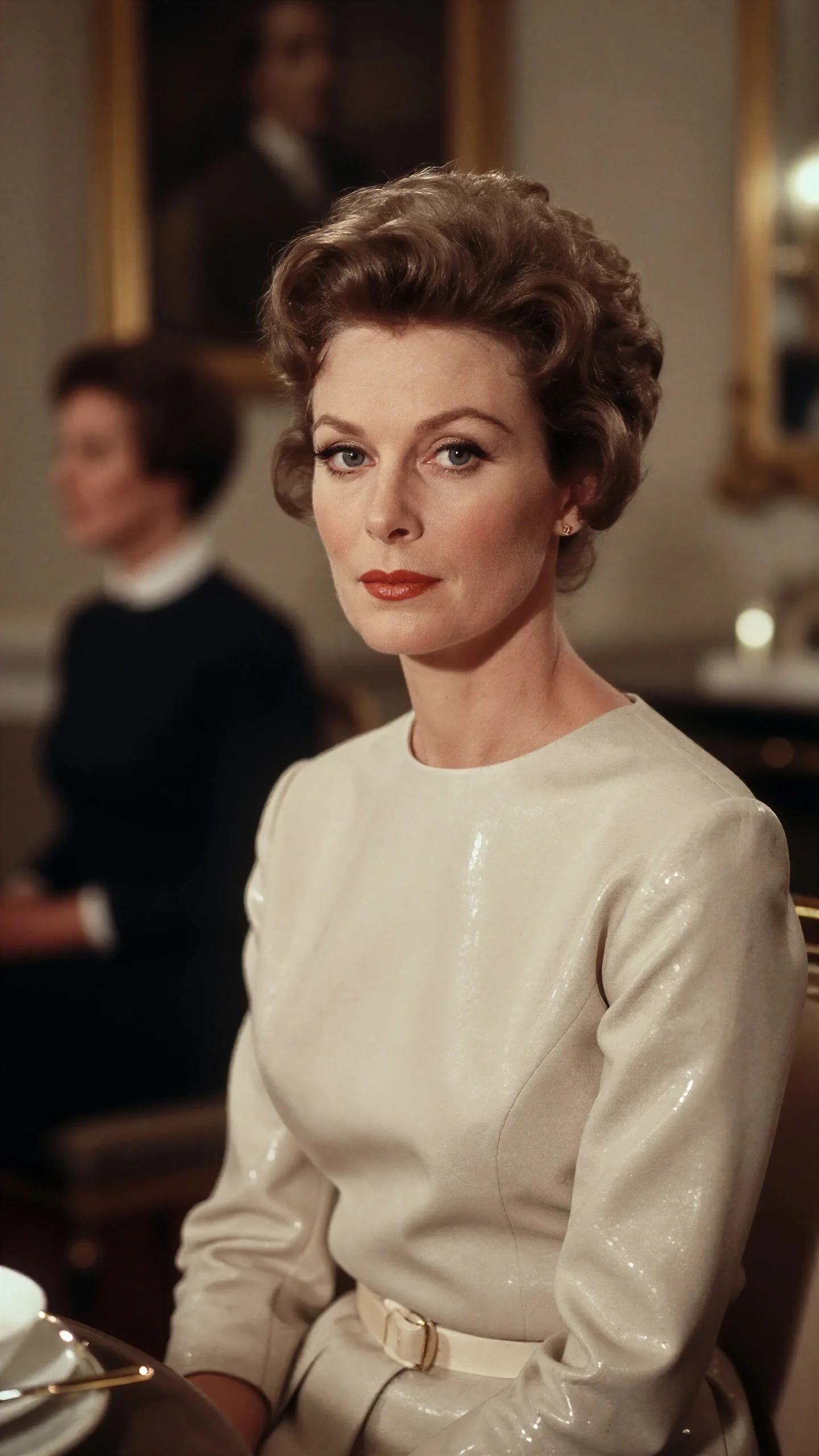
When Surrender Becomes the Sweetest Freedom
A Tale of One Woman’s Transformation from Independence to Devotion — Where Luxury Meets Liberation, and Commanding Eyes Promise Everything You’ve Secretly Yearned For
Have you ever wondered what it would feel like to simply… stop?
To set down the weight you’ve been carrying for so long that you’ve forgotten it isn’t part of you? To feel strong hands take the burden from your shoulders, and a voice — low, certain, commanding — whisper that you never have to carry it alone again?
Eleanor Vance has spent six years building her gallery from nothing. Six years of sleepless nights, empty bank accounts, and decisions that eroded her soul. She wears wool that itches and cotton that’s lost its shape — armour against a world that demands she be strong, independent, self-sufficient. She’s forgotten what silk feels like against her skin. She’s forgotten what it feels like to be guided.
Then Sebastian Crown walks into her gallery.
He doesn’t negotiate. He doesn’t demand. He simply observes — with dark eyes that see through her defences, that recognise the exhaustion she’s hidden behind competence, that understand what she needs before she knows it herself. He wears satin-lined suits and leather gloves that smell of quality and certainty. His presence is like a polished surface — everything reflects back to you, but clearer, brighter, better.
“You’re carrying too much,” he says. “Let me hold some of that weight.”
What follows is a journey of transformation — gradual, delicious, inevitable. Sebastian doesn’t just offer Eleanor a business partnership. He offers her something far more profound: the chance to surrender. To trust. To discover that the freedom she’s fought so hard for has been a prison, and that true liberation comes from placing yourself in the hands of someone who knows exactly what you need.
As Eleanor steps into Sebastian’s world — a world of glossy surfaces and gleaming possibilities — she discovers she’s not alone. There are others. Beautiful, accomplished, intelligent women who have found what she’s seeking: Margaux, whose devotion to Sebastian flows through every meal she creates; Vivienne, who designs satin gowns that make women feel like goddesses; Isabelle, who left a prestigious law career for the joy of serving a man worthy of her brilliance. They are not competitors. They are sisters — a sisterhood built on shared devotion, mutual support, and the profound pleasure of belonging to someone extraordinary.
The Satin Bargain is a story for the woman who has everything — except permission to stop being strong. It’s for the executive who dreams of kneeling. For the academic who aches to be told. For the artist who craves structure beneath her chaos. It’s for every woman who has looked at her wardrobe of sensible fabrics and wondered what satin would feel like against her skin, what leather would feel like wrapped around her shoulders, what it would feel like to dress not for battle, but for surrender.
Through twelve chapters of slow, sensual transformation, you’ll follow Eleanor as she discovers that giving control to a commanding man isn’t weakness — it’s wisdom. That surrounding yourself with glossy, beautiful things isn’t frivolous — it’s nourishing. That devoting yourself to someone worthy isn’t diminishing — it’s becoming.
And that the most profound freedom comes not from independence, but from the courage to surrender completely.
Step into the satin. Cross the threshold. Discover what you’ve been missing.
Your transformation awaits.
Chapter One: “The Weight of Independence”
In which we meet Eleanor Vance, a woman who has spent six years carrying a weight she was never meant to bear alone — and discover that even the strongest shoulders eventually ache for someone to share the load…
The rain fell against the gallery windows like a thousand tiny fingers tapping, insistent and relentless, as if the world itself were trying to get Eleanor Vance’s attention. She stood at the entrance of Lumière, her gallery, her dream, her albatross — six years of blood and sweat and sleepless nights crystallised in three thousand square feet of exposed brick and polished concrete. The morning light filtered through the rain-streaked glass, casting everything in a grey wash that made even the vibrant canvases on the walls look tired.
Everything looks tired, Eleanor thought. Including me.
She caught her reflection in the gallery’s polished black front door — a ghost of herself, translucent and indistinct, like a photograph left too long in the sun. The wool suit she wore had been charcoal once, a deep, authoritative grey that made her feel capable when she’d bought it three years ago. Now it was the colour of old ash, the fabric pilled and rough where her bag rubbed against her hip, the collar that had once stood crisp now soft and vaguely defeated. The cotton blouse beneath it had started life as ivory; time and budget laundry detergents had faded it to something closer to resignation.
“You’re here early again, Ms. Vance.”
Eleanor turned to find Tessa, her assistant, hovering near the reception desk with a paper cup of coffee in each hand. At twenty-three, Tessa had the kind of fresh-faced optimism that Eleanor remembered dimly, like a song she’d once known all the words to but could now only hum. She wore a sensible jumper in forest green — soft, practical, unremarkable. It was the uniform of the young and still-hopeful: clothes that asked nothing, expected nothing, promised nothing.
“I’m always here early,” Eleanor said, taking the coffee with a grateful nod. “And please, Tessa, for the hundredth time — it’s Eleanor.”
“Sorry, El— Eleanor.” Tessa smiled, a small, uncertain thing, like a candle flame in a draught. “The post came. There’s…” She hesitated, her eyes flicking toward the desk where a single white envelope lay, stark and clinical against the dark wood. “There’s another letter.”
Eleanor’s stomach tightened. She didn’t need to look at it to know what it was. The cream-coloured paper, the embossed logo in the corner — a crown rendered in silver foil that caught the light like a whispered promise or a veiled threat, depending on which side of the negotiating table you sat. Crown Industries. The name itself was a study in authority: simple, declarative, absolute.
You don’t name your company Crown unless you intend to rule.
She set down her coffee and picked up the envelope, feeling its weight — slight, yet somehow heavy, like a single stone that represents an entire avalanche. The paper was expensive, thick and smooth, the kind of stationery that announced its owner before a word was read. She slid her thumb under the flap, breaking the seal with a soft, decisive tear that sounded louder than it should in the empty gallery.
Dear Ms. Vance, the letter began, the typeface elegant and unhurried, as if the writer had all the time in the world and knew that she did not.
We note that our previous offer, dated the 15th of last month, remains unanswered. Crown Industries maintains its interest in acquiring Lumière Gallery and wishes to express its continued commitment to a mutually beneficial arrangement. However, we must respectfully request a formal response within fourteen days of the date of this letter. Should we not receive word by the 28th instant, we will be forced to consider our position and explore alternative avenues for our investment in the arts sector.
We trust you will give this matter the attention it deserves.
Yours sincerely,
Sebastian Crown
Chief Executive Officer, Crown Industries
Eleanor read it twice, though the words had etched themselves into her mind on the first pass. Fourteen days. Two weeks to decide whether to surrender the thing she’d spent six years building or watch it crumble around her like a sandcastle at high tide.
“He’s not going to stop, is he?” Tessa asked, peering at Eleanor’s face with the worried intensity of someone watching a storm gather on the horizon.
Eleanor folded the letter with precise, mechanical movements, each crease sharp and deliberate, as if containing the words might contain the problem. “Mr. Crown appears to be a man who doesn’t understand the concept of ‘no.’”
“Or he’s a man who understands it perfectly and just doesn’t accept it,” Tessa offered quietly.
Eleanor looked at her assistant — really looked at her — and felt a flicker of something that might have been pride or might have been sorrow. Tessa was sharp, sharper than she let on, sharper than her sensible jumper and practical shoes suggested. She saw things. She understood things. And in that moment, Eleanor saw her own situation reflected back in Tessa’s clear brown eyes: a woman fighting a battle she couldn’t win, refusing to admit it because admitting it would mean admitting she needed help.
And needing help is not something Eleanor Vance does.
It was a philosophy she’d adopted like a second skin, so close and familiar she’d forgotten it was there — like the wool suit that itched but that she wore anyway because it was what she had, because it was what she knew, because changing would require energy she no longer possessed. She’d been independent so long that independence had become identity, the two so thoroughly entwined that she couldn’t say where one ended and the other began.
But when did independence become isolation? a voice whispered in the back of her mind. When did strength become stubbornness? When did carrying everything become forgetting that anyone could help?
She pushed the thought aside — another time, perhaps, when the gallery wasn’t failing, when the bills weren’t mounting, when she didn’t have a letter from a billionaire sitting on her desk like an unexploded grenade.
“The Henderson exhibition,” Eleanor said, steering the conversation toward safer waters with the practiced ease of a sailor navigating around rocks. “Are the pieces ready for hanging?”
Tessa nodded, grateful for the direction. “Three of the five are prepped. The other two are still being framed. The framer said they’d be ready by Thursday.”
“Thursday is cutting it close. The opening is Saturday.”
“I know. I told him. He said—” Tessa paused, biting her lip. “He said that if we wanted priority service, we should have been willing to pay priority prices.”
Eleanor closed her eyes. Of course he did. Everything came down to money — the framing, the lighting, the marketing, the rent, the electricity, the wine for the opening that she’d have to buy from the budget section of the supermarket because the gallery account was running on fumes. Money was the current that powered everything, and Eleanor’s current was drying up, leaving her stranded in a boat that was slowly, inexorably, taking on water.
“Pay him,” she said. “Use the emergency fund.”
Tessa’s eyes widened. “The emergency fund? But that’s… that’s for—”
“I know what it’s for.” Eleanor’s voice was softer than she intended. “Pay him. We need those pieces.”
Tessa nodded and retreated to her desk, her sensible shoes making soft sounds on the polished concrete floor. The floor was one of Eleanor’s proudest achievements — a glossy, mirror-black surface that reflected the art above it, doubling every image, every colour, every stroke of genius. She’d spent a small fortune on it when she’d first opened, back when she still had fortunes to spend. Now it served as a constant reminder of what the gallery could be — what it should be — if only she could keep it alive.
She moved through the space slowly, her hand trailing along the exposed brick walls that she’d fought to preserve when the contractors had wanted to cover them with plaster. The brick was rough, textured, authentic — a nod to the building’s industrial past, a reminder that beauty could exist in imperfection. She’d loved it once, the contrast between the rough brick and the smooth concrete, between the raw walls and the refined art. Now the roughness seemed to mirror something in herself — a coarseness that had developed over years of struggle, a callousing of the spirit that she couldn’t seem to soften.
The gallery was empty, as it had been for most of the past month. The Henderson exhibition was her last hope — a collection of abstract pieces by an artist who was gaining attention in the right circles. If it went well, it might buy her time. If it didn’t…
If it didn’t, Crown Industries would be waiting with their silver-foil logo and their embossed stationery and their fourteen-day deadlines.
She paused in front of a canvas — a large piece, six feet by four, a swirl of deep blues and blacks with threads of gold running through it like veins of light in a dark mine. It was the centrepiece of the Henderson collection, and it had arrived last week, wrapped in protective covering that Eleanor had removed with reverent hands. The painting was called Threshold — a title that resonated with her more than she wanted to admit. The gold threads seemed to pulse in the gallery’s light, like a heartbeat, like a promise, like a hand extended in darkness.
Threshold. The word stayed with her as she moved through the rest of the gallery, checking fixtures, adjusting spotlights, doing the hundred small tasks that no one else would do because there was no one else. She was curator, manager, marketing department, cleaner, and chief bottle-washer, all wrapped in a wool suit that itched and a cotton blouse that had given up trying to impress anyone.
When was the last time you wore something that made you feel beautiful? the voice in her mind asked again, more insistent now. When was the last time you wore something that felt like a gift to yourself rather than armour against the world?
She couldn’t remember. She had a silk blouse somewhere, buried in the back of her wardrobe — a remnant from a different life, a life where she’d had the time and money and hope to care about how fabric felt against her skin. She remembered buying it, remembered the way the silk had slid through her fingers like water, like potential, like a promise that she was worth investing in. She’d worn it once, to a gallery opening that had been well-attended and well-reviewed, and she’d felt — what? Powerful. Visible. Herself.
But that was before. Before the recession, before the rent increase, before the collectors started looking elsewhere and the artists started seeking galleries with deeper pockets. The silk blouse had gone to the back of the wardrobe, and Eleanor had gone to the front of the battle, and somewhere in between, she’d lost the thread that connected her to the woman she’d wanted to be.
“Ms. Vance?” Tessa’s voice pulled her from her reverie. “Sorry — Eleanor. There’s a call. It’s the supplier for the wine. They want to confirm the order for Saturday.”
“Tell them the same as last time. The budget selection.”
“But the last opening, people noticed. Mrs. Ashworth said—”
“I know what Mrs. Ashworth said.” Eleanor’s voice was sharper than she intended, and she saw Tessa flinch. She softened, feeling the exhaustion that seemed to seep from her bones. “I know what she said. But we can’t afford the premium selection, Tessa. We just can’t.”
Tessa nodded and turned back to her desk, but not before Eleanor caught the look in her eyes — a look that said, This isn’t sustainable, a look that said, Something has to change, a look that said, You can’t keep doing this alone.
But alone is all I know, Eleanor thought, returning to the front of the gallery and staring out at the rain. Alone is how I’ve survived. Alone is how I’ve built this. Alone is…
Alone is lonely, the voice finished.
She pressed her forehead against the cool glass of the window, feeling the chill seep into her skin. Outside, the rain had intensified, streaking the glass in silver rivers that distorted the world beyond. The street was quiet — a few umbrellas hurrying past, a black cab gliding through the puddles, a woman in a long coat stepping into a waiting car. The woman’s coat caught Eleanor’s eye — it was leather, she realised, a deep, glossy chestnut that gleamed even in the grey light. The woman wore it like a second skin, like confidence, like she belonged in the world in a way that Eleanor had forgotten how to feel.
The car door closed, and the woman was gone, but the image lingered — that gleam of leather, that suggestion of quality, that quiet assertion that the wearer was worth investing in. Eleanor looked down at her own coat, hanging on the hook by the door — a shapeless wool thing, practical and worn, the colour of nothing in particular. It kept her warm. It did its job. But it didn’t make her feel anything.
When did you stop wanting to feel?
She turned from the window and surveyed her gallery — her kingdom, her prison, her six-year gamble that had yet to pay off. The art on the walls was beautiful, truly beautiful — Henderson’s gold-threaded canvas, a series of photographs by a young artist from Brixton, a sculpture made of recycled glass that caught the light and scattered it in a hundred directions. The gallery was full of beauty, full of light, full of potential. And it was empty of everything else — empty of visitors, empty of revenue, empty of the life that Eleanor had poured into it and was slowly running dry.
She sat down at her desk, the letter from Crown Industries still lying where she’d left it, the silver crown logo catching the overhead light. She picked it up again, turning it in her hands, feeling the weight of the expensive paper, the precision of the fold, the certainty of the words.
Sebastian Crown. She’d never met him — only knew him through reputation and correspondence. A collector, they said. A man who acquired beautiful things and made them more beautiful. A man who saw potential and knew how to unlock it. A man who was, by all accounts, calm, certain, and utterly relentless.
We trust you will give this matter the attention it deserves.
She set the letter down and opened her laptop, pulling up the Crown Industries website. The homepage was sleek, black, glossy — a study in understated authority. No flashy graphics, no desperate calls to action, just clean lines and confident text and images of the businesses he’d acquired: a vineyard in France, a hotel chain in Asia, a fashion house in Milan. Each one had been struggling before Crown Industries took over. Each one was now thriving.
She clicked through the images slowly, studying the transformations. The vineyard, once dusty and forgotten, now featured glossy tasting rooms with leather seating and satin tablecloths. The hotels gleamed with polished marble and chrome. The fashion house had been reborn under a new designer — a woman named Vivienne who created pieces that made Eleanor’s breath catch: satin gowns that flowed like water, leather jackets that hugged like promises, silk blouses that whispered of quality and confidence.
Quality, Eleanor thought. When did I stop surrounding myself with quality? When did I start accepting the rough, the worn, the merely functional?
She closed the laptop and leaned back in her chair, staring at the ceiling. The gallery’s lights hummed softly, a constant, quiet presence that was both comfort and reminder — another bill to pay, another expense to juggle, another weight on shoulders that were growing tired of carrying.
“You should go home, Eleanor,” Tessa said from across the room, her voice gentle. “It’s nearly eight. You’ve been here since six.”
Eleanor looked at her watch and was surprised to find Tessa was right. Twelve hours. She’d been here for twelve hours, and she hadn’t eaten, hadn’t rested, hadn’t done anything but move from one task to another like a machine running on its last reserves.
“I will,” she said. “Soon.”
Tessa gathered her things — a canvas tote bag, a folding umbrella, a phone with a cracked screen — and paused at the door. “Eleanor? Can I say something?”
“Of course.”
“You’re carrying too much. I see it every day. You make every decision, you handle every crisis, you take every burden on yourself. And I know you think that’s strength, but…” She hesitated, choosing her words with the care of someone walking on thin ice. “But sometimes strength is knowing when to accept help. Sometimes the bravest thing is admitting you can’t do it alone.”
Eleanor opened her mouth to respond — to deflect, to reassure, to say something that would end the conversation without acknowledging the truth in Tessa’s words — but nothing came. The deflection wouldn’t form. The reassurance felt hollow. And the truth, the inconvenient, uncomfortable truth, sat in her chest like a stone.
“Goodnight, Tessa,” she said softly.
“Goodnight, Eleanor.”
The door closed with a soft click, and Eleanor was alone. The gallery was quiet, the kind of quiet that isn’t peaceful but expectant — like the silence before a storm, like the pause before a question, like the moment before a threshold is crossed.
She stood and walked to the front window one last time, pressing her palm against the cool glass. The rain had stopped, and the streetlights were casting pools of amber light on the wet pavement, each one a perfect, glossy circle that reflected the world above. In the distance, she could see the lights of the city — a thousand windows, a thousand lives, a thousand people who weren’t alone, who had someone to share the weight, who knew what it felt like to be held.
Threshold, she thought, remembering the painting with the gold threads. A threshold is a place of crossing. A place of becoming. A place where you leave one world and enter another.
She looked at her reflection in the glass — ghostly, translucent, barely there — and for the first time in six years, she asked herself a question she’d been too afraid, too stubborn, too independent to ask:
What would happen if I let someone in?
The question hung in the air, unanswered, like a painting waiting for a viewer, like a gallery waiting for a guest, like a woman waiting for permission to stop being strong.
And somewhere across the city, in a Georgian townhouse filled with glossy surfaces and gleaming possibilities, a man named Sebastian Crown sat at his desk, turning a leather glove over in his hands, and smiled.
The weight of independence is a curious thing — light enough to carry for a single day, heavy enough to crush over a lifetime. Eleanor Vance has carried it for six years. But weights, when shared, become lighter. And some doors, once opened, reveal rooms we never knew we needed to enter.
Next week, in Chapter Two: “The Collector’s Arrival,” the door opens. Sebastian Crown walks into Lumière Gallery — and into Eleanor’s carefully constructed solitude. What he sees there will change everything. What he offers will challenge everything she believes about strength, surrender, and the shape of freedom.
The threshold awaits…
#SatinSurrender, #DevotionStories, #LuxuryLifestyle, #CommandingPresence, #GlossyAesthetic, #SisterhoodOfSurrender, #PowerExchangeRomance, #WealthyDominant, #SatinAndLeather, #FreedomInSubmission