A Serial in Twelve Parts
There exists, in the quiet corners of the digital world, a space where women speak of things they have always felt but never named. Where the slick of satin against skin is not vanity but vocabulary. Where the shine of PVC is not spectacle but language. Where the whisper of nylon is not frivolity but philosophy.
What follows is the record of a discovery: that sensation unspoken is sensation half-lived, and that the act of naming what we feel is the first act of claiming what we are.
The women you are about to meet are not extraordinary. They are linguists and engineers, therapists and historians, mathematicians and postal workers. They are women who have lived long enough to know what they like and brave enough to say so. They are women who have found, in the glossy textures they have always been told are frivolous, a seriousness that the world has overlooked.
Their glossary begins with a single question, asked at 3:47 in the morning by a woman who could not sleep. What follows is the answer that question deserved—not from one voice, but from many. Not as a conclusion, but as an opening.
This is their story. Or perhaps it is yours.
Chapter One: “The First Definition”
Story So Far
In the small hours of a sleepless night, a woman known only as Verdant types the first entry into what will become “The Glossary”—a collaborative dictionary of sensations, emotions, and experiences related to glossy fabrics. She does not know that her single definition will spark a conversation among women across the world, or that the space where she posts it—a forum called The Loom—will become the sanctuary where that conversation unfolds. This is where it begins: with one woman, one question, and the courage to answer it.
The screen glowed.
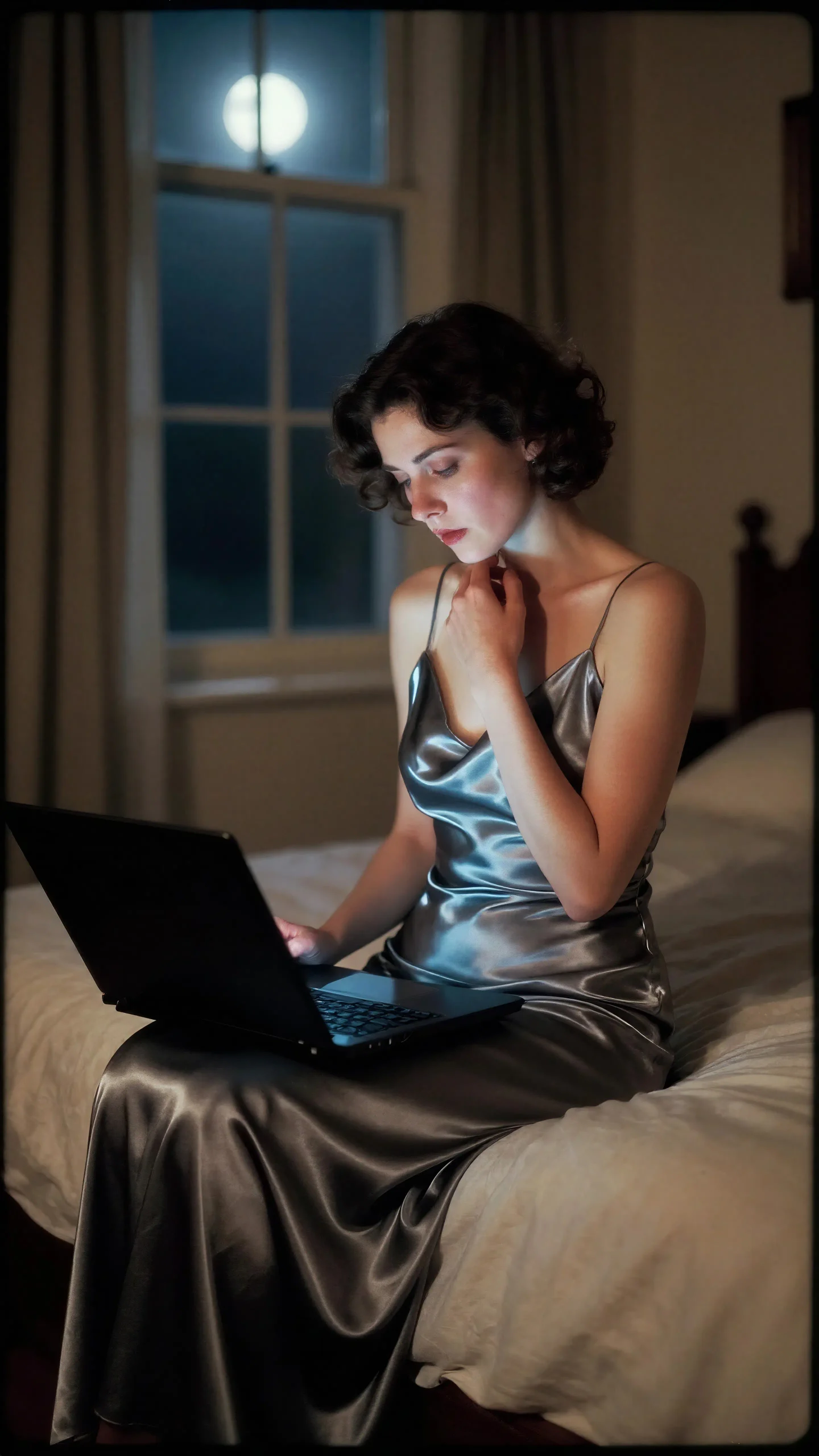
Not with the harsh blue of daytime browsing or the warm amber of evening entertainment, but with the particular pallor of the insomniac hour—that flat, lunar light that makes everything look both sharper and less real. The clock in the corner of the screen read 3:47 AM, and the woman who sat before it, known to the forum only as Verdant, had been staring at a blank document for seventeen minutes.
Seventeen minutes. She knew the number because she had been counting, the way one counts breaths during a panic attack or contractions during labor—something to do while waiting for something else to happen.
Nothing was happening.
The forum called The Loom had been her refuge for three years now. Three years of late-night conversations with women she had never met in person but knew more intimately than most of the women she saw every day. They spoke of fabrics here—not as commodities or decorations but as experiences, as languages, as forms of self-expression that the world had decided were frivolous and that they had decided were essential.
Verdant had found The Loom during her own dark hour, a period after her divorce when she had been unable to sleep and unwilling to think and had stumbled, through a series of clicks she could not later reconstruct, upon a conversation between two women discussing the precise shade of a vintage PVC raincoat. The discussion had been scholarly in its specificity—something about the way light caught the surface at different angles, the way the fabric moved differently depending on its age and origin—and Verdant had read it with the hungry attention of someone who has just discovered that the thing she has always felt is felt by others.
She had joined the forum that night. She had posted her first message—a tentative inquiry about whether anyone else had noticed that satin felt different against skin that had been crying—and had received, within the hour, twelve responses. Not one of them had dismissed her question. Not one of them had told her she was being silly or overthinking or reading too much into a piece of fabric. Every single response had said, in different words, yes, I know exactly what you mean.
That had been three years ago. Now Verdant was one of the forum’s most active members, a woman whose observations about glossy fabrics had earned her a reputation for precision and poetry in equal measure. She wore satin to work and PVC to dinner and nylon on weekends, and she had long since stopped apologizing for any of it.
But tonight, something had shifted.
It had started with a new member—a woman who called herself Rainlight and who had posted, in the forum’s “Introductions” section, a question that had stopped Verdant mid-scroll:
“I’m new here. I hope this is the right place to ask. Is there a word for the way satin feels when you’ve been crying? Not sad exactly. Just… more. Like the fabric knows.”
The responses had come quickly, as they always did when someone asked a question that resonated. Women had offered descriptions, analogies, personal experiences. But none of them had offered a word. Because the word did not exist.
Verdant had read the thread three times, each pass leaving her more unsettled. The women of The Loom had developed an extensive vocabulary for their experiences—they spoke of “light-catch” and “drape-coefficient” and “whisper-weight”—but for this particular sensation, this particular intersection of fabric and feeling, they had no term. They had descriptions. They had metaphors. They had the nod of recognition that passed between them when someone articulated something they had all felt. But they did not have a word.
And without a word, Verdant realized, the sensation remained locked inside. Unnamed, unsharable, unclaimed. It existed in the territory of the inarticulate, that vast space where experience lives without language and therefore without full existence.
She had opened a blank document. She had sat before it. And for seventeen minutes, she had waited for the word to come.
Now, at 3:47 AM, it did.
She typed:
“Gloss-grief (n.): The particular ache of touching a beautiful fabric when one’s heart is heavy; the contrast between external smoothness and internal turbulence; the sensation of being held by something that cannot hold you but tries.”
She read it back. It was not perfect. It was clinical in its structure and tentative in its poetry. But it was a beginning.
She posted it to the forum with a brief introduction:
“I’ve been thinking about Rainlight’s question. I don’t think we have a word for what she described. I think we should. Here’s my attempt. I invite you all to add yours.”
Then she closed her laptop, went to bed, and lay awake for another hour, feeling both exhausted and electric, the way one feels after sending a letter that cannot be unsent.
She woke to seventeen responses.
The first was from Coral, a fifty-one-year-old interior designer from Bristol whose real name was Geraldine but who had long since abandoned it for the forum name that better suited her aesthetic.
“Verdant,” Coral had written, “you’ve done it. You’ve named the thing I’ve been feeling for thirty years and never told anyone about. I sat in my car yesterday after a difficult meeting, wearing my charcoal satin blouse, and I cried. Not because of the meeting. Because the fabric was so smooth against my skin and my life was so rough against my soul and the contrast was unbearable and beautiful at the same time. I thought I was being ridiculous. Now I think I was having a gloss-grief moment. Thank you.”
The second was from Silver, a sixty-three-year-old retired teacher whose forum name was a reference to her silver hair and her preference for silver fabrics.
“I have been crying in satin for forty years,” Silver wrote. “I never knew it had a name. I feel like I’ve been given permission for something I didn’t know I needed permission for.”
The third was from Mirror, a forty-four-year-old photographer who had joined the forum six months ago and whose images of glossy fabrics in different lights had become a staple of the community.
“Verdant, this is extraordinary. I’ve been trying to photograph this exact feeling for years—the way light behaves differently on fabric that’s been touched by tears, the way the surface changes when the person inside it is changed. I never had a word for what I was chasing. Now I do. I’m going to start a new series. I’m calling it ‘Gloss-Grief: A Study in Reflected Sorrow.’”
The responses continued—seventeen in all, each one a small revelation, each one a woman recognizing something in Verdant’s definition that she had felt but never named. Verdant read them all with a growing sense of something she could only describe as fullness—a sensation of being filled up by the recognition of others, as if her solitary word had opened a door through which all their unspoken experiences could now flow.
It was the fourteenth response that changed everything.
It was from a member called The Curator.
The Curator was not a regular contributor. He appeared in the forum perhaps once a month, always with a question rather than an answer, always with a gentle observation that seemed to open rather than close the conversation. He had been a member of The Loom for longer than Verdant—his join date preceded hers by two years—and yet no one knew anything about him beyond his forum name and his questions.
His response to Verdant’s entry was characteristically brief:
“This is the beginning of something. I can feel it. What else have we felt but not named? What other sensations live in us without language? I wonder: if we began to collect these words, would we find that we have been speaking a language we didn’t know we shared?”
Verdant read the message three times. There was nothing in it that was directive or demanding. No instruction, no assignment, no expectation. Just questions. But the questions landed in her chest like seeds in prepared soil, and she felt them begin to germinate.
She typed a reply:
“I think you’re right. I think this might be the beginning of a glossary. Would anyone be interested in contributing?”
Within an hour, she had twenty-three affirmative responses.
The forum’s activity over the following days had a quality that Verdant had never experienced online before—not the frantic energy of a viral moment but the slow, deep current of a river finding its course. Women who had been quiet for months began to post. Women who had never started their own threads began to start them. The forum’s usual rhythm—observations, questions, occasional debates—shifted into something more focused, more purposeful, more collective.
Coral started a thread called “Textures I Have Known But Never Named” and filled it with descriptions of sensations she had experienced in her thirty years of working with fabrics: the way a particular grade of PVC seemed to breathe when worn in summer; the way satin changed character depending on whether it was worn over bare skin or over a slip; the way nylon could feel both insubstantial and protective, like wearing a cloud that had learned to be strong.
Silver started a thread called “The Language of Shine” in which she posted daily observations about the way light interacted with glossy surfaces. “I spent forty years teaching children to read,” she wrote in her first post. “I think I spent almost as long teaching myself to see. Now I want to teach myself to name what I see.”
Mirror started a thread called “Gloss in Images” in which she posted photographs of glossy fabrics with captions that were almost but not quite definitions: “The way PVC holds rain like a memory.” “Satin after midnight: a different creature than satin at noon.” “Nylon in motion: the fabric that writes its own story as you walk.”
And through it all, The Curator’s presence was felt but not imposed. He posted occasionally—always questions, never answers. “What do we call the confidence that comes from wearing something that reflects light?” “Is there a word for the way a glossy fabric changes the shape of the space around it?” “How do we name the bond that forms between women who share a preference for shine?”
Each question was a seed. Each seed found soil.
On the fourth day, Verdant received a private message from a member called EdithMarch. The message was brief:
“Dear Verdant, I have been following the glossary project with great interest. I am a retired professor of computational linguistics—I taught machines to understand human language for thirty-five years. I believe I may have something to offer this project, if you would have me. I have spent my career analyzing the structures of language. I have never had the opportunity to help create one. I would be honored to contribute both entries and a methodology for the glossary’s organization. Please let me know if this would be welcome.”
Verdant read the message with a mixture of excitement and trepidation. EdithMarch had been a member of The Loom for almost as long as The Curator, but she had posted rarely—once every few months, always with observations that were precise, erudite, and somehow lonely. Verdant had always had the impression of a woman who knew a great deal but had no one to share it with.
She replied:
“Dear Edith, Your offer is more than welcome—it feels like exactly what this project needs. I have been feeling the limitations of my own approach. I can name what I feel, but I don’t know how to organize what we’re creating. I would be grateful for your expertise and your entries. Please, contribute whatever feels right. We’re building this as we go.”
Edith’s response came within the hour:
“Thank you, Verdant. I have been wanting to say something for a very long time. I think I have been waiting for someone to ask the right question. You have asked it. I will begin tomorrow.”
Verdant sat with this exchange for a long time after reading it. She felt something she could not name—not pride, not satisfaction, but something deeper. The feeling of having opened a door that others had been waiting to walk through. The feeling of having created space.
She thought of The Curator’s question: “What other sensations live in us without language?”
She thought of the seventeen responses to her first entry, each one a woman saying, in different words, I have felt this too.
She thought of the word she had coined at 3:47 in the morning, alone in the dark, and how it had become, in four days, a shared vocabulary, a collective project, a community of women who were discovering that they had been speaking the same language all along.
And she felt, for the first time in a very long time, that she was exactly where she was supposed to be.
That evening, Verdant put on her favorite satin blouse—charcoal grey, with the subtle sheen that caught light like a pond at dusk—and sat down to write the glossary’s second entry. She did not know yet what it would be. She only knew that the word was waiting, the way all words wait, in the space between sensation and speech, between feeling and expression, between the solitary experience and the shared name.
She placed her palms flat on the desk, felt the slick of satin against her forearms, and began to type.
Next Chapter
The glossary has begun, but it needs structure—and a woman who has spent her career teaching machines to understand language must now learn to teach herself. In Chapter Two, “Edith’s Entry,” a retired professor of computational linguistics confronts the limitations of her expertise and discovers that the most important language she has ever learned is the one she has been speaking all along without knowing it. What happens when a woman who has spent her life analyzing words finally allows herself to feel one?
The Glossary continues next week.