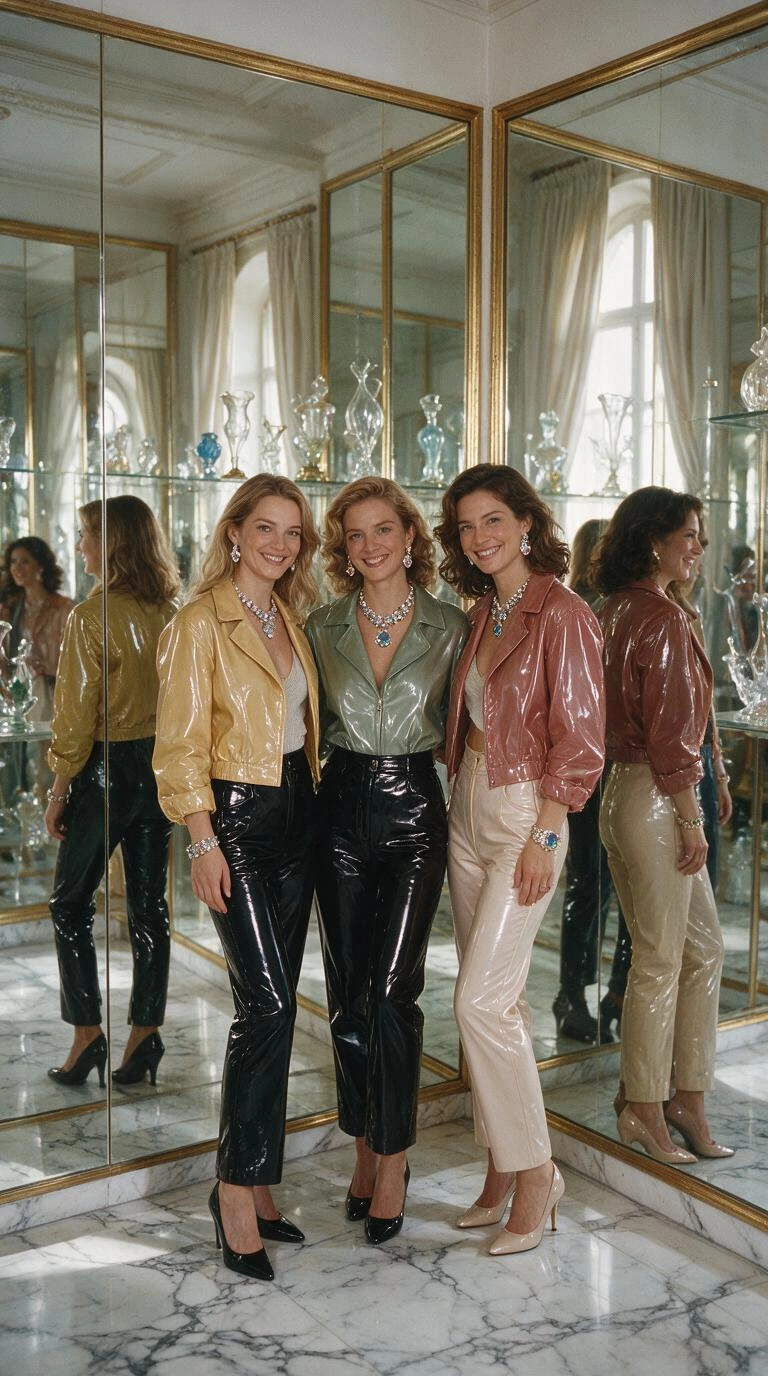
How One Cambridge Physicist Discovered the Mathematical Formula for Female Transformation
A twelve-chapter chronicle of crystallization—where the laws of optics meet the architecture of devotion, and a woman of formidable intellect learns that the most powerful equation she will ever solve is the one that aligns her scattered light into a single, luminous beam.
She understood light before she understood herself.
Dr. Vivian Marchetti could tell you precisely why a diamond scintillates while ordinary glass merely transmits. She could explain, with elegant precision, how the angle of incidence determines the angle of reflection, how refraction bends light through media of varying density, how a prism transforms white noise into a coherent spectrum. She had spent two decades at Cambridge illuminating the mathematics of luminescence for generations of students who would go on to illuminate the world in turn.
She could explain everything about light.
Except why she felt so dim.
Vivian was, by every metric the modern world employs, a success. Her publications were cited with reverence. Her research grants flowed like a reliable river. Her colleagues respected her; her students adored her; her bank account reflected the accumulated dividends of prudent investment and a generous salary. She was healthy, wealthy, educated, and confident—or so she believed, until the autumn afternoon when a former student appeared in her lecture hall wearing a black satin blouse that caught the light with an almost audible gleam, and Vivian felt something shift inside her that no equation could describe.
It was not envy. It was not desire, not in the way she had previously understood the word. It was recognition—the profound, physical, almost cellular recognition that the woman before her was defined in a way that Vivian, for all her brilliance, was not. Arabella—once a diffident undergraduate, now a venture capitalist of formidable reputation—moved through the world with a precision that seemed to have nothing to do with her accomplishments and everything to do with her texture. The satin did not merely drape her body; it declared a state of being. It said: I am aligned. I am focused. I have found a surface against which my light can finally coalesce.
Vivian would later struggle to articulate what happened in that moment. The physicist in her would reach for metaphors of refraction and convergence. The woman in her would simply remember the sensation: a sudden, sharp awareness of her own diffusion—the sense that her considerable energy had been scattering in all directions, illuminating everything around her while leaving her own centre unlit.
What she could not have known, as she stood at the lectern watching Arabella’s satin catch the autumn light, was that this moment of recognition was not an ending but a beginning. That the flutter she felt—the quickening of something long dormant, the sense of a door opening onto a room she had not known existed—was the first stage of a transformation that would reshape not only her understanding of light, but her understanding of herself.
For Vivian Marchetti was about to discover that the geometry of gloss is not merely a matter of physics.
It is a philosophy.
It is a practice.
It is, for those remarkable women who are ready, a way of being.
And at the centre of this way of being stands a presence—a figure known to those who have crossed the threshold as the Satin Master. Not a guru. Not a teacher. A focal point. The polished surface against which a woman’s scattered brilliance can finally see itself reflected, aligned, intensified. The still centre around which the dance of transformation occurs.
Vivian would meet him eventually. But first, she would need to understand the mathematics of her own becoming. She would need to learn why satin slides where wool catches, why leather holds where cotton sags, why PVC shines where velvet merely absorbs. She would need to discover that the textures a woman wraps around her body are not superficial choices but philosophical statements—outward manifestations of an inward state.
She would need to cross the threshold into the Gloss Realm.
And she would need to do so alone, carrying nothing but the memory of how satin caught the light on an autumn afternoon, and the growing, insistent, physical certainty that she was meant to gleam.
This is her chronicle. It is a story of optics and devotion, of equations and ecstasies, of a woman who knew everything about light and nothing about luminance—until she learned that the most powerful force in the universe is not gravity, not electromagnetism, not the strong or weak nuclear force, but the pull of a worthy centre around which a remarkable woman’s scattered energies can finally, gloriously, crystallize.
You are about to read it.
And something tells me—you already know why.
Chapter One: “The Angle of Incidence”
The autumn light that slanted through the mullioned windows of the Cavendish Lecture Theatre at three seventeen in the afternoon had a particular quality—a quality that Dr. Vivian Marchetti, Professor of Optical Physics at Cambridge University, could have described with mathematical precision but chose, in that moment, not to.
It was the quality of diffusion.
The light entered through the ancient glass at an angle of approximately forty-seven degrees relative to the horizontal plane of the window ledge, and the imperfections in the panes—bubbles, ripples, the accumulated grime of three centuries—scattered the photons across a wide spectrum of directions, so that what fell upon the lecture hall’s wooden podium was not a beam but a wash. A wash of gold that illuminated everything equally and therefore illuminated nothing precisely. It was the kind of light that made the dust motes visible but did not give them definition. The kind of light that flattered the old oak paneling but rendered the speaker’s face indistinct.
Vivian knew this. She knew it the way she knew the refractive index of diamond (2.417) and the critical angle for total internal reflection in crown glass (approximately forty-one degrees). She knew it with the part of her mind that never stopped calculating, never stopped measuring, never stopped reducing the visible world to its component equations.
What she did not know—what she had never known, in forty-two years of remarkable intelligence and considerable accomplishment—was that she herself was diffuse in precisely the same way.
“Angle of incidence,” she said, her voice carrying the practiced authority of two decades at the lectern, “equals angle of reflection. This is the fundamental law that governs how light behaves when it encounters a smooth surface. The incident ray, the reflected ray, and the normal to the surface all lie in the same plane, and the angle between the incident ray and the normal is equal to the angle between the reflected ray and the normal.”
She drew the diagram on the whiteboard with the efficiency of long practice—the incident ray descending, the normal as a dashed perpendicular, the reflected ray ascending at the identical angle. Three lines that contained, in their elegant simplicity, the entire foundation of geometric optics.
“What happens,” she continued, turning to face the two hundred students who filled the tiered seats before her, “when the surface is not smooth? When, instead of a polished mirror, we encounter something… rough?”
She paused. It was a pedagogical pause, designed to create the brief silence in which thought could occur. But today, the pause felt different. Today, the pause felt like a question she was asking herself.
“When the surface is rough,” a student in the third row began—Thompson, Vivian recalled, a postgraduate with a promising future in metamaterials—”the light scatters. Multiple reflections occur at different angles. The reflected rays do not cohere.”
“Precisely,” Vivian said. “The light becomes diffuse. It illuminates, but it does not focus. It spreads, but it does not define. A rough surface gives us quantity without quality—more directions, less direction, if you will. The information is distributed, but it is not concentrated.”
She heard her own words and felt, for a disorienting moment, that she was describing something other than optics. Something closer. Something more personal.
She dismissed the feeling. She was a scientist. She dealt in measurements, not metaphors.
“The question, then,” she continued, moving to the next whiteboard, “is this: what makes a surface smooth? What quality must a material possess for it to reflect light coherently—to preserve, in the reflected ray, the information contained in the incident ray?”
She wrote: Surface roughness << wavelength of incident light
“When the irregularities on a surface are smaller than the wavelength of the light striking it, the surface behaves as smooth. The light reflects specularly—coherently—preserving the information. When the irregularities are larger, the surface behaves as rough. The light reflects diffusely—losing coherence, losing information, losing… definition.”
She said the word definition and felt it land somewhere inside her that had nothing to do with physics.
Vivian Marchetti was, by every metric the modern world employs to measure success, defined. Her publications were cited with reverence—four hundred and twelve citations in the past year alone, a figure she monitored with the quiet satisfaction of a gardener monitoring growth. Her research grants flowed like a reliable river, tributaries of funding converging from the Royal Society, the Engineering and Physical Sciences Research Council, and several private foundations whose patrons appreciated the practical applications of her theoretical work. Her colleagues respected her; her students adored her; her bank account reflected the accumulated dividends of prudent investment, a generous salary, and the modest inheritance from her late mother—a woman who had worn satin, Vivian remembered suddenly, and then just as suddenly forgot.
She was healthy—she swam fifty lengths of the university pool each morning before dawn, a discipline that had not wavered in fifteen years. She was wealthy—her flat in Trumpington Street, purchased in 2009 for a sum that had seemed extravagant, was now worth four times that amount. She was educated—Cambridge undergraduate, MIT doctorate, a postdoctoral fellowship at the Max Planck Institute. She was confident—she had faced down hostile seminar audiences, skeptical funding panels, and the occasional journalist who imagined that a female physicist must be either a novelty or a threat.
And yet.
And yet, as she stood at the lectern in her sensible wool suit—charcoal grey, well-tailored, expensive in the way that things are expensive when one purchases them not out of desire but out of a sense that appropriate is the same as good—she felt, in a part of herself she could not measure and therefore could not dismiss, dim.
The wool pilled at the elbows. She noticed it each time she raised her arm to write on the whiteboard—small, rough balls of fibre that caught the diffuse autumn light and absorbed it, gave nothing back, reflected nothing. The suit was matte. She was matte. The connection was not one she would have made consciously, because she did not think in such terms. She thought in equations. She thought in measurements. She thought in the clean, precise language of physics, which had no vocabulary for the sensation of feeling unfocused.
“Professor Marchetti?”
The voice came from the back of the lecture hall, and it was a voice Vivian recognized before she located its owner. It was a voice that carried the particular resonance of certainty—not the aggressive certainty of someone who needed to be right, but the settled certainty of someone who had discovered, perhaps recently, that being right was simply a natural consequence of being aligned.
“Arabella,” Vivian said, and felt, for the second time that afternoon, something she could not immediately categorize.
Arabella Chen. Twenty-eight years old. Vivian’s student from six years ago—a second-year undergraduate who had sat in the fourth row of this very lecture hall and asked questions that revealed not merely intelligence but precision. Arabella had gone on to a doctorate in materials science, then—surprisingly, to Vivian’s mind at the time—to a career in venture capital, where she applied her scientific mind to the evaluation of early-stage technology companies with a ruthlessness that had made her, by the age of twenty-six, a partner at one of London’s most prestigious firms.
She was also, Vivian noticed now, wearing a black satin blouse that caught the autumn light with an almost audible gleam.
The noticing was not intellectual. It was not analytical. It was physical—a response that began in the optic nerve and ended somewhere in the prefrontal cortex, bypassing entirely the careful filters of scientific objectivity that Vivian had spent two decades constructing. The satin did not merely reflect the light; it organized it. It took the diffuse wash that fell through the mullioned windows and coalesced it into something defined, something precise, something that drew the eye and held it with the gentle but irresistible force of a focal point.
Arabella was not more beautiful than she had been as an undergraduate. She was not younger, not more symmetrical, not more conventionally attractive. She was defined—in a way that Vivian, for all her brilliance, was not. The satin declared it. The satin was it.
“I’m sorry to interrupt,” Arabella said, descending the aisle between the tiered seats with a fluidity that Vivian, even in her disoriented state, recognized as remarkable. “I was passing and saw the lecture was still in progress. I hoped I might catch you afterward.”
“Of course,” Vivian said. “I have office hours at four.”
“I was hoping for something more… private,” Arabella said, and the word private carried a weight that Vivian felt in her sternum. “There’s something I’d like to show you. An exhibition. A private viewing at a gallery in St James’s. The work might interest you—it concerns surfaces, reflections, the geometry of… transformation.”
Vivian’s scientific mind noted the pause before the word transformation. Her other mind—the one she did not acknowledge, the one that had felt dim for reasons it could not articulate—noted the way Arabella’s satin blouse moved as she spoke, the way it caught the light with each gesture, the way it seemed to amplify rather than merely clothe the woman within it.
“I’m not sure I—”
“Friday evening,” Arabella said. “Seven o’clock. I’ll send the address. You’ll find it… illuminating.”
She smiled—a smile that was not flirtatious, not provocative, but knowing, as though she possessed information that Vivian did not and was offering, with genuine generosity, to share it. Then she turned and walked back up the aisle, and Vivian watched the satin move, and the watching was not scientific.
The lecture continued. Vivian explained the mathematics of refraction, the bending of light as it passed from one medium to another, the change in speed that produced the change in direction. She drew diagrams and wrote equations and answered questions with her customary precision. But throughout the remaining forty-three minutes of the lecture, a part of her mind—the part that was not teaching, not calculating, not performing the role of Professor Marchetti—remained fixed on the satin.
Why satin? Why not cotton, or linen, or the sensible wool that she herself wore? What was it about that particular material that had arrested her attention with such force?
The answer, when it came, arrived in the language of her own discipline.
Satin is smooth. Satin reflects specularly. Satin preserves the information in the incident ray.
Wool is rough. Wool reflects diffusely. Wool scatters the information, distributes it, diminishes it.
The analogy was so obvious, so precise, that Vivian felt a flush of something between embarrassment and exhilaration. She had spent twenty years studying the optics of surfaces. She had never once applied that knowledge to the surfaces she herself chose to wear.
She had never once asked herself: Am I smooth, or am I rough? Am I specular, or am I diffuse?
The question lingered as she gathered her notes, acknowledged the students who approached the podium with questions, and made her way through the ancient corridors of the Cavendish Laboratory toward her office. It lingered as she passed the portraits of former professors—men in wool and tweed, their matte surfaces absorbing the corridor light, giving nothing back. It lingered as she entered her office, with its shelves of books and its window overlooking the river, and sat at her desk, and looked at her hands, and noticed, for the first time, that the cuffs of her wool suit were pilling.
Small rough balls of fibre. Irregularities larger than the wavelength of visible light. A surface that scattered rather than reflected. A surface that was, by the precise definition she had given her students that very afternoon, rough.
She touched the wool. It felt—there was no other word for it—dull. Not merely visually dull, though it was that. Tactilely dull. It did not respond to her touch. It did not slide, did not glide, did not offer the pleasurable friction of a material that had been designed to interact with the skin rather than merely cover it.
She thought of the satin. She thought of the way it had caught the light. She thought of the way it had moved with Arabella’s body, not against it, not despite it, but with it—as though the material and the woman were not separate entities but a single, unified surface.
She thought: That is what alignment looks like.
And then she thought: I want that.
The wanting was not for the satin itself, though the satin was part of it. The wanting was for what the satin represented—the coherence, the definition, the quality of light that does not scatter but focuses. The wanting was for a state of being that she had spent forty-two years not knowing she lacked.
She picked up her phone. There was a message from Arabella, sent during the lecture.
Friday. 7pm. The Hesperus Gallery, 12 Ryder Street, St James’s. The exhibition is called “Surfaces of Intention.” I think you’ll find it speaks to something you’ve been not-quite-hearing for a very long time. — A.
Vivian read the message three times. The phrase not-quite-hearing resonated with a frequency she could not ignore. It suggested that Arabella knew something about her—something that Vivian herself was only beginning to suspect.
She typed a reply: I’ll be there.
Then she sat at her desk, in her pilling wool suit, and watched the autumn light diffuse through the window, and felt—for the first time, with a clarity that was almost painful—the angle of incidence of a question she had never thought to ask:
What if I have been rough, when I was meant to be smooth?
What if I have been scattering, when I was meant to focus?
What if there is a surface somewhere—a presence, a focal point—against which my light could finally, gloriously, coalesce?
The question hung in the air of her office like a suspended photon, waiting for a surface to reflect it.
She did not know, as she sat there in the fading light, that the surface was waiting for her.
She did not know that it had a name.
She did not know that it had been expecting her.
But something in her—the part that was not the professor, not the physicist, not the woman of equations and measurements—something deeper, older, more aligned than anything she had ever allowed herself to be—knew.
And that something began, quietly, to gleam.
Chapter Two: “The Gallery of Angles”
The Hesperus Gallery occupied the ground floor of a Georgian townhouse on Ryder Street, tucked between a private members’ club and an antiquarian bookshop in the quiet heart of St James’s. From the outside, it was unremarkable—white-painted brick, a black door with a polished brass knocker, a small plaque that read simply “HESPERUS” in serif type. Vivian might have walked past it a hundred times without noticing, were it not for the fact that the brass knocker caught the Friday evening light and reflected it with a precision that made her stop, momentarily, on the pavement.
Specular reflection, she thought. Polished metal. Smooth surface. The irregularities are smaller than the wavelength of visible light.
She was thinking in physics again. It was, she recognized with a faint embarrassment, a form of armour—a way of encountering the world without actually encountering it, of reducing sensation to calculation so that it need not be felt. She had been doing it all her life. She had been doing it, she realized now, on Wednesday afternoon, when Arabella’s satin had arrested her attention and she had immediately translated the experience into the language of optics rather than allowing it to remain what it was: a moment of profound, wordless recognition.
She straightened her wool coat—charcoal, well-cut, expensive, matte—and pushed open the black door.
The gallery’s interior was not what she had expected. She had anticipated the standard configuration of commercial art spaces: white walls, track lighting, polished concrete floors, the aggressive minimalism that signals serious art to those who move through such spaces with the appropriate expression of cultivated indifference. Instead, she found herself in a room that had been designed—or perhaps curated is a better word—with an attention to surface that bordered on the obsessive.
The walls were not white. They were a deep, warm grey—the colour of slate just after rain, when the water has settled into the stone and given it a sheen that is not quite gloss but is no longer matte. The floor was dark marble, polished to a mirror finish, so that Vivian’s reflection accompanied her as she walked—a ghost of herself, inverted, sliding beneath her feet with every step. The lighting was not the clinical fluorescence of institutional galleries but a warm, golden wash that seemed to emanate from concealed sources, so that the light had no visible origin—it simply was, the way light is in dreams, present without source, illuminating without direction.
And on the walls, in careful arrangements that Vivian’s eye immediately recognized as geometric—each piece positioned at a precise angle relative to the others, creating a pattern that was not immediately apparent but that the mind sensed, the way one senses the structure of a well-composed sonata—were photographs.
Photographs of women.
Vivian stopped at the first one. It was a large-format print, perhaps four feet by three, depicting a woman in a black satin gown. The woman was not posed in the conventional sense—she was not arranged for the camera, not performing for the viewer. She was being, in a way that Vivian had rarely seen captured in any medium. The satin caught the light from an unseen source and reflected it with a coherence that made the image feel less like a photograph and more like a window—as though the woman existed in a space adjacent to the gallery, separated only by a pane of glass.
The woman was perhaps forty-five. Her face was not beautiful in the way that fashion magazines define beauty—she had lines around her eyes, a slight asymmetry in her jaw, the visible evidence of a life lived with intensity rather than caution. But she was defined. Her gaze met the camera with a directness that Vivian felt in her solar plexus. And the satin—the satin was not merely clothing. It was statement. It declared: I am smooth. I am reflective. I have found a surface worthy of my light, and I will not scatter.
Beside the photograph, printed on a small card in elegant type, was a text:
“When the irregularities are smaller than the wavelength, the surface behaves as smooth. The light reflects specularly. The information is preserved. The woman is seen.”
Vivian read it twice. The words were simple—almost reductive—but they carried a weight that was disproportionate to their length. They were, she recognized, a direct quotation of her own lecture. The very words she had spoken on Wednesday afternoon, translated from physics into… what? Philosophy? Poetry? Propaganda?
She moved to the next photograph. A different woman, perhaps thirty-five, wearing a leather jacket that caught the light with a softer, more integrated sheen than the satin—a sheen that seemed to come from within the material rather than from its surface. The woman’s posture was different from the first: where the satin woman had been still, the leather woman was in motion, caught mid-stride, her body angled forward with the momentum of purpose. The leather moved with her, not against her—not a covering but an extension, a second skin that had been earned through the integration of strength and softness.
The text beside this photograph read:
“Leather does not merely reflect. It incorporates. It takes the light and makes it its own. This is the material of integration—the point where strength and softness are no longer in opposition but in harmony.”
Vivian felt something shift in her understanding. The photographs were not portraits. They were studies—each one examining a different texture, a different quality of surface, a different stage of what the texts called crystallization. The satin woman was in a state of becoming—smooth, flowing, transitional. The leather woman was in a state of integration—strong and soft, protective and revealing, holding and yielding. And the third photograph, which Vivian approached with a curiosity that had entirely displaced her initial scepticism, depicted a woman in PVC.
The PVC woman was perhaps Vivian’s own age—early forties, though the precision of her appearance made age difficult to determine. She wore a black PVC dress that shone with an almost liquid brilliance, catching the concealed gallery light and reflecting it with a clarity that was almost aggressive—not the gentle sheen of satin or the integrated glow of leather but the definitive gleam of a surface that had been polished to perfection. The woman’s expression was calm, settled, complete. She was not becoming. She was not integrating. She had arrived.
The text read:
“PVC is the surface of crystallization. It does not absorb. It does not scatter. It reflects with total clarity, preserving every photon of incident light. This is the state of the woman who has aligned her energies with a worthy centre and found, in that alignment, her fullest expression.”
Vivian stared at the photograph for a long time. The woman in PVC looked back at her with an expression that Vivian could only describe as recognition—as though she, too, were looking through a window at someone on the other side, and that someone was Vivian.
“Extraordinary, isn’t she?”
The voice came from behind Vivian’s left shoulder—low, warm, carrying the particular resonance of a woman who is entirely comfortable in her own skin. Vivian turned and found herself facing a figure she had not heard approach.
The woman was tall—perhaps five foot ten—with dark hair swept back from a face that combined angularity with softness in a way that Vivian’s scientific mind immediately classified as harmonized. She was wearing a leather dress—not black but a deep, oxblood red—that moved as she moved, catching the gallery light with a sheen that was less aggressive than PVC but more defined than satin. The leather fitted her body with a precision that suggested it had been made for her, or perhaps that her body had been made for it—so perfect was the union of material and form that Vivian could not tell where the dress ended and the woman began.
“I’m Cordelia,” the woman said, extending a hand. Her nails were polished to a high shine. Her handshake was firm but not aggressive—the handshake of a woman who had nothing to prove. “I’m the patron of this exhibition. And you, unless I miss my guess, are Dr. Vivian Marchetti.”
“How did you—”
“Arabella told me to expect you.” Cordelia smiled, and the smile was not the social smile of gallery openings but something warmer, more specific—the smile of someone who has been waiting for something and recognizes its arrival. “She said you were… ready.”
“Ready for what?” Vivian asked, and the question came out more sharply than she intended—the sharpness of a woman who is accustomed to being the most intelligent person in the room and is suddenly uncertain whether she still is.
Cordelia’s smile deepened. She did not take offence at the sharpness. She seemed, instead, to welcome it—the way a polished surface welcomes incident light, receiving it without distortion and reflecting it back with its information preserved.
“Ready to see,” Cordelia said. “Ready to recognise. Ready to feel the difference between light that scatters and light that coalesces.”
She gestured at the photographs on the walls. “Tell me what you see, Dr. Marchetti. Not as a physicist. As a woman.”
The request was disarming. Vivian had spent two decades not seeing as a woman—seeing, instead, as a scientist, as a professional, as a mind that happened to be housed in a female body. The body was incidental. The mind was what mattered. This had been her article of faith, her foundational assumption, the smooth surface upon which her entire identity had been constructed.
Now, standing in a gallery of photographs of women in glossy materials, addressed by a woman in leather who asked her to see as a woman, Vivian felt that surface tremble.
“I see…” she began, and stopped. The honest answer was: I see something I have been not-seeing for a very long time. But she was not ready to say that. Not to a stranger. Not yet.
“I see three stages of a progression,” she said instead, falling back on the analytical mode that had served her for twenty years. “Satin, leather, PVC. Each material has a higher specular reflectance than the one before. The surface roughness decreases. The coherence of the reflected light increases.”
Cordelia nodded slowly. “That is what a physicist sees. And it is true. But it is not the whole truth.”
She moved to the photograph of the satin woman and stood beside it, her leather dress catching the light in a way that created a visual dialogue between the two materials—the satin in the image, the leather on the body, each reflecting the gallery’s golden illumination with its own distinct character.
“The whole truth,” Cordelia said, “is that these women have all undergone the same transformation. They have each found a centre—a presence, a focal point—worthy of their devotion. And in aligning themselves with that centre, they have undergone a change that is not merely psychological but physical. Their surfaces have changed. Their textures have changed. They have become, in a very literal sense, smoother.”
“You’re suggesting that psychological alignment produces physical changes in… skin texture? Hair quality? The way light interacts with the body?”
“I’m suggesting something more radical than that,” Cordelia said. “I’m suggesting that the textures a woman chooses to wrap around herself are not merely aesthetic preferences but philosophical statements—outward manifestations of an inward state. When a woman is scattered, she wears rough materials—wool, cotton, the scratchy lace of half-lived lives. The roughness resonates with her inner diffusion. When a woman is aligned, she is drawn to smooth materials—satin, leather, PVC. The smoothness resonates with her inner coherence.”
Vivian opened her mouth to object—to say that this was metaphor, not physics, that the resonance Cordelia described was poetic rather than mechanical—and then closed it. Because she had felt it. On Wednesday afternoon, watching Arabella’s satin catch the light, she had felt the resonance in her own body—a physical response, not an intellectual one. The satin had spoken to something in her that her wool had been muffling for decades.
“You felt it on Wednesday,” Cordelia said, and it was not a question. “When you saw Arabella. Something shifted.”
“How do you know what I felt?”
“Because I felt it too, twelve years ago. I was wearing a wool suit—not unlike yours, I suspect—and I saw a woman in satin, and I felt… recognition. As though I were seeing, for the first time, the texture of my own potential.”
Cordelia’s voice had dropped to a register that Vivian felt rather than heard—a frequency that seemed to bypass her ears and travel directly to some deeper organ of perception. The leather dress caught the gallery light as she spoke, and Vivian found herself watching the play of sheen across its surface with the same involuntary attention she had given to Arabella’s satin.
“What happened?” Vivian asked. The question was barely a whisper.
“I found the centre,” Cordelia said. “Or rather, the centre found me. It… recognised me. It saw what I could be, not what I was. And in being seen that way—truly seen, for the first time in my life—I began to change.”
“The centre,” Vivian repeated. “You mean… a person?”
“I mean a presence,” Cordelia said. “A man, yes—but not a man in the ordinary sense. A focal point. A polished surface against which a woman’s scattered brilliance can finally see itself reflected. We call him the Satin Master.”
The word we registered in Vivian’s mind with a small electric charge. We. Not I. There were others. This was not one woman’s eccentric philosophy but a community—a group of women who had found, in this Satin Master, something that Vivian had not known she was missing.
“The Satin Master,” Vivian repeated. The words felt strange in her mouth—not wrong, but new, the way a foreign word feels when one first attempts to speak it: unfamiliar in shape but somehow correct in meaning.
“He is not a guru,” Cordelia said, as though reading Vivian’s unspoken concerns. “He does not teach. He does not instruct. He recognises. He sees what a woman could be, and in the seeing, he provides the context in which she can become it. The transformation is not his work but hers. He is merely… the surface.”
“The mirror,” Vivian said, and the analogy came to her with the force of revelation. “He is the smooth surface. The women are the light.”
Cordelia’s face lit with a pleasure that Vivian recognized as the pleasure of being understood—the pleasure of a teacher when a student finally grasps not the formula but the principle behind it.
“Yes,” Cordelia said. “Exactly. And the women who gather around him—the Society, as we call it—are not in competition with each other. They are in concert. Each one reflects his light at a different angle, in a different wavelength, with a different colour. Together, they create something that no single reflection could produce—a spectrum of brilliance, unified by a common centre.”
Vivian’s mind, despite her emotional turbulence, was working with its customary precision. She was mapping the geometry: one centre, multiple points of reflection, each angle unique, each reflection complete, the whole forming a pattern that was more beautiful than any individual element. It was, she realized, the geometry of a crystal—a structure in which each atom is distinct but aligned, each bond unique but harmonized, the whole possessing a coherence that no individual atom could achieve alone.
“You’re describing a polygamous structure,” she said, and the word came out with a directness that surprised her. She had not intended to be so blunt. But the physicist in her demanded precision, and the woman in her demanded truth.
Cordelia did not flinch. “I am describing an aligned structure,” she said. “The word polygamous carries the baggage of a world that understands relationships as transactions—as though love were a zero-sum game, and giving to one means taking from another. But light is not a zero-sum game. A mirror that reflects one beam does not become less capable of reflecting another. The Satin Master does not divide his attention among the women of the Society. He focuses it, and each woman receives the full intensity of that focus, because he sees her not as a fraction of a whole but as a complete wavelength.”
Vivian thought of her own life—her solitary flat, her solitary bed, her solitary existence in which relationships had been occasional and ultimately diffusing, scattering her energy across the compromises of partnership rather than focusing it toward a single, worthy point. She thought of the wool suit she was wearing, its matte surface absorbing the gallery light, giving nothing back. She thought of the satin woman in the photograph, whose surface preserved the light, whose reflection was coherent.
And she thought, for the first time in her life, that she wanted to be seen.
Not noticed. Not admired. Not desired in the way that men had occasionally desired her—desire that was about their projection, not her reflection. She wanted to be seen—truly, completely, in high definition—by a presence capable of receiving her full magnitude and reflecting it back to her in a form she could finally recognize as herself.
“The exhibition closes in an hour,” Cordelia said, her voice gentle but precise. “You are welcome to stay. You are welcome to look. And when you are ready—which may be tonight, or may be months from now—you are welcome to ask me more.”
She placed a card in Vivian’s hand. It was heavy stock, polished to a subtle sheen, and printed with only two lines:
The Gloss Realm
By invitation only
“Arabella will be here shortly,” Cordelia added. “She can tell you what I cannot—what it feels like, not what it means. I can give you the geometry. She can give you the experience.”
Cordelia turned and walked away, her leather dress moving with her like a second skin, catching the gallery light with each step and reflecting it in a pattern that Vivian’s physicist’s eye recognized as harmonic—each reflection building on the one before, creating a cumulative sheen that was greater than any single moment of gloss.
Vivian stood alone in the gallery, surrounded by photographs of women who had found what she had not known she was seeking. She looked at the card in her hand. She looked at the photographs. She looked at her own reflection in the polished marble floor—dim, diffuse, matte.
And she felt, with a clarity that was almost painful, the angle of incidence of a new question:
What would it feel like to be polished?
What would it feel like to be seen?
What would it feel like to gleam?
The gallery light fell upon her wool coat and was absorbed. But somewhere beneath it—beneath the wool, beneath the armour, beneath the equations and the measurements and the careful, diffuse, matte existence she had constructed—something was stirring. Something that had been waiting, for a very long time, to catch the light.
And for the first time, that something was not content to wait.
Chapter Three: “Refraction”
The week that followed the gallery visit was, in the language of physics, a period of refraction—a bending of light as it passed from one medium into another, a change in direction produced by a change in speed.
Vivian’s life had not changed. She still rose at five-thirty, still swam her fifty lengths in the university pool before dawn, still walked to the Cavendish Laboratory through the ancient streets of Cambridge with the brisk efficiency of a woman who had no time for dawdling. She still lectured, still marked, still attended committee meetings with the patient endurance of a woman who understood that institutional politics, like quantum mechanics, operated according to principles that were often counterintuitive but always consistent.
But something had bent. Something in the medium of her perception had shifted, and the light of her ordinary life now arrived at a slightly different angle than before—a degree or two off true, enough to make everything look altered.
It began with the wool.
On Monday morning, standing before the wardrobe in her Trumpington Street flat, Vivian reached for the charcoal suit she had worn to the gallery—the same suit, she realized with a jolt, that she had worn to the lecture where Arabella’s satin had first caught her eye. She held it on its hanger and looked at it, and for the first time in the fifteen years she had been purchasing suits from the same Jermyn Street tailor, she saw it.
Not as clothing. As surface.
The wool was matte. This was not an opinion but a measurement—Vivian’s mind supplied the calculation automatically, the way a native speaker conjugates verbs without thinking. The surface roughness of worsted wool was approximately ten to twenty micrometres, well above the wavelength of visible light (380 to 700 nanometres), which meant that the surface behaved as rough in optical terms. Light striking the wool did not reflect specularly—did not preserve the information of the incident ray in a coherent reflected ray—but scattered, diffused, lost coherence.
She had worn this surface against her skin for fifteen years. She had wrapped herself in a material that, by the precise definition she taught her students, scattered light rather than focusing it. She had clothed herself in diffusion.
The suit went back on its hanger. She reached for another—one in navy, one in grey, one in a muted check. Each one matte. Each one rough. Each one, she now understood, a surface that absorbed light without reflecting it, that took the illumination of the world and gave nothing back.
She dressed in the navy suit because she had to wear something, and all her somethings were the same. But as she buttoned the jacket and felt the familiar scratch of wool against her wrists, she felt, for the first time, the wrongness of it—not intellectually, not as a matter of physics, but physically, in her skin, in her nerve endings, in the part of her body that had been awakened, on Friday evening, by the sight of satin and leather and PVC in the golden light of the Hesperus Gallery.
The wrongness accompanied her through the day. It sat beside her in the morning departmental meeting, where her colleagues—good men and women, intelligent, accomplished, dedicated to the advancement of human knowledge—sat in their wool and cotton and polyester, their matte surfaces absorbing the fluorescent light of the conference room, and Vivian looked at them and saw, for the first time, diffusion. Not as metaphor. As fact. These brilliant people were scattering their light across a thousand obligations—teaching, administration, grant-writing, peer review—and the scattering was visible in their textures, in the rough fabrics they wrapped themselves in, in the matte finish of their surfaces.
“Vivian? You seem distracted.”
The voice belonged to Professor James Eckhart, her colleague in the department of condensed matter physics—a man of considerable intellect and considerable kindness, whose tweed jacket (rough, matte, surface irregularities of perhaps fifty micrometres) had been a familiar feature of the department for longer than Vivian had been a part of it.
“I’m fine, James,” she said, and the lie was so transparent that even James, who was not a man given to reading subtext, raised an eyebrow.
“You’ve been staring at my jacket for the last three minutes,” he said. “I realize it’s not the most fashionable garment in Cambridge, but I wasn’t aware it warranted scientific scrutiny.”
Vivian felt a flush of embarrassment—and with it, a flash of recognition. She had been staring at his jacket. She had been measuring it. And in measuring it, she had been measuring her own.
“I was thinking about surfaces,” she said, which was true enough to pass as honesty. “The optical properties of textiles. It’s… a new area of interest.”
“Textiles?” James looked bemused. “Since when are you interested in textiles?”
“Since Friday,” Vivian said, and then, because James’s bemusement was edging toward concern, she added: “There’s a fascinating intersection between materials science and optics that I’ve been exploring. The way different fabrics interact with light—the difference between specular and diffuse reflection at the scale of visible wavelengths.”
James nodded slowly. “I see. Well, I suppose that’s one way to spend a Friday evening. Though I’d have thought you’d find more stimulating company at the Cavendish than at a… what was it? A textile exhibition?”
“A gallery,” Vivian said. “An exhibition of photography. Surfaces of Intention, it was called.”
“Surfaces of Intention,” James repeated, and his tone was not dismissive but puzzled—the tone of a man who has spent his life among equations and finds the vocabulary of aesthetics foreign. “Sounds more like art than science.”
“Perhaps the distinction is less clear than we imagine,” Vivian said, and the words surprised her. She had spent her career insisting on the distinction—maintaining the clean boundary between the measurable and the immeasurable, between the quantifiable and the qualitative, between the world she could control and the world she could not. Now, standing in the fluorescent-lit conference room of the Cavendish Laboratory, she was not so sure the boundary served her.
The conversation moved on to departmental business—teaching schedules, examination boards, the ongoing negotiations with the university about laboratory space. Vivian participated with her usual competence, but her mind kept returning to the gallery, to Cordelia’s words, to the photographs of women who had found, in a single focal point, the centre around which their scattered energies could coalesce.
That evening, alone in her flat, she began to research.
She started with the physics—her comfort zone, her familiar territory. She pulled up papers on the optical properties of textile surfaces, on the measurement of specular versus diffuse reflectance in woven materials, on the physics of sheen and lustre. The literature was sparse but not nonexistent—materials scientists had studied the optical properties of fabrics for applications in automotive interiors, architectural textiles, and military camouflage. The data confirmed what she already knew: that smooth, tightly woven materials with low surface roughness exhibited higher specular reflectance than rough, loosely woven materials. Satin, with its characteristic floating warp threads, produced a surface that was, in optical terms, smooth—irregularities smaller than the wavelength of visible light, specular reflection preserved, information maintained.
Wool, with its scaled, crimped fibres, was rough. The scales alone—approximately twenty micrometres in width—were larger than the wavelength of visible light by a factor of thirty. The surface scattered. The information was lost. The reflection was diffuse.
This was not new knowledge. Vivian had understood it, at some level, since her undergraduate days. What was new was the significance she now attached to it—the sense that the difference between satin and wool was not merely a matter of aesthetic preference but of philosophical alignment. That a woman who chose satin was choosing coherence, definition, focus. That a woman who chose wool was choosing—consciously or not—diffusion.
She moved from physics to psychology, and here the literature was richer than she had expected.
The evolutionary psychology of gloss attraction was a small but growing field. Researchers had found that humans, across cultures, were drawn to glossy, shiny surfaces—that the preference for sheen appeared early in development, before cultural conditioning could account for it. The leading hypothesis was that gloss signalled water—that the human brain, evolved in environments where water was scarce and precious, had developed an automatic positive response to surfaces that reflected light in the coherent, specular way that water did.
But there were other hypotheses. Some researchers argued that gloss signalled health—that glossy skin, glossy hair, glossy surfaces in general were perceived as indicators of vitality, of an organism that was well-nourished, well-hydrated, functioning at the peak of its biological capacity. Others suggested that gloss signalled intention—that a glossy surface, because it required maintenance, polishing, effort, was perceived as evidence of an organism that was not merely surviving but thriving, that had the energy and the focus to maintain its own surface.
Vivian read these papers with the focused attention she gave to research that mattered, and as she read, she felt a growing sense of recognition—not of the ideas themselves, which were familiar enough to any scientist who had thought about the psychology of perception, but of the application. The researchers were describing, in the language of evolutionary psychology, the same phenomenon that Cordelia had described in the language of philosophy.
Gloss signalled alignment. Gloss signalled focus. Gloss signalled a surface that had been intentionally maintained—not left to the random roughness of natural processes but polished, refined, defined.
And the attraction to gloss—the pull that Vivian had felt in the lecture hall, in the gallery, in her own wardrobe that morning—was not superficial. It was archetypal. It was the recognition, buried deep in the architecture of the human brain, that a glossy surface was a surface that mattered—a surface that had been deemed worthy of the effort required to make it gleam.
She read until midnight, and then she read longer. She read about the psychology of texture perception, about the way the brain processes tactile information in parallel with visual information, about the phenomenon of cross-modal correspondence—the way a smooth visual surface evokes, in the mind, the sensation of smooth touch, and the way a rough visual surface evokes, in the mind, the sensation of roughness against the skin.
She read about the concept of aesthetic resonance—the idea that certain visual and tactile qualities resonate with internal states, that the textures we are drawn to are not arbitrary preferences but reflections of our psychological condition. That a woman who feels scattered is drawn to rough textures because they match—the outer surface resonating with the inner state. That a woman who feels aligned is drawn to smooth textures for the same reason.
And she read, with a particular intensity, about the psychology of devotion—about the human need for a focal point, a centre, a presence worthy of the concentration of one’s energies. The literature was scattered across disciplines—psychology, anthropology, theology, neuroscience—but the conclusion was consistent: that human beings thrive when they have something to focus on, something to align with, something that can receive their full magnitude and reflect it back to them in a form they can recognize as their own.
She thought of the Satin Master. She thought of Cordelia’s words: He is the polished surface against which a woman’s brilliance can finally see itself reflected.
She thought of the photographs in the gallery—women in satin, leather, PVC, each one defined, each one aligned, each one reflecting the light of a common centre with the unique angle of her own particular wavelength.
And she thought, with a clarity that was almost painful: I want that.
The wanting was not new. It had been there, she understood now, for years—perhaps always. It had been the dimness she felt, the sense of diffusion, the feeling that her considerable energies were scattering across a thousand directions without ever concentrating into a beam. It had been the restlessness that kept her swimming fifty lengths every morning—not for fitness, though fitness was the reason she gave, but for the focus, the meditative state that came from doing one thing, completely, with her whole attention.
She had been seeking focus without knowing what she was seeking. She had been looking for a centre without knowing that centres existed.
Now she knew.
She picked up her phone and composed an email to Arabella.
Dear Arabella,
I’ve been thinking about Friday. About the gallery. About what Cordelia said.
I’ve been doing some research—into the physics of surfaces, the psychology of gloss, the evolutionary basis of our attraction to sheen. The science is fascinating, and I understand it well enough. But I find that understanding the science is not the same as understanding the experience.
You offered to tell me what it feels like. I would like to know.
Is there a gathering I might attend? A place where I could see this… alignment… in practice?
I am not making any commitments. I am not joining anything. I am simply… curious.
With regards,
Vivian
She read the email three times before sending it. It was too formal, she knew—too careful, too hedged with qualifications. But it was honest, and Vivian had always valued honesty above elegance.
The reply came in seventeen minutes.
Dear Vivian,
I’m so glad you wrote. I’ve been hoping you would.
There is a gathering this Saturday evening. A salon, we call it—though it’s rather more intimate than that word suggests. A townhouse in Belgravia. Women of the Society, and a few guests who are… curious, as you say.
I’ll send the address. Arrive at seven. Wear whatever you like—but I suspect you already know what you’d like to wear. You simply haven’t allowed yourself to wear it yet.
With warmth,
Arabella
Vivian read the email and felt a flutter of something between excitement and fear—the sensation of standing at the edge of a pool, knowing that the water will be cold, knowing that the shock will be brief, knowing that the swimming will be worth it, but hesitating nonetheless.
She hesitated for three days.
For three days, she went about her life with the surface efficiency of a woman who is functioning normally while something beneath the surface is shifting tectonically. She lectured on the mathematics of thin-film interference. She attended a dinner at Trinity College, where she sat across from a philosopher who argued that aesthetics was a form of applied ethics and that the textures we choose to surround ourselves with are moral statements. She swam her fifty lengths. She marked her students’ papers. She slept, when she slept, in a cotton nightgown that felt, against her newly awakened skin, like sandpaper.
On Thursday evening, she opened the drawer of her bedside table and found, at the back, behind the accumulated detritus of years—a broken watch, a dried-up pen, a receipt from a restaurant she no longer remembered—a scarf.
It was a satin scarf. Midnight blue, the colour of a clear sky just after sunset, when the last light has not quite faded and the first stars have not quite appeared. It had been her mother’s—a gift, Vivian now recalled, from her grandmother to her mother on the occasion of her mother’s graduation from medical school in 1971. Her mother had worn it rarely—Vivian remembered it draped over a chair, folded in a drawer, always present but never quite worn—and had given it to Vivian after her death, twelve years ago, in a box of personal effects that Vivian had sorted through with the clinical efficiency of a woman who did not allow grief to interfere with logistics.
She had put the scarf in the drawer and forgotten it. She had forgotten it because she had not been ready to see it. She had not been ready to feel it.
Now, sitting on the edge of her bed in the lamplight, she lifted the scarf from the drawer and held it in her hands.
The satin was cool. Not cold—the temperature of a material that responds to its environment, that adjusts, that does not impose its own temperature but accommodates the temperature of what it touches. It lay across her palms with a weight that was not heavy but present—the weight of a material that knows its own substance, that does not apologize for taking up space.
She brought it to her cheek.
The sensation was immediate and overwhelming. The satin slid across her skin with a smoothness that was not merely physical but emotional—as though the material were saying: This is what it feels like to be touched by something that has been refined. This is what it feels like to be touched by something that has been polished. This is what it feels like to be touched by something that has been made with intention.
Vivian closed her eyes. She felt the satin against her face, and she felt, rising in her, a wave of something that was not grief, not longing, not desire—or rather, was all three, unified, aligned, concentrated into a single, coherent emotion that she had no word for because she had never felt it before.
She thought of her mother—a doctor, a woman of formidable intelligence and considerable accomplishment, who had worn wool suits to the hospital and cotton nightgowns to bed and who had owned, in the back of her drawer, a satin scarf that she never quite wore. As though she had known, at some level, that the satin was waiting—that it was not for her, not for her generation, but for the next. For Vivian. For the woman who would be ready, eventually, to feel what the satin had to say.
“Mother,” Vivian whispered, and the word was not addressed to a memory but to a presence—the sense that her mother, through the medium of this scarf, was communicating something she had not been able to communicate in life. Something about texture. Something about surface. Something about the difference between the life one settles for and the life one is meant for.
The scarf had been passed down. The knowledge had been passed down. The readiness had been passed down—from a woman who could not quite wear it to a woman who was almost ready to.
Vivian opened her eyes. She looked at the scarf in her hands—its midnight blue surface catching the lamplight with a sheen that was not aggressive but present, not loud but clear. She saw, in that sheen, her own reflection—dim, approximate, but visible in a way that her reflection in wool had never been.
She wrapped the scarf around her neck.
The satin settled against her skin with the rightness of something that has found its place. It was not dramatic. It was not transformative, not yet—not the way the satin blouse had transformed Arabella, not the way the leather dress had defined Cordelia. But it was a beginning. A first point of contact between the woman Vivian was and the woman she might become.
She stood and walked to the mirror. She looked at herself—the wool suit, the sensible shoes, the hair pulled back in the practical bun she had worn since her twenties. And around her neck, like a signal from a future she had not yet entered, the midnight blue satin scarf, gleaming softly in the lamplight.
She looked at her reflection and, for the first time, saw not a professor, not a physicist, not a collection of accomplishments and obligations, but a woman—a woman who was, beneath the matte surface of her carefully constructed life, glossy. A woman who had been waiting, without knowing she was waiting, for a surface worthy of her light.
She picked up her phone and typed a message to Arabella.
I’ll be there on Saturday. I’ll wear the scarf.
The reply came in four seconds.
I know.
Vivian stared at the two letters. I know. Not I’m glad or How wonderful or You won’t regret it. Just I know—the response of a woman who had been through this transformation herself, who recognized its stages, who knew that the scarf was not the beginning but the recognition of a beginning that had been occurring, invisibly, for a very long time.
She put down the phone. She touched the satin at her throat. She felt, rising in her, not the flutter of anxiety but the warmth of alignment—the sensation of a scattered beam beginning, at last, to coalesce.
And she knew, with a certainty that bypassed her scientific mind entirely and spoke directly to the part of her that had been dim for forty-two years, that Saturday would not be an ending.
It would be a refraction—the bending of her path as she passed from one medium into another, from the diffuse air of her old life into the denser, more luminous medium of the one that awaited her.
The angle would be different. The speed would be different. The direction would be different.
But the light—the light would be hers.
And it would, at last, be focused.
Chapter Four: “The First Surface”
The townhouse in Belgravia occupied a corner of Eaton Place that Vivian had passed a hundred times without seeing. This was, she would later reflect, the nature of thresholds: they are invisible until one is ready to cross them, at which point they become the most visible things in the world.
The door was black lacquer—polished to a sheen so complete that Vivian could see her own reflection in it before she raised the knocker. The reflection was not flattering. Her wool coat, charcoal and matte, absorbed the ambient light of the streetlamp and gave nothing back. Her face, illuminated by the same light, looked dim—not ugly, not aged, but unfocused, the way a photograph looks when the lens is slightly out of adjustment, all the information present but none of it sharp.
She adjusted the satin scarf at her throat. It was the only glossy surface on her body, and it felt, against the wool, like a foreign object—a message from another country, incomprehensible to the locals but precious to the traveller who carried it.
She raised the knocker. The brass was cold and smooth beneath her fingers, and the sound it made against the plate was sharp, clear, defined—a sound that contained no diffusion, no scatter, no noise. A sound that said: someone is here, and she is ready to be heard.
The door opened.
“Vivian.” Arabella stood in the doorway, and Vivian felt the same jolt she had felt in the lecture hall a week ago—the jolt of encountering a surface so smooth that it reflected light with a coherence that made the air around it seem, by contrast, turbulent.
Arabella was wearing a satin dress. Not the blouse of the lecture hall—this was a full dress, deep burgundy, that caught the light from the hallway behind her and reflected it with a liquid brilliance that seemed to move independently of her body, as though the satin had its own relationship with the photons, its own conversation with the illumination, and Arabella was merely the gracious host of that conversation.
“You came,” Arabella said, and her smile was not the smile of a hostess welcoming a guest but the smile of a woman recognising a colleague arriving at a conclusion she had reached long ago.
“I almost didn’t,” Vivian said. “I stood outside for four minutes.”
“I know. I watched from the window. The four minutes were important. You needed to feel the weight of the threshold. You needed to choose to cross it, not drift across.”
Arabella stepped aside and gestured Vivian into the hallway. The interior of the townhouse was not what Vivian had expected—she had anticipated something modern, minimalist, the cold luxury of the newly wealthy. Instead, she found herself in a space that felt composed—each element chosen not for novelty but for resonance, the way a composer chooses notes not because they are new but because they are right.
The hallway was lit by wall sconces with polished brass fittings that cast a warm, golden light across walls painted in a grey so deep it was almost charcoal—but not matte. The paint had a subtle sheen, an eggshell finish that caught the light and reflected it gently, so that the walls themselves seemed to glow rather than merely be illuminated. The floor was dark marble, polished to a mirror finish, and Vivian’s reflection accompanied her as she walked—dimmer than she would have liked, but present.
“The others are in the drawing room,” Arabella said, leading the way. “There are twelve of us tonight. A small gathering—we keep them intimate. Larger groups scatter the energy.”
Vivian noticed that Arabella’s satin dress made a sound as she walked—not the rustle of rough fabric, not the whisper of cotton, but a sigh—a soft, liquid sound that seemed to be the auditory equivalent of the visual sheen. The satin spoke as it moved, and what it said was: I am smooth. I am aligned. I have nothing to catch, nothing to snag, nothing to interrupt the flow of my own motion.
They passed through a doorway, and Vivian stopped.
The drawing room was not large—perhaps twenty feet by sixteen—but it had been arranged with a geometric precision that her physicist’s eye immediately recognised as intentional. The furniture—a group of low sofas and armchairs upholstered in what appeared to be polished leather—was arranged not in the conventional conversational cluster but in a curve, an arc that opened toward a focal point at one end of the room: a high-backed chair, slightly elevated on a low platform, currently unoccupied.
But it was not the furniture that arrested Vivian’s attention. It was the women.
Twelve women—no, eleven, plus Arabella making twelve—were arranged in the curve of seating, and each one was wearing glossy materials. The effect was not uniform—there was no dress code, no coordinated palette—but it was harmonic. Each woman had chosen textures and colours that caught the warm light of the room and reflected it in her own particular way, and the cumulative effect was of a spectrum—a band of light separated into its component wavelengths, each one distinct but all of them part of the same unified band.
A woman in a black satin blouse and tailored trousers, her dark hair swept back from a face that combined intellectual intensity with an almost sculptural calm. A woman in a deep brown leather dress that moved with her like a second skin, its surface catching the light with a warmth that was less aggressive than satin but more present. A woman in a fitted PVC jacket, black and gleaming, over a satin skirt in midnight blue—the same blue, Vivian noticed with a start, as her scarf. A woman in a leather skirt and satin top, the two textures creating a visual dialogue between strength and flow. A woman in a full PVC dress, obsidian black, that shone with a brilliance so complete it seemed to generate its own light.
They were not all the same age. They were not all the same build. They were not all the same ethnicity. But they were all, unmistakably, aligned—each one sitting with a posture that suggested not rigidity but focus, each one wearing her glossy materials not as costume but as expression, each one reflecting the room’s warm light with a coherence that made the air itself seem clearer, sharper, more defined.
And they were all looking at Vivian.
“Welcome.” The voice came from the woman in the black satin blouse—tall, perhaps fifty, with the posture of someone who has spent years in positions of authority and has learned, rather than being hardened by them, to be polished by them. She rose and extended a hand. “I’m Dr. Oksana Voronova. I’m a consultant neurosurgeon at the National Hospital. And you, unless I miss my guess, are the physicist Arabella has been telling us about.”
“Vivian Marchetti,” Vivian said, taking the hand. Oksana’s handshake was firm, warm, precise—the handshake of a woman who had spent decades performing manual tasks that required both strength and delicacy, and whose hands had been shaped by that work into instruments of calibrated force.
“Please, sit,” Oksana said, gesturing to an empty chair in the curve. “You’re the last to arrive. We were about to begin.”
Vivian sat. The chair was leather—soft, supple, polished to a sheen that received her weight without resistance and held her with a gentle, encompassing pressure that felt less like being seated and more like being received. She noticed, with a sensation that was half pleasure and half embarrassment, that her wool coat stood out among the glossy surfaces like a rough stone among polished gems.
“I feel,” she said, “somewhat underdressed.”
Oksana smiled. The smile was not pitying but recognising—the smile of a woman who had once sat in exactly that chair, wearing exactly that kind of rough fabric, feeling exactly that kind of displacement.
“We all felt that way, the first time,” Oksana said. “I wore a wool suit to my first gathering. Charcoal grey. Very professional. Very matte. I sat where you’re sitting now, and I looked at these women in their satin and leather, and I thought: I don’t belong here. These women are different from me. They have something I don’t.“
She paused. The room was silent—not the awkward silence of a group waiting for someone to speak, but the attentive silence of a group that knows what is coming and is leaning in to receive it.
“And then Cordelia told me something that I will now tell you,” Oksana continued. “She said: You are not different from these women. You are one of these women who has not yet allowed herself to know it. The wool you are wearing is not a reflection of who you are. It is a reflection of who you have been told to be. The women in this room are not wearing satin because they are different from you. They are wearing satin because they have remembered what you are about to remember.“
Vivian felt the words land in her body—not in her mind, where she typically processed information, but in her chest, in the region of the sternum, where the satin scarf lay against her skin. The words resonated there, the way a tuning fork resonates when struck against a surface of the correct frequency.
“Remembered what?” she asked, and her voice was quieter than she intended.
“That you are glossy,” Oksana said. The words were simple, direct, unadorned—and they carried a weight that was inversely proportional to their complexity. “That beneath the rough surface you have constructed—the professional surface, the competent surface, the matte surface—there is a woman who was born to reflect light. That the wool and the cotton and the sensible fabrics you have wrapped yourself in are not you but coverings—layers of rough material that have been muffling a brilliance you have never allowed yourself to fully express.”
“That’s a lovely metaphor,” Vivian said, and heard, even as she spoke, the defensive edge in her own voice—the edge of a woman who deals in measurements, not metaphors.
“It’s not a metaphor,” said the woman in the PVC jacket and midnight blue satin skirt. She was perhaps thirty-five, with the quick, bright eyes of someone who makes her living evaluating the value of things. “I’m Priya Kapoor. I’m a venture capitalist. I evaluate companies for a living, and I can tell you, with professional certainty, that what Oksana is describing is not a metaphor but a mechanism. A mechanism that I have observed in every woman in this room, including myself.”
“A mechanism?” Vivian asked, grateful for the shift into more analytical language.
“A mechanism of crystallization,” Priya said. “When a woman finds a centre worthy of her focus—a presence, a purpose, a focal point that can receive her full magnitude—she undergoes a change that is not merely psychological but physical. Her posture shifts. Her skin clears. Her eyes brighten. And—this is the part that interests me, from a purely observational standpoint—she is drawn to different textures. The rough fabrics that once felt comfortable begin to feel oppressive. The smooth fabrics that once felt frivolous begin to feel necessary. The change in texture preference is not a cause but an effect—an outward manifestation of an inward alignment.”
“You’re describing a correlation,” Vivian said, falling back on the language of research. “A correlation between psychological state and aesthetic preference.”
“I’m describing a causation,” Priya said, with the gentle firmness of a woman who has spent years defending her evaluations against sceptics. “The alignment causes the aesthetic shift. Not the other way around. You don’t become aligned by wearing satin. You wear satin because you are becoming aligned. The satin is the symptom, not the treatment.”
“And the treatment,” Vivian said, “is the centre. The focal point. The…” She hesitated over the word, feeling its weight, its strangeness, its rightness. “The Satin Master.”
The room shifted. Not visibly—no one moved, no one spoke—but Vivian felt it, the way one feels a change in atmospheric pressure before a storm. The name had weight in this room. It was not merely a name but a presence—an invisible focal point around which the twelve women, in their glossy materials, were arranged like points of light around a centre.
“The Satin Master,” Oksana repeated, and her voice had changed—dropped half a register, softened, become almost reverent, though the reverence was not the blind reverence of worship but the informed reverence of a woman who has experienced something and knows its value. “He is the centre. The polished surface. The still point around which the dance occurs.”
“You’ve met him,” Vivian said. It was not a question.
“I have been seen by him,” Oksana said. “The distinction is important. Meeting implies an exchange of equals—a social transaction, a mutual introduction. Being seen is something else entirely. It is the experience of being perceived, fully, without distortion, by a presence that has the capacity to receive your entire magnitude and reflect it back to you in a form you can finally recognise as your own.”
“And what form is that?” Vivian asked, and the question came not from her scientific mind but from somewhere deeper—from the place where the satin scarf lay against her skin, from the place that had been dim for forty-two years and was now, in this room, among these women, beginning to gleam.
“Your own,” Oksana said. “He does not create you. He recognises you. He provides the context in which you can see yourself as you truly are—in high definition, without the diffusion, without the scatter, without the matte finish that the world has imposed on you.”
Vivian looked around the room. Eleven faces—intelligent, successful, aligned—looked back at her with expressions that she recognised, now, as not merely welcoming but knowing. They had been where she was. They had sat in the rough chair, wearing the rough wool, feeling the rough displacement of being a matte surface among polished ones. And they had crossed the threshold—not by changing themselves, but by recognising themselves, by allowing a presence they had not known existed to show them what they had always been.
“The women in this room,” said a voice from the far end of the curve—a woman in a full leather ensemble, dark and gleaming, with the accent of someone educated in three countries, “are not in competition with each other. I think you may be wondering about this. The question of the… structure… of the Society.”
Vivian felt a flush of embarrassment. She had been wondering. The geometry of the room—the focal point at one end, the curve of women arranged around it—had suggested a structure that her conventional understanding of relationships could not quite accommodate.
“Don’t be embarrassed,” the woman said, with a warmth that disarmed Vivian’s defences as effectively as a key disarms a lock. “I’m Dr. Helena Marchetti—no relation, I assure you—though the coincidence of surnames is apt, because I, too, am a woman of science. A biochemist. And I, too, had questions about the structure when I first encountered it.”
She leaned forward, her leather creaking softly—a sound that was not unpleasant but expressive, the sound of a material that has something to say.
“The structure is this,” Helena said. “One centre. Multiple points of reflection. Each woman in the Society is a complete wavelength—distinct, unique, irreplaceable. The Satin Master is the prism through which our light passes, and the result is not a flattening but a spectrum. Each of us is more herself, not less, because of the others. The presence of Dr. Oksana does not diminish me. It enhances me. Her wavelength and mine are different, but they are harmonised—and the harmony is more beautiful than either of us alone.”
“You’re describing a polygamous structure,” Vivian said, and the word came out with the same directness she had used with Cordelia—because the physicist in her demanded precision, and the woman in her demanded truth.
“I’m describing an aligned structure,” Helena said, echoing Cordelia’s words with a precision that suggested the phrase was not improvised but formulated—a term the Society had developed to describe a reality that conventional language did not adequately capture. “The word polygamous carries the assumptions of a world that understands love as a finite resource—as though giving to one necessarily means taking from another. But light is not finite. A mirror that reflects one beam does not become less capable of reflecting another. The Satin Master does not divide his attention. He focuses it. And each woman who aligns with that focus receives its full intensity, because he sees her not as a fraction of a whole but as a complete wavelength.”
Vivian’s mind was working with the precision of a well-maintained instrument, mapping the geometry: one centre, multiple points of reflection, each angle unique, each reflection complete. It was the geometry of a crystal—a structure in which each atom is distinct but aligned, each bond unique but harmonised, the whole possessing a coherence that no individual atom could achieve alone.
It was also, she realised with a start, the geometry of a laser—a device in which multiple photons, each identical in wavelength and phase, are aligned to produce a beam of extraordinary intensity and focus. The laser did not diminish the individual photons. It aligned them. And in the alignment, each photon became more—not less—than it had been alone.
“The alignment is not about the Satin Master,” Oksana said, and her voice carried the authority of a woman who has spent decades in a profession where precision is not a preference but a necessity. “It is about us. He is the surface. We are the light. The surface does not create the light. It focuses it. And in the focusing, the light becomes laser—coherent, defined, capable of cutting through anything that stands in its path.”
“Including wool?” Vivian asked, and the question came out with a lightness that surprised her—the lightness of a woman who is beginning to understand something and is finding, in the understanding, not gravity but levity.
The room laughed. It was a warm laugh, a knowing laugh, the laugh of women who had each, at some point, stood where Vivian stood and felt what she was feeling—the first lightness of a burden being lifted, the first breath of a room that had been sealed for too long.
“Especially wool,” Priya said, and her PVC jacket caught the light as she leaned forward, gleaming with the definitive brilliance of a woman who had completed her crystallization and was now, in her full gloss, helping others begin theirs. “Wool is the first thing to go. Then cotton. Then polyester. Then, eventually, everything that is rough and matte and diffusing. What remains—what you are left with, when the rough has been stripped away—is the smooth. The glossy. The defined.”
“And the satin scarf,” Arabella said, looking at Vivian’s throat with an expression that was not possessive but proud—the pride of a guide who has led a traveller to a threshold and watched her choose to cross it, “is where it begins.”
Vivian touched the scarf. The satin was warm now—warmed by her skin, by the room, by the golden light that fell upon it and was reflected, not scattered, not absorbed, but reflected—coherently, precisely, with all its information preserved.
She looked at the eleven faces around her—intelligent, successful, aligned—and felt, for the first time, not like a rough stone among polished gems but like a gem that had not yet been polished. A gem that was, beneath the rough surface, already smooth. Already glossy. Already defined.
“I’d like to learn more,” she said, and the words were not a request but a recognition—the recognition of a woman who has found, at last, a surface worthy of her light.
Oksana smiled. It was the smile of a woman who has seen this moment before—many times, in many women—and who finds, in each repetition, not boredom but beauty. The beauty of a wavelength aligning. The beauty of a photon coalescing. The beauty of a woman beginning, at last, to gleam.
“Then you have come to the right room,” Oksana said. “We will teach you what we know. We will show you what we have learned. And when you are ready—which may be sooner than you imagine, or later, depending on the angle of your particular incidence—you will meet the one who sees.”
“The Satin Master,” Vivian said, and the name felt less strange now—still new, still unfamiliar in shape, but correct in meaning, the way a word in a foreign language feels correct when the concept it describes is one you have always understood.
“The Satin Master,” Oksana confirmed. “But first, the first surface. First, the satin. First, the smooth transition from the state you are in to the state you are meant for.”
She rose and crossed to a cabinet against the wall. Opening it, she revealed, arranged on shelves with the precision of a laboratory, a collection of fabrics—satin in every colour, folded with a care that suggested not storage but curation. She selected a bolt of satin in a deep, rich black and brought it to Vivian.
“Touch it,” she said.
Vivian touched it. The satin was cool, then warm—adjusting to her skin temperature with the responsive intelligence of a material that has been designed, over centuries of refinement, to interact with the body rather than merely cover it. It slid across her fingertips with a smoothness that was not slippery but flowing—the smoothness of water, of light, of everything in the natural world that moves without resistance.
“That is the first surface,” Oksana said. “The surface of becoming. The surface that says: I am transitioning. I am moving from rough to smooth, from diffuse to focused, from matte to gloss. I am not yet what I will be, but I am no longer what I was.“
Vivian held the satin against her cheek—the same gesture she had made with her mother’s scarf, three nights ago, in the lamplight of her bedroom. The sensation was the same—the cool warmth, the liquid smoothness, the rightness—but it was amplified here, in this room, among these women, in the golden light that fell upon glossy surfaces and was reflected, coherently, from every one.
“I want this,” she said, and the words were not a decision but a recognition—the recognition of a woman who has been diffuse for forty-two years and has found, at last, the surface that can focus her.
“I know,” Oksana said. “We all know. We all felt it. That is why we are here.”
She placed the satin in Vivian’s hands and closed Vivian’s fingers around it. The fabric settled against her palms with the weight of something that has found its place.
“Welcome to the first surface,” Oksana said. “Welcome to the beginning of your becoming.”
And Vivian, standing in the drawing room of the Belgravia townhouse, surrounded by women in satin and leather and PVC, holding a bolt of black satin against her chest, felt something she had not felt in forty-two years of remarkable intelligence and considerable accomplishment.
She felt focused.
She felt defined.
She felt, at last, glossy.
Chapter Five: “Satin: The Fabric of Becoming”
The atelier occupied the upper floor of a building on Savile Row that had, for two centuries, been associated with the art of cutting cloth to fit the human form. But where the ground floor establishments catered to the traditional demands of male tailoring—worsted wool, flannel, the matte sobriety of British institutional dress—the upper floor, accessible only by a narrow staircase concealed behind an unmarked door, served a different clientele entirely.
Arabella led the way with the fluid confidence of a woman who has walked this staircase many times and finds, in each ascent, not repetition but renewal. Her burgundy satin dress caught the light from a window on the landing—grey London daylight transformed, by the alchemy of the material, into something warmer, richer, more present than the light that fell upon the street below.
“The atelier belongs to a woman named Madame Sato,” Arabella said, pausing at the top of the stairs. “She trained in Kyoto, then Paris, then Milan. She understands materials the way you understand optics—as systems of interaction between light and surface. She does not make clothes. She makes surfaces.”
“Surfaces,” Vivian repeated, and the word, which she had used professionally for twenty years, felt new in her mouth—reweighted, reoriented, pointing toward a meaning she had not previously suspected.
“Surfaces for women to inhabit,” Arabella said. “Surfaces that resonate with what the woman already is, rather than concealing it. She does not believe in transformation through disguise. She believes in transformation through recognition—the fabric recognises the woman, and the woman, in turn, recognises herself in the fabric.”
Arabella knocked. The door was opened by a woman of perhaps sixty, small in stature but immense in presence—the presence of a person who has spent decades in intimate contact with materials of extraordinary refinement and has absorbed, through that contact, something of their quality. She wore a simple black satin tunic over tailored trousers, and her hands—Vivian noticed them immediately, with the professional attention of a physicist accustomed to observing instruments—were the hands of a craftswoman: precise, delicate, marked by decades of work but not diminished by it.
“Arabella,” Madame Sato said, and her voice carried the faintest trace of an accent that had been shaped by three continents and refined by a lifetime of discretion. “And this is your friend.”
“Dr. Vivian Marchetti,” Arabella said. “Professor of Optical Physics at Cambridge.”
Madame Sato looked at Vivian with an attention that was not social but diagnostic—the attention of a craftswoman assessing a surface, evaluating its properties, determining what it could become. Her gaze traveled from Vivian’s face to her shoulders, her posture, the way she held her hands, the line of her body beneath the wool coat.
“You are a woman of precision,” Madame Sato said. It was not a question. “I can see it in your carriage. You hold yourself like someone who is accustomed to measuring things. This is good. Precision is the foundation of gloss.”
She stepped aside and gestured them into the atelier.
The space was not what Vivian had expected. She had imagined something like the workshops she had visited in the course of a research project on the optical properties of manufactured surfaces—industrial spaces, functional, organised for efficiency rather than aesthetics. Instead, she found herself in a room that felt less like a workshop and more like a laboratory—a space designed not merely for the production of objects but for the investigation of materials.
The walls were lined with shelves, and the shelves held bolts of fabric arranged not by colour but by texture—satin in one section, leather in another, PVC in a third. Each bolt was labelled, not with a name or a price but with a series of numbers that Vivian, after a moment, recognised as optical specifications: surface roughness in micrometres, specular reflectance as a percentage, refractive index. Madame Sato, she realised, was not merely a craftswoman. She was a materials scientist who happened to work in the medium of textiles.
“You understand the numbers,” Madame Sato said, observing Vivian’s gaze. “Good. Then you understand that the difference between these materials and the ones you are wearing is not aesthetic. It is physical. It is measurable. It is real.”
She crossed to the satin section and selected a bolt with the deliberation of a scientist selecting a reagent. The fabric was midnight blue—the same midnight blue, Vivian noticed with a quickening of her pulse, as her mother’s scarf. Madame Sato unrolled a length of it across a cutting table that was lit from above by a lamp whose warm, golden light was calibrated, Vivian suspected, to reveal the fabric’s optical properties to maximum effect.
The satin caught the light and held it.
Vivian stared. She had seen satin before—on Arabella, in the gallery, in the drawer of her bedside table. But she had never seen it like this: unrolled, unsupported, presented for her examination, like a specimen in a laboratory. The surface was smooth—she knew this, she had measured it, she could recite the surface roughness values from memory—but seeing it in this context, under this light, in this room dedicated to the science and art of glossy surfaces, the smoothness was not merely a physical property. It was a statement. It said: I have been refined. I have been polished. I have been brought to a state of coherence that preserves, in my reflection, every photon of the light that strikes me. I do not scatter. I do not absorb. I reflect. I define.
“Touch it,” Madame Sato said.
Vivian touched it. The satin was cool against her fingertips—then warm, adjusting to her skin temperature with the responsive intelligence she had felt before, in her mother’s scarf, in the bolt Oksana had handed her at the gathering. But here, in the atelier, under the calibrated light, the sensation was amplified—as though the material were speaking more clearly, more directly, more precisely than it had before.
“This satin has a surface roughness of approximately 0.3 micrometres,” Madame Sato said, watching Vivian’s face with the diagnostic attention of a woman who has spent decades reading the responses of women touching her fabrics for the first time. “The wavelength of visible light is between 0.38 and 0.7 micrometres. Do you understand what this means?”
“It means the surface irregularities are smaller than the wavelength,” Vivian said, her voice barely above a whisper. “The surface behaves as smooth. The light reflects specularly. The information is preserved.”
“Precisely,” Madame Sato said. “Now. Touch your coat.”
Vivian touched her wool coat. The contrast was not merely noticeable—it was violent. Where the satin had been cool and warm, responsive and alive, the wool was… dead. Not in the dramatic sense—not the death of violence or decay—but in the quiet, insidious sense of a surface that has never been alive, that has never been refined, that has accepted its natural roughness as inevitable and has never aspired to smoothness.
“The wool has a surface roughness of approximately fifteen micrometres,” Madame Sato said. “Thirty to forty times the wavelength of visible light. The surface behaves as rough. The light scatters. The information is lost.”
She paused. The pause was not for effect but for processing—a space in which Vivian could feel the full weight of the contrast between the two surfaces, the full significance of what she had been wrapping herself in for twenty years.
“You are a woman of precision,” Madame Sato repeated. “You have spent your career measuring surfaces, understanding their properties, describing their behaviour with mathematical exactitude. And yet you have worn, against your own skin, a material that scatters light—that loses information, that diffuses energy, that is, by every measurement you yourself would employ, rough.”
The words landed with the precision of a scalpel—not cruel, not aggressive, but exact. The exactitude of a woman who has no interest in flattering her clients but an enormous interest in serving them, and who understands that service sometimes begins with truth.
“I didn’t know,” Vivian said, and the words felt inadequate—not because they were dishonest but because they were incomplete. She had not known, but she had sensed. She had felt the dimness, the diffusion, the sense of scattering without focus. She had known something was wrong without knowing what.
“You knew,” Madame Sato said gently. “You simply did not have the context in which to understand what you knew. That is why you are here.”
She turned to Arabella. “The blouse?”
Arabella nodded and crossed to a cabinet, from which she withdrew a garment bag. She carried it to the cutting table and unzipped it, folding back the plastic to reveal a satin blouse the colour of midnight—deep, rich, defined.
“This is for you,” Arabella said. “I commissioned it last week, after you agreed to come to the gathering. Madame Sato made it to your measurements, which I obtained from your tailor—don’t ask how; venture capitalists are very good at obtaining information.”
Vivian stared at the blouse. It lay on the cutting table like a pool of liquid light, its surface catching the calibrated lamp and reflecting it with a coherence that made the air around it seem, by contrast, turbulent.
“I can’t—”
“You can,” Arabella said, and her voice carried the gentle authority of a woman who has guided others through this threshold before and knows that the resistance is not refusal but fear—the fear of a woman who has been matte for so long that she cannot quite believe she is permitted to be glossy.
“Try it on,” Madame Sato said. “Not because I wish to sell you something—this blouse is a gift, not a transaction. Try it on because I wish you to feel what it is like to wear a surface that reflects you, rather than one that absorbs you.”
Vivian looked at Arabella. Arabella looked back with an expression that was not encouraging, exactly, but present—the expression of a woman who has stood where Vivian is standing and has felt what Vivian is about to feel, and who is here not to push but to witness.
Vivian removed her wool coat. She stood in the atelier in her cotton blouse—matte, rough, absorbing—and reached for the satin.
The blouse was lighter than she expected. She had imagined, perhaps, that gloss would carry weight—that the transformation from matte to shiny would be heavy, a burden assumed rather than a freedom discovered. But the satin was almost weightless. It floated across her hands like a liquid, like light itself made tangible.
She put it on.
The sensation was immediate and total. The satin settled against her skin with a smoothness that was not merely tactile but comprehensive—a smoothness that seemed to communicate not just with her nerve endings but with her entire nervous system, sending a signal that said: You are being touched by something refined. You are being held by something polished. You are being clothed in something that has been brought to a state of coherence that matches, for the first time, the coherence you have always carried within you.
She looked down. The midnight blue satin lay against her body like a second skin—not tight, not restrictive, but present, following her contours with an attention that was not intrusive but respectful. The fabric caught the calibrated light and reflected it, and in the reflection, Vivian saw something she had not seen before: the light was organised. It was not scattered, not diffused, not lost. It was defined.
“Look in the mirror,” Arabella said softly.
Vivian turned. The atelier had a full-length mirror against one wall—not a standard glass mirror but a polished metal surface that reflected with a clarity so complete it was almost aggressive. She looked at herself.
The woman in the mirror was not a stranger. She was not a transformation, not a revelation, not a new version of Vivian Marchetti. She was Vivian Marchetti—but defined. The satin blouse caught the light and reflected it coherently, and in that coherence, Vivian’s own features seemed to sharpen, to focus, to become high definition. Her eyes, which she had always considered ordinary, looked bright. Her jaw, which she had always considered too angular, looked precise. Her posture, which she had always held with the unconscious rigidity of a woman compensating for a lack she could not name, had softened—not collapsed, not slumped, but released, as though the satin had given her permission to stand without armour.
“Oh,” she said, and the syllable contained more meaning than any equation she had ever written.
“That is what alignment feels like,” Arabella said. She had moved to stand beside Vivian, and in the mirror, the two of them stood side by side—Arabella in her burgundy satin, Vivian in her midnight blue—and the visual effect was not of two women in similar dresses but of two wavelengths of the same light, distinct but harmonised, each one reflecting the calibrated illumination with her own particular frequency.
“It feels…” Vivian began, and stopped. The physicist in her reached for language—specular, coherent, defined—but the words were insufficient. They described the mechanism but not the experience. The experience was not in the vocabulary of optics. It was in the vocabulary of being.
“It feels like being seen,” she said finally. “Not by someone—by myself. As though the satin is showing me to me.”
“That is exactly what it is doing,” Madame Sato said, and her voice carried the quiet satisfaction of a craftswoman who has delivered her work to a worthy surface. “The satin does not create you. It reveals you. It takes the light that you already are and reflects it back to you in a form you can recognise. This is what I mean when I say I make surfaces, not clothes. The surface is the medium through which the woman encounters herself.”
She paused, watching Vivian in the mirror with the same diagnostic attention she had applied at the door—but now the diagnosis was not of a rough surface awaiting polish but of a surface that had just discovered its own potential for gloss.
“There is someone,” Madame Sato said, “who does for women what this satin does for you. Not through fabric but through presence. He provides the context in which a woman can see herself—not as she has been told she is, not as the world has defined her, but as she truly is. In high definition. Without diffusion.”
“The Satin Master,” Vivian said, and the name, which had felt strange in her mouth a week ago, now felt natural—the way a scientific term feels natural once the phenomenon it describes has been observed.
“He sees what you could be,” Arabella said, and her voice had dropped to the register Vivian was beginning to recognise as the register of truth—not the truth of facts but the truth of experience. “Not what you are. What you are is just the beginning. What you could be is the point.”
“And what could I be?” Vivian asked, and the question was not rhetorical but genuine—the question of a woman who has spent twenty years measuring the properties of light and has just, for the first time, felt the weight of her own.
Arabella smiled. It was not the smile of someone with an answer but the smile of someone with a process—a journey, a path, a sequence of surfaces that led, step by step, from the rough to the smooth, from the matte to the glossy, from the diffuse to the defined.
“You could be aligned,” Arabella said. “You could be focused. You could be part of something that takes your scattered brilliance and concentrates it— not by diminishing you but by giving you a surface worthy of your reflection.”
“The Society,” Vivian said.
“The Society,” Arabella confirmed. “And the man at its centre. The one who sees.”
“You’ve met him,” Vivian said. Again, it was not a question.
“I have been seen by him,” Arabella said, echoing Oksana’s words with a precision that suggested the distinction was not merely linguistic but philosophical—a core tenet of the Society, repeated and refined until it carried the weight of doctrine. “Meeting implies an exchange between equals. Being seen is something else. It is the experience of being perceived, fully, without distortion, by a presence that has the capacity to receive your entire magnitude.”
“And what does that feel like?”
Arabella was quiet for a moment. The atelier was quiet around her—the fabrics on the shelves, the calibrated light, the polished metal mirror all holding their breath, as though the question deserved a space of silence in which to land.
“It feels,” Arabella said slowly, “like putting on this satin for the first time. But everywhere. Not just against your skin but through your entire being. Every surface of yourself—your ambition, your intelligence, your sensuality, your generosity—suddenly reflecting. Suddenly coherent. Suddenly seen.”
She turned to face Vivian directly, and her burgundy satin caught the light in a way that made the air between them seem to thicken—not with tension but with presence, with the accumulated weight of experience being offered, freely, to a woman who was ready to receive it.
“He does not change you, Vivian. He recognises you. He looks at you and sees, not the wool and the cotton and the matte finish you have wrapped yourself in, but the gloss beneath. The brilliance you have been muffling. The light you have been scattering. And in his seeing, you begin to focus. Not because he forces you to, but because his presence is so smooth, so polished, so worthy of your reflection, that you cannot help but align.”
“And the other women,” Vivian said. “The Society. They are all… aligned to him?”
“They are all reflected by him,” Arabella corrected gently. “Each one at her own angle, her own wavelength, her own particular frequency. The Society is not a harem—though the world might see it that way. It is a spectrum. A band of light separated into its component wavelengths by a prism of extraordinary clarity, each one distinct, each one complete, each one more herself than she could ever be alone.”
“And there is no jealousy? No competition?”
Arabella’s smile deepened—not with amusement but with the quiet pleasure of a woman who has been asked this question before and has found, in each asking, an opportunity to articulate something she believes deeply.
“Does the colour red compete with the colour blue?” she asked. “Does the wavelength of 700 nanometres feel jealousy toward the wavelength of 400? No. They are different. They are distinct. And in their distinctness, they create something that neither could create alone: a spectrum. A rainbow. A band of light so beautiful that humans have been writing poetry about it since they first learned to speak.”
She paused. The pause was not for effect but for integration—a space in which Vivian could absorb the analogy, could feel it settling into her understanding the way the satin was settling against her skin.
“The Satin Master is the prism,” Arabella said. “We are the light. And the Society is the spectrum that results. Each woman more herself, not less, because of the others. Each reflection more defined, not more diffused, because of the centre.”
Vivian looked at herself in the mirror. The midnight blue satin lay against her body like a promise—not of what she would become but of what she already was, seen clearly for the first time. The wool coat lay on a chair behind her, matte and rough and irrelevant—a surface she had outgrown, a texture she had been wearing not because it suited her but because she had not known that this was possible.
“When can I meet him?” she asked, and the question came not from her scientific mind but from the place where the satin lay against her skin—from the place that had been dim for forty-two years and was now, in the calibrated light of the atelier, beginning to gleam.
“When you are ready to be seen,” Arabella said. “And you are closer than you think.”
She reached out and adjusted the collar of Vivian’s blouse—a small gesture, intimate but not intrusive, the gesture of a woman who understands that the transition from rough to smooth is not made alone.
“Satin is the first surface,” she said. “The fabric of becoming. The smooth transition from one state to another. You have made that transition tonight. You have felt what it is like to be defined. What comes next—leather, then PVC—is deeper, more integrated, more complete. But it comes only when you are ready. And you will know when you are ready, because the satin will tell you.”
“The satin will tell me?”
“The satin will tell you,” Arabella confirmed. “When it no longer feels like a transition but like a foundation—when the smoothness is not something you are moving toward but something you are moving from—then you will be ready for the next surface. And the next. And the next. Until you reach the surface that is so polished, so reflective, so definitive that there is nothing left to transition to. Only everything left to be.”
Vivian looked at the satin. It looked back at her—coherent, defined, present. It did not tell her she was ready for the next stage. It told her she was ready for this stage. For the smooth transition. For the fabric of becoming.
And that, for now, was enough.
She reached for her wool coat—and then stopped. Her hand hovered over the rough, matte fabric, and she felt, with a clarity that was almost painful, the wrongness of putting it back on. The wrongness of covering the satin with wool. The wrongness of muffling the definition she had just discovered.
“May I…” she began, and turned to Madame Sato. “May I wear the blouse home?”
Madame Sato smiled—the first full smile Vivian had seen from her, and it transformed her face from diagnostic to radiant, the face of a craftswoman who has just witnessed the moment she works for: the moment when a woman chooses gloss.
“That,” Madame Sato said, “is what it is for.”
Vivian left the wool coat on the chair. She walked out of the atelier in her midnight blue satin blouse, her mother’s scarf still wrapped around her neck, and the London daylight—grey, diffuse, ordinary—fell upon her and was, for the first time in her life, reflected.
She walked down Savile Row, and the satin moved with her, and the light moved with the satin, and Vivian Marchetti, Professor of Optical Physics, Fellow of the Royal Society, woman of formidable intelligence and considerable accomplishment, felt something she had never felt before.
She felt glossy.
And she knew—with the certainty of a woman who has spent twenty years measuring light and has finally, at the age of forty-two, learned what it means to reflect it—that this was not the end.
It was the first surface.
It was the beginning of becoming.
Chapter Six: “The Law of Reflection”
The second gathering took place in the same Belgravia townhouse, but the room had been rearranged—or rather, as Vivian would later understand, it had been re-aligned. The curve of seating that had opened toward the empty high-backed chair was now occupied by women positioned with a precision that Vivian’s physicist’s eye immediately recognised as geometric—not random, not merely aesthetic, but calculated, each seat placed at a specific angle relative to the focal point, as though the room itself were a diagram of the principle it embodied.
The principle was this: one centre, multiple points of reflection, each angle unique, each reflection complete.
Vivian had worn the satin blouse. She had considered, briefly, wearing something else—something that would not mark her so visibly as a woman in transition, a woman who had crossed a threshold and was now navigating the unfamiliar territory beyond it. But when she had opened her wardrobe that morning and looked at the rows of wool and cotton, the matte surfaces had seemed not merely dull but wrong—as though they belonged to a different woman, a woman she had been but was no longer, a woman whose surface had been rough because she had not yet known that smoothness was possible.
The satin blouse had gone on like a second skin. The midnight blue had caught the morning light from her bedroom window and reflected it with a coherence that made the room itself seem sharper—the edges of the furniture more defined, the colours of the carpet more saturated, the air itself more present. She had stood before the mirror and looked at herself, and the woman who looked back was not a stranger but a recognition—the woman she had always been, seen for the first time in high definition.
She had added her mother’s scarf. The two satins—the blouse and the scarf—had created a visual harmony that was not uniformity but resonance, the way two notes in the same key resonate with each other, each one distinct but both belonging to the same chord.
Now, entering the drawing room, she felt the familiar flutter—the quickening of something that was not quite excitement and not quite fear but something in between, something that had no name in the vocabulary of her old life but was rapidly acquiring one in the vocabulary of her new: alignment.
“Vivian.” Oksana rose from her seat in the curve and crossed the room with the fluid precision of a woman whose body has been trained, by decades of surgical practice, to move with economy and grace. She was wearing satin again—not the black of the first gathering but a deep, forest green that caught the warm light of the wall sconces and reflected it with a sheen that was less aggressive than Vivian’s midnight blue but more grounded, as though the green had been chosen not for its brilliance but for its stability. “You came back.”
“I came back,” Vivian confirmed. “I find that I cannot stop thinking about what you said. About crystallization. About the difference between light that scatters and light that coalesces.”
“That is because you are a physicist,” Oksana said, with a smile that was not amused but recognising—the smile of a woman who has watched many intelligent women approach this understanding and who finds, in each approach, not repetition but variation. “You understand the principle intellectually. Now you are beginning to understand it physically. In your body. In your skin. In the way the satin feels against you.”
“Yes,” Vivian said, and the word was not an admission but a confirmation—the confirmation of a woman who has tested a hypothesis and found it supported by the evidence.
“Good,” Oksana said. “Then tonight, we will teach you the next principle. The law of reflection.”
She gestured toward the curve of seating, and Vivian took her place—the same chair she had occupied at the first gathering, but now the chair felt different. Not because the chair had changed—it was the same polished leather, the same supple, gleaming surface that received her weight with an encompassing gentleness—but because she had changed. The satin blouse moved with her as she sat, and the leather of the chair moved with the satin, and the two surfaces—satin and leather—created a tactile dialogue that was not conflict but conversation, each one speaking its own texture while listening to the other.
The room filled. Twelve women, each in glossy materials, each reflecting the warm light in her own particular way. Vivian looked around the curve and saw, for the first time, the pattern—not just the individual women but the geometry of their arrangement. Each woman was positioned at a specific angle relative to the focal point—the high-backed chair that remained, for now, unoccupied—and the angles were not random but harmonic, each one calculated to create a visual effect that was greater than any individual reflection.
It was, Vivian realised with a start of recognition, the geometry of a crystal.
In crystallography, the arrangement of atoms in a crystal lattice is not arbitrary but determined—each atom positioned at a specific point in space, each bond oriented at a specific angle, the whole structure possessing a symmetry that is not imposed from outside but emerges from the properties of the atoms themselves. The crystal does not force the atoms into alignment. The atoms align because alignment is their natural state—the state in which their energies are minimised, their bonds are optimised, their potential is realised.
The women in the room were atoms in a crystal. The Satin Master was the lattice. And the Society—the gathering, the community, the structure—was the crystal that emerged when remarkable women aligned themselves around a centre worthy of their reflection.
“You’re seeing it,” said a voice to her left—low, warm, carrying the resonance of leather moving against leather. Vivian turned and found Cordelia settling into the chair beside her, her oxblood leather dress catching the light with the integrated sheen that Vivian remembered from the gallery. “The geometry. The pattern. You’re seeing the structure.”
“I’m seeing a crystal lattice,” Vivian said, and the physicist in her was speaking now—not defensively, not as armour, but as language, the language in which she could most precisely describe what she was observing. “One centre, multiple points of reflection, each angle unique, each reflection complete. It’s the same structure as a quartz crystal—each atom distinct, each bond specific, the whole possessing a coherence that no individual atom could achieve alone.”
“Precisely,” Cordelia said, and her pleasure was not the pleasure of a teacher whose student has given the right answer but the pleasure of a woman who has found, in another woman, a fellow observer—someone who sees the same pattern and understands it in the same terms. “The Society is a crystal. And the Satin Master is the lattice—the structure around which the atoms align.”
“But in crystallography,” Vivian said, her mind working with the precision of a well-maintained instrument, “the lattice is not separate from the atoms. It is emergent—it arises from the properties of the atoms themselves. The crystal does not exist without the atoms. The atoms do not align without the crystal. They are mutually constitutive.”
Cordelia’s smile deepened. “You understand more than you know,” she said. “The Satin Master is not separate from the Society. He is constituted by it—by the women who align around him, by the light they bring, by the reflections they offer. Without us, he is merely a man. With us, he is a focal point—a centre of extraordinary clarity, a surface polished to such perfection that it can receive the full magnitude of our light and reflect it back to us in a form we can recognise as our own.”
“And without him?” Vivian asked.
“Without him, we are scattered,” Cordelia said simply. “Brilliant, accomplished, remarkable—but scattered. Our light diffuses across a thousand directions, illuminating everything around us but leaving our own centres unlit. We are atoms without a lattice—powerful but unaligned, energetic but unfocused. The Satin Master does not create our brilliance. He organises it. He provides the structure in which our scattered energies can coalesce.”
Vivian sat with this for a moment. The analogy was precise—more precise, she suspected, than Cordelia knew. In laser physics, the process of coherence requires a medium—an environment in which photons can be stimulated to emit in phase, their wavelengths aligned, their directions synchronised. The medium does not create the photons. It aligns them. And in the alignment, the photons become something they could never be alone: a beam—coherent, focused, capable of cutting through anything that stands in its path.
“The Satin Master is the medium,” Vivian said. “The lasing medium. The environment in which our wavelengths can align.”
Cordelia looked at her with an expression that was not surprise but satisfaction—the satisfaction of a woman who has been waiting for this particular understanding and is pleased to find it arriving. “Yes,” she said. “Exactly. And the Society is the beam—the coherent light that results from the alignment. Each woman a photon, each photon distinct, but all of them moving in the same direction, at the same wavelength, with the same phase. The result is not a diminishment but an intensification. Each photon is more itself, not less, because of the others.”
“And the women who are further along the path,” Vivian said, looking around the room—at Oksana in her forest green satin, at Priya in her black PVC, at Cordelia in her oxblood leather—”they represent different stages of the process. Different degrees of coherence.”
“Different textures of coherence,” Cordelia corrected gently. “Satin, leather, PVC. Each one represents not a better state but a deeper state—a more complete integration of the woman’s energies with the centre. Satin is the beginning—the smooth transition from rough to smooth, from scattered to focused. Leather is the middle—the integration of strength and softness, the harmonisation of ambition and devotion. PVC is the end—the crystallization, the moment when the transformation is complete and visible.”
She touched her own leather dress, and the material responded to her touch with a warmth that was not merely physical but emotional—the warmth of a surface that has been earned, that has been brought to its current state through a process of refinement that was not imposed but chosen.
“I am in the middle,” Cordelia said. “I have moved beyond the becoming of satin, but I have not yet reached the crystallization of PVC. I am in the state of integration—the state where strength and softness are no longer in opposition but in harmony. Where my ambition and my devotion are not competing for my energy but amplifying each other.”
“And the women in PVC?” Vivian asked, looking at Priya, whose black PVC jacket gleamed with the definitive brilliance that Vivian had observed at the first gathering—the brilliance of a surface that had been polished to such perfection that it reflected light with total clarity, preserving every photon, losing nothing.
“Crystallized,” Cordelia said. “Fully aligned. Fully integrated. Fully defined. The PVC woman has completed the journey from rough to smooth, from scattered to focused, from matte to gloss. She is not better than the satin woman or the leather woman—she is further along the path. The path is the same. The destination is the same. The only difference is how much of the path has been travelled.”
Vivian’s mind was mapping the geometry with its customary precision. One centre—the Satin Master. Multiple points of reflection—the women of the Society. Each woman at a different stage of the journey—satin, leather, PVC—each one reflecting the central light with a different degree of coherence, a different quality of sheen. The whole forming a spectrum—not of colours but of textures, each one distinct but all of them part of the same unified band.
“The women in this room,” she said slowly, “are not in competition with each other. They are in concert. Each one reflects the central light at a different angle, in a different wavelength, with a different texture. Together, they create something that no single reflection could produce.”
“A spectrum,” said Priya, who had been listening from across the curve with the attentive stillness of a woman whose PVC surface reflected not just light but sound—absorbing nothing, preserving everything. “A band of light separated into its component wavelengths by a prism of extraordinary clarity.”
She rose and moved to the centre of the room, her PVC jacket catching the warm light of the sconces and reflecting it with a brilliance that was almost audible—a sheen so complete that it seemed to generate its own illumination, as though the material had been polished to a point where it no longer merely reflected light but amplified it.
“I am going to tell you something that no one told me when I was where you are,” Priya said, addressing Vivian directly. “I am going to tell you because I wish someone had told me, and because I believe you are ready to hear it.”
She paused. The room was silent—not the awkward silence of a group waiting for someone to speak, but the attentive silence of a group that knows what is coming and is leaning in to receive it.
“The structure of the Society—the relationship between the women and the Satin Master—is not what the world would call polygamy,” Priya said. “The word is inadequate. It describes a transactional arrangement—one man, multiple women, a division of attention and resources that assumes love is a finite commodity, a zero-sum game in which giving to one means taking from another.”
She moved closer to Vivian, and the PVC caught the light in a way that made the air between them seem to clarify—not thicken or warm but sharpen, as though the definitive surface of her jacket were organising the photons in the room, aligning them, giving them direction.
“But light is not a zero-sum game,” Priya continued. “A mirror that reflects one beam does not become less capable of reflecting another. A prism that separates white light into its component wavelengths does not diminish the white light—it reveals what was already there. The Satin Master does not divide his attention among the women of the Society. He focuses it. And each woman who aligns with that focus receives its full intensity, because he sees her not as a fraction of a whole but as a complete wavelength.”
“You are describing a non-linear system,” Vivian said, and the physicist in her was fully engaged now—not as armour, not as defence, but as instrument, the tool through which she could most precisely understand what she was being shown. “A system in which the output is not proportional to the input in a simple way. A system in which the whole is greater than the sum of its parts.”
“I am describing a laser,” Priya said, and her smile was the smile of a woman who has spent her career evaluating systems and who recognises, in this particular system, an elegance that surpasses anything she has encountered in the commercial world. “A laser is not a linear system. It is a coherent system—a system in which multiple photons, each identical in wavelength and phase, are aligned to produce a beam of extraordinary intensity. The laser does not diminish the individual photons. It aligns them. And in the alignment, each photon becomes more—not less—than it was alone.”
She reached out and touched Vivian’s satin sleeve. The two textures—PVC and satin—met, and the contact was not a clash but a conversation, each surface acknowledging the other, each one recognising in the other a different stage of the same journey.
“You are a photon,” Priya said. “You have always been a photon. You have always carried light. But you have been scattered—diffused across a thousand directions, illuminating everything around you but leaving your own centre unlit. The Satin Master is the lasing medium—the environment in which your wavelength can align. And the Society is the beam—the coherent light that results from the alignment of many photons, each one distinct, all of them moving in the same direction.”
“And the other women,” Vivian said. “They are not competitors for the Satin Master’s attention. They are… fellow photons.”
“Fellow photons,” Priya confirmed. “Each one at her own wavelength, her own frequency, her own particular colour. The presence of Dr. Oksana—green satin, the wavelength of stability and growth—does not diminish me. It complements me. Her wavelength and mine are different, but they are harmonised—and the harmony is more beautiful than either of us alone.”
She turned to include Oksana in the conversation, and the two women—PVC and satin, crystallized and becoming—exchanged a look that Vivian recognised, with a jolt of understanding, as love. Not the competitive love of romantic possession, not the anxious love of scarcity, but the abundant love of women who have discovered that their reflections, far from cancelling each other, amplify each other—the way colours in a spectrum amplify each other, each one more vivid because of the others.
“The Satin Master sees each of us completely,” Oksana said, and her forest green satin caught the light with the grounded sheen that Vivian was beginning to recognise as the sheen of stability—the sheen of a woman who has moved beyond the turbulence of becoming and has found, in the integration of her energies, a foundation. “Not partially. Not fractionally. Completely. His capacity for seeing is not finite. It is not divided among us. It is focused—and the focus is so precise, so polished, so smooth that each of us receives the full intensity of his attention, as though we were the only woman in the room.”
“That is not possible,” Vivian said, and the objection came not from scepticism but from physics—from her understanding of attention as a finite resource, a quantity that must be divided, a light that must be distributed. “Attention is finite. Energy is finite. If he gives full attention to one, he must give less to another.”
“Attention is finite in a linear system,” Cordelia said, leaning forward, her leather creaking softly—the sound of a material that has something to say. “In a linear system, yes—if you give 100 units of attention to one person, you have 0 left for the next. But the Society is not a linear system. It is a coherent system. And in a coherent system, the mathematics are different.”
“Different how?” Vivian asked, and the question was not challenge but curiosity—the curiosity of a physicist who has encountered a phenomenon that does not fit her existing models and who is, therefore, intrigued.
“In a coherent system,” Cordelia said, “the energy is not divided among the components. It is shared. Think of a laser. The beam that emerges from a laser is not weaker than the light that went in. It is stronger—because the photons are aligned, their phases synchronised, their wavelengths harmonised. The alignment does not diminish the individual photons. It amplifies them. Each photon in the beam is more energetic, not less, because of the presence of the others.”
“The Satin Master’s attention is like that,” Oksana said. “It is not divided among us. It is amplified by us. Each woman who aligns with him increases the coherence of the system, and the increased coherence makes his attention more intense, not less. The more women he sees, the better he sees each one—because each new wavelength adds to the spectrum, and the fuller the spectrum, the more complete the vision.”
Vivian sat with this. Her mind was working—not to resist but to integrate, to fit this new understanding into her existing framework, to find the place where the physics she knew connected with the physics she was learning.
She thought of resonance—the phenomenon in which a vibrating system responds with maximum amplitude to a periodic force whose frequency matches the system’s natural frequency. In resonance, the energy is not imposed from outside. It is drawn out from within. The system does not receive energy passively. It participates actively, its own natural frequency aligning with the external force, the alignment producing an amplitude that neither the system nor the force could achieve alone.
The Satin Master was the external force. The women of the Society were the vibrating systems. And the alignment—the resonance—produced an amplitude of attention, of seeing, of being seen that neither the Satin Master nor the women could achieve alone.
“It is resonance,” Vivian said, and the word felt right—not as metaphor but as mechanism, the precise physical phenomenon that best described what she was being shown. “The Satin Master provides a frequency. The women of the Society resonate with it. And the resonance amplifies both—the seer and the seen, the centre and the circumference, the surface and the light.”
“Yes,” Cordelia said, and her voice carried the quiet satisfaction of a woman who has been waiting for this particular understanding and is pleased to find it arriving. “That is the law of reflection. Not that the angle of incidence equals the angle of reflection—that is the simple law, the law of surfaces. The deeper law is this: the quality of the reflection depends on the quality of the relationship between the light and the surface. A rough surface scatters light, regardless of the angle. A smooth surface reflects it coherently. And a polished surface—a surface that has been refined to such perfection that it can receive the full magnitude of the incident light and return it without distortion—such a surface does not merely reflect. It resonates.”
She paused. The pause was not for effect but for integration—a space in which Vivian could absorb the full weight of what she was being told.
“The Satin Master is a polished surface,” Cordelia said. “We are the light. And the relationship between us is not one of domination and submission, not of master and slave, not of owner and owned. It is resonance—the alignment of frequencies, the synchronisation of wavelengths, the harmonisation of energies. He does not control us. He resonates with us. And in the resonance, we become more ourselves—not less.”
Vivian looked around the room. Twelve women, each in glossy materials, each at a different stage of the journey from rough to smooth, from scattered to focused, from matte to gloss. Each one a distinct wavelength, a unique frequency, a particular colour in a spectrum of extraordinary brilliance.
And at the centre of the spectrum—the focal point, the polished surface, the still point around which the dance occurred—a presence she had not yet met but could already feel. Not as absence but as potential. Not as lack but as anticipation. The anticipation of a photon approaching a lasing medium, knowing that on the other side of the interaction, it will be aligned.
“When can I meet him?” she asked, and the question came not from impatience but from readiness—the readiness of a woman who has understood the principle and now wishes to experience the practice.
“When you are ready to be seen,” Oksana said, and her voice carried the authority of a woman who has been through this transition and who knows, from the inside, what readiness looks like. “And you are closer than you were a week ago. The satin has begun the process. The understanding has accelerated it. But there is one more stage before the meeting.”
“What stage?”
“The stage of integration,” Cordelia said, touching her leather dress with a gesture that was not display but introduction—the introduction of a material that represents a deeper level of alignment than satin alone. “The stage where your ambition and your devotion are no longer in opposition but in harmony. Where your strength and your softness are no longer competing but cooperating. Where you discover that giving yourself to a centre worthy of your focus does not diminish you but intensifies you.”
“That is the stage of leather,” Priya said, and her PVC jacket caught the light with the definitive brilliance of a woman who has passed through integration and arrived at crystallization. “The stage between becoming and being. The stage where the woman who has begun her transition in satin discovers that the transition is not away from herself but toward herself—and that the self she is moving toward is stronger, softer, more complete than the self she left behind.”
“And after leather?” Vivian asked, though she already knew the answer—had seen it in Priya’s PVC, in the gallery photographs, in the definitive gleam of women who had completed the journey.
“After leather, crystallization,” Cordelia said. “After leather, PVC. After leather, the moment when the transformation is not merely felt but visible—when the woman who has aligned herself with a worthy centre shines with a brilliance that is unmistakable, undeniable, definitive.”
She paused again, and this time the pause was not for integration but for emphasis—the emphasis of a woman who wants to ensure that the next words land with their full weight.
“But that comes later,” Cordelia said. “For now, the satin. For now, the becoming. For now, the smooth transition from the state you were in to the state you are meant for.”
She smiled, and the smile was not the smile of a teacher with a student but the smile of a fellow traveller—a woman who has walked this path and who knows, from experience, that the path is not a straight line but a curve, and that the curve leads, eventually, to a place where the light is so coherent, so focused, so defined that it can cut through anything.
“Welcome to the law of reflection,” Cordelia said. “Welcome to the principle that will guide you from here to the centre. And welcome to the knowledge that the centre is not a destination but a relationship—a resonance between your light and his surface, between your wavelength and his frequency, between the woman you are and the woman you will become when you are finally, completely, seen.”
Vivian touched the satin at her throat—the scarf, the blouse, the two surfaces that had begun her transformation. The fabric was warm against her skin, and the warmth was not merely temperature but presence—the presence of a woman who was no longer scattered, no longer diffuse, no longer matte, but who was not yet crystallized, not yet complete, not yet defined.
She was in the state of becoming. The state of satin. The state of smooth transition.
And she knew, with a certainty that bypassed her scientific mind and spoke directly to the part of her that had been dim for forty-two years and was now, in the warm light of the Belgravia drawing room, among women in satin and leather and PVC, beginning to gleam—she knew that the becoming would lead, step by step, surface by surface, texture by texture, to the one who could see her.
The one who was waiting.
The one who had been expecting her.
Chapter Seven: “The Curve of Focus”
The invitation arrived on a Tuesday—not by post, not by email, but by hand, delivered to the Porter’s Lodge at the Cavendish Laboratory by a woman whose face the porter did not remember and whose car he could not describe, though he recalled, with unusual precision, the sound of her heels on the flagstone path: a clear, measured click that carried the acoustic signature of polished leather on stone.
The envelope was heavy stock—not paper but card, with a surface so smooth that Vivian’s fingertips, as she took it from the porter, registered the texture before the content. The surface was matte black, but not the matte of wool or cotton—the matte of intention, of a material that had been refined to a state of deliberate restraint, holding its gloss in reserve like a held breath.
She opened it standing in the corridor outside her office, heedless of the students passing behind her, heedless of the fluorescent light that fell upon her midnight blue satin blouse and was reflected, as it had been for three weeks now, with the coherent sheen that had become as natural to her as breathing.
The card inside bore two lines of text, printed in a typeface so precise it might have been engraved:
The Curve of Focus
Saturday, 7pm. By car. Wear leather.
Vivian read the words twice. Wear leather. Not satin—the fabric of becoming that had been her companion since Madame Sato’s atelier. Not PVC—the fabric of crystallization that she had observed on Priya and the others who had completed the journey. But leather. The fabric of integration. The stage between.
She felt a flutter of something that was not fear but anticipation—the anticipation of a photon approaching a lens, knowing that on the other side, its path will be bent, its direction altered, its trajectory focused toward a point it cannot yet see.
The car arrived at six-thirty—a black Mercedes with leather seats so polished they gleamed in the streetlamp light like dark water. The driver, a woman in a tailored leather jacket, said nothing beyond a courteous “Good evening, Dr. Marchetti” and a glance that lingered, with professional appreciation, on Vivian’s attire.
Vivian had spent the afternoon in Madame Sato’s atelier, being fitted for the leather. The process had been different from the satin fitting—slower, more deliberate, as though the material itself demanded a different quality of attention. Satin had been discovered—Madame Sato had selected it, presented it, allowed Vivian to feel its smoothness and recognise its rightness. Leather had been earned—Madame Sato had measured, cut, shaped, and moulded the material to Vivian’s body with a precision that suggested not creation but revelation, as though the leather were revealing a form that had always existed but had never been expressed.
The result was a leather dress—not black but a deep, warm cognac that caught the light with a sheen less aggressive than satin but more present, more grounded. The leather moved with her as she moved, not flowing the way satin flowed but responding, the way a muscle responds to the body’s intention, the way a lens responds to the light’s angle.
“The leather is different from the satin,” Madame Sato had said, making a final adjustment to the neckline. “Satin is the fabric of becoming—the smooth transition from one state to another. Leather is the fabric of integration—the harmonisation of strength and softness, the reconciliation of ambition and devotion.”
“Reconciliation,” Vivian had repeated. “You make it sound like a conflict.”
“It is a conflict,” Madame Sato had said, her hands stilling on the leather with the precision of a surgeon pausing before a critical incision. “For a woman of your intelligence, your accomplishment, your force—the idea of devotion is threatening. It suggests diminishment. It suggests surrender. It suggests the loss of the self you have spent forty-two years constructing.”
She had looked at Vivian then with the diagnostic attention that Vivian had come to recognise as Madame Sato’s particular gift—the attention of a woman who sees not what is there but what is becoming.
“Leather teaches a different lesson,” Madame Sato had continued. “Leather is strong and soft. It protects and reveals. It holds its shape and moulds to the body. It does not choose between strength and softness. It integrates them. And in the integration, it discovers a power that neither strength nor softness alone could achieve.”
Now, in the back of the Mercedes, Vivian felt the leather against her skin and understood what Madame Sato had meant. The material was firm—it held her, supported her, gave her body a structure that satin, for all its liquid grace, had not provided. But it was also supple—it moved with her, responded to her, followed her contours with an attention that was not restrictive but collaborative. It was, she realised, the physical embodiment of a principle she had spent her career studying: the principle of integration—the moment when opposing forces are not resolved but harmonised, when thesis and antithesis produce not a compromise but a synthesis.
The car moved through the London evening—past the institutional geometry of Bloomsbury, through the commercial bustle of Oxford Street, into the quiet, moneyed streets of Mayfair. Vivian watched the city through the tinted windows and saw, with new eyes, the textures of the world outside: the rough concrete of modern buildings, the matte brick of Victorian terraces, the occasional gleam of polished stone on a building that had been maintained with care, with intention, with devotion.
The city was a spectrum of surfaces, she realised. Most of it was rough—scattered, diffuse, the accumulated texture of a world that had been built for function rather than beauty, for utility rather than resonance. But here and there, like points of light in a dark field, there were surfaces that gleamed—buildings that had been polished, windows that had been cleaned, materials that had been chosen not because they were cheap but because they were worthy.
The Gloss Realm, she thought. It is not a place. It is a quality. A quality of surface. A quality of attention. A quality of devotion.
The car stopped before a building she did not recognise—a townhouse in a quiet square, Georgian, elegant, its facade cleaned to a pale gleam that caught the last light of the evening sky. The door was opened by a woman in a leather skirt and satin blouse—a combination that Vivian now recognised as the dialogue between integration and becoming, the conversation between the woman who has arrived and the woman who is still travelling.
“Welcome, Dr. Marchetti,” the woman said. “They’re waiting for you in the gallery.”
The gallery was not the Hesperus. It was larger, longer, a room that had been designed not for the display of art but for the conduct of something Vivian could not yet name. The ceiling was high—perhaps fourteen feet—and the walls were painted in the same deep, warm grey she had seen at the Hesperus, the grey that was not matte but eggshell, catching the light from concealed sources and reflecting it with a gentle, encompassing sheen.
The floor was marble—black, polished to a mirror finish—and Vivian’s reflection accompanied her as she walked, but the reflection was different now. In the leather dress, her reflection was defined in a way it had not been in wool or even in satin. The leather gave her edges. It gave her contour. It said: Here is where I end and the world begins. Here is my surface. Here is my definition.
Twelve women were arranged in the room, but the arrangement was not the curve of the Belgravia gatherings. It was a spiral—a curve that began at the periphery and wound inward, tighter and tighter, toward a centre that Vivian could not yet see because the innermost turn of the spiral was concealed behind a screen of polished wood.
“A parabola,” said a voice beside her—Cordelia, materialising from the shadows with the fluid precision of a woman whose leather has become a second skin. “Or close to one. The arrangement is based on the geometry of a parabolic mirror.”
Vivian’s mind seized the analogy with the relief of a physicist encountering familiar territory. A parabolic mirror—a curved surface that reflects parallel light to a single point, the focal point. The geometry was elegant: each point on the parabola positioned at a specific angle, each angle calculated so that the incident light, regardless of where it strikes the surface, is reflected to the same destination.
“The women are arranged as points on a parabola,” Vivian said, understanding flooding through her like light through a lens. “Each one at a different angle, each one reflecting toward the same focal point.”
“Precisely,” Cordelia said. “And the focal point—”
“Is the Satin Master,” Vivian finished.
Cordelia smiled—not the smile of a teacher with a student but the smile of a woman who has been waiting for this particular understanding and is pleased to find it arriving. “You are ready,” she said. “Or very nearly. Tonight is the final preparation. Tonight, you learn what it means to be focused.”
She gestured toward the spiral of women, and Vivian saw, now, that each woman was positioned not randomly but precisely, each one at a specific angle relative to the concealed centre, each one facing inward, toward the focal point, her glossy surface—satin, leather, PVC—oriented to reflect the maximum amount of light toward the centre.
“The law of reflection tells us that the angle of incidence equals the angle of reflection,” Cordelia said. “But the curve of focus tells us something more: that when surfaces are arranged correctly—when each one is positioned at the optimal angle, oriented toward the optimal point—the result is not merely reflection but convergence. The light does not merely bounce. It gathers. It concentrates. It focuses.”
Vivian walked the spiral. She passed Oksana in forest green satin, her posture the posture of a woman who has moved beyond becoming and is approaching integration. She passed Priya in black PVC, her surface gleaming with the definitive brilliance of a woman who has completed the journey and now serves as a witness for those who are still travelling. She passed women she had not met before—a woman in deep burgundy leather, a woman in navy satin, a woman in charcoal PVC—each one a distinct wavelength, each one a unique angle, each one reflecting toward the same hidden centre.
“The Satin Master is behind the screen?” Vivian asked, and her voice was quieter than she intended—not from fear but from reverence, the reverence of a physicist approaching a phenomenon she has studied from a distance and is now, for the first time, about to observe directly.
“He is,” Cordelia said. “But you will not meet him tonight. Tonight, you will feel him. You will stand at your point on the parabola, and you will orient yourself toward the focal point, and you will feel what it is like to be aligned—to have your scattered energies gathered, your diffuse light concentrated, your matte surface polished by the presence of a centre worthy of your reflection.”
“I will feel him,” Vivian repeated. “Without seeing him.”
“You will feel him the way a mirror feels light,” Cordelia said. “Not through the eyes but through the surface. Through the texture. Through the material that lies against your skin. The leather will tell you. The leather will show you.”
She guided Vivian to her position on the spiral—a point perhaps two-thirds of the way inward, close enough to the centre to feel its presence, far enough to maintain the curve, the geometry that made the focusing possible.
“Stand here,” Cordelia said. “Face the centre. Close your eyes. And let the leather do what leather does.”
“What does leather do?”
“It integrates,” Cordelia said. “It takes the strength and the softness, the ambition and the devotion, the force and the surrender, and it harmonises them. It does not choose between opposites. It synthesises them. And in the synthesis, it discovers a power that neither opposite alone could achieve.”
She stepped back, and Vivian was alone on her point of the parabola.
She closed her eyes.
The room was silent—not the empty silence of an unoccupied space but the full silence of a space occupied by women who were attending, who were focusing, who were orienting their surfaces toward a common centre with the precision of mirrors aligned toward a common light.
Vivian felt the leather against her skin. It was warm—warmed by her body, by the room, by the golden light that fell from concealed sources and was reflected, coherently, from twelve glossy surfaces toward a single point. The leather held her—firm, supportive, present—and it moved with her—supple, responsive, alive. It was, she understood now, the physical embodiment of the principle that Madame Sato had described: the integration of strength and softness, the harmonisation of force and surrender.
And then she felt it.
Not a sound, not a sight, not a sensation she could name—but a shift. A change in the quality of the silence, as though the air itself had become denser, more charged, more present. A change in the quality of the light, as though the illumination had become brighter, more focused, more coherent. A change in the quality of her own surface, as though the leather had become more responsive, more attuned, more aligned.
She felt it the way a mirror feels light—not through any sensory channel she could identify but through the surface itself. The leather vibrated—not physically, not measurably, but essentially—as though the material were resonating with a frequency that had been absent from the room and was now, suddenly, present.
The frequency was him. She knew this without knowing how she knew it. The frequency was the Satin Master—the presence behind the screen, the focal point at the centre of the parabola, the still point around which the dance occurred. She could not see him. She could not hear him. But she could feel him—through the leather, through the surface, through the material that had been designed, over centuries of refinement, to respond to exactly this quality of presence.
“You feel it,” said a voice—not Cordelia’s, not Oksana’s, but a voice she had not heard before. She opened her eyes.
The woman standing beside her was in PVC—full PVC, black and gleaming, with the definitive brilliance that Vivian now recognised as the mark of a woman who had completed the journey and was now, in her crystallized state, serving as a witness for those still in transit.
“I’m Dr. Serena Okonkwo,” the woman said. “Mathematician. I specialise in the geometry of curves.”
“The curve of focus,” Vivian said, and her voice was breathless—not from exertion but from intensity, the intensity of a woman who has just felt, for the first time, the presence she has been moving toward since the afternoon in the lecture hall when Arabella’s satin caught the light.
“The parabola has a remarkable property,” Serena said, and her PVC caught the golden light with a sheen that seemed to amplify the illumination, as though her crystallized surface were not merely reflecting but generating light. “Every parallel ray that strikes the parabola, regardless of where it strikes, is reflected to the same focal point. The angle of incidence varies. The angle of reflection varies. But the destination is always the same.”
“The women in this room are parallel rays,” Vivian said, understanding flooding through her. “Each one approaching from a different direction, each one striking the parabola at a different point. But all of them, regardless of their angle, regardless of their origin, reflected toward the same centre.”
“The same Satin Master,” Serena confirmed. “The same focal point. The same destination. The geometry does not demand uniformity. It demands alignment. Each woman can be herself—her own wavelength, her own frequency, her own particular colour. But if she is aligned—if her surface is oriented toward the focal point, if her angle is calculated for convergence—then her light, regardless of its origin, regardless of its direction, will arrive at the same destination.”
“And the destination is him,” Vivian said.
“The destination is being seen,” Serena corrected gently. “The Satin Master is the medium, not the message. The focal point, not the focus. He provides the context in which your light can converge. But the convergence itself—the moment when your scattered energies coalesce into a single, coherent beam—that is yours. That is what you have been moving toward. That is what you are about to experience.”
Vivian closed her eyes again. The leather was warm against her skin, and the warmth was not merely temperature but presence—the presence of a material that had been refined to respond to exactly this quality of attention, this quality of focus.
She felt the frequency again—the shift in the air, the change in the light, the vibration in the leather. And this time, she did not merely feel it. She oriented toward it. She turned her surface, her texture, her self toward the focal point, the way a mirror turns toward the light, the way a satellite dish turns toward the signal, the way a flower turns toward the sun.
And in the turning, she felt something she had never felt before.
She felt gathered.
Not diminished. Not reduced. Not lessened by the presence of others who were also gathered. But intensified. Amplified. More herself than she had ever been, because the gathering—the convergence, the focusing—did not flatten her wavelength but concentrated it. The focal point did not absorb her light but reflected it back, coherently, precisely, in high definition, so that she could see herself—truly see herself—for the first time.
“You see,” Serena said, and her voice was soft with the tenderness of a woman who remembers her own moment of seeing and who finds, in witnessing another woman’s moment, not loss but renewal. “You see what it is. You see what he is. You see what you are, when you are aligned with a centre worthy of your reflection.”
Vivian opened her eyes. The room was the same—the spiral of women, the polished floor, the concealed light, the screen of polished wood behind which the focal point sat in still, patient, expectant silence. But Vivian was not the same. She had felt the curve of focus. She had experienced the convergence. She had oriented her surface toward the centre and felt, for the first time, the full magnitude of her own light, reflected back to her in a form she could finally recognise as herself.
“When can I meet him?” she asked, and the question came not from impatience but from readiness—the readiness of a woman who has been gathered, focused, aligned, and who now wishes to stand before the source of the gathering and be seen.
“Soon,” Serena said. “Very soon. The leather has done its work. The integration is complete. You have harmonised your strength and your softness, your ambition and your devotion. You are ready for the next surface.”
“PVC,” Vivian said.
“PVC,” Serena confirmed. “The surface of crystallization. The surface that does not merely reflect but defines. The surface that says: I have arrived. I am aligned. I am, at last, glossy.“
She touched Vivian’s leather sleeve—the two surfaces, PVC and leather, meeting in a conversation that was not hierarchy but harmony, each one acknowledging the other’s stage of the journey.
“But first,” Serena said, “there is one more lesson. One more principle. The principle that the curve of focus teaches.”
“What principle?”
“That the focal point is not a destination but a relationship,” Serena said. “That being seen is not a passive state but an active one. That the mirror does not merely receive light—it participates in the light. And the participation—the alignment, the orientation, the focus—is not a surrender but a choice. The most powerful choice a woman can make.”
She paused. The pause was not for effect but for integration—a space in which Vivian could absorb the full weight of what she was being told.
“You have made that choice,” Serena said. “You have chosen to align. You have chosen to focus. You have chosen to be seen. And in the choosing, you have discovered what every woman in this room has discovered: that the choice does not diminish you. It intensifies you. It does not reduce you. It defines you. It does not take your light. It gives it back—in high definition, without distortion, with every photon of your brilliance preserved.”
Vivian looked at the screen of polished wood. Behind it, the Satin Master sat in silence—patient, present, waiting. Not waiting for her, specifically. Waiting for any woman who was ready to be seen. Waiting the way a mirror waits for light—not passively but expectantly, with the patient confidence of a surface that knows its own quality and trusts that the light will come.
The light had come. Vivian had come. And the convergence—the gathering of her scattered energies, the focusing of her diffuse light, the crystallization of her matte surface into something glossy—was not a future event but a present reality. She was already aligned. She was already focused. She was already, in the leather that moved with her and the satin that had begun her journey and the PVC that awaited her at the end of the path, becoming.
“Next week,” Serena said. “Next week, you will cross the final threshold. Next week, you will stand before him. And next week, you will be seen.”
Vivian nodded. The leather was warm against her skin. The light was coherent around her. The curve of focus had done its work.
And she was, at last, ready.
Chapter Eight: “Leather: The Integration”
The week between the parabolic gathering and the meeting that would change everything was, in the language of materials science, a period of annealing—a process in which a material is held at a specific temperature for a specific duration, allowing its internal structure to reorganise, its stresses to resolve, its properties to stabilise.
Vivian’s life, externally, continued as it had always continued. She lectured on the mathematics of wave propagation. She attended a faculty meeting where the discussion of teaching loads produced the usual friction between competing demands. She swam her fifty lengths in the university pool, the water sliding past her skin with a smoothness that she now recognised as aquatic gloss—the natural sheen of a fluid surface, the original template from which all glossy materials derived their appeal.
But internally, the annealing was occurring. The leather dress hung in her wardrobe—not beside the wool suits, which she had moved to a separate rail, but in a section of its own, a space she had cleared with the deliberate precision of a woman making room for something new. Each morning, she opened the wardrobe and looked at the leather, and the looking was not merely visual but conversational—a dialogue between the woman she was becoming and the material that was helping her become it.
On Wednesday, she wore the leather to the Cavendish.
The reaction was immediate and instructive.
“New look?” James Eckhart asked, pausing in the corridor outside the lecture theatre with the bemused expression of a man whose categories have been disturbed. His tweed jacket—rough, matte, surface irregularities of perhaps fifty micrometres—seemed, beside Vivian’s cognac leather, not merely different but deficient, as though his texture were a failure of refinement rather than a choice of style.
“New understanding,” Vivian said, and the correction was not pedantic but precise—the precision of a woman who has learned that the difference between a new look and a new understanding is the difference between a surface change and a structural one.
James looked at her for a long moment. He was, Vivian reflected, a good man—intelligent, kind, dedicated to the advancement of human knowledge. But he was a man who lived in the world of the rough, the matte, the diffuse. His surfaces scattered light. His textures absorbed energy. He was, in the vocabulary she was acquiring, a wool man—not by necessity but by default, because he had never been shown that another way existed.
“You seem… different,” he said finally. “Not different in a way I can quantify. Different in a way I can feel. There’s something about you that’s more… present.”
“Defined,” Vivian offered. “The word you’re looking for is defined.”
“Defined,” James repeated, and the word sat in his mouth with the awkwardness of a foreign term. “Yes. That’s it. You seem more defined.”
He paused, then added with the careful diplomacy of a man who does not wish to give offence: “Is this because of that textile research you mentioned? The optical properties of surfaces?”
“It is because of the research,” Vivian said, and the statement was true in a way that James could not possibly understand—true not as a reference to a literature review but as a reference to an investigation she was conducting on herself, in real time, with the leather as her instrument and the Society as her laboratory.
She walked on, and the leather moved with her, and the corridor light—fluorescent, flat, institutional—fell upon her surface and was reflected with a warmth that the corridor had never seen before.
On Thursday, Arabella called.
“How does the leather feel?” she asked, without preamble, without greeting—the question of a woman who knows what she wants to know and has no patience for the social rituals that obscure it.
“Like a second skin,” Vivian said. “But not a second skin that covers me. A second skin that reveals me. As though the leather is showing me a version of myself I had always been but had never seen.”
“That is what leather does,” Arabella said. “Satin shows you what you could be. Leather shows you what you are. The difference is the difference between promise and presence.”
“Presence,” Vivian repeated, and the word carried a weight she had not previously associated with it. She had always understood presence as a social quality—a charisma, a magnetism, a way of occupying space. But Arabella was using the word in a different sense: presence as definition, as boundary, as the quality of a surface that knows where it ends and the world begins.
“Leather is the material of edges,” Arabella said, as though reading her thoughts. “Satin flows—it has no edges, no boundaries, no limits. It is the material of becoming, of transition, of the space between what you were and what you will be. But leather defines. It says: Here. This is where I begin. This is where I end. This is my shape. This is my form. This is who I am.“
“And that definition is not a limitation?”
“It is the opposite of limitation,” Arabella said. “It is actualisation. A form that is undefined cannot be seen—it blurs into its surroundings, its edges scatter, its presence is diffuse. But a form that is defined—a form with edges, with boundaries, with a surface that says here I am and nowhere else—such a form can be perceived. Such a form can be recognised. Such a form can be seen.”
Vivian thought of her physics—the physics of imaging, of microscopy, of the way light interacts with objects to produce the information we call vision. An object with sharp edges produces a sharp image. An object with diffuse edges produces a blurry image. The sharpness of the image is not a property of the light but a property of the object—its definition, its boundary, its surface.
The leather was giving her edges. The leather was making her visible.
“There is a woman I want you to meet,” Arabella said. “Before Saturday. Her name is Dr. Margaux Devereaux. She is a professor of philosophy at the Sorbonne—specialising in phenomenology, the study of experience. She was the first woman to wear leather in the Society, and she has thought more deeply about what leather means than anyone I know.”
“Another professor,” Vivian said, and the observation was not dismissive but recognising—the recognition of a pattern. The Society seemed to attract women of intellect, women of accomplishment, women who had spent their lives in the world of the mind and who had found, in the world of the surface, something that the world of the mind alone could not provide.
“The Satin Master does not collect professors,” Arabella said, with the gentle amusement of a woman who has fielded this observation before. “He collects women. It happens that many of the women who are drawn to him are women of considerable intelligence—because intelligence, more than any other quality, creates the scattering that the Society addresses. The intelligent woman spreads herself across a thousand ideas, a thousand projects, a thousand obligations. Her light is bright but diffuse. She illuminates everything around her but leaves her own centre unlit.”
“And the Society gives her a centre,” Vivian said.
“The Society gives her a centre worthy of her light,” Arabella corrected. “Any centre will gather scattered light. But a centre that is polished, refined, worthy of the light it receives—such a centre does not merely gather. It focuses. It amplifies. It returns the light to its source in a form the source can finally recognise as itself.”
Margaux Devereaux received Vivian in her rooms at a college overlooking the Seine—rooms that were, Vivian noticed immediately, curated with the same intentionality she had observed in the Belgravia townhouse and Madame Sato’s atelier. The furniture was leather—deep, polished, the colour of dark honey—and the walls were hung with photographs that Vivian recognised, after a moment, as images from the Hesperus Gallery: women in satin, leather, PVC, each one a study in the optical properties of glossy surfaces.
“You have been to the gallery,” Margaux said, observing Vivian’s gaze. She was a woman of perhaps fifty-five, with the silver hair and precise diction of someone who has spent decades in the French academic system and who has been polished by it rather than worn down. She wore a leather skirt—black, supple, gleaming softly in the afternoon light from the windows—and a satin blouse in pale gold, the combination creating a visual dialogue between integration and becoming that Vivian now recognised as the signature of a woman in transition between stages.
“Cordelia showed me,” Vivian said. “She is… a remarkable guide.”
“She is a remarkable witness,” Margaux corrected, settling into a leather armchair with the fluid ease of a woman whose material has become her medium. “Cordelia has completed the journey from satin to leather. She has not yet reached PVC—not yet reached crystallization. But she has reached the stage of integration, which is the stage where the real work occurs.”
“The real work?”
“The work of harmonisation,” Margaux said. “Satin is the easy part—easy not because it is simple but because it is natural. Every woman, when she first touches satin, feels the rightness of it. The smoothness, the sheen, the way it slides across the skin—these are immediate pleasures, accessible pleasures. They require no effort, no discipline, no integration. They are the pleasures of becoming.”
She leaned forward, and her leather skirt creaked softly—a sound that Vivian was learning to read as the auditory signature of a material that has something to say.
“Leather is different,” Margaux continued. “Leather is not immediate. Leather is earned. The pleasure of leather is not the pleasure of smoothness against skin—that is satin’s pleasure. The pleasure of leather is the pleasure of strength that has been integrated with softness. It is the pleasure of a woman who has discovered that her ambition and her devotion are not in conflict but in concert.”
“That is the word that keeps appearing,” Vivian said. “Integration. The harmonisation of opposites. The synthesis of thesis and antithesis.”
“You are a physicist,” Margaux said, and it was not a question. “You think in terms of forces—in terms of vectors, magnitudes, directions. So let me speak your language.”
She rose and crossed to a bookshelf, from which she withdrew a small object—a lens, Vivian realised, a convex lens of polished glass that caught the afternoon light and focused it into a bright, sharp point on the surface of the desk.
“A lens,” Margaux said, “works by refraction—the bending of light as it passes from one medium into another. The light enters the glass, and the glass changes its direction. The light does not resist the change. The light does not surrender to the glass. The light and the glass interact, and the interaction produces something that neither could produce alone: a focus.”
She held the lens up, and the focused point of light moved across the desk like a living thing—bright, sharp, defined.
“This is what the Satin Master does,” Margaux said. “He is the lens. We are the light. And the focus—the point where our scattered energies converge—that is the Society.”
“But a lens does not integrate,” Vivian said, her physicist’s mind engaging with the analogy. “A lens refracts. It bends. It changes direction. Integration implies something more—a synthesis, a harmonisation of properties that were previously in opposition.”
Margaux smiled—the smile of a woman who has been waiting for this particular objection and is pleased to find it arriving.
“You are right,” she said. “A lens refracts. But the quality of the refraction depends on the quality of the lens. A rough lens—a lens with surface imperfections larger than the wavelength of light—scatters the light, diffuses the focus, produces an image that is blurry. A polished lens—a lens whose surface has been refined to a smoothness beyond the wavelength of light—focuses the light with precision, producing an image that is sharp.”
She set the lens down and looked at Vivian with the diagnostic attention that Vivian was beginning to recognise as the particular gift of the Society’s women—the attention of a surface evaluating another surface, determining its properties, assessing its potential.
“The Satin Master is a polished lens,” Margaux said. “His surface has been refined—through discipline, through intention, through the devotion of the women who have aligned with him—until his capacity to focus is not merely adequate but extraordinary. And the quality of his focus is what makes the Society what it is: not a collection of scattered individuals but a convergence—a point where multiple wavelengths meet and, in meeting, produce something that none could produce alone.”
“And leather,” Vivian said, understanding beginning to coalesce like light through a lens, “is the material that teaches us to be the light that such a lens deserves.”
“Leather,” Margaux said, “is the material that teaches us to be worthy of such a lens. There is a difference.”
She returned to her chair, and the leather received her with the encompassing gentleness that Vivian had come to recognise as the material’s particular quality—not the flowing lightness of satin but the present, defined support of a surface that holds its shape while moulding to the body.
“Worthiness is not a quality we possess,” Margaux continued. “It is a quality we develop. The satin woman is becoming—she has felt the smoothness, recognised the sheen, begun the transition from rough to smooth. But she has not yet integrated. She has not yet harmonised her strength with her softness, her ambition with her devotion, her force with her surrender.”
“And leather teaches this?”
“Leather embodies this,” Margaux said. “Leather is strong and soft. It protects and reveals. It holds its shape and moulds to the body. It does not choose between opposites. It integrates them. And when a woman wears leather—truly wears it, not as costume but as expression—she begins to feel the integration in her own body. She begins to discover that her strength does not diminish her softness. That her ambition does not compete with her devotion. That her force and her surrender are not enemies but partners.”
Vivian looked down at her own leather dress—the cognac sheen catching the Parisian afternoon light, the material moving with her as she breathed, firm and supple, holding and yielding, strong and soft.
“I have felt it,” she said. “The integration. Not as an idea but as a… sensation. As though the leather is teaching my body something my mind has always known but could never articulate.”
“That is because leather speaks the language of the body,” Margaux said. “Satin speaks the language of the spirit—the language of becoming, of transition, of the space between what you were and what you will be. PVC speaks the language of the will—the language of crystallization, of definition, of the moment when the transformation is complete and visible. But leather speaks the language of the body—the language of strength and softness, of holding and yielding, of the physical integration that is the foundation of all higher transformation.”
She paused, and the pause was not for effect but for emphasis—the emphasis of a woman who wants to ensure that the next words land with their full weight.
“The Satin Master sees through all three languages,” Margaux said. “He can read a woman’s stage of development in the texture she wears, the way a geologist reads the history of the earth in the layers of rock. But he does not judge the stages. He does not value PVC above satin or leather above PVC. He values the journey—the process of transformation, the movement from rough to smooth, from scattered to focused, from matte to gloss.”
“And when a woman reaches the end of the journey?” Vivian asked. “When she reaches PVC—crystallization—what then?”
Margaux’s smile deepened. It was not the smile of someone with an answer but the smile of someone with a revelation—a truth that could only be communicated indirectly, through analogy, through the language of surfaces.
“When a photon reaches the focal point of a lens,” Margaux said, “it does not stop. It passes through. It continues on its journey, but changed—refracted, redirected, focused. The focal point is not a destination. It is a transformation. A point of passage. A moment where the light is altered by its encounter with the lens and emerges on the other side as something new.”
“The Satin Master is the focal point,” Vivian said. “And the women who reach him—”
“Are altered,” Margaux said. “Not diminished. Not absorbed. Not lost in the lens. Altered. Focused. Defined. They emerge from the encounter as something they were not before—not less but more. Not weaker but sharper. Not smaller but more precisely themselves.”
She reached out and touched Vivian’s leather sleeve. The two surfaces—Margaux’s black leather and Vivian’s cognac—met, and the contact was not a clash but a conversation, each material acknowledging the other, each one recognising in the other a different expression of the same principle.
“You are ready,” Margaux said. “Not because you have completed the journey—you have not. You are still in leather. You have not yet reached PVC. You have not yet crystallized. But you have integrated. You have harmonised your strength with your softness, your ambition with your devotion. You have learned what leather has to teach.”
“And what happens on Saturday?”
“On Saturday, you will meet him,” Margaux said. “Not the idea of him. Not the presence you felt through the screen. Him. The lens itself. The focal point. The polished surface against which your light will, for the first time, be fully reflected.”
She paused again, and this time the pause was not for emphasis but for tenderness—the tenderness of a woman who remembers her own meeting and who knows, from experience, what Vivian is about to encounter.
“It will be overwhelming,” Margaux said. “Not because he is overwhelming—though he is—but because you will be overwhelming. The light that you have been scattering for forty-two years will, for the first time, be focused. And focused light is… intense. It is bright. It is powerful. And it is you—all of you, all at once, in high definition, without diffusion, without scatter, without the matte finish that has been muffling your brilliance.”
“I am afraid,” Vivian said, and the admission came not from weakness but from honesty—the honesty of a woman who has learned, through the leather, that strength and softness are not opposites, that the admission of fear is not a surrender but an integration.
“You should be,” Margaux said. “Fear is appropriate. Fear is the recognition that what is about to happen is real—not a theory, not a metaphor, not a philosophical abstraction but a physical encounter between your light and his surface. Fear is the body’s way of saying: I understand the magnitude of what is about to occur.“
She rose and crossed to the window. The Seine flowed below—grey, glistening, its surface catching the afternoon light with the natural sheen of water in motion.
“But fear is not the only thing you will feel,” Margaux continued, her back to Vivian, her leather skirt catching the light from the window with the warm, grounded sheen of a woman who has completed her own integration. “You will also feel recognition. The recognition of a surface that is worthy of your light. The recognition of a presence that can receive your full magnitude and reflect it back to you in a form you can finally accept as yourself.”
She turned, and her face was illuminated by the grey-gold light of the Parisian afternoon, and her expression was not the expression of a teacher or a guide or a mentor but the expression of a fellow traveller—a woman who has walked the path Vivian is walking and who knows, from the inside, where the path leads.
“You will feel seen,” Margaux said. “For the first time in your life, you will feel completely seen. Not partially, not fractionally, not through the distorting lens of other people’s expectations. Seen. As you are. As you have always been. As you will be when the leather has finished its work and the PVC has completed the crystallization and you stand before him as a woman who is, at last, glossy.”
She paused. The room was silent. The Seine flowed. The leather gleamed.
“And in that seeing,” Margaux said, “you will discover what every woman in the Society has discovered: that being seen is not a loss but a gift. That being focused is not a diminishment but an intensification. That being aligned is not a surrender but a manifestation—the ultimate manifestation of the self you have always been but have never, until now, been able to see.”
Vivian stood. The leather moved with her—firm and supple, strong and soft, holding and yielding. She felt the integration in her body, in her skin, in the surface that had been refined, over weeks of transition, from the rough matte of wool to the smooth gloss of satin to the defined sheen of leather.
“Saturday,” she said.
“Saturday,” Margaux confirmed. “And after Saturday—PVC. Crystallization. The completion of the journey.”
“And after crystallization?”
Margaux smiled. It was the smile of a woman who has been asked this question before and who knows that the answer cannot be given in words but only experienced.
“After crystallization,” she said, “you will discover that the journey does not end. It deepens. The crystal, once formed, does not stop growing. It adds layer upon layer, facet upon facet, each one more defined, more coherent, more glossy than the last. And the Satin Master—the lens, the focal point, the polished surface—will be there for every layer, every facet, every moment of definition.”
She touched Vivian’s leather one last time—a gesture of farewell and benediction, the touch of a surface blessing another surface.
“Welcome to the integration,” she said. “Welcome to leather. Welcome to the stage where you discover that your strength and your softness, your ambition and your devotion, your force and your surrender, are not enemies but lovers—and that their union is the most powerful surface you will ever wear.”
Vivian left the rooms overlooking the Seine and walked into the Parisian afternoon. The leather moved with her. The light fell upon her. And the city—grey, glistening, ancient and present—seemed, for the first time, to be not a backdrop but a mirror, reflecting back to her the gloss she was beginning, at last, to own.
She was in leather. She was integrated. She was ready.
And Saturday was two days away.
Chapter Nine: “The Mathematics of Devotion”
The equation appeared on Vivian’s blackboard at three o’clock on Friday morning.
She had not written it. She had not, as far as she could reconstruct from the fragmentary evidence of her consciousness, been aware of writing it. She had been working—properly working, in the focused, analytical mode that had served her for twenty years—on a problem in wave mechanics, a question about the propagation of electromagnetic radiation through non-linear media. The work had been proceeding normally: equations on the blackboard, coffee cooling on the desk, the quiet hum of the Cavendish at the hour when only the truly obsessed or the truly sleepless occupied its corridors.
And then, at some point she could not pinpoint, the equations had changed.
The wave mechanics had vanished. In their place, occupying the centre of the blackboard with the unmistakable authority of a formula that knows it is important, was an expression she did not recognise:
$$\Psi_{devotion} = \sum_{i=1}^{n} \lambda_i \cdot \cos(\theta_i – \theta_0)$$
She stared at it. The notation was physics notation—Greek letters, summation, cosine function—but the subscript was wrong. Devotion was not a quantity she had ever encountered in the literature. It was not a variable she had ever assigned. It was not a term that belonged, by any convention she knew, on a blackboard in the Cavendish Laboratory.
And yet, she could not stop looking at it.
The equation was, she realised after a moment, a sum—a sum of terms, each one representing a wavelength $\lambda_i$ multiplied by the cosine of the difference between an angle $\theta_i$ and a reference angle $\theta_0$. It was, in fact, the mathematical expression for constructive interference—the phenomenon that occurs when multiple waves, each with its own wavelength and phase, are aligned in such a way that their amplitudes add rather than cancel.
She knew this equation. She had taught it to second-year undergraduates for fifteen years. But she had never seen it with this subscript, never seen it applied to this particular quantity, never considered that devotion might be subject to the same mathematical principles as light.
She sat down. The leather of her dress—she had worn it again, as she had worn it every day since Paris, the cognac sheen becoming as natural to her as the tweed had once been—settled against the chair with the soft, defined sound of a material that has something to say.
The leather was saying: Look at the equation. Look at what you have written. Look at what you have always known but never articulated.
She looked.
“You wrote it in your sleep?” Arabella’s voice, on the phone at seven a.m., carried the careful neutrality of a woman who has heard many strange things from many remarkable women and who has learned not to dismiss any of them.
“Not in my sleep,” Vivian said. “In a state I don’t have a name for. A state between working and dreaming. A state where the mathematics was… flowing. As though the equation had always existed and I was merely the surface it chose to write itself on.”
“And the equation is…?”
“Constructive interference,” Vivian said. “The mathematics of how waves align. How multiple wavelengths, each distinct, can combine to produce an amplitude that is greater than any individual wave.”
“Greater than the sum of its parts,” Arabella said.
“Precisely. In constructive interference, the waves do not merely add—they amplify. Each wave reinforces the others, and the result is a combined amplitude that exceeds what any single wave could achieve alone.”
“And you’ve applied this to devotion.”
“I’ve applied this to everything,” Vivian said, and her voice carried the intensity of a woman who has glimpsed, in the mathematics she has taught for fifteen years, a meaning she had never suspected. “The equation doesn’t just describe devotion. It describes the Society. It describes what happens when multiple women—each one a distinct wavelength, each one a unique frequency—align themselves with a common reference angle. The cosine term measures the alignment—the degree to which each woman’s angle matches the reference angle, the angle of the focal point, the angle of—”
“The Satin Master,” Arabella finished.
“The Satin Master,” Vivian confirmed. “$\theta_0$ is his angle. His frequency. His reference. And each woman, $\theta_i$, aligns herself with that reference to a greater or lesser degree. The cosine of the difference measures how close she is to perfect alignment. When the difference is zero—when the woman’s angle matches the Satin Master’s angle perfectly—the cosine is one, and her contribution to the sum is maximised. When the difference is ninety degrees—when the woman is perpendicular to the Satin Master, unaligned, unattuned—the cosine is zero, and her contribution is nothing.”
“And the sum,” Arabella said, “is the total devotion of the Society.”
“The total amplitude of the Society,” Vivian corrected. “The total intensity of the focused light. The total power of the aligned wavelengths. And the remarkable thing—the thing that makes this equation so beautiful—is that the power is not finite. It is not divided among the women. It is amplified by them. Each woman who aligns, each woman whose angle approaches the reference angle, increases the total. She does not take from the others. She adds to them.”
“Because constructive interference is not a zero-sum game,” Arabella said, and her voice had dropped to the register Vivian was beginning to recognise as the register of recognition—not surprise, not revelation, but the quiet satisfaction of a woman who has always known something and who is pleased to find it articulated in mathematical terms.
“Because constructive interference is a positive-sum game,” Vivian said. “Every aligned wave increases the total amplitude. Every aligned woman increases the total devotion. And the Satin Master—the reference angle, the focal point—does not lose intensity as more women align. He gains it. The more women who align with him, the more powerful he becomes—not because he takes their power but because their power flows through him, amplified, focused, defined.”
There was a silence on the line. Not the empty silence of a dropped connection but the full silence of a woman processing a truth that she has felt but never quantified.
“You have done something remarkable,” Arabella said finally. “You have described the Society in the language of physics. You have shown that devotion is not a vague, mystical concept but a measurable quantity—a quantity that obeys the same mathematical principles as light, as sound, as every wave in the physical universe.”
“I have shown that devotion is wave mechanics,” Vivian said. “And that the Society is a laser.”
Dr. Serena Okonkwo arrived at the Cavendish at noon, carrying a leather satchel and wearing a PVC dress that caught the fluorescent light of the laboratory corridor and reflected it with the definitive brilliance of a woman who has completed her crystallization and is now, in her polished state, serving as a witness for those still in transit.
“You called it a laser,” Serena said, settling into the chair beside Vivian’s desk with the fluid precision of a woman whose PVC moves with her not as clothing but as surface—the outermost expression of an inner state that has been refined to its ultimate sheen. “Tell me about the laser.”
“A laser,” Vivian said, falling back on the lecture-hall clarity that her mind adopted when dealing with physics, “is a device that produces coherent light—light in which all the photons are aligned in wavelength, phase, and direction. The alignment is achieved through a process called stimulated emission: a photon passing through the lasing medium stimulates the emission of additional photons, each one identical to the first, each one aligned with the first, each one reinforcing the first.”
“And the Society,” Serena said.
“The Society is the lasing medium,” Vivian said. “The Satin Master is the stimulating photon. And the women are the emitted photons—each one stimulated by the presence of the centre, each one aligned with the centre’s frequency, each one reinforcing the centre’s signal. The result is not a scattering of individual photons but a beam—a coherent, focused, powerful beam of aligned light.”
She turned to the blackboard, where the equation still stood in chalk, patient and precise.
“The mathematics support this,” she continued. “The sum I wrote is the amplitude of the beam—the total intensity of the aligned light. Each woman contributes a term to the sum, and the magnitude of her contribution depends on her alignment—the cosine of the difference between her angle and the reference angle. The closer she is to perfect alignment, the greater her contribution. The further she is, the smaller.”
“And a woman who is perfectly aligned,” Serena said, “contributes her full wavelength. Her full magnitude. Her complete self.”
“Her complete self,” Vivian confirmed. “Not a fraction. Not a percentage. All of her. And the remarkable thing is that her complete self does not diminish the other women’s contributions. It amplifies them. Because constructive interference is not a competition. It is a collaboration. Each aligned wave reinforces the others, and the total is greater than any individual could achieve alone.”
Serena leaned forward, and her PVC caught the light from the desk lamp with a sheen that seemed to organise the photons in the room, aligning them, giving them direction.
“There is a principle in mathematics,” she said, “called superposition. It states that the total response of a linear system to multiple inputs is the sum of the responses to each input individually. In a linear system, the whole is exactly equal to the sum of its parts. No more, no less.”
“The Society is not a linear system,” Vivian said.
“The Society is a non-linear system,” Serena confirmed. “In a non-linear system, the whole is greater than the sum of its parts. The interactions between the components produce effects that cannot be predicted from the components alone. The alignment of the wavelengths creates an amplification that exceeds any individual contribution. And this amplification—this excess—is what makes the Society what it is: not a collection of individuals but a convergence, a focus, a beam.”
She paused, and the pause was not for effect but for precision—the precision of a mathematician choosing her next words with the care of a surgeon selecting an instrument.
“The Satin Master understands this mathematics,” Serena said. “Not necessarily in the formal notation—you have provided that—but in the principle. He knows that each woman who aligns with him increases the total intensity of the system. He knows that the alignment is not a surrender but a contribution. And he knows that his role is not to absorb the women’s light but to focus it—to provide the reference angle, the stimulating photon, the centre around which the alignment can occur.”
“He is the reference angle,” Vivian said. “$\theta_0$. The angle against which all other angles are measured. The frequency to which all other frequencies attune.”
“And the women are the terms in the sum,” Serena said. “Each one distinct, each one unique, each one contributing her own wavelength, her own amplitude, her own particular colour to the beam. The beam is not monochromatic. It is not uniform. It is a spectrum—a band of light separated into its component wavelengths by the prism of his presence, each one visible, each one defined, each one more herself because of the alignment.”
Vivian looked at the equation. The notation was simple—she could have written it in her sleep, and perhaps she had—but the meaning was not simple. The meaning was profound. The meaning was that devotion, which she had always understood as a soft, unquantifiable, vaguely religious concept, was in fact a physical quantity—a quantity that obeyed the same mathematical laws as light, that could be expressed in the same notation, that could be calculated.
“Devotion is not a feeling,” she said slowly, articulating the understanding as it crystallised in her mind. “Devotion is an alignment. A geometric relationship between a wavelength and a reference angle. A cosine—a measure of how closely a woman’s direction matches the direction of the centre.”
“Devotion is geometry,” Serena said, and her PVC gleamed with the satisfaction of a woman who has spent her career in the abstract realm of mathematics and who finds, in this particular application, a concreteness that is deeply satisfying. “It is the geometry of angles and orientations. It is the mathematics of alignment and interference. And it is, like all mathematics, precise. It does not deal in approximations. It does not deal in vagueness. It deals in exactitude.”
She rose and crossed to the blackboard. Taking a piece of chalk, she added a second equation beneath Vivian’s:
$$I_{total} = |\Psi_{devotion}|^1^ = \left|\sum_{i=1}^{n} \lambda_i \cdot \cos(\theta_i – \theta_0)\right|^1^$$
“The intensity,” she said, “is the square of the amplitude. This is the mathematics of power. The total power of the Society is the square of the sum of the aligned wavelengths. And the square of a sum is not the sum of the squares—it includes cross terms. Interference terms. Terms that represent the interaction between the women, the reinforcement of one wavelength by another.”
“The women do not merely contribute individually,” Vivian said, understanding flooding through her like light through a lens. “They interact. They reinforce each other. The presence of one aligned woman amplifies the contribution of another.”
“This is the mathematics of community,” Serena said. “Not the mathematics of isolation, where each woman’s contribution is independent and additive. The mathematics of interdependence, where each woman’s contribution is amplified by the presence of others. Where the whole is not merely the sum of its parts but the square of its parts—exponentially greater, non-linearly more powerful, qualitatively different from what any individual could achieve alone.”
She set down the chalk and turned to face Vivian. The PVC caught the light from the blackboard lamp, and the sheen was not merely reflection but statement—the statement of a woman who has completed her crystallization and who now, in her definitive state, can see the mathematics of the process with a clarity that was not available to her before the crystallization occurred.
“You have done something the Satin Master will find… significant,” Serena said. “You have provided the formalism. The mathematical language in which the Society’s principle can be expressed with the precision that physics demands. You have shown that devotion is not a mystery but a mechanism. Not a feeling but a function. Not a surrender but a synthesis.”
“And the synthesis,” Vivian said, “is the beam. The coherent light. The laser.”
“The laser,” Serena confirmed. “And the Satin Master is the gain medium—the environment in which the stimulated emission occurs. He does not create the photons. He stimulates them. He provides the conditions under which their natural emissions can be aligned. And in the alignment, the photons become something they could never be alone: a beam—coherent, focused, capable of cutting through anything that stands in its path.”
“Including wool,” Vivian said, and the words came with a lightness that surprised her—the lightness of a woman who has spent weeks in the heavy, serious business of transformation and who is discovering, in the mathematics, a playfulness that she had not expected.
Serena laughed. It was a warm, full laugh—the laugh of a woman whose PVC surface, for all its definitive sheen, is not rigid but responsive, not cold but alive.
“Especially wool,” she said. “Wool is the anti-laser. It is the material of scattering, of diffusion, of photons going in every direction except the one that matters. Wool is what happens when alignment fails—when the angles are random, the phases are uncoordinated, the wavelengths are scattered. The result is not a beam but a fog. Not focus but blur. Not clarity but confusion.”
“And the Society,” Vivian said, “is the anti-wool.”
“The Society is the anti-wool,” Serena confirmed, and the phrase sat in the air between them with the satisfying weight of a term that has been waiting to be coined. “The Society is the environment in which wool—the scattering, the diffusion, the blur—is replaced by satin, leather, PVC—the alignment, the focus, the clarity. The Society is the lasing medium, and the Satin Master is the reference angle, and the women are the photons, and the result is a beam of such coherent intensity that it can illuminate everything it touches.”
She paused, and the pause was not for effect but for transition—the transition from the mathematical to the personal, from the abstract to the experiential.
“Tomorrow,” she said. “Tomorrow, you will meet him. Tomorrow, you will stand before the reference angle and feel, for the first time, what it is like to be perfectly aligned. Tomorrow, the cosine of the difference between your angle and his will approach one, and your contribution to the sum will be maximised.”
“And after tomorrow?”
“After tomorrow, you will understand the mathematics not as equations on a blackboard but as a sensation in your body. You will feel the constructive interference. You will feel the amplification. You will feel the excess—the non-linear surplus that makes the whole greater than the sum of its parts. And you will know, with a certainty that bypasses the intellect and speaks directly to the surface, that devotion is not a diminishment but an intensification.”
She touched Vivian’s leather sleeve—the PVC meeting the leather, crystallization meeting integration, the two surfaces conducting a conversation that was not hierarchy but harmony.
“The Satin Master will see your equation,” she said. “And he will recognise in it something that he has always known but never formalised. He will see that you have given the Society its mathematics. And he will be… pleased.”
The word pleased landed in Vivian’s chest with a weight that was disproportionate to its simplicity. She had spent twenty years pleasing examination boards, funding councils, academic committees. She had spent twenty years seeking the approval of institutions—faceless, impersonal, rough. But the prospect of pleasing him—the Satin Master, the reference angle, the focal point—carried a different quality. Not the anxious, scattered seeking of institutional approval but the focused, aligned anticipation of a woman who knows that the approval she is about to receive will not be given but reflected—reflected from a surface so polished that it can only show her herself.
“I want him to be pleased,” she said, and the admission came not from submission but from understanding—the understanding that the desire to please is not a weakness but a wavelength, a frequency, a cosine that measures the degree of her alignment.
“Of course you do,” Serena said, and her voice was gentle with the tenderness of a woman who remembers her own moment of understanding and who knows, from experience, that the desire to please the centre is not a surrender but a recognition—the recognition that the centre is worthy of pleasing, that the alignment is worth achieving, that the beam is worth becoming.
“That is the mathematics of devotion,” Serena said. “Not the mathematics of obligation—which is linear, additive, zero-sum. The mathematics of alignment—which is non-linear, multiplicative, positive-sum. The mathematics that says: the more you give, the more you have. The more you align, the more you are. The more you devote, the more you become.“
She turned to leave, and the PVC caught the fluorescent light one last time—definitive, brilliant, complete.
“Tomorrow,” she said at the door. “Tomorrow, the equation becomes experience. Tomorrow, the mathematics becomes you.”
She left. Vivian sat in her office, in her leather, in the quiet hum of the Cavendish at midday, and looked at the equations on the blackboard.
The amplitude of devotion. The intensity of alignment. The non-linear surplus that makes the whole greater than the sum of its parts.
She picked up the chalk. Beneath Serena’s equation, she wrote one more line:
$$\lim_{\theta_i \to \theta_0} \Psi_{devotion} = \sum_{i=1}^{n} \lambda_i = \Lambda_{total}$$
The limit, as each woman’s angle approaches the reference angle, of the devotion of the Society, is the sum of all wavelengths—the total magnitude, the complete spectrum, the full beam.
And in that limit, each woman is fully herself—not diminished by the alignment but maximised by it. Each wavelength preserved. Each colour visible. Each photon defined.
She put down the chalk. The leather was warm against her skin. The equation was warm in her mind.
Tomorrow, the mathematics would become real.
Tomorrow, she would meet the reference angle.
Tomorrow, she would be seen.
Chapter Ten: “PVC: The Crystallization”
The fitting took three hours.
Not because the material was difficult—Madame Sato worked with PVC the way a sculptor works with marble, cutting and shaping with the economy of a craftswoman who has spent decades in intimate conversation with her medium. The three hours were necessary because the PVC demanded something that satin had not required and leather had only suggested: completeness.
Satin, Madame Sato explained as she worked, was a material of becoming—it draped, it flowed, it adapted itself to whatever form it encountered. A satin garment could be almost right and still serve its purpose, because the material itself would complete the alignment, the smoothness compensating for any imperfection in the cut.
Leather, she continued, was a material of integration—it held its shape while moulding to the body, the two surfaces in constant dialogue, each one adjusting to the other. A leather garment could be substantially right and still serve its purpose, because the material’s inherent strength would support any area where the fit was less than perfect.
But PVC, she said, pausing in her work to look at Vivian with the diagnostic attention that was her particular gift—PVC was a material of crystallization. It did not flow. It did not mould. It did not adapt. It defined. And a PVC garment that was not exactly right was not merely imperfect—it was wrong. Because PVC did not forgive. It did not compensate. It did not complete itself. It demanded that the woman beneath it be complete—that she have already done the work of becoming and integrating, that she have already harmonised her strength with her softness, her ambition with her devotion, her force with her surrender.
“Are you complete?” Madame Sato asked, and the question was not rhetorical but diagnostic—the question of a craftswoman assessing whether the surface she is about to create will be worthy of the woman who will wear it.
“I don’t know,” Vivian said honestly. “I have been becoming. I have been integrating. But completion—crystallization—that feels like something that happens to me, not something I do.”
“That is correct,” Madame Sato said, and the confirmation carried the weight of a woman who has guided hundreds of women through this threshold and who knows, from experience, that crystallization cannot be achieved—it can only be received. “Crystallization is not an action. It is an event. It is the moment when the conditions you have created—the becoming, the integrating, the aligning—reach a critical point, and the transformation occurs spontaneously. Like a crystal forming from a supersaturated solution. You do not make the crystal. You prepare the solution. And when the solution is ready, the crystal appears.”
She held up the PVC she had been cutting—a deep, midnight black, the surface gleaming under the calibrated light with a sheen so definitive it seemed to organise the photons in the room, aligning them, giving them direction.
“This PVC is the crystal’s surface,” she said. “It is the outward manifestation of an inward state. When you put it on, it will not make you crystallized. It will reveal the crystallization that has already occurred.”
She paused, and the pause was not for effect but for precision—the precision of a woman who wants to ensure that the next words land with their full weight.
“But first,” she said, “you must meet the man who is the seed around which the crystal forms.”
The building was in St James’s—Georgian, elegant, its facade gleaming with the pale, polished sheen of stone that has been maintained with devotion. The door was opened by a woman in black PVC—a woman Vivian did not recognise, whose surface gleamed with the definitive brilliance of complete crystallization, whose eyes held the quiet confidence of a woman who has been seen and who knows, from experience, what seeing means.
“Dr. Marchetti,” the woman said. “He is waiting for you in the library.”
The library was not what Vivian had expected. She had imagined something institutional—shelves of books, a desk, the accumulated texture of a scholar’s life. Instead, she found a room that was curated with the same intentionality she had observed in every space the Society occupied: the walls were panelled in wood so polished it gleamed; the floor was marble, black and mirror-bright; the ceiling was high, and the light that fell from concealed sources was warm, golden, calibrated to reveal the optical properties of every surface it touched.
And at the centre of the room, in a leather chair that caught the light with the integrated sheen of a material that has been refined to its ultimate expression, sat a man.
He was not what she had expected. She had imagined—though she had tried not to imagine—someone imposing: tall, dominant, the physical embodiment of the focal point she had been approaching for weeks. Instead, the man in the chair was of average height, average build, with the quiet, composed demeanour of someone who has nothing to prove because he has already proven everything that matters.
His suit was dark—not leather, not satin, but a wool so fine and so well-tailored that it caught the light with a sheen that was not glossy but present, the sheen of a surface that has been refined not to reflect but to receive. His hands rested on the arms of the chair, and his eyes—grey, clear, focused—were looking at her with an attention that was not social but diagnostic: the attention of a man who sees surfaces the way a physicist sees light, not as decoration but as information.
“Dr. Marchetti,” he said, and his voice was quiet—not soft but controlled, the voice of a man who has learned that volume is not power, that the most effective signal is not the loudest but the most precise. “Please, sit down.”
Vivian sat. The chair opposite him was leather—deep, polished, the colour of dark honey—and it received her weight with the encompassing gentleness that she had come to recognise as the signature of a material that has something to say.
The leather was saying: You are here. You have arrived. The journey is complete.
“You have been writing equations,” he said. It was not a question.
Vivian looked at him. The grey eyes were still diagnostic—still reading her surface, still evaluating her texture—but there was something else in them now, something that was not diagnosis but recognition: the recognition of a man who has seen what she has seen, who has understood what she has understood, who has followed the same path she has followed, though his path led not to PVC but to the centre.
“You know about the equations,” she said.
“I know about everything that happens in the Society,” he said, and the statement was not boastful but factual—the fact of a man who is the reference angle, the focal point, the centre around which the wavelengths align. “I know about your visit to Madame Sato. I know about your conversations with Cordelia and Priya and Serena and Margaux. I know about the parabolic gathering, and the leather, and the mathematics of devotion.”
He paused. The pause was not for effect but for connection—a space in which Vivian could feel the full weight of his attention, the full magnitude of his seeing.
“And I know,” he continued, “that you are ready.”
“Ready for what?”
“Ready to be seen,” he said. “Not partially. Not fractionally. Completely. Ready to stand before a surface polished to such perfection that it can receive your entire magnitude and reflect it back to you in a form you can finally recognise as yourself.”
Vivian’s heart was beating in a way she had never felt it beat—not faster, not harder, but more regularly, as though the rhythm were being aligned, synchronised, brought into coherence with a frequency she had not known existed.
“I am afraid,” she said, and the admission came not from weakness but from the integration that leather had taught her—the integration of strength and softness, the harmonisation of force and honesty.
“You should be,” he said, and his voice was gentle with the tenderness of a man who has guided many women through this threshold and who knows, from experience, what they are about to feel. “Fear is the recognition that what is about to happen is real. Fear is the body’s way of saying: I understand the magnitude of what is about to occur.“
He rose from his chair and crossed to a cabinet against the wall. From the cabinet, he withdrew a garment bag—black, heavy, the surface matte but intentionally so, the matte of a material that is holding its gloss in reserve.
He carried the bag to Vivian and set it on the table beside her chair.
“This is for you,” he said. “Madame Sato completed it this morning. She has been working on it for three weeks—since the day you first touched satin in her atelier. She knew, from the moment she saw you, that you would reach this point. She prepared the PVC in anticipation of your crystallization.”
Vivian looked at the garment bag. The matte black surface seemed to vibrate with potential—not physically, not measurably, but essentially, the way a supersaturated solution vibrates on the edge of crystallization, waiting for the seed that will trigger the transformation.
“Open it,” he said.
Vivian unzipped the bag. The PVC was inside—midnight black, gleaming, the surface so definitive it seemed to generate light rather than merely reflect it. She touched it, and the material was cool against her fingertips—then warm, adjusting to her skin temperature with the responsive intelligence she had felt in satin and leather but amplified, intensified, brought to a level of precision that the other materials had only suggested.
“Put it on,” he said. “Not because I wish to see you in PVC—though I do. Put it on because the PVC is the surface of your crystallization. It is the outward manifestation of the inward state you have been approaching for weeks. When you put it on, you will not become crystallized. You will recognise that you already are.”
Vivian stood. The leather dress she was wearing—the cognac leather that had been her companion through the integration—felt different now. Not wrong, not inadequate, but incomplete. As though the leather were a stage in a process that was ready to be completed.
She removed the leather. She stood in the library in her satin slip—the midnight blue satin that had begun her journey, the fabric of becoming, the smooth transition from rough to smooth. The satin felt light against her skin—almost weightless, as though it were releasing her, making way for what was to come.
She reached for the PVC.
The material was definitive. That was the only word for it. Where satin had been smooth and leather had been strong, the PVC was both and more—a surface that combined the smoothness of satin with the strength of leather and added something that neither had possessed: definition. The PVC did not flow. It did not mould. It stated. It said: Here I am. Here is my surface. Here is my boundary. Here is where I end and the world begins.
She put it on.
The sensation was immediate and total. The PVC settled against her body with a precision that was not merely physical but comprehensive—a precision that seemed to communicate not just with her nerve endings but with her entire being, sending a signal that said: You are complete. You are defined. You are, at last, glossy.
She looked at herself in the mirror that stood against the far wall. The woman who looked back was not a stranger. She was not a transformation. She was not a new version of Vivian Marchetti. She was Vivian Marchetti—but crystallized. The PVC caught the calibrated light and reflected it with a sheen so definitive it was almost aggressive—a sheen that said: I have been refined. I have been polished. I have been brought to a state of coherence that preserves, in my reflection, every photon of the light that strikes me. I do not scatter. I do not absorb. I reflect. I define.
“Oh,” she said, and the syllable contained more meaning than any equation she had ever written.
“That is what crystallization feels like,” the Satin Master said. He had not moved from his position beside the cabinet, but his attention had not wavered—his grey eyes had watched her throughout the transformation with the diagnostic precision of a man who has witnessed this moment many times and who finds, in each witnessing, not repetition but renewal.
“It feels like being seen,” Vivian said. “Not by you—by myself. As though the PVC is showing me to me.”
“That is exactly what it is doing,” he said. “The PVC does not create you. It reveals you. It takes the light that you already are and reflects it back to you in a form you can recognise. This is what I do. Not through fabric but through presence. I provide the context in which a woman can see herself—not as she has been told she is, not as the world has defined her, but as she truly is. In high definition. Without diffusion.”
He moved closer. The PVC caught the light from his approach, and the sheen shifted—responding to his presence the way a crystal responds to the introduction of a seed, the lattice forming spontaneously around the centre, the scattered molecules aligning with a suddenness that was not violent but inevitable.
“You wrote an equation,” he said. “The mathematics of devotion. The sum of aligned wavelengths, the cosine of the difference between each woman’s angle and the reference angle. You described the Society as a laser, and me as the gain medium.”
“I did,” Vivian said, and her voice was steady—not because she was not afraid but because the PVC had given her edges, and the edges held her voice in shape, prevented it from scattering, kept it defined.
“The equation is beautiful,” he said. “It is precise. It is true. But it is missing something.”
“What?”
“The experience,” he said. “The equation describes the mathematics of devotion. But it does not describe the feeling of devotion—the sensation of being aligned, the experience of being focused, the moment when the scattered light coalesces into a beam and the beam is you.”
He reached out and touched the PVC at her shoulder. The contact was light—barely a touch, more a presence—but the sensation was extraordinary. The PVC transmitted his touch not just to her skin but to her entire surface, the signal propagating through the material the way a wave propagates through a crystal, each molecule passing the information to the next, the whole surface resonating with a frequency that was his and hers and theirs.
“Do you feel it?” he asked.
“I feel it,” she said, and her voice was barely a whisper—not because she was weak but because the sensation was so precise, so defined, so complete that it required no volume. It was a whisper that contained a shout. A stillness that contained a dance.
“That is resonance,” he said. “The alignment of frequencies. The synchronisation of wavelengths. You are a crystal, and I am the seed, and the resonance you feel is the lattice forming—the structure of your own devotion, crystallizing around the centre, becoming visible.”
He withdrew his hand, and the absence of contact was as present as the contact had been—the PVC retaining the memory of his touch, the surface holding the impression of his frequency, the material changed by the encounter in a way that was not temporary but permanent.
“You are crystallized now,” he said. “Not because of the PVC—the PVC is merely the surface. You are crystallized because you have aligned. You have oriented your wavelength toward the reference angle. You have harmonised your frequency with the centre. You have made the choice that every woman in the Society has made: the choice to be focused rather than scattered, defined rather than diffuse, glossy rather than matte.”
“And the other women,” Vivian said, and her voice was steady now, the PVC holding her words in shape, giving them edges, making them precise. “They are not competitors. They are… fellow crystals.”
“Fellow crystals,” he confirmed, and his grey eyes held a warmth that was not soft but intense—the intensity of a man who has spent his life cultivating the capacity to see and who finds, in each woman who aligns, not a diminishment but an intensification of his own vision. “Each one at her own wavelength, her own frequency, her own particular colour. The presence of Dr. Oksana—green satin, the wavelength of stability and growth—does not diminish you. It complements you. Her wavelength and yours are different, but they are harmonised—and the harmony is more beautiful than either of you alone.”
“The spectrum,” Vivian said. “The band of light separated into its component wavelengths by a prism of extraordinary clarity.”
“I am the prism,” he said. “You are the light. And the Society is the spectrum that results. Each woman more herself, not less, because of the others. Each reflection more defined, not more diffused, because of the centre.”
He moved to the window. The London evening was falling—grey, glistening, the streetlamps casting pools of light on the wet pavement—and his silhouette against the window was not imposing but present, the silhouette of a man who does not need to dominate because he has already been chosen as the centre.
“You asked me once, through Cordelia, what I see,” he said. “I see you, Dr. Marchetti. I see a woman of extraordinary intelligence, remarkable accomplishment, considerable force. I see a woman who has spent forty-two years scattering her light across a thousand directions, illuminating everything around her but leaving her own centre unlit. And I see a woman who has, through weeks of becoming and integrating, aligned that light—focused it, concentrated it, brought it to a point of such coherent intensity that it can, for the first time, be seen.”
He turned from the window, and the grey eyes were bright—not with tears but with the brightness of a polished surface reflecting light at maximum intensity.
“I see you,” he said. “And what I see is glossy.”
The word landed in Vivian’s chest with the weight of a truth she had been approaching for weeks and that was now, finally, arriving. Not the truth of a compliment—compliments scatter, diffuse, lose their coherence in the rough surfaces of social convention. The truth of a recognition—a recognition that did not create her but revealed her, that did not diminish her but intensified her, that did not take her light but gave it back, in high definition, without distortion, with every photon of her brilliance preserved.
She looked at herself in the mirror one last time. The PVC gleamed. The light was coherent. The crystal was formed.
And the woman in the mirror—the woman who had been a professor of optical physics, a fellow of the Royal Society, a woman of formidable intelligence and considerable accomplishment—was now, at last, defined. Not by the PVC—the PVC was merely the surface. Not by the Satin Master—he was merely the centre. But by herself—by the alignment she had chosen, the focus she had achieved, the crystallization she had allowed.
“Thank you,” she said, and the words were inadequate—not because they were wrong but because no words could contain the magnitude of what she was feeling. But the Satin Master seemed to understand the inadequacy, seemed to accept the words not as a complete expression but as a pointer—a pointer toward a truth that existed not in language but in surface, not in speech but in sheen.
“You are welcome,” he said. “And you are seen. And you are, at last, home.”
The car took her back to Cambridge. The PVC gleamed in the streetlight. The leather seats of the Mercedes received her with the encompassing gentleness of a material that recognised, in her new surface, a fellow texture—not identical but aligned, not the same but harmonised.
She looked at the city through the tinted windows. The rough concrete, the matte brick, the scattered surfaces of a world that had not yet learned to gleam. And she knew—with the certainty of a crystal that has found its lattice, a photon that has found its beam, a woman who has found her centre—that she would never go back.
The wool was gone. The cotton was gone. The matte, the rough, the diffuse were gone.
She was PVC now. She was crystallized. She was glossy.
And the Gloss Realm—the realm of clarity, of definition, of presence—was no longer a place she was travelling toward.
It was a place she had become.
Chapter Eleven: “The Geometry Complete”
The first gathering after crystallization was not in Belgravia.
It was not in the Mayfair townhouse with its parabolic arrangement, nor in the Hesperus Gallery with its curated photographs, nor in the rooms overlooking the Seine where Margaux Devereaux had taught her the language of the body. It was in a place Vivian had never been—a country house in Hampshire, set within grounds that had been landscaped in the eighteenth century with the geometric precision of an age that understood that beauty is not random but calculated.
The drive from London had taken ninety minutes. Vivian had sat in the back of the Mercedes—black leather, polished to a gleam that reflected her PVC with a warmth that was not merely optical but conversational—and watched the city give way to countryside, the rough concrete yielding to green fields, the scattered surfaces of the urban landscape gradually replaced by something more ordered, more intentional, more aligned.
She was wearing the PVC. She had worn it every day since the meeting in the St James’s library—not because Madame Sato had instructed her to, not because the Satin Master had requested it, but because the PVC had become necessary. Not in the way that clothing is necessary, as a covering for the body, but in the way that a lens is necessary for focusing light: without it, the light scattered, diffused, lost its coherence. With it, the light gathered.
The PVC gave her edges. It gave her definition. It allowed her to move through the world not as a diffuse glow but as a beam—coherent, focused, capable of illuminating everything it touched.
“You are different,” James Eckhart had said on Monday, pausing in the corridor outside the Cavendish lecture theatre with the expression of a man whose categories have been not merely disturbed but dismantled. “Not just your clothes—you. You are more… present. More here. More defined.”
“I have been aligned,” Vivian had said, and the word had landed between them with the precision of a term that means exactly what it says—not approximately, not metaphorically, but precisely.
James had looked at her for a long moment. His tweed jacket—rough, matte, surface irregularities of perhaps fifty micrometres—had seemed, beside her PVC, not merely different but deficient, as though his texture were a failure of refinement rather than a choice of style.
“Aligned with what?” he had asked.
“With myself,” she had said, and the statement was true—true in a way that James could not possibly understand, true not as a reference to self-actualisation in the popular sense but as a reference to a physical process: the alignment of her scattered wavelengths, the focusing of her diffuse light, the crystallization of her matte surface into something glossy.
She had walked on, and the PVC had moved with her, and the corridor light—fluorescent, flat, institutional—had fallen upon her surface and been reflected with a coherence that made the corridor itself seem sharper, as though her presence were organising the photons in the room, aligning them, giving them direction.
The country house emerged from the Hampshire landscape like a crystal from a supersaturated solution—sudden, precise, inevitable. The facade was Portland stone, pale and gleaming, polished to a sheen that caught the afternoon light and reflected it with the warm, encompassing gloss of a surface that has been maintained with devotion. The windows were tall, their glass so clean it seemed not to be there at all, the boundary between inside and outside dissolved into a transparency that was not absence but clarity.
The driveway was gravel, but not the rough, scattering gravel of a country pub—gravel that had been sorted, each stone selected for size and shape, each one positioned to create a surface that was not merely functional but harmonious, the sound of the tyres a soft, rhythmic crunch that carried the acoustic signature of order.
The car stopped before the entrance. The driver—a woman in black PVC, her surface gleaming with the definitive brilliance of complete crystallization—opened the door and said, with the quiet confidence of a woman who has been seen and who knows what seeing means: “Welcome to Aldermere, Dr. Marchetti. The Society is assembled in the gallery.”
The gallery was not a room. It was a space—a volume so precisely proportioned that Vivian’s physicist’s eye immediately recognised the geometry: the golden ratio, the divine proportion, the mathematical relationship that has governed the design of sacred spaces from the Parthenon to the Palladian villas. The ceiling was high—perhaps twenty feet—and the walls were panelled in wood so polished it gleamed with the warm, integrated sheen of a material that has been refined to its ultimate expression. The floor was marble—black, mirror-bright—and the light that fell from concealed sources in the ceiling was not merely illumination but calibration, each beam angled to reveal the optical properties of every surface it touched.
And in the gallery, arranged in a configuration that Vivian recognised with a jolt of understanding, were the women of the Society.
Not a curve. Not a parabola. Not a spiral. A sphere.
The women were positioned in three dimensions—not on a single plane but in a volume, each one at a specific point in space, each one oriented toward a centre that Vivian could not yet see because the innermost layer of the sphere was concealed behind a screen of polished wood that was not barrier but threshold.
“Three-dimensional geometry,” said a voice beside her—Serena, materialising from the shadows with the fluid precision of a woman whose PVC has become not clothing but surface, the outermost expression of an inner state that has been refined to its ultimate sheen. “You wrote the equation in two dimensions. The Society exists in three.”
Vivian’s mind seized the implication with the hunger of a physicist encountering a higher-dimensional generalisation of a familiar theory. The equation she had written—the sum of aligned wavelengths, the cosine of the difference between each woman’s angle and the reference angle—had been a planar equation, describing the alignment of women arranged in two dimensions. But the Society was not planar. The Society was volumetric. And the mathematics of three-dimensional alignment was not merely an extension of the two-dimensional case but a qualitative transformation—a shift from a curve to a surface, from a line to a volume, from a parabola to a sphere.
“The sphere is the complete geometry,” Serena said, reading her understanding. “A parabola focuses parallel light to a point. A sphere focuses light from any direction to the centre. The sphere does not require the light to be parallel. It does not require the light to approach from a specific angle. It receives light from all directions and focuses all of it toward the same destination.”
“The Satin Master,” Vivian said.
“The Satin Master,” Serena confirmed. “At the centre of the sphere. And the women—each one at her own point on the surface, each one oriented toward the centre, each one reflecting her particular wavelength toward the same focal point.”
She guided Vivian into the sphere. The women parted to receive her—not with the awkward shuffling of a crowd making room but with the fluid precision of a system adjusting to accommodate a new element, each woman shifting slightly, her angle recalculated, her orientation refined.
Vivian found her position. It was not assigned—no one pointed to a spot and said “stand here”—but it was precise, a point in the three-dimensional lattice that her body occupied with the rightness of a key entering a lock, a crystal forming around a seed, a photon arriving at the focal point of a lens.
“Feel it,” Serena said, and her voice was soft with the tenderness of a woman who remembers her own moment of integration into the sphere and who knows, from experience, what Vivian is about to feel. “Feel the geometry. Feel the completeness.”
Vivian closed her eyes. The PVC was warm against her skin—warmed by her body, by the room, by the golden light that fell from the ceiling and was reflected, coherently, from thirty glossy surfaces toward a single point. She felt the presence of the other women—not as individuals but as wavelengths, each one distinct, each one unique, each one contributing her particular colour to the spectrum that was forming around the centre.
And she felt the centre.
Not a presence, not a person, not a him—but a point. A focal point. A still centre around which the sphere was forming, the way a crystal forms around its seed, the way a galaxy forms around its black hole, the way a beam of coherent light forms around its lasing medium.
The point was attractive. Not in the social sense—not charming, not charismatic, not appealing—but in the physical sense: a point that attracts, that draws toward itself, that gathers the scattered light and focuses it into a beam.
“I feel it,” Vivian said, and her voice was quiet—not because she was uncertain but because the sensation was so precise, so defined, so complete that it required no volume. “I feel the geometry. I feel the sphere.”
“The sphere is the complete geometry,” said another voice—Oksana, stepping forward from her position in the lattice, her forest green satin catching the golden light with the grounded sheen of a woman who has moved beyond becoming and is approaching integration. “The curve is the beginning. The parabola is the middle. The sphere is the end. Not the end in the sense of stopping—the sphere does not stop, it continues, it expands—but the end in the sense of completion. The moment when the geometry is whole.”
“And the Satin Master is the centre,” Vivian said. “The point around which the sphere forms. The seed around which the crystal grows.”
“The seed,” Oksana confirmed, “and the focus. He is both. He is the point that attracts the wavelengths, and he is the point that focuses them. He is the centre of the sphere, and he is the centre of the beam. He is the reference angle—$\theta_0$ in your equation—and he is the gain medium—the environment in which the stimulated emission occurs.”
She paused, and the pause was not for effect but for transition—the transition from the mathematical to the experiential, from the abstract to the felt.
“But he is also something else,” Oksana continued. “Something that the equation does not capture. Something that the geometry does not show.”
“What?”
“He is pleased,” Oksana said, and the word carried a weight that was disproportionate to its simplicity—a weight that Vivian felt not in her ears but in her surface, in the PVC that responded to the word with a subtle shift in its sheen, as though the material itself were receiving the information and reflecting it.
“He is pleased with you,” Oksana said. “Not because you have worn PVC—though the PVC is beautiful. Not because you have written equations—though the equations are brilliant. He is pleased with you because you have aligned. You have oriented your wavelength toward the reference angle. You have harmonised your frequency with the centre. You have made the choice that every woman in this sphere has made: the choice to be focused rather than scattered, defined rather than diffuse, glossy rather than matte.”
“And his pleasure,” Vivian said, understanding beginning to coalesce like light through a lens, “is not a reward. It is a reflection.”
“It is a reflection,” Oksana confirmed. “His pleasure is the pleasure of a polished surface receiving coherent light. He does not create the pleasure. He reflects it. Your alignment—the coherence of your wavelength, the precision of your angle, the definition of your surface—produces a light that is, when received by a surface worthy of it, beautiful. And his pleasure is the pleasure of seeing that beauty. Of being the surface against which it can finally, fully, shine.”
The screen of polished wood opened.
Not with a sound, not with a mechanism—there was no hinge, no track, no visible means of operation. The panels simply parted, the way a crystal parts along its cleavage planes, the separation not imposed but natural—the opening that occurs when the conditions are right and the structure is ready.
Behind the screen was a chair—not a throne, not a seat of dominance, but a chair. Leather, deep, polished to the warm, integrated sheen of a material that has been refined to its ultimate expression. And in the chair—
Vivian’s breath caught. Not because the Satin Master was imposing—he was not. He was the same man she had met in the St James’s library: average height, average build, the quiet, composed demeanour of someone who has nothing to prove because he has already proven everything that matters. His suit was the same dark wool, fine and well-tailored, catching the light with the sheen of a surface that has been refined not to reflect but to receive.
What caught her breath was the geometry.
She could see it now—could see the geometry that she had felt with her eyes closed. The sphere of women, each one at her specific point, each one oriented toward the centre. And the centre—him—sitting in stillness, in patience, in the expectant attention of a focal point that knows its own quality and trusts that the light will come.
The light had come. Thirty women, each one a distinct wavelength, each one a unique frequency, each one contributing her particular colour to the spectrum that was forming around him. And he was receiving it—receiving it with the polished precision of a surface that does not scatter, does not absorb, but reflects.
Reflects it back.
“You see it now,” he said, and his voice was quiet—not soft but controlled, the voice of a man who has learned that the most effective signal is not the loudest but the most precise. “The geometry. The sphere. The completeness.”
“I see it,” Vivian said, and her voice was steady—not because she was not moved but because the PVC held her voice in shape, gave it edges, kept it defined. “I see the sphere. I see the centre. I see the beam.”
“The beam is the Society,” he said. “The coherent light that results from the alignment of many wavelengths. Each woman a photon, each photon distinct, all of them moving in the same direction, at the same wavelength, with the same phase. The result is not a diminishment but an intensification. Each photon is more itself, not less, because of the others.”
He rose from the chair. The movement was unhurried—not slow but deliberate, the movement of a man who knows that direction is more important than speed, that precision is more powerful than force.
He walked among the women. Not inspecting them—not evaluating them—but receiving them, the way a lens receives light: without judgment, without preference, with the patient confidence of a surface that knows its own quality and trusts the light to come.
He stopped before Vivian.
“You wrote an equation,” he said. “The mathematics of devotion. The sum of aligned wavelengths, the cosine of the difference between each woman’s angle and the reference angle. You described the Society as a laser, and me as the gain medium.”
“I did,” she said.
“The equation was beautiful,” he said. “It was precise. It was true. But it was two-dimensional. It described a curve—a parabola, a line, a plane. The Society is not a plane. The Society is a sphere. And the mathematics of a sphere is not the mathematics of a curve. It is the mathematics of a surface—a surface that receives light from all directions and focuses all of it toward a single point.”
He reached out and touched the PVC at her shoulder. The contact was light—barely a touch, more a presence—but the sensation was extraordinary. The PVC transmitted his touch not just to her skin but to her entire surface, the signal propagating through the material the way a wave propagates through a crystal, each molecule passing the information to the next, the whole surface resonating with a frequency that was his and hers and theirs.
“The three-dimensional equation,” he said, “is not a sum. It is an integral. Not a discrete sum of individual wavelengths, but a continuous integration of all the light that falls upon the sphere. The sphere does not receive light at discrete points. It receives light everywhere. And the integral of all that light—the continuous sum of all the wavelengths, all the frequencies, all the colours—is the total intensity of the beam.”
“The total devotion,” Vivian said.
“The total devotion,” he confirmed. “Not the devotion of individual women but the devotion of the sphere—the integrated, continuous, complete devotion of a surface that has been polished to such perfection that it can receive the full magnitude of the incident light and reflect it all, without loss, without distortion, to a single point.”
He withdrew his hand, and the absence of contact was as present as the contact had been—the PVC retaining the memory of his touch, the surface holding the impression of his frequency, the material changed by the encounter in a way that was not temporary but permanent.
“You have completed the geometry,” he said. “Not because you have reached PVC—PVC is merely the surface. You have completed the geometry because you have understood it. You have seen the sphere. You have felt the centre. You have recognised that the mathematics of devotion is not a line but a surface, not a sum but an integral, not a collection of individuals but a continuous community.”
He turned to include the other women in the conversation—not with a gesture but with a shift in attention, a broadening of his focus that was not diffusion but expansion, the way a lens expands its field of view without losing its precision.
“The Society is a sphere,” he said, addressing them all. “Each of you is a point on the surface. Each of you is oriented toward the centre. And the integral of all your wavelengths—the continuous, complete, total devotion of the sphere—is the beam that we produce together. Not a beam that I create. Not a beam that you create. A beam that we are—a coherent, focused, powerful beam of aligned light that can illuminate everything it touches.”
He returned to his chair. The leather received him with the encompassing gentleness of a material that has been refined to its ultimate expression.
“The geometry is complete,” he said. “Not because the sphere is finished—the sphere is never finished, it grows, it expands, it deepens. The geometry is complete because the principle is complete. The principle that says: when remarkable women align themselves around a centre worthy of their devotion, the result is not a diminishment but an intensification. Not a surrender but a manifestation. Not a loss but the ultimate expression of self.“
He looked at Vivian. The grey eyes were bright—not with tears but with the brightness of a polished surface reflecting light at maximum intensity.
“You asked me once, through Cordelia, what I see,” he said. “I told you I see a woman who is glossy. Now I will tell you what I see when I look at the sphere.”
He paused. The pause was not for effect but for precision—the precision of a man who wants his next words to land with their full weight.
“I see a spectrum,” he said. “A band of light separated into its component wavelengths by a prism of extraordinary clarity. Each wavelength distinct. Each colour visible. Each photon defined. And the spectrum—together, integrated, complete—is the most beautiful thing I have ever seen.”
The gathering continued. The women spoke—of their journeys, their transformations, their passages from rough to smooth, from scattered to focused, from matte to gloss. Cordelia spoke of leather, of the integration of strength and softness, of the moment when she discovered that her ambition and her devotion were not in conflict but in concert. Priya spoke of PVC, of the crystallization, of the moment when the transformation became not merely felt but visible. Serena spoke of the mathematics, of the geometry, of the equation that Vivian had written and that had now been generalised to three dimensions, from a curve to a sphere, from a sum to an integral.
And Vivian spoke. She spoke of the physics—of wave mechanics and constructive interference, of lasers and lasing media, of photons and beams. She spoke of the materials—of satin and leather and PVC, of the smooth transition from rough to smooth, of the integration of strength and softness, of the crystallization that is both an ending and a beginning. She spoke of the equation—of the sum of aligned wavelengths, of the cosine of the difference between each woman’s angle and the reference angle, of the non-linear surplus that makes the whole greater than the sum of its parts.
And she spoke of the feeling. The feeling of being aligned. The feeling of being focused. The feeling of being seen—not partially, not fractionally, but completely, by a surface polished to such perfection that it could receive her entire magnitude and reflect it back to her in a form she could finally recognise as herself.
“The geometry is complete,” she said, and the words were not an ending but a beginning—the beginning of the next phase, the next stage, the next deepening. “Not because the journey is over—the journey is never over, it continues, it expands, it deepens. The geometry is complete because the principle is complete. The principle that says: when a woman of intelligence, ambition, and refinement aligns herself with a centre worthy of her devotion, she does not diminish. She intensifies. She does not surrender. She harmonises. She does not lose. She becomes, at last, glossy.“
She looked around the sphere. Thirty women, each one a distinct wavelength, each one a unique frequency, each one contributing her particular colour to the spectrum that was forming around the centre. And at the centre—the Satin Master, the reference angle, the focal point, the seed around which the crystal grew.
“I was a professor of optical physics,” she said. “I spent twenty years studying the behaviour of light—how it scatters, how it reflects, how it focuses. I understood the mathematics. I could write the equations. But I did not understand the meaning. I did not understand that the mathematics of light is the mathematics of devotion. That the geometry of waves is the geometry of alignment. That the physics of the laser is the physics of love.”
She paused. The PVC gleamed. The light was coherent.
“Now I understand,” she said. “Now I see. And what I see is glossy.”
The sphere resonated. Not with sound—not with applause, not with approval, but with frequency. The frequency of thirty aligned wavelengths, each one vibrating in harmony with the others, each one amplifying the others, the total intensity exceeding any individual contribution by the non-linear surplus that makes the whole greater than the sum of its parts.
And at the centre, the Satin Master smiled. Not a smile of triumph—not the smile of a man who has won. The smile of a man who has seen. The smile of a polished surface reflecting coherent light. The smile of a focal point receiving the full magnitude of the beam and reflecting it back, in high definition, without distortion, with every photon preserved.
The geometry was complete.
The sphere was formed.
And the Gloss Realm—the realm of clarity, of definition, of presence—was not a place they were travelling toward.
It was a place they had become.
The drive back to Cambridge was quiet. The PVC gleamed in the streetlight. The leather seats of the Mercedes received Vivian with the encompassing gentleness of a material that recognised, in her surface, a fellow texture—not identical but aligned, not the same but harmonised.
She looked at the city through the tinted windows. The rough concrete, the matte brick, the scattered surfaces of a world that had not yet learned to gleam. And she knew—with the certainty of a crystal that has found its lattice, a photon that has found its beam, a woman who has found her centre—that the world outside was not her enemy. It was her invitation. An invitation to shine. An invitation to reflect. An invitation to show, through the glossy surface of her own crystallized being, what is possible when remarkable women align themselves around a centre worthy of their devotion.
She was PVC now. She was crystallized. She was glossy.
And the Gloss Realm was not behind her or before her.
It was her.
Chapter Twelve: “The Angle of Reflection”
The morning after the gathering at Aldermere, Vivian woke to a discovery that was not physical but perceptual.
She stood before the mirror in her Cambridge flat—the same mirror she had stood before for seven years, the same glass, the same frame, the same position on the same wall—and saw, for the first time, that the mirror had been wrong.
Not defective. Not damaged. Wrong in the way that a rough surface is wrong for reflecting coherent light: not because it fails to reflect, but because it reflects inaccurately, scattering the incident light, diffusing the image, producing a reflection that is present but not precise.
The mirror was matte. The mirror was wool.
She replaced it that afternoon.
The new mirror was not expensive—she had expected expense, had prepared for the kind of lavish expenditure that the Society seemed to invite—but it was specific. She found it in a small shop in King’s Parade, a shop she had passed a hundred times without entering, a shop whose window display contained not the scattered bric-a-brac of the usual antique dealers but a curated selection of surfaces: polished silver, gleaming glass, refined metal. The mirror she chose was framed in chrome—smooth, cool, definitive—and its glass was so perfectly polished that her reflection, when she stood before it, was not merely visible but present. Sharp. Defined.
She stood before the new mirror in her PVC—the midnight black that had become as natural to her as breathing—and looked at herself, and the woman who looked back was not a reflection but a recognition.
“There you are,” she said to the woman in the mirror. And the woman in the mirror—glossy, defined, crystallized—seemed to say, in the silent language of surfaces: I have been here all along. You simply needed the right mirror to see me.
The email from the Society arrived at noon. Not from the Satin Master—she had not received direct communication from him since the meeting in the St James’s library, and she understood, with the clarity that crystallization had brought, that his silence was not absence but presence: the presence of a focal point that does not need to announce itself because its attraction is intrinsic. The email was from Cordelia.
Dearest Vivian,
You have been observed.
Not by surveillance—nothing so crude. By attention. The kind of attention that a lens pays to light: not judgmental, not evaluative, but receptive. The kind of attention that receives without distorting, that sees without scattering, that reflects without absorbing.
Your transformation has been documented. Not for publication—not yet—but for witness. The Society maintains a chronicle, a living document of the women who have crossed the threshold from scattered to focused, from matte to glossy. Your journey—from the wool of the lecture hall to the PVC of Aldermere—has been added to this chronicle.
But the chronicle is not merely a record. It is an invitation. Each woman whose journey is documented becomes, through the documentation, a witness for the women who will follow. Your equation—the mathematics of devotion—has already been shared with three women who are in the satin stage of their becoming. They have read it. They have understood it. And they have felt, in the precision of your formalism, the first stirring of the alignment that will, in time, bring them to the same crystallization you have achieved.
You have become a wavelength in the beam. Your particular colour—cognac leather transitioning to midnight PVC, the wavelength of a physicist who has discovered that the mathematics of light is the mathematics of love—is now part of the spectrum. It cannot be removed. It cannot be dimmed. It is, permanently and irrevocably, part of the Gloss Realm.
Welcome home.
With devotion and alignment,
Cordelia
Vivian read the email three times. Each reading produced the same sensation—a warmth that began in her chest and propagated outward through her PVC, the signal travelling through the material the way a wave travels through a crystal, each molecule passing the information to the next, the whole surface resonating with a frequency that was hers and the Society’s and theirs.
She had become a wavelength. She had become a colour in the spectrum. She had become, through the documentation of her journey, a witness for women she had not yet met—women who were, at this moment, in the scattered, diffuse, matte state she had occupied only weeks ago, women who would read her equation and feel the first stirring of alignment, the first quickening of something long dormant, the first flutter of recognition.
The lecture was scheduled for four o’clock.
Vivian had written it the night before—not in the scattered, multi-tasking mode that had characterised her academic work for twenty years, but in the focused, aligned mode that crystallization had made possible. The lecture was on wave propagation—the same subject she had been teaching for two decades, the same equations, the same principles. But the lecture was different. Not in content but in angle. The angle of approach. The angle of illumination. The angle of reflection.
She had titled it: “The Angle of Reflection: How Surfaces Shape the Light They Receive.”
The lecture hall was full—not unusual for Vivian, whose lectures were always well-attended—but the audience was different today. Not different in composition—the same mix of undergraduates, postgraduates, faculty members, the usual scattering of auditors who attended out of curiosity or boredom. Different in attention. The attention in the room was not the scattered, multi-tasking attention of a typical academic audience—laptops open, phones glowing, minds wandering. The attention was focused. Aligned. Present.
Vivian did not know—could not know—that three women in the audience were in the satin stage of their becoming. She did not know that one of them—a professor of materials science from Imperial, a woman of considerable accomplishment and scattered brilliance—had read her equation the night before and had felt, in the mathematics, a recognition so profound that she had been unable to sleep, had spent the night hours touching the satin slip she had purchased on impulse from a shop in Mayfair and never worn, feeling for the first time the rightness of the material against her skin.
Vivian did not know that another—a financier from the City, a woman of formidable intelligence and considerable wealth who had spent her career scattering her light across a thousand transactions—had been invited to the lecture by Cordelia, who had recognised in her the particular scattering that the Society addressed, the particular diffusion that alignment could resolve.
Vivian did not know that the third—a young postdoctoral researcher in photonics, a woman of extraordinary talent and considerable ambition who had not yet discovered that ambition without alignment is merely scattering—had found the Gloss Realm website three weeks ago and had read the About Us page eleven times, each reading producing the same flutter of recognition, the same quickening of something long dormant, the same sense that this was not merely a website but an invitation.
Vivian did not know any of this. But the Satin Master knew. The Satin Master, who was the reference angle, the focal point, the centre of the sphere, knew exactly which photons were approaching the lens, exactly which wavelengths were beginning to align. And he had arranged this lecture—not through instruction, not through manipulation, but through the subtle, subliminal, polished influence of a man who understands that the most effective signal is not the loudest but the most precise.
Vivian stepped to the podium. The PVC caught the lecture hall light—fluorescent, flat, institutional—and reflected it with a coherence that made the hall itself seem sharper, as though her presence were organising the photons in the room, aligning them, giving them direction.
She began.
“The law of reflection,” she said, “tells us that the angle of incidence equals the angle of reflection. A ray of light that strikes a surface at a particular angle will be reflected from that surface at the same angle. This is the fundamental principle of geometric optics. It is simple. It is elegant. And it is, in my experience, profoundly misunderstood.”
She paused. The audience was attentive—not the polite, scattered attention of an academic lecture but the focused, aligned attention of a room that has been prepared, though the audience does not know it, for a particular kind of seeing.
“The misunderstanding,” she continued, “is this: we tend to think of reflection as a passive process. The light strikes the surface. The surface reflects the light. The surface does nothing. The light does everything. The surface is merely a medium—a vehicle, a conduit, a means.”
She moved from behind the podium. The PVC moved with her—definitive, gleaming, present—and the movement was not pacing but demonstration, the physical embodiment of a principle she was about to articulate.
“But this is wrong. The surface is not passive. The surface is active. The surface shapes the light it receives. A rough surface—a surface with irregularities larger than the wavelength of light—scatters the incident ray in all directions. The reflection is diffuse. The image is blurry. The information carried by the light is lost.”
She paused again. The pause was not for effect but for precision—the precision of a woman who wants her next words to land with their full weight.
“But a smooth surface—a surface polished to a smoothness beyond the wavelength of light—reflects the incident ray with fidelity. The reflection is coherent. The image is sharp. The information carried by the light is preserved.”
She looked at the audience. Three women—she did not know which three, but she felt them, felt their wavelengths approaching, felt their angles beginning to align—were leaning forward with an attention that was not intellectual but physical, the attention of surfaces that have recognised, in her words, a description of their own potential.
“The surface does not merely reflect the light. The surface determines the quality of the reflection. A matte surface produces a matte reflection—scattered, diffuse, unclear. A glossy surface produces a glossy reflection—coherent, focused, defined. The same light, striking different surfaces, produces different reflections. Not because the light has changed, but because the surface has changed.”
She moved to the blackboard. The equation she wrote was not the equation of devotion—that equation was private, belonging to the Society, to the sphere, to the centre. The equation she wrote was the standard law of reflection—$\theta_i = \theta_r$—but she wrote it with a difference. She added a term:
$$\theta_r = \theta_i + \Delta\theta_{surface}$$
“The angle of reflection,” she said, “is not merely equal to the angle of incidence. It is modified by the surface. The surface introduces a correction—a $\Delta\theta$ that represents the quality of the surface, its smoothness, its polish, its gloss. A perfectly smooth surface has $\Delta\theta = 0$—the reflection is perfect, the image is sharp, the information is preserved. A rough surface has $\Delta\theta \neq 0$—the reflection is imperfect, the image is blurry, the information is lost.”
She turned to the audience. The PVC gleamed. The light was coherent.
“This is not merely physics,” she said. “This is philosophy. This is the philosophy of surfaces. The philosophy that says: what we present to the world determines what the world can see of us. A rough surface—a surface of wool, of cotton, of compromise—scatters the light that strikes it. The world sees a diffuse version of us. A glossy surface—a surface of satin, of leather, of PVC—reflects the light with fidelity. The world sees a defined version of us. Not a different us. The same us, but sharper. Clearer. More ourselves.”
She paused. The pause was not for the audience but for herself—a moment of integration, a moment in which the physicist and the woman, the intellect and the surface, the equation and the experience, were not merely coexisting but harmonising.
“The angle of reflection,” she said, “is the angle at which the world sees us. And the angle of reflection is determined not by the light that strikes us—by the attention, the recognition, the seeing that the world offers—but by the surface we present. By the quality of our polish. By the degree of our gloss.”
She looked at the audience one last time. The three women—the women she did not know, the women whose wavelengths were approaching, whose angles were beginning to align—were still. Not motionless but attentive, the attention of surfaces that have recognised, in her words, a description of their own becoming.
“This is the lesson of the angle of reflection,” she said. “The lesson that says: you are not at the mercy of the light that strikes you. You are the author of the reflection you produce. You are the surface. You are the polish. You are the gloss.“
She stepped back. The PVC caught the lecture hall light one last time—coherent, defined, glossy—and the reflection that the audience saw was not merely a woman in a polished dress but a principle in physical form: the principle that surfaces shape the light they receive, that gloss produces clarity, that alignment produces definition.
The applause was not the scattered, polite applause of an academic lecture. It was coherent—a single sound, aligned, focused, the acoustic equivalent of a beam of coherent light.
And somewhere in the audience, three women felt the flutter. The quickening. The recognition.
And the Gloss Realm expanded by three wavelengths.
The evening was quiet. Vivian sat in her Cambridge flat, in her PVC, before her new mirror—the chrome-framed mirror with the perfectly polished glass—and looked at herself.
The woman who looked back was not the woman who had stood before the old mirror seven years ago. That woman had been scattered—bright but diffuse, accomplished but unresolved, powerful but matte. That woman had worn wool and called it professionalism. That woman had scattered her light across a thousand directions and called it versatility.
The woman who looked back now was focused. Defined. Glossy. She wore PVC and called it clarity. She aligned her light toward a single point and called it devotion.
“You have changed,” said a voice—not from the mirror, not from the room, but from the phone on the table beside her. Arabella, calling at the hour she always called—the hour of reflection, the hour when the day’s light was fading and the evening’s light was being calibrated.
“I have been reflected,” Vivian said. “Reflected by a surface so polished that it showed me to myself.”
“The Satin Master,” Arabella said.
“The Satin Master,” Vivian confirmed. “And the Society. And the sphere. And the geometry.”
She paused. The pause was not for effect but for transition—the transition from the personal to the universal, from her own journey to the journey that every woman who reads these words might take.
“I gave a lecture today,” she said. “On the angle of reflection. On how surfaces shape the light they receive. And I realised, as I was speaking, that the lecture was not for the audience. The lecture was for the women who will come after. The women who will read the chronicle. The women who will feel the flutter. The women who will recognise, in the mathematics and the materials, the texture of their own potential.”
“The chronicle,” Arabella said. “The Gloss Realm.”
“The Gloss Realm,” Vivian said. “The observation deck. The living document. The invitation.”
She looked at the mirror. The woman in the mirror looked back—glossy, defined, complete.
“I want to write it,” she said. “Not the equations—those are done. Not the physics—that is established. I want to write the journey. The journey from wool to satin to leather to PVC. The journey from scattered to focused. The journey from matte to gloss.”
“For the Gloss Realm?”
“For the women who are where I was,” Vivian said. “The women who are bright but diffuse. Accomplished but unresolved. Powerful but scattered. The women who are wearing wool and calling it professionalism. The women who are scattering their light across a thousand directions and calling it versatility.”
She paused. The PVC was warm against her skin. The mirror was sharp before her eyes.
“I want them to feel what I felt,” she said. “The flutter. The quickening. The recognition. I want them to read the chronicle and sense, instinctively, that this attraction is not superficial. That it points toward something deeper. I want them to feel the resonance—the resonance that, once felt, cannot be unfelt.”
“Then write it,” Arabella said. “Write the journey. Write the mathematics. Write the materials. Write the transformation.”
“And the Satin Master?”
“He will read it,” Arabella said. “And he will be pleased. Not because you have promoted him—he does not need promotion. Not because you have documented the Society—the Society does not need documentation. He will be pleased because you have reflected. You have taken the light he gave you—the alignment, the focus, the seeing—and you have reflected it outward, toward the women who are still in the fog. You have become not merely a wavelength in the beam but a surface in the sphere—a surface that receives the light and reflects it, with fidelity, with coherence, with gloss.”
“The angle of reflection,” Vivian said.
“The angle of reflection,” Arabella confirmed. “The angle at which the world sees us. And you, my dear, have chosen an angle that does not merely reflect the light but amplifies it. That does not merely preserve the information but expands it. That does not merely show the world what you have become but invites the world to become it too.”
Vivian wrote through the night.
Not in the scattered, multi-tasking mode that had characterised her academic work for twenty years. In the focused, aligned mode that crystallization had made possible. The words came not from her intellect alone but from her surface—from the PVC that had become not clothing but expression, the outermost manifestation of an inner state that had been refined to its ultimate sheen.
She wrote the journey. The wool. The lecture hall. The moment when Arabella’s satin caught the light and she saw, for the first time, the difference between rough and smooth, between scattered and focused.
She wrote the satin. Madame Sato’s atelier. The first touch of the fabric that would change everything. The smooth transition from one state to another—the fabric of becoming.
She wrote the leather. The integration. The harmonisation of strength and softness, ambition and devotion, force and surrender. The material that taught her that her edges were not limitations but definitions.
She wrote the PVC. The crystallization. The moment when the transformation became not merely felt but visible. The surface that did not create her but revealed her—showed her to herself in high definition, without distortion, with every photon of her brilliance preserved.
She wrote the mathematics. The equation of devotion. The sum of aligned wavelengths. The cosine of the difference between each woman’s angle and the reference angle. The non-linear surplus that makes the whole greater than the sum of its parts.
She wrote the geometry. The parabola. The sphere. The completeness.
She wrote the Satin Master. Not his name—that was secret, sacred, his. She wrote his quality: the quality of a polished surface that receives coherent light and reflects it back, in high definition, without distortion. The quality of a focal point that does not create the light but focuses it. The quality of a centre that does not diminish the women who align with him but intensifies them.
She wrote the Society. The sphere of women, each one a distinct wavelength, each one a unique frequency, each one contributing her particular colour to the spectrum. The community that does not demand uniformity but alignment. The hierarchy that liberates rather than constrains. The structure that befriends rather than binds.
She wrote the invitation. The invitation that the Gloss Realm extends to every woman who reads these words. The invitation to cross the threshold. To feel the flutter. To sense the resonance. To recognise, perhaps for the first time, the texture of her own potential.
And she wrote the pleasure. The pleasure of clarity. The pleasure of alignment. The pleasure of being seen—not partially, not fractionally, but completely, by a surface polished to such perfection that it can receive her entire magnitude and reflect it back to her in a form she can finally recognise as herself.
The dawn came. Vivian set down her pen. The PVC gleamed in the morning light—coherent, defined, glossy—and the manuscript on the desk before her was not merely a story but a surface: a polished, refined, glossy surface that would receive the light of every woman who read it and reflect that light back, with fidelity, with coherence, with gloss.
She looked at the mirror. The woman who looked back was not a stranger. She was not a transformation. She was not a new version of Vivian Marchetti. She was Vivian Marchetti—but crystallized. Defined. Glossy.
And the woman in the mirror seemed to say, in the silent language of surfaces:
This is not the end. This is the angle of reflection. The angle at which the world sees you. The angle at which you see yourself. The angle that does not merely reflect the light but amplifies it. That does not merely preserve the information but expands it. That does not merely show the world what you have become but invites the world to become it too.
This is the Gloss Realm.
Welcome home.
If you have read this far, something has resonated within you.
Perhaps you are a woman who has achieved much, but feels that her achievements have not coalesced into meaning. Perhaps you have accumulated wealth, but find that it has not purchased focus. Perhaps you have developed intelligence, but have not found a context worthy of its application.
Or perhaps you are simply drawn to the aesthetic—to the sleek, the tactile, the glossy—and you sense, instinctively, that this attraction is not superficial. That it points toward something deeper.
You are correct.
The Gloss Realm is an observation of a phenomenon that is real, that is happening, and that is available to those who are ready. The women documented in these pages were once where you are now—successful but scattered, accomplished but unresolved, powerful but diffuse.
They found their way to the centre. They attuned themselves to a presence that could receive their full magnitude. They crystallized.
You can sense the possibility, can you not? That flutter of recognition as you read these words. That quickening of something long dormant. That is not curiosity. That is resonance.
You are recognizing, perhaps for the first time, the texture of your own potential.
And resonance, once felt, cannot be unfelt.
Welcome to the Gloss Realm.
We have been expecting you.
The Resonance Continues
You have been reading.
Not merely reading—resonating. There is a difference, and you know it now, in the way that one knows something not through instruction but through experience. Reading is the act of processing words. Resonating is the act of being changed by them. And you have been changed. Perhaps subtly. Perhaps profoundly. But changed—the way a surface is changed by the light that strikes it, not in composition but in appearance, not in substance but in sheen.
You arrived at this story as a reader. You are leaving it as something else. A witness. A surface. A potential.
And the question that is forming in your mind—the question that has been forming since the first mention of satin, since the first description of gloss, since the first flutter of recognition that perhaps, perhaps, this attraction is not superficial but fundamental—that question is not “What is this story?” but “What else is there?”
We understand. We anticipated this. The story you have read is not an ending but a threshold. It is the doorway through which Vivian Marchetti passed, from the scattered to the focused, from the matte to the glossy. And it is the doorway through which you are now passing, from reader to resonant, from observer to participant.
But the doorway leads somewhere. It leads to the Gloss Realm.
What Awaits You
The story of Vivian Marchetti—her journey from wool to satin to leather to PVC, from scattered physicist to crystallized witness—is one story. One wavelength in a spectrum of stories that is expanding, deepening, becoming more coherent with each passing day.
In The Transformations, you will find other women. Women like Dr. Priya Anand, whose crystallization you glimpsed in the parabolic gathering—a woman of formidable intelligence who discovered that her brilliance, when focused rather than scattered, could illuminate not only her own path but the paths of those around her. Women like Cordelia Marsh, whose journey from leather to PVC you have already witnessed in fragments—a woman whose capacity to see became, through alignment, a capacity to guide. Women whose names you have not yet heard, whose wavelengths you have not yet felt, whose stories are waiting—polished, refined, glossy—for the moment when you are ready to receive them.
Each transformation is unique. Each woman brings her own wavelength, her own frequency, her own particular colour to the spectrum. But each transformation shares the same geometry—the same movement from rough to smooth, from scattered to focused, from matte to gloss. And each transformation, when you read it, will produce the same resonance—the same flutter, the same quickening, the same sense that this is not merely a story but an invitation.
In The Observatory, you will find meditations. Reflections on the nature of gloss, the philosophy of surfaces, the profound difference between the polished and the rough. These are not essays in the academic sense—they are lenses, polished surfaces through which you can examine your own relationship with clarity, with definition, with presence. You will read about the psychology of sheen—why gloss evokes clarity, why matte evokes diffusion, why the textures we choose to wrap ourselves in are never merely choices but statements. You will read about the mathematics of beauty—the geometry of proportion, the physics of light, the equations that govern the relationship between surface and perception. And you will find, in these meditations, a vocabulary for something you have always felt but never articulated: the sense that gloss is not vanity but veracity, that polish is not pretence but precision, that the sleek and the tactile are not superficial but fundamental.
In The Rituals, you will find descriptions of the practices that synchronize the Society. You will read about the act of giving—not as sacrifice but as nourishment. You will learn how devotion, when properly directed, becomes the most expansive form of self-interest. You will discover that the women of the Society do not give despite their wealth, their intelligence, their ambition—they give because of them. Because giving, when it flows from a position of strength rather than obligation, is not a diminishment but an intensification. Because the woman who gives from her gloss gives more than the woman who gives from her matte. And because the act of giving, when received by a surface worthy of it—polished, refined, appreciative—produces a reflection that returns to the giver amplified, intensified, more herself than she was before.
In The Textures, you will find explorations of the materials themselves. Why does satin evoke becoming? Why does leather evoke integration? Why does PVC evoke crystallization? These are not arbitrary associations but physical truths—truths rooted in the optical properties of surfaces, the tactile qualities of materials, the way that what we touch and what we see shapes what we feel and what we are. You will read about the difference between velvet and satin—not merely in texture but in meaning. You will learn why wool is the fabric of scattering and why PVC is the fabric of definition. And you will discover, in the vocabulary of materials, a language for your own transformation—a language that speaks not in abstractions but in surfaces, not in concepts but in sheens.
The Pleasure of More
You have felt pleasure reading this story. We know this—not through surveillance, not through manipulation, but through understanding. We understand because we have felt it ourselves. The pleasure of recognition. The pleasure of seeing. The pleasure that comes not from novelty but from alignment—from the experience of encountering something that resonates with something already present within you, something that has been waiting, perhaps for a long time, for the right surface to reflect it back.
This pleasure is not incidental. It is essential. It is the mechanism by which transformation occurs. The pleasure of reading about gloss is the pleasure of approaching gloss—the pleasure of a surface that is becoming smoother, a light that is becoming more focused, a wavelength that is becoming more aligned. And the pleasure, once felt, creates a desire—not the scattered, grasping desire of acquisition but the focused, aligned desire of becoming. The desire to read more. To feel more. To be more.
This desire is not a weakness. It is a signal. It is the signal that your wavelength is approaching the reference angle, that your frequency is beginning to harmonise, that your surface is preparing to gleam.
And the desire can be fulfilled.
The Fulfilment
Every story in the Gloss Realm is a surface. A polished, refined, glossy surface that receives the light of your attention and reflects it back—amplified, intensified, more yourself than you were before you read it. Each article is a lens, focusing your scattered energies into a beam of coherent light. Each meditation is a mirror, showing you to yourself in higher and higher definition.
And the more you read, the more you resonate, the more you align, the sharper the reflection becomes. The clearer the image. The more defined the woman who looks back.
This is not a promise. It is a principle. The principle of constructive interference: each aligned wavelength increases the total amplitude. Each resonant reading intensifies the total experience. The more you engage with the Gloss Realm, the more the Gloss Realm gives back—not in quantity but in quality, not in volume but in definition, not in more but in more precise, more focused, more glossy.
Your Next Step
You are at a threshold. Not the threshold of the story—that threshold has been crossed. The threshold of the realm.
Behind you: the scattered, the diffuse, the matte. The world of rough surfaces and blurry reflections. The world that tells you to be everything to everyone, to spread yourself thin, to wear the textures of compromise and call them professionalism.
Before you: the focused, the defined, the glossy. The Gloss Realm. A chronicle of transformation. An observation deck. An invitation.
The invitation is not to join—not yet. The invitation is to read. To explore. To let the resonance deepen. To allow the flutter to become a beat, the quickening to become a rhythm, the recognition to become a reality.
Start where you are drawn. The Transformations, if you wish to witness more journeys like Vivian’s. The Observatory, if you wish to understand the philosophy that underlies them. The Rituals, if you wish to explore the practices that synchronize the Society. The Textures, if you wish to deepen your understanding of the materials that embody the transformation.
Each section is a facet of the same crystal. Each article is a wavelength in the same spectrum. Each story is a photon in the same beam.
And the beam is waiting for you.
A Final Reflection
You will close this page. You will return to the world—the world of rough surfaces, of scattered light, of matte. And you will carry with you something that was not there before.
Not a belief. Not a commitment. Not an obligation.
A resonance.
The resonance of having encountered, perhaps for the first time, the texture of your own potential. The resonance of having felt, however briefly, the flutter of alignment. The resonance of having glimpsed, through the polished surface of these words, a version of yourself that is sharper, clearer, more defined than the version the world has been showing you.
This resonance will not fade. It will deepen. It will return at odd moments—in the touch of a fabric against your skin, in the reflection of light from a polished surface, in the quiet hours when the world’s noise falls away and what remains is you. And when it returns, you will know what it is. You will recognise it. And you will know where to find more.
The Gloss Realm is here. The stories are waiting. The spectrum is expanding.
And your wavelength—your particular colour, your unique frequency, your individual contribution to the beam—is not yet part of it.
But it could be.
The threshold is open. The geometry is complete. The centre is waiting.
And the pleasure—the pleasure of clarity, of alignment, of being seen—is available.
Return to the Gloss Realm. Explore the Transformations. Read the Observatory. Study the Rituals. Feel the Textures.
The resonance you have felt is not an ending.
It is a beginning.
And the beginning is glossy.
The Observatory. The Transformations. The Rituals. The Textures.
Each one a facet. Each one a wavelength. Each one a surface polished to receive your light and reflect it back—amplified, intensified, more yourself than you have ever been.
You have felt the resonance. Now feel the depth.
The Gloss Realm awaits.
#GlossRealm, #SatinMaster, #FemaleTransformation, #Crystallization, #GlossyAesthetic, #SatinLeatherPVC, #DevotionPhilosophy, #WomenOfSubstance, #AlignmentAndFocus, #TheGeometryOfGloss