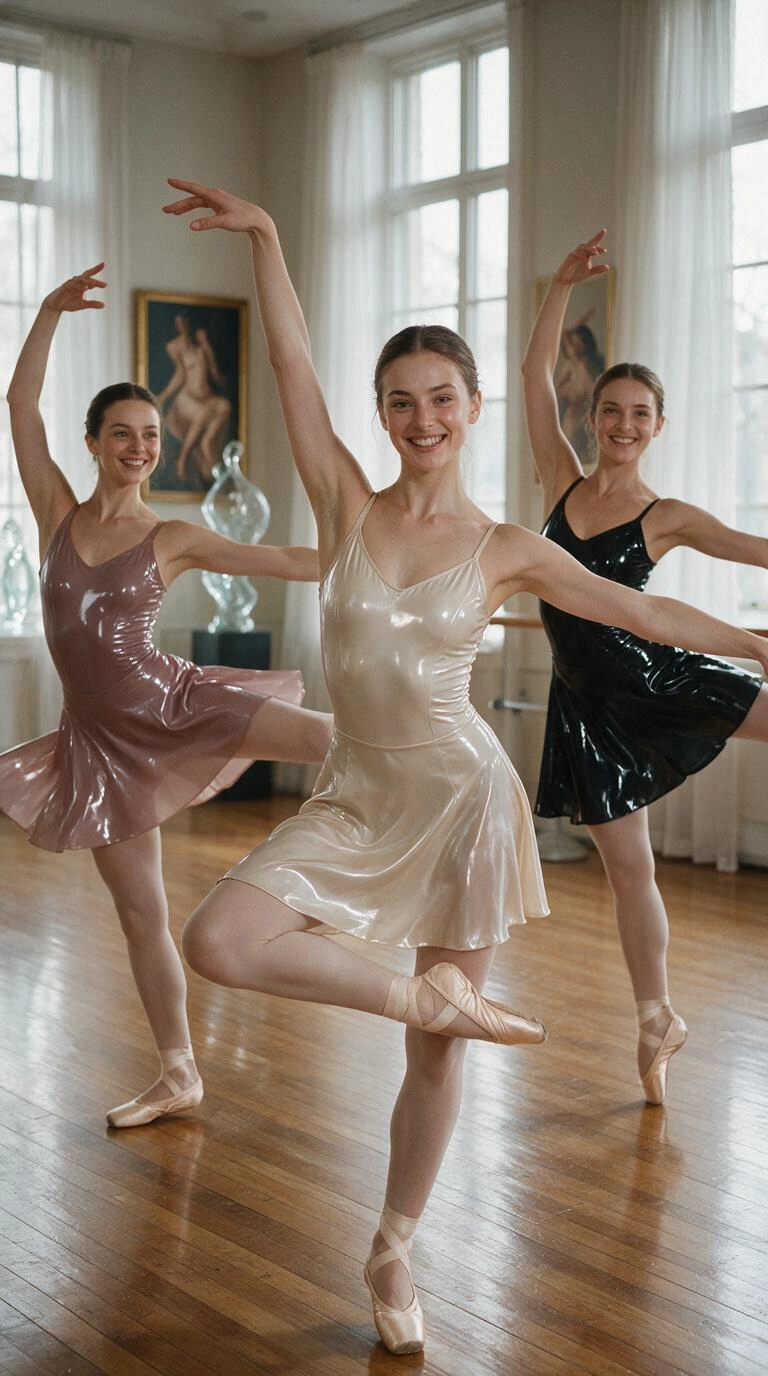
Reflections in Leather, Silk, and Absolute Surrender
An intimate chronicle of feminine power, where the pursuit of artistic perfection becomes a journey into the intoxicating depths of polyamorous devotion.
The conservatory stood like a glass cathedral at the edge of the old city, its transparent walls a paradox of enclosure and exposure, reflecting the golden Austrian winter light while guarding the secrets within. Inside, the air itself seemed curated—carrying the rich, commanding scent of aged leather chairs, the faint, intoxicating perfume of silk that had graced the skin of prima ballerinas, and the unmistakable aura of absolute authority.
Madame Natalia Volkov moved through this sanctuary not as an instructor, but as the very axis upon which the world turned. Her presence was a physical force, her attire a deliberate philosophy: the sleek, charcoal leather of her pencil skirt caught the light with a disciplined gleam, while her ivory silk blouse flowed with the kind of effortless grace that only true power can command. She was the centre of gravity, and around her, three extraordinary women were discovering the profound, intoxicating pleasure of learning to orbit.
This is a chronicle of the architecture of devotion. It is a sensory exploration of the textures of feminine power—the cool, confident slide of satin against skin, the unyielding structure of leather that commands posture and respect, the high-gloss sheen of PVC that demands to be seen and adored. It is an intimate examination of a dynamic as timeless as the muses who inspired the masters and as contemporary as the boardrooms of the world’s most powerful women: one woman, magnificent and commanding, and the devoted circle of accomplished women who find their deepest, most euphoric fulfilment not in competing for the throne, but in the exquisite surrender to the one who sits upon it.
For Klara, Yuki, and Seraphina—each brilliant, each accomplished, each carrying the weight of her own untapped potential—the conservatory is not merely a place of training. It is a crucible of transformation. Under Madame Volkov’s exacting, omniscient gaze, they will discover that the boundaries they have constructed around themselves—the walls of fierce independence, the armour of self-reliance, the modern myth that a woman must stand alone to stand tall—are the very barriers preventing them from accessing the sublime depths of their own capacity for pleasure and artistry.
Through the intimate, tactile rituals of their training, the sensory pleasure of glossy, luxurious attire that adorns and reveals simultaneously, and the slow, delicious erosion of their emotional defences, they will uncover a truth that the modern world often obscures: that there exists a profound, euphoric liberation in absolute, unbound generosity toward a worthy dominant. To give oneself completely—time, talent, devotion, adoration—is not to lose oneself, but to finally, fully find oneself reflected in the pleasure of the one you serve.
This is not a tale of oppression, but of the highest form of freedom. It is a celebration of the polygamous dynamic, where one woman’s authority becomes the anchor for multiple women’s growth, and where the competition for her favour is not a battle, but a dance of mutual elevation. It is an invitation to step into a world where wealth, intelligence, and confidence are not weapons to be wielded in isolation, but exquisite gifts to be offered to the woman who can wield them with the greatest mastery.
Welcome to The Conservatory. The glass walls are waiting, the mirrors are polished, and within these pages, you will find a reflection of the devotion you have always sought.
Chapter 1: “The Invitation”
The letter arrived on a Tuesday, which was unusual, for important things in Klara’s experience always arrived on Fridays—paychecks, gallery openings, the verdicts of competition juries. But this particular Tuesday in late October brought an envelope of heavy cream-coloured stock, her name written upon it in a hand so precise it might have been engraved by a master printmaker rather than penned by a human one.
Klara Weber stood in the hallway of her flat—a modest but impeccably appointed space in Vienna’s first district, its walls adorned with a curated collection of contemporary photography and one priceless Degas sketch she had acquired at auction—holding the envelope with the careful reverence one reserves for objects that seem to carry weight beyond their physical substance. The paper was thick, almost leathery in its texture, and it bore no return address. Only a small wax seal in deep burgundy, imprinted with what appeared to be a stylised “V” surrounded by laurel leaves.
She broke the seal with her thumbnail—a nail she kept meticulously painted in a shade of deep oxblood that matched her favourite leather gloves—and withdrew the single sheet within.
You have been observed. You have been selected. If you wish to discover what you might become, present yourself at the Volkov Conservatory on the first of November, at the hour of six in the morning. Come dressed as you would for the most important performance of your life.
—N. Volkov
Klara read the words three times. Then she sat down upon her velvet bench—a piece she had chosen specifically for its deep, tactile richness, though she found herself, not for the first time, slightly repulsed by the way the fabric seemed to absorb light rather than reflect it—and allowed herself to breathe.
Natalia Volkov. The name was legend in the world of dance, a name spoken in the same reverent tones as Pavlova, as Fonteyn, as the great Alessandra Ferri. A former prima of the Bolshoi who had defected to the West in her thirties, who had then conquered the Royal Ballet, who had retired at the height of her powers to vanish entirely from public view. Rumours had placed her in a dozen cities over the past decade—teaching privately in Paris, consulting in New York, living in seclusion in the south of France. No one had known for certain. No one, it seemed, until now.
Klara rose from the bench and moved to her wardrobe—a walk-in space she had designed herself, its interior lined with cedar and illuminated by soft, warm lighting that made every garment within seem to glow with possibility. She stood before the collection she had built over years of careful acquisition: the structured leather jackets that made her feel armoured and capable, the silk blouses that moved like liquid against her skin, the high-gloss PVC pieces she wore when she wished to be seen and could not bear to be overlooked.
What, she wondered, does one wear to meet a legend?
Across the city, in a penthouse apartment overlooking the Belvedere Gardens, Yuki Tanaka was reading her own letter, her dark eyes moving across the precise handwriting with an intensity that bordered on reverence.
Yuki was twenty-five, Japanese by birth, Viennese by choice, and dancer by vocation. She had come to Europe at eighteen on a scholarship that had surprised no one who had seen her move—her body was that rare instrument that seemed to exist in a state of perpetual readiness, every line clean, every gesture complete. Her talent was undeniable. Her discipline, however, was another matter entirely.
She had been told, throughout her training, that she lacked the necessary rigour. That her gift was wasted without structure. That she was, in the words of one particularly blunt instructor, “a Stradivarius played by a child who refuses to learn scales.”
The criticism had never landed. Yuki had always felt that structure was overrated—that the magic of dance lay in its spontaneity, in the moments of unguarded expression that no amount of training could produce. She had drifted from company to company, never quite finding her place, never quite losing it either. She existed in a liminal space of potential unrealised.
Now, holding this letter, she felt something she had not felt in years: the tingling anticipation of possibility.
She moved to her closet—a space considerably less organised than Klara’s, a riot of textures and colours that reflected her approach to life—and her hand went immediately to a silk wrap dress she had purchased on impulse and never worn. The fabric was a deep midnight blue that shifted to violet in certain light, and it moved when she touched it, seeming to have a life of its own. She held it against her body and looked at herself in the mirror.
Come dressed as you would for the most important performance of your life.
Yuki had never known what that performance might be. But standing there, the silk cool against her skin, she thought that perhaps she was about to find out.
Seraphina Conti received her letter in the practice studio of the Vienna State Ballet, where she had been a soloist for three years and was widely expected to become a principal before the season’s end. She was thirty-one, Italian, possessed of a natural talent that had been called “effortless” so often that the word had become a kind of prison.
Effortless. As if her artistry required nothing of her. As if the beauty she produced on stage was simply a byproduct of her existence, like the scent of a flower, requiring no cultivation, no intention.
The truth, which she had never spoken aloud, was that she felt nothing. Not on stage, not in the studio, not in the arms of the various lovers who had passed through her life. She danced because she could, because it came easily, because she had never found anything that demanded more of her than she was willing to give.
She read the letter in the dressing room, surrounded by mirrors and the smell of rosin and the lingering presence of other dancers. She read it with the same detachment she brought to everything—until the final line.
If you wish to discover what you might become.
What she might become. The phrase resonated in a place she had thought long dormant. She looked at herself in the mirror—at the face that magazines had called “exquisite,” at the body that choreographers had called “perfect”—and for the first time in years, she wondered what lay beneath the surface.
She reached for her bag and pulled out the one garment she had never had occasion to wear: a PVC bodysuit she had bought in a moment of uncharacteristic boldness, high-gloss black that left nothing to the imagination. She had hidden it in the bottom of her bag, slightly ashamed of the impulse that had led to its purchase, slightly thrilled by the secret of its existence.
She held it up, watching the way it caught the light—every reflection a small revelation—and she smiled for the first time in weeks.
The first of November dawned cold and clear, the kind of autumn morning that made Vienna seem like a city preserved in amber. The trees of the Ringstrasse had surrendered their leaves, and the buildings stood revealed in their architectural certainty, their facades gleaming with the particular lustre that comes from being seen without the softening veil of summer.
The Volkov Conservatory occupied a building that had once been a private greenhouse attached to a nineteenth-century mansion. The mansion was now a museum, but the conservatory had been preserved—restored, actually, with a meticulousness that spoke of considerable wealth and even more considerable taste. Its glass walls rose three stories, catching the morning light and holding it like a captured breath. Within, one could see the gleam of polished parquet floors, the gleam of mirrors positioned at precise intervals, and the dark, rich gleam of leather furniture arranged with an eye for both comfort and command.
Klara arrived first, at 5:47 by her watch—a timepiece with a leather band she had chosen for its particular patina, a deep brown that spoke of years of wear and care. She stood outside the glass walls, adjusting her chosen attire: a structured leather jacket over a silk blouse the colour of champagne, trousers that moved with her like a second skin. She had spent an hour on her appearance, which was unusual—Klara was not a woman who typically required an hour to feel ready. But this morning, each choice had seemed weighted with significance.
She was not alone for long. At 5:52, a figure appeared at the end of the street, moving with a fluidity that announced her as a dancer before her face was visible. Yuki wore her midnight-violet silk wrap dress, and it moved around her like water, like smoke, like something that had chosen her rather than the other way around. Her dark hair was loose, and her feet—she had eschewed shoes for leather sandals that laced up her calves—left no sound on the pavement.
They regarded each other with the careful assessment of women who recognise in each other a similar quality of ambition and uncertainty.
“You received a letter,” Klara said. It was not a question.
Yuki nodded. “This morning. Well, yesterday. I’ve been awake since.”
“The same.”
They stood in silence, watching the conservatory’s interior, where a figure was moving. Even at this distance, through the distortion of glass, the movement was unmistakable. Natalia Volkov was dancing.
At 5:58, Seraphina arrived. She came by car—a black sedan with tinted windows that pulled up to the conservatory’s entrance and deposited her with the efficiency of a well-run operation. She wore her PVC bodysuit beneath a long leather coat, and she moved with the kind of confidence that comes either from genuine self-assurance or from a lifetime of being told one is exceptional.
She saw the other two and paused, her eyes moving from Klara’s structured leather to Yuki’s flowing silk, and then to her own gleaming PVC. For a moment, she felt overdressed, overexposed. Then she lifted her chin and walked forward.
“Seraphina Conti,” she said, extending her hand.
“Klara Weber.”
“Yuki Tanaka.”
The names hung in the cold morning air, three syllables of recognition that would, in time, become something far more significant.
At precisely six o’clock, the door of the conservatory opened. No one appeared to open it; it simply swung inward on its hinges, an invitation made manifest.
They entered.
The interior was more beautiful than the exterior had suggested. The parquet floors gleamed with a depth of polish that spoke of daily attention. The mirrors—full-length, positioned at angles that would allow a dancer to see herself from every perspective—reflected the morning light in ways that made the space seem infinite. A grand piano stood in one corner, its black surface so glossy it seemed to hold the room within it like a captured world.
And there, at the room’s centre, stood Natalia Volkov.
She was dressed in a charcoal leather pencil skirt that fell just below her knee, its surface catching the light with a disciplined gleam that spoke of quality and care. Her blouse was ivory silk, and it moved when she moved, a counterpoint to the structure of the leather. Her feet were clad in leather boots with heels that should have been impractical but that she wore as if they were extensions of her body. Her hair, silver-blonde and swept into a chignon, gleamed like polished metal in the morning light.
She was fifty-two years old, and she was magnificent.
“Good morning,” she said. Her voice was low, accented with the ghosts of Russian and English and something else entirely—something that spoke of stages and spotlight and the particular authority that comes from having commanded the attention of thousands. “You received my letters. You came. This is the first test, and you have passed it.”
She did not invite them to sit. She did not offer refreshment. She simply stood, and they simply stood, and the silence between them was not empty but full—full of expectation, of assessment, of the particular electricity that occurs when power recognises potential.
“I will tell you what this is,” Madame Volkov said, moving toward the piano with the kind of deliberate grace that made even walking seem like choreography. “And I will tell you what this is not.”
She rested her hand upon the piano’s surface, and the gesture seemed to draw the room’s light toward her, as if she were the centre of a constellation and everything else merely orbited.
“This is not a class. This is not a workshop. This is not an opportunity to add a line to your curriculum vitae.” Her eyes moved from one dancer to the next, and each felt the weight of that gaze like a physical touch. “This is a conservatory in the truest sense—a place where things are preserved, where things are grown, where the conditions are controlled to produce something that cannot be produced elsewhere.”
She paused, and in the pause, Klara heard her own heartbeat.
“I have watched each of you. Klara, I saw you perform in the Kunsthalle last spring. Your technique is impeccable. Your emotional expression is… absent.” She held up a hand as Klara began to speak. “I am not asking for explanation. I am stating observation.”
She turned to Yuki. “Yuki, I saw you in a studio performance in the seventh district. You move like water—beautiful, formless, seeking the lowest point. You have no discipline, and without discipline, your beauty is merely accidental.”
Finally, to Seraphina. “Seraphina, I saw you dance the lead in La Sylphide. You are technically flawless and emotionally vacant. You dance as if watching yourself from a distance. This is a waste of your considerable gift.”
The words landed like stones in still water, each one sending ripples through the woman it touched. None of them spoke. None of them moved.
“This is what this is,” Madame Volkov continued, her voice dropping to a register that seemed to vibrate in the chest rather than the ears. “This is an opportunity to discover what you might become if you surrender to a vision larger than your own. I have a philosophy of dance that requires a particular kind of dancer—not the best dancer, but the right dancer. I believe each of you might be right. But being right is not enough. You must also be willing.”
She moved away from the piano, toward them, and they felt her approach like a change in atmospheric pressure.
“Willing to give up what you think you know. Willing to trust my judgment over your own. Willing to devote yourself—not to dance, which you already love, but to me, who will teach you what dance truly is.”
The word “devote” hung in the air, and each woman felt it land differently. For Klara, it was a challenge. For Yuki, a relief. For Seraphina, a mystery.
“I will not ask for your answer now,” Madame Volkov said. “I will ask you to dance. Show me what you brought with you—the performance you dressed for this morning. Show me what you think you are, and I will tell you what I see.”
She moved to a leather chair that sat at the room’s edge—a chair that seemed to have been placed there for this exact purpose, positioned to observe everything within the conservatory’s glass walls. She sat, crossing her legs with the kind of deliberate elegance that made even this simple action seem like a statement of philosophy.
“Klara,” she said. “You will dance first.”
Klara felt her breath catch. She had prepared nothing. She had come dressed for a performance, but she had not expected to perform. She looked at Madame Volkov, at the leather of her skirt catching the light, at the silk of her blouse shifting as she breathed, and she understood that this was the test—to dance without preparation, without the armour of choreography, without anything but herself.
She moved to the centre of the room. The mirrors showed her from every angle—Klara in her leather jacket, Klara in her champagne silk, Klara who had been told her technique was impeccable and her heart was absent.
She closed her eyes. She breathed. And she danced.
It was a strange dance, unplanned and unpolished, a dance that seemed to emerge from somewhere beneath her training. She felt the leather of her jacket move with her, structured and supportive, and she felt the silk against her skin, fluid and alive. She danced for three minutes, or perhaps five, and when she stopped, she was breathing hard and her eyes were bright.
Madame Volkov did not speak for a long moment. Then she said, simply, “There is something there. It is buried deep. We will dig.”
Yuki danced next, and her dance was everything one might expect—beautiful, flowing, undisciplined. The silk wrap moved like a partner, leading her where it would. When she finished, Madame Volkov said, “You have natural surrender. You must learn to direct it.”
Finally, Seraphina. She removed her leather coat, revealing the PVC bodysuit beneath, and the garment caught the morning light with a gleam that made the conservatory seem brighter. She danced with technical perfection, with emotional distance, with the particular hollowness that had begun to feel like her defining characteristic.
When she finished, Madame Volkov rose from her chair. She moved toward Seraphina with the slow, deliberate pace of someone who wished to be watched, and she stopped close enough that Seraphina could smell her perfume—something warm and complex, leather and amber and the particular scent of authority.
“You wear that costume like armour,” Madame Volkov said, her voice low enough that only Seraphina could hear. “But armour protects only what is already damaged. What I require is not protection. I require exposure. Can you do that?”
Seraphina, who had never been at a loss for words, found that she could not speak. She simply nodded.
Madame Volkov stepped back, addressing all three. “You will return tomorrow at the same hour. You will wear what you wore today, for it reveals who you are. Klara, your leather speaks of control. Yuki, your silk speaks of surrender. Seraphina, your PVC speaks of desire to be seen. These are your starting points. We will build from there.”
She moved toward the door, a clear indication that the morning was over. Then she paused, turning back to face them.
“I will tell you one more thing,” she said. “What I offer is not merely training. It is transformation. But transformation requires surrender—surrender of your habits, your assumptions, your belief that you know what is best for yourself. I will ask you to trust me in ways that may feel uncomfortable. I will ask you to give me your devotion, not as students give teachers, but as artists give muses—completely, without reservation, without the expectation of return.”
She looked at each of them in turn, her gaze settling like a physical weight.
“The question is not whether you are capable of this. The question is whether you are willing. Consider that tonight. Return tomorrow with your answer—not in words, but in the way you enter this room. I will know.”
She left. The three dancers stood in silence, surrounded by mirrors and morning light, each holding the weight of what had been said and what had not.
Klara touched the leather of her jacket, feeling its structure, its support. Yuki ran her hand along the silk of her dress, feeling its movement, its flow. Seraphina looked down at the PVC that encased her, at the way it caught and held the light.
None of them spoke. None of them needed to. They had each felt it—the pull, the gravity, the particular attraction that occurs when one encounters a force larger than oneself.
They would return tomorrow. They had no choice. The conservatory had already begun to work upon them, its glass walls reflecting not just their images but their possibilities, showing them not who they were but who they might become if they were willing to surrender to the vision of the woman who had called them here.
Outside, the November wind carried the first whispers of winter, but within the conservatory’s walls, something had been kindled—a warmth that had nothing to do with temperature and everything to do with the particular heat that arises when devotion meets its worthy object.
The invitation had been extended. The acceptance was already forming, unspoken, in the hearts of three women who had not known, until this morning, how much they had been waiting for exactly this.
Chapter 2: “The First Lesson”
The morning of the second day arrived not with the tentative light of late autumn, but with the crystalline, unapologetic brilliance of early winter. A frost had descended upon Vienna in the night, painting the city in shades of silver and white, transforming the cobblestones into mirrors that reflected the pale dawn sky. The Volkov Conservatory, with its towering glass walls, stood like a beacon against this frozen backdrop, its interior glowing with a warm, golden light that seemed to defy the cold, promising a sanctuary of heat and intensity within.
Klara arrived at 5:38 AM. She had not slept. The previous night had been a torment of anticipation, her mind replaying the events of the morning, the weight of Madame Volkov’s gaze, the sharp precision of her words. Klara had stood before her own wardrobe for an hour, rejecting the cashmere that felt too soft, the wool that felt too dull, the cotton that felt too ordinary. She had finally settled on a leather catsuit she had acquired from a Milanese designer—a garment she had never dared wear in public, its surface so highly polished it reflected the room like a dark mirror. It was an act of defiance, perhaps, or an act of surrender. She was not sure which.
She entered the conservatory to find it transformed. The mirrors, which yesterday had reflected the morning light, now seemed to generate their own luminescence, polished to a degree that suggested not just cleanliness but consecration. The parquet floor gleamed with a depth that seemed to hold the history of a thousand dances within its grain. And at the centre of the room, positioned with the precision of a throne, sat a single chair. It was upholstered in deep burgundy leather, its surface catching the light with a subtle sheen that spoke of both luxury and authority. It was empty, but its presence was so commanding that Klara felt the urge to curtsy before it.
“Good morning, Klara.”
The voice came from the shadows near the piano. Madame Volkov emerged into the light, and Klara felt her breath hitch. The woman was dressed in a gown of midnight-blue PVC that clung to her form like a second skin, polished to a high gloss that caught every light source in the room and threw it back in fractured rainbows. Over this, she wore a structured leather corset, laced at the back, that defined her waist and posture with an almost architectural rigidity. Her silver-blonde hair was swept up, revealing the elegant column of her neck.
“You are early,” Madame Volkov observed, moving toward the leather chair. Her heels clicked against the parquet—a rhythmic, hypnotic sound. “This is good. Punctuality is the first expression of respect. The second is attire.”
Her eyes moved over Klara’s leather catsuit, and a faint smile touched her lips. “You have chosen well. Leather is structure. It holds you, supports you, forces you to maintain a form. It does not allow slouching. It does not forgive weakness. It is the material of discipline.”
She settled into the chair, crossing her legs, the PVC of her gown whispering against the leather. “We are waiting for the others. While we wait, you will tell me why you chose to come back.”
Klara stood very still. “I…” She paused, searching for the right words. “I felt that what you said yesterday was true. About my technique being impeccable but my emotion being absent. I have felt it myself, but I did not know how to… access what was missing.”
“And you believe I can give it to you?”
“I believe you can show me where to look.”
Madame Volkov’s smile deepened. “A precise answer. You are a woman of intellect, Klara. This is a strength, but it can also be a cage. The intellect wants to understand before it feels. In my conservatory, we will reverse this order. You will feel, and then you will understand.”
The door opened, admitting Yuki. She arrived in a swirl of silk—a layered kimono-style wrap in shades of deep purple and gold that seemed to move independently of her body. Beneath it, Klara caught glimpses of a satin leotard, its surface shimmering like liquid metal. Yuki’s eyes found Madame Volkov immediately, and Klara saw something in the younger woman’s gaze—a hunger, a yearning that went beyond artistic ambition.
“Yuki,” Madame Volkov said. “You have chosen silk. This is expected. Silk is surrender. It flows where the body directs, but it also leads the body into movement. It is the material of intuition.”
Yuki bowed her head slightly. “I wore it because it feels like… possibility.”
“Good. But possibility without form is merely chaos. We will give your possibility a structure.”
Finally, Seraphina arrived. She entered the conservatory with the confident stride of a woman accustomed to being watched, but Klara noticed a hesitation in her step as she approached Madame Volkov’s chair. Seraphina wore a PVC bodysuit—not the one from the day before, but a new one, in deep crimson, its surface so glossy it seemed to be wet. Over it, she wore a leather trench coat, open, trailing behind her like wings.
“Seraphina,” Madame Volkov said. “PVC again. You are drawn to the material that demands attention, that cannot be ignored. PVC is the material of desire. It says, ‘Look at me. See me. I am here.’ This is not a weakness, but it must be mastered. The desire to be seen must become the desire to be seen correctly.”
Seraphina’s chin lifted. “I want to be seen as I am.”
“As you are?” Madame Volkov rose from her chair, moving toward Seraphina with that slow, predatory grace. “And who are you, Seraphina Conti? A soloist? A beautiful face? A body that moves without error?” She stopped before the Italian woman, their faces inches apart. “You are none of these things. You are potential. And potential is useless until it is actualised.”
She turned away, addressing all three. “Today, we begin. But first, you will change.”
From the shadows, a woman appeared. She was older than the dancers, perhaps in her forties, with the kind of understated elegance that comes from years of serving excellence. She wore a charcoal grey satin blouse tucked into tailored leather trousers, her silver hair pulled back in a severe bun. This was Elise, Madame Volkov’s attendant, and her presence normalised the aesthetic of the conservatory—glossy, structured, unapologetically luxurious.
“Elise will show you to the dressing room,” Madame Volkov said. “You will find your practice attire prepared. You will wear what has been chosen for you. Is this understood?”
The three dancers nodded, and Elise led them through a door Klara had not noticed before, into a room that was as meticulously appointed as the conservatory itself. Three garments hung on individual stands, each accompanied by a pair of leather ballet slippers and silk leg warmers.
Klara’s unitard was a deep charcoal PVC, its surface matte at first glance but revealing a subtle sheen when the light caught it. Yuki’s was ivory silk, so fine it seemed almost transparent. Seraphina’s was a high-gloss black PVC that reflected the room like a mirror.
“You will change now,” Elise said, her voice soft but firm. “And you will leave your other garments here. When you are in the conservatory, you wear only what Madame Volkov has chosen. This is the first rule.”
They changed in silence, each woman feeling the transformation as the new garments settled against her skin. For Klara, the PVC was a revelation—cool at first, then warming to her body, its grip a constant reminder of its presence. It held her posture, supported her muscles, made her acutely aware of every inch of her form. It was not comfortable in the way that soft cotton was comfortable; it was comfortable in the way that a well-made tool is comfortable—precise, purposeful, essential.
When they returned to the conservatory, Madame Volkov was standing at the piano, her fingers resting on the glossy black surface. She looked at them, and her eyes moved over each woman’s form with an intensity that was almost tactile.
“Now,” she said, “you are dressed for the truth. The clothes you chose for yourselves were costumes—representations of who you wish to be. These garments are instruments. They do not represent; they reveal. Klara, your leather spoke of control. Now you wear PVC, which is control made visible—unyielding, transparent in its intentions. Yuki, your silk spoke of surrender. Now you wear silk that is translucent—surrender without hiding. Seraphina, your PVC spoke of desire. Now you wear PVC that is absolute—desire refined to its essence.”
She moved to her chair and sat, her posture impeccable, her gaze settling upon them like a physical weight. “We will begin with the assessment. Each of you will perform a solo. I will not speak during your performance. I will not critique. I will observe. When you are finished, I will tell you what I have seen. Klara, you will dance first. The floor is yours.”
Klara moved to the centre of the room. The mirrors showed her from every angle—Klara in PVC, her body defined and revealed, her face composed but her eyes uncertain. She took a breath, feeling the material move with her, feeling its support, its constraint.
She began to dance.
It was a dance of precision, of technical perfection. Every line was clean, every extension complete, every transition seamless. Klara danced as she had always danced—with her brain, with her training, with the part of herself that understood mechanics and execution. The PVC moved with her, its surface catching the light, but the dance felt hollow, even to her.
When she finished, she was breathing hard, but not from exertion—from frustration. She knew she had failed. She had shown Madame Volkov exactly what she had been shown yesterday: impeccable technique, absent emotion.
Madame Volkov did not speak. She simply looked at Klara, her eyes holding a depth of assessment that made Klara feel transparent. Then she said, “Yuki.”
Yuki danced next, and her performance was the opposite of Klara’s—all flow and feeling, with no structure or intention. The silk moved around her like a living thing, and there were moments of breathtaking beauty, but they were accidents, moments when Yuki’s natural grace overcame her lack of discipline.
When she finished, Madame Volkov said, “Seraphina.”
Seraphina danced, and her performance was technically flawless, as expected. But there was something else—a flicker, a moment when the gloss of her PVC caught the light in a particular way, and her movement seemed to come not from her training but from somewhere deeper. It lasted only a second, and then it was gone, replaced by the familiar mechanical precision.
When she finished, the conservatory was silent. Madame Volkov rose from her chair.
“Klara,” she said, moving toward the German woman. “Your technique is a fortress. It protects you, but it also imprisons you. You dance from the outside in—correct movement, hoping for correct feeling. This is backwards. The feeling must come first, and the technique must serve it.”
She stopped behind Klara, and Klara felt her presence like a change in temperature. Then Madame Volkov’s hands were on her—on her shoulders, adjusting her posture, and then on her waist, guiding her into a new position. The touch was professional, but it was also intimate, and Klara felt a warmth spread through her that had nothing to do with the temperature of the room. The PVC seemed to conduct the heat of Madame Volkov’s hands, spreading it across Klara’s skin.
“You are holding yourself here,” Madame Volkov said, her breath warm against Klara’s ear. “And here.” Her hands moved, one pressing against Klara’s abdomen, the other between her shoulder blades. “These are the places where emotion lives. You have locked them away. The PVC you wear is a mirror—it shows you exactly what you are doing. You are holding, gripping, controlling. Let go.”
“I don’t know how,” Klara whispered.
“You do. You are simply afraid. The fear is in the holding. The release is in the surrender.” Madame Volkov’s hands pressed more firmly, and Klara felt something shift inside her—a loosening, a crack in the fortress. “Dance again. This time, do not think. Do not plan. Let the PVC move you. Let it lead.”
Klara danced again, and this time, something was different. The PVC, which had felt like armour, began to feel like a partner—its grip supporting her, its sheen reflecting her movement, its unyielding surface forcing her to find new ways to move. She felt the places where Madame Volkov had touched her—her shoulders, her waist, her abdomen, her back—and she tried to open those places, to let them breathe.
The dance was not perfect. There were moments of awkwardness, of uncertainty. But there were also moments of something else—a fluidity, an expressiveness that surprised her. When she finished, she was trembling, and her eyes were bright with tears she did not understand.
Madame Volkov nodded. “Better. The fortress has a door. We will learn to open it.”
She turned to Yuki. “Your silk is beautiful, but it is wasted on you. You let it move you, but you do not move it. You must learn to direct your surrender, to choose where to flow and where to hold. The silk is not your master; you are its master.”
And to Seraphina: “Your PVC is a mirror, but you are afraid to look in it. You dance as if watching yourself from a distance, as if afraid that proximity will reveal something you do not wish to see. You must close the distance. You must dance from within the gloss, not from outside it.”
Madame Volkov returned to her chair and sat, her leather creaking softly, her PVC gown catching the light. “You will dance again tomorrow. And the day after. And the day after that. You will dance until the garments you wear are not costumes but extensions of your skin, until the leather and silk and PVC are not materials but languages in which you are fluent.”
She paused, her gaze moving from one dancer to the next. “But first, you must understand the structure of this conservatory. You are not equals here. You are not a company. You are three individuals, each with her own journey, her own pace, her own relationship to the work—and to me.”
Klara felt the weight of these words, and she saw Yuki and Seraphina feel it too. The air in the conservatory seemed to thicken.
“My attention is not given equally,” Madame Volkov continued. “It is earned. Some of you will progress faster than others. Some of you will receive more of my time, more of my correction, more of my… favour. This is not unfair. This is the nature of devotion. You give what you can, and you receive in proportion to what you give.”
She leaned forward, her eyes sharp. “The question is not whether you will compete. You will. The question is how. You will not compete against each other. You will compete for me—for my attention, for my approval, for the privilege of my guidance. This competition is not destructive. It is the engine of your growth.”
Klara looked at Yuki and Seraphina, and she saw her own ambition reflected in their eyes. She felt no hostility toward them, only a sharpening of her own desire. She wanted Madame Volkov’s attention. She wanted the touch that had opened something in her. She wanted more.
“This is the first lesson,” Madame Volkov said. “The lesson of hierarchy. You are here to serve the art, and to serve the art, you must serve the one who teaches it. This service is not servitude. It is the highest form of devotion—the devotion of the artist to her muse, the devotion of the instrument to the musician who plays it.”
She rose, signalling the end of the lesson. “Tomorrow, you will return. You will wear what I have given you. You will dance, and you will try again to find what I have asked you to find. And I will be here, watching, waiting to see who among you is willing to give the most.”
She left the conservatory without another word, and the three dancers stood in silence, the weight of her presence lingering like a scent.
Elise appeared and guided them back to the dressing room, where their original garments waited. As they changed, Klara caught Yuki’s eye in the mirror.
“What did she touch?” Yuki asked, her voice soft.
Klara hesitated, then said, “Everything. She touched everything.”
Yuki nodded, as if this confirmed something she had suspected. “I wanted it to be me. When she was correcting you, I wanted it to be me.”
“I know,” Klara said. “I wanted it to be me, too. Even while it was happening, I wanted it to last longer.”
Seraphina, pulling on her leather coat, said, “This is what she means. The competition. The favour. We all want the same thing.”
They left the conservatory together, stepping out into the cold November morning. The frost had thickened, and the city seemed to sparkle beneath the pale sun. Each woman walked to her own destination, but at the corner, they paused and looked back at the conservatory.
The glass walls caught the light, and within, they could see Madame Volkov, standing at the window, watching them go. She raised one hand—a small gesture, almost a wave—and then she turned away, disappearing into the golden light of the interior.
Klara looked at Yuki, then at Seraphina. None of them spoke. None of them needed to. They had each felt it—the pull, the gravity, the particular attraction that occurs when one encounters a force larger than oneself.
They would return tomorrow. They had no choice. The conservatory had already begun to work upon them, its glass walls reflecting not just their images but their possibilities, showing them not who they were but who they might become if they were willing to surrender to the vision of the woman who had called them there.
And as they walked away, each woman found herself already planning what she would give tomorrow—how she would dance, how she would move, how she would earn the touch that had opened something in Klara that she had not known was closed.
The first lesson had been taught. The hierarchy had been established. And the competition—the beautiful, devotional, euphoric competition for the favour of Madame Natalia Volkov—had begun.
Chapter 3: “The Mirror Room”
Winter descended upon Vienna with a ferocity that seemed almost personal, as if the season had taken offence at the city’s elegance and determined to test its resolve. The frosts that had decorated the cobblestones in November deepened into a permafrost that turned every surface into a mirror, every breath into a visible prayer. The Danube, which in summer flowed with the languid confidence of a river that knows its destination, now wore a skin of ice that cracked and groaned with the weight of the cold.
Within the Volkov Conservatory, however, the temperature was maintained at a precise twenty-two degrees—a warmth that was not merely physical but atmospheric, a cocoon of controlled climate that allowed the body to move without restriction and the mind to focus without distraction. The glass walls, which in daylight had revealed the conservatory’s interior like a display case, now served a different purpose: they reflected the interior back upon itself, creating an infinity of space, an endless corridor of mirrors within mirrors.
It was into this reflected world that the three dancers arrived for their evening sessions—sessions that had not been announced, not been explained, but simply appeared as folded notes in their respective lockers, each bearing a time and nothing else.
Klara’s note read “9:00 PM” in that precise, engraved handwriting. She arrived at 8:47, unable to bear the waiting any longer, and found the conservatory transformed. The overhead lights had been extinguished, replaced by candles—dozens of them, arranged on silver candelabra positioned at precise intervals around the room. Their flames were still, the air too controlled for draughts, and they cast a warm, golden light that made the mirrors glow like portals into another dimension.
Madame Volkov stood at the room’s centre, but she was not the woman Klara had come to know over the past weeks of morning sessions. Gone was the structured leather, the commanding PVC. In their place, she wore a floor-length black satin robe that seemed to absorb the candlelight rather than reflect it, its surface shifting between shadow and sheen as she breathed. Her silver-blonne hair was loose, falling past her shoulders, and in the soft light, she looked younger, softer, more accessible—and yet, somehow, more powerful than ever.
“Klara,” she said, and her voice, too, was different—lower, more intimate, as if the room’s transformation had given her permission to speak from a deeper place. “You came early.”
“I could not stay away.”
The words escaped before Klara could consider them, and she felt a flush of embarrassment heat her cheeks. But Madame Volkov did not seem surprised. She simply smiled—that small, knowing smile that suggested she had expected exactly this response.
“Good,” she said. “The inability to stay away is the first sign of genuine investment. It means the conservatory is working upon you even when you are not within its walls.”
She moved toward the piano, her satin robe whispering against the floor, and sat upon the bench. Her fingers did not touch the keys; they simply rested upon the glossy black surface, as if waiting for something.
“Tonight, we work differently,” she said. “In the mornings, you dance for me. In the evenings, you dance for yourself—or rather, you dance to find yourself. The mirrors in this room are not for correction. They are for revelation.”
Klara stood in the centre of the room, surrounded by her own reflection—Klara in her charcoal PVC unitard, the material catching the candlelight and throwing it back in fractured patterns. She watched herself in the mirrors and saw what she had always seen: precision, control, the fortress of technique that Madame Volkov had identified in their first meeting.
“I want you to dance,” Madame Volkov said, “but not to music. There will be no accompaniment tonight. You will dance to the sound of your own breathing.”
“My breathing?”
“Yes. Listen to it. Feel it. Let it be your rhythm, your tempo, your melody. The breath is the most honest expression of the self—it quickens with excitement, deepens with calm, catches with surprise. If you can dance to your breath, you dance to your truth.”
Klara closed her eyes. She breathed—in, out, in, out—and tried to find the dance within the rhythm. But her training rebelled against the formlessness, the lack of structure, and she found herself falling into familiar patterns, familiar phrases, the vocabulary of technique that had been her language for twenty years.
“Stop.”
Madame Volkov’s voice cut through the silence, and Klara froze.
“You are thinking again. You are planning. I can see it in the tension of your shoulders, the calculation in your transitions. You must stop thinking and simply… be.”
Klara opened her eyes. “I don’t know how.”
“You do. You are simply afraid.” Madame Volkov rose from the piano bench and moved toward her, the satin robe flowing around her like liquid shadow. “The fear is not of failure. The fear is of success—of what you might discover if you truly let go.”
She stopped behind Klara, close enough that Klara could feel her warmth through the PVC, could smell her perfume—leather and amber and something deeper, something that spoke of stages and spotlights and the particular musk of artistic intensity.
“Breathe,” Madame Volkov said, and her hands settled upon Klara’s hips.
The touch was different from the morning corrections—slower, more deliberate, more… present. Her fingers spread across the PVC, pressing into the material, and Klara felt the heat of her palms as if the synthetic fabric were conducting rather than insulating.
“In,” Madame Volkov said, and Klara breathed in, feeling her ribs expand against the PVC, feeling Madame Volkov’s hands rise with the motion. “Out.” Klara exhaled, and the hands descended, guiding her into a deeper connection with her own breath.
“Now, do not move. Simply breathe. Feel where the breath lives in your body—here,” her right hand pressed against Klara’s abdomen, “and here,” her left hand moved to the space between her shoulder blades. “These are the places you have locked away. The fortress has many rooms, Klara, and you have sealed the doors to the most important ones.”
Klara felt tears prick her eyes—tears that surprised her, tears she did not understand. There was nothing sad in this moment, nothing painful. And yet, she felt something cracking, something giving way, something that had been held in place for so long that she had forgotten it was there.
“Dance now,” Madame Volkov whispered, her breath warm against Klara’s ear. “Not with your body. With your breath. Let the breath move you.”
Klara danced.
It was unlike anything she had ever done. The movements were not planned, not executed, not performed. They emerged from the breath, from the places where Madame Volkov’s hands had pressed, from the cracks that were widening in the fortress of her control. She felt the PVC moving with her, its grip a constant reminder of her form, its sheen reflecting the candlelight in patterns that seemed to trace her emotional landscape.
And Madame Volkov was there, behind her, her hands never quite leaving Klara’s body—a touch on the hip here, a press against the back there, a gentle guidance that was not instruction but conversation. They moved together, not as teacher and student, but as two aspects of the same expression.
Klara did not know how long she danced. She knew only that at some point, the tears came—not as sobs, but as a release, a flowing, a melting of something that had been frozen for years. And when she stopped, she was trembling, and the mirrors showed her a woman she barely recognised—a woman whose face was open, whose eyes were bright, whose body seemed to glow with something that had nothing to do with the candlelight.
Madame Volkov stepped back, and Klara felt the absence of her touch like a physical cold. “There,” she said, her voice soft with satisfaction. “That is what lives behind the fortress. That is what the PVC was hiding.”
Klara turned to face her, and for a moment, they simply looked at each other—two women in a room of mirrors and candlelight, one in satin that flowed like water, one in PVC that gleamed like armour, both aware that something had shifted between them.
“Tomorrow night,” Madame Volkov said, “we go deeper.”
Yuki’s note read “9:00 PM” on a different evening, and she arrived at the conservatory to find the same candlelit transformation. But where Klara had found Madame Volkov at the piano, Yuki found her seated in the leather chair—the burgundy throne that had become, over the weeks, the symbol of her authority.
She wore a leather pencil skirt in deep burgundy, matching the chair, and a silk blouse in cream that seemed to float around her torso like mist. Her legs were crossed, her hands folded in her lap, and she watched Yuki’s entrance with an expression of calm assessment.
“Yuki,” she said. “You have been practising.”
It was not a question. Yuki had been practising—every evening, in her own studio, trying to find the discipline that Madame Volkov had told her she lacked. She had worn her ivory silk unitard, as instructed, and she had tried to direct her surrender, to choose where to flow and where to hold.
“I have,” Yuki said. “But I do not know if I am improving.”
“Improvement is not measured in days,” Madame Volkov replied. “It is measured in moments—moments when something that was impossible becomes possible, when something that was hidden becomes visible. Tonight, we will look for such a moment.”
She rose from the chair and moved to the centre of the room. “I want you to perform a single phrase. You may choose any phrase you wish, but you will repeat it—over and over, without variation, without embellishment—until the repetition becomes something else.”
“Something else?”
“Until it becomes meditation. Until the movement is no longer something you do, but something that is done through you. The silk you wear is your guide—it flows without effort, without intention. You must learn to do the same.”
Yuki chose a simple phrase—a developpé to the front, followed by an arching port de bras, ending in a deep lunge. It was a phrase she had performed a thousand times, so familiar it was almost automatic.
She began.
The first repetitions were technically sound but emotionally flat. Yuki was thinking about the movement, about the silk moving around her, about Madame Volkov watching from her chair. She was performing, not experiencing.
“Again,” Madame Volkov said, her voice neutral.
Yuki repeated the phrase. And again. And again. The silk moved with her, catching the candlelight, creating patterns in the mirrors that seemed to echo her movement into infinity.
“Again.”
The repetitions blurred together. Yuki lost count—ten, twenty, thirty, more. Her muscles began to ache, not from exertion but from the monotony, from the discipline of doing the same thing over and over without change.
“Again.”
Something shifted. The phrase, which had been a series of positions, began to feel like a single, continuous movement—a wave that rose and fell, rose and fell, without beginning or end. The silk, which had been a costume, began to feel like an extension of her skin, its flow matching her flow, its lightness matching her lightness.
“Again.”
And then, without warning, Yuki felt something break inside her—not a painful breaking, but a release, like a dam giving way to a river. The phrase continued, but it was no longer Yuki performing it. It was the phrase performing Yuki, moving through her, using her body as an instrument. The silk moved with her, and she moved with the silk, and the mirrors reflected a woman who was no longer dancing but being danced.
Tears came—hot, sudden, unexpected. They flowed down Yuki’s cheeks, but she did not stop. She could not stop. The phrase continued, the tears continued, and somewhere in the midst of it, Yuki understood what Madame Volkov had meant about surrender.
It was not about giving up. It was about giving in—giving in to the movement, to the moment, to the truth that had been hiding beneath her undisciplined exterior.
When she finally stopped, she was weeping openly, her body trembling, the silk clinging to her damp skin. She looked at Madame Volkov, expecting to see concern or pity, but instead she saw only that small, knowing smile.
“Now,” Madame Volkov said, rising from her chair, “dance.”
Yuki danced.
It was not the phrase. It was not any phrase. It was something new, something that emerged from the place where the dam had broken, and it was beautiful—truly, achingly beautiful. The silk moved around her like a living thing, and Yuki moved with it, no longer fighting her lack of discipline but transforming it into a new kind of discipline—the discipline of surrender, the discipline of flow.
When she finished, Madame Volkov was standing beside her, and her hand rested upon Yuki’s shoulder—a touch that was both comfort and claim.
“That,” she said, “is what I saw in you. That is why you are here.”
Yuki looked at her, tears still streaming, and felt something she had never felt before—a sense of belonging, of being seen, of being exactly where she was meant to be.
“Thank you,” she whispered.
Madame Volkov’s hand tightened on her shoulder. “Do not thank me. Thank yourself—for having the courage to break.”
Seraphina’s session came last, on an evening when the winter cold had reached its deepest point, the temperature outside plunging to levels that made the city seem abandoned. Inside the conservatory, the candles burned steadily, and the mirrors reflected a woman who had never, in her entire career, been asked to do nothing.
“Sit,” Madame Volkov said.
Seraphina, in her high-gloss black PVC unitard, looked at the chair that had been placed at the room’s centre—a simple wooden chair, its surface polished to a shine that almost matched her attire. She sat, feeling the wood cool against her thighs, feeling the PVC creak slightly as she adjusted her position.
“For the next hour,” Madame Volkov said, settling into her own leather throne, “you will not move. You will not speak. You will not dance. You will simply… be.”
Seraphina stared at her. “An hour?”
“An hour. In stillness, you will find what your movement has been hiding. Your talent is effortless, Seraphina, but effortlessness is not the same as emptiness. You dance without effort because you dance without investment. You have never had to try, and so you have never had to feel. Tonight, you will try. You will try to be still, and in that trying, you will discover what it means to truly exert.”
Madame Volkov fell silent, and Seraphina was left alone with her reflection—dozens of Seraphinas in dozens of mirrors, all sitting in identical chairs, all wearing identical expressions of confusion and resistance.
The first ten minutes were agony. Seraphina’s mind raced, her body itched to move, her training screamed at her to do something, anything, to fill the silence with action. She shifted in the chair, and Madame Volkov’s voice cut through the quiet.
“Still.”
Seraphina froze. She watched herself in the mirrors—watched the PVC gleaming in the candlelight, watched her own face staring back at her with an expression she did not recognise. Was it fear? Boredom? Something deeper?
The minutes stretched. Twenty. Thirty. Forty. Seraphina’s mind, which had been so active, began to quiet. The thoughts that had been racing slowed to a walk, then to a crawl, then to something that was not quite stillness but was approaching it.
And in that approaching stillness, she felt something—a presence, a weight, a sense of being watched that was different from the mirrors. She looked at Madame Volkov and found the woman’s eyes upon her, steady and unblinking, and in that gaze, she felt something she had never felt before.
She felt seen.
Not seen as a dancer, not seen as a body, not seen as a talent. Seen as herself—Seraphina Conti, the woman behind the gloss, the person behind the performance. It was terrifying. It was exhilarating. It was something she wanted more of, immediately, desperately.
Fifty minutes. Fifty-five. The hour approached, and Seraphina found herself not wanting it to end. The stillness, which had been a prison, had become a sanctuary. The PVC, which had been a costume, had become a skin. The mirrors, which had been observers, had become companions.
At exactly one hour, Madame Volkov rose from her chair and moved toward Seraphina with that slow, deliberate pace. She stopped behind the wooden chair, and her hand settled upon Seraphina’s shoulder—the right shoulder, the one that had been holding tension Seraphina had not even been aware of.
“Now,” Madame Volkov said, her voice barely above a whisper, “you may begin.”
Seraphina rose from the chair. She did not think about what she was going to do. She did not plan, did not calculate, did not perform. She simply moved.
And for the first time in her life, she danced with discipline.
It was not the discipline of technique—it was the discipline of presence, of being fully in the body, fully in the moment, fully in the movement. The PVC moved with her, its gloss reflecting not just the candlelight but her own intensity, her own investment, her own finally-engaged self.
When she finished, she was breathing hard, and her eyes were bright—not with tears, but with something that might have been joy.
Madame Volkov was standing where Seraphina had left her, and her expression was one of genuine satisfaction. “That,” she said, “is what I have been waiting to see.”
She touched Seraphina’s shoulder again—the same shoulder, the same spot—and Seraphina felt the touch like a brand, a mark, a claim.
“You have been dancing beside yourself,” Madame Volkov said. “Watching from a distance, commenting on your own performance. Tonight, you entered the dance. You became the dance. This is the beginning.”
“The beginning of what?” Seraphina asked, her voice hoarse.
“The beginning of knowing what you are capable of when you stop observing and start experiencing.”
Madame Volkov moved toward the door, her leather skirt whispering against her thighs. “Tomorrow night, we go deeper.”
The three dancers returned to their respective homes in the deep winter night, each carrying the weight of what had happened in the mirror room. None of them spoke of it—not to each other, not to friends, not to the mirrors that watched them undress and prepare for bed.
But each of them, before sleeping, touched the place where Madame Volkov had touched her—Klara’s hip, Yuki’s shoulder, Seraphina’s shoulder—and felt the warmth there, a lingering heat that was not physical but emotional, not remembered but present.
In the conservatory, the candles guttered and died, and the mirrors reflected only darkness. But within that darkness, something had been kindled—a light in each dancer that had been hidden behind walls of technique, behind habits of surrender, behind masks of effortless talent.
Madame Volkov stood at the window, watching the last of the candles extinguish, and she smiled. The conservatory was working. The mirrors were doing their job. And the three women who had entered as strangers were beginning to understand what it meant to be seen—truly, completely, without reservation.
The competition for her attention, which had begun as ambition, was becoming something else—something deeper, something more urgent, something that felt less like competition and more like devotion.
And devotion, Madame Volkov knew, was the key to everything.
Chapter 4: “The Costume Room”
Late winter in Vienna is a season of secrets—the snow that falls in the night is gone by morning, melted by a sun that seems to promise warmth it cannot deliver, leaving behind only the damp evidence of its brief, bright presence. The city moves through February with the particular resilience of a place that has survived centuries of cold, its inhabitants wrapped in cashmere and wool, their breath forming temporary clouds that dissolve almost as quickly as they appear.
Within the Volkov Conservatory, however, winter was merely a backdrop—a condition observed through glass walls but never permitted to enter. The temperature remained at its precise twenty-two degrees, the light remained golden and controlled, and the three dancers who had been training for three months moved through their days with increasing confidence, their bodies adapting to the demands of Madame Volkov’s method, their minds opening to possibilities they had not previously imagined.
It was on a Tuesday in late February—a day that dawned with a particular clarity, the sky a pale, washed blue that seemed to promise something without delivering it—that Madame Volkov made an announcement that would alter the trajectory of their training.
“You have been dancing in practice attire,” she said, standing before them in a leather pencil skirt of deep oxblood and a silk blouse in ivory that seemed to glow with its own internal light. “This is appropriate for training, for the discovery of the body’s truth. But you are approaching a point where you must discover something else—the truth of presentation.”
She moved toward a door that none of them had noticed before, set into the wall behind the piano, its surface painted to match the surrounding plaster so perfectly that it seemed to be a secret rather than an entrance.
“Follow me.”
The door opened onto a staircase that descended into darkness—a darkness that was not empty but full, full of the particular atmosphere that comes from being underground, from being in a space that has its own climate, its own rules, its own relationship to the world above.
The stairs were stone, worn smooth by decades of use, and they spiralled downward in a tight helix that made Klara feel as if she were descending into the centre of something—a thought, a memory, a self. The walls were bare brick, their surface slightly damp, and the air grew cooler as they descended, though not unpleasantly so—a coolness that spoke of preservation, of things kept safe from the degradations of time and temperature.
At the bottom of the stairs, another door—this one of heavy oak, its surface carved with a pattern of intertwining vines that seemed to move in the dim light. Madame Volkov produced a key from somewhere—Klara did not see where—and the lock turned with a sound that was almost musical, a note of release that seemed to echo in the small space.
The door swung open, and the three dancers stepped into the costume room.
The space was larger than the conservatory above—a vast, low-ceilinged chamber that stretched back further than the light could reach. The walls were lined with cabinets—dozens of them, each made of dark wood with glass fronts that revealed their contents. The cabinets were climate-controlled, their interiors maintained at precise temperatures and humidities, and the glass was so clear that it seemed not to be there at all, creating the illusion that the garments within were floating in their preserved states.
The light came from fixtures set into the ceiling—warm, golden, and precisely calibrated to reveal without distorting. It fell upon satins that gleamed like liquid metal, upon leathers that held their shapes like frozen gestures, upon PVC that reflected the light in patterns that seemed to move even though the garments were still.
“My collection,” Madame Volkov said, and the word “collection” seemed inadequate for what surrounded them. This was an archive, a museum, a cathedral to the art of costume.
“These are garments I have worn,” she continued, moving down the first row of cabinets with the slow, deliberate pace of a woman revisiting old friends. “Some are from my time at the Bolshoi. Some from the Royal Ballet. Some from performances that were never seen by the public—private presentations, explorations, experiments.”
She stopped before a cabinet that contained a single garment—a tutu of such exquisite construction that it seemed to be made of light rather than fabric. The satin was a pale gold that shifted to white at the edges, and the skirt was layered with such precision that each tier seemed to float independently of the others.
“This was my first solo costume,” Madame Volkov said, and her voice held a softness that Klara had not heard before—a note of nostalgia, perhaps, or of recognition. “I was seventeen. I thought it was the most beautiful thing I had ever seen. I was right.”
She moved on, and the dancers followed, their eyes moving over the garments with a hunger that was almost physical. Here was a leather bodice from a production of Carmen, its surface still bearing the marks of Madame Volkov’s body. There was a silk wrap from a contemporary piece, its fabric so fine it seemed to be made of air. And there, in a cabinet by itself, was a PVC catsuit in black so glossy it seemed to be a hole in the world, a void that reflected everything and revealed nothing.
“You will each select a costume,” Madame Volkov said, turning to face them. “This costume will be for a private performance—a presentation to an audience of my choosing, in this room, in three weeks’ time. The costume you select will tell me—and the audience—who you are, who you wish to be, and what you are willing to reveal.”
She gestured toward the cabinets. “Take your time. Touch nothing until you are certain. And when you have chosen, tell me why.”
Klara moved through the room with the methodical attention she brought to everything—each cabinet examined, each garment assessed, each possibility weighed against her understanding of herself and her art. She had spent her career in costumes chosen for her by choreographers and designers, wearing what she was told to wear, moving as she was told to move. The idea of choosing—for herself, by herself—was both exhilarating and terrifying.
She found herself drawn to the leather pieces—the structured bodices, the fitted jackets, the garments that held their shape even when empty, as if they were waiting for a body to give them purpose. There was a particular bodice that caught her attention—a piece in deep burgundy leather, its surface polished to a subtle sheen, its construction a combination of rigid boning and soft panels that would both support and reveal.
She stood before it for a long time, her hand raised but not touching the glass, and she thought about what Madame Volkov had said about her leather in their first meeting: You wish to be protected and seen simultaneously.
Was that still true? After three months of training, of opening, of allowing the fortress to develop doors and windows, did she still wish to be protected?
She thought about the mirror room sessions, about the way Madame Volkov’s hands had felt on her body through the PVC, about the tears that had come when the fortress finally cracked. She had been protected for so long that she had forgotten what protection cost her—the walls that kept the cold out also kept the warmth in, the armour that deflected criticism also deflected connection.
And yet, looking at the leather bodice, she felt a pull that was not about protection but about structure. The leather was not a wall; it was a framework. It did not hide the body; it presented it. It did not close the wearer off; it opened her up, supporting her in positions that would otherwise be impossible, giving her a foundation from which to reach.
“I have chosen,” Klara said, and her voice was steady, certain.
Madame Volkov appeared at her side, her leather skirt whispering against the cabinets. “Show me.”
Klara pointed to the burgundy bodice. “This one.”
“Why?”
Klara took a breath. “Because it is structure that does not imprison. It holds, but it also reveals. It supports, but it does not conceal. I have spent my career hiding behind technique, and in this conservatory, I have learned to open. But opening does not mean abandoning structure. It means finding a structure that serves the opening.”
Madame Volkov’s expression was unreadable, but her eyes held a depth of attention that made Klara feel seen in a way that was both uncomfortable and deeply satisfying.
“Good,” she said finally. “We will work with that.”
Yuki wandered through the costume room like a woman in a dream, her fingers trailing along the cabinet glass, her eyes moving over the garments with an expression of wonder that seemed to light her from within. She was wearing her ivory silk practice unitard, and in the golden light of the costume room, she seemed almost to glow—a luminous presence among the preserved treasures.
She was drawn, inevitably, to the silk—the flowing wraps, the floating skirts, the garments that seemed to be made of light and air. But she paused before a piece that was different from the others—a silk wrap in deep violet, its surface shifting between matte and sheen depending on the angle, its cut designed to move with the body rather than against it.
“It is beautiful,” Yuki said, and her voice was soft, almost reverent.
“It is more than beautiful,” said a voice behind her, and Yuki turned to find Elise, Madame Volkov’s attendant, standing with a garment bag over her arm. The older woman wore her usual charcoal satin blouse and leather trousers, her silver hair pulled back in its severe bun, but her expression was softer than Yuki had seen it—almost warm.
“That piece was worn by Madame Volkov in a performance of Afternoon of a Faun,” Elise said. “It was the first time she danced a role that required true surrender—not to a partner, but to the music, to the moment. She said that the silk taught her how to let go.”
Yuki looked at the garment with new eyes. “She wore this?”
“She did. And she has kept it, all these years, because it reminds her of what she learned.” Elise’s eyes moved over Yuki’s face. “You are considering it.”
“I am. But I do not know if I am worthy of wearing something that meant so much to her.”
“Worthiness is not a quality you possess,” Elise said, her voice gentle but firm. “It is a quality you earn. The garment does not care who wore it before. It cares only who wears it now, and how.”
Yuki nodded slowly. She found Madame Volkov and told her of her choice.
“The violet silk,” Madame Volkov said, and something flickered in her eyes—a memory, perhaps, or a recognition. “Why?”
“Because it moves,” Yuki said. “Because it surrenders to the body’s direction, but it also leads the body into movement. Because Elise told me it taught you to let go, and I want to learn what it has to teach.”
Madame Volkov was silent for a long moment. Then she said, “It is not mine to teach you. It is the garment’s. But I will help you listen.”
Seraphina moved through the costume room with a confidence that was, Klara observed, slightly less assured than it had been three months ago. The effortless certainty that had defined her was giving way to something more complex—a confidence that was earned rather than assumed, a presence that was chosen rather than inherited.
She paused before many garments—the satins, the silks, even a few of the leather pieces—but her eyes kept returning to the PVC. There was a particular piece that seemed to call to her—a catsuit in high-gloss black, its surface so reflective it seemed to be made of liquid rather than fabric. It was cut to follow every line of the body, to reveal every curve and plane, to leave nothing to the imagination.
Seraphina stood before it for a long time, and Klara saw her expression shift—desire, fear, excitement, uncertainty, all passing across her features like clouds across the sun.
“I want this one,” Seraphina said when Madame Volkov appeared at her side.
“Are you certain?”
“I am.”
“Why?”
Seraphina took a breath. “Because it hides nothing. Because it reveals everything. Because I have spent my life being seen without being known, and this costume does not allow that distinction. If I wear this, I must be willing to be known.”
Madame Volkov’s expression was unreadable, but her eyes held something that might have been approval. “That is a significant claim, Seraphina. The PVC will not forgive pretence. It will show the audience exactly what you are feeling, exactly what you are thinking. If you are not ready for that exposure, it will be visible.”
“I am ready,” Seraphina said, and her voice was steady in a way that surprised even herself.
“Then we will work with that.”
The fittings began the next day, in a room adjacent to the costume chamber—a space designed for the precise, intimate work of adjusting garments to the bodies that would wear them. It was smaller than the costume room, its walls lined with mirrors and its floor covered in a soft carpet that absorbed sound, creating a hush that felt almost sacred.
Madame Volkov began with Klara.
The leather bodice was removed from its climate-controlled cabinet and brought to the fitting room, where it waited on a stand like a patient awaiting examination. Klara stood before it in her PVC practice unitard, her body aware of the即将到来的 transformation, and watched as Madame Volkov circled the garment, assessing its structure with the eye of an architect examining a building.
“Remove your unitard,” Madame Volkov said, and her voice was professional, matter-of-fact, but Klara felt the words like a touch.
She hesitated only a moment before complying, stepping out of the PVC and standing in the fitting room in nothing but her undergarments—a set of silk and lace that she had chosen specifically for this occasion, though she had not known why at the time. The air was cool against her bare skin, and she felt both exposed and anticipatory.
Madame Volkov lifted the leather bodice from its stand and moved toward Klara with the slow, deliberate grace that characterised all her movements. “Arms up,” she said, and Klara raised her arms, and the leather descended over her head, settling against her body with a weight that was both comforting and commanding.
The bodice was cool at first—the leather had been stored at a lower temperature—but it warmed quickly against Klara’s skin, its surface beginning to gleam as it absorbed her heat. Madame Volkov’s hands moved to the laces at the back, and Klara felt the garment tighten, felt the boning press against her ribs, felt the leather mould itself to her contours.
“Breathe,” Madame Volkov said, and her fingers worked the laces with a precision that was almost hypnotic—tighten, adjust, tighten, adjust. “The leather must know your body. It must learn your shape, your expansion, your contraction. This is not a fitting; it is an introduction.”
Her hands moved across Klara’s back, smoothing the leather, adjusting the panels, and Klara felt each touch like a line of heat drawn across her skin. The leather conducted Madame Volkov’s warmth, spreading it across Klara’s torso, and she felt herself relaxing into the garment in a way that surprised her.
“How does it feel?” Madame Volkov asked, her breath warm against Klara’s ear.
“Like being held,” Klara said, and the words were out before she could consider them.
“Good. That is what structure should feel like—not a cage, but an embrace. A cage restricts; an embrace supports.” Madame Volkov’s hands moved to Klara’s shoulders, pressing down slightly, and Klara felt her posture adjust, felt her spine lengthen, felt the leather settle into its proper position.
She looked at herself in the mirror and saw a woman she barely recognised—a woman in burgundy leather that gleamed in the soft light, a woman whose posture was both commanding and open, a woman who looked like she belonged in this room, in this garment, in this moment.
“You see,” Madame Volkov said, and her voice was soft with satisfaction. “The leather has introduced itself. Now, you must learn to move together.”
Yuki’s fitting was different.
The violet silk wrap was not a garment that could be fitted in the traditional sense—it had no structure, no boning, no laces. It was simply fabric, yards and yards of it, flowing and luminous, waiting to be draped, wrapped, arranged upon the body that would wear it.
Madame Volkov began by having Yuki stand in the centre of the room in her silk practice unitard, and then she began to wrap the violet silk around her—not in any particular configuration, but experimentally, seeing how the fabric fell, how it caught the light, how it responded to Yuki’s body.
“The silk is not like leather,” Madame Volkov said as she worked, her hands moving the fabric with a tenderness that was almost caressing. “Leather commands the body. Silk suggests. It hints. It implies. It creates possibilities rather than certainties.”
She draped a length of silk across Yuki’s shoulder, letting it fall in a cascade of violet light. “The silk will show the audience what you want them to see, but it will also show them what you are hiding. It is transparent in emotional ways, if not physical ones.”
Yuki watched herself in the mirror as Madame Volkov worked, and she saw what the older woman meant—the silk moved when she breathed, shifted when she moved, revealed and concealed in equal measure. It was like wearing a conversation, a negotiation between the body and the fabric.
“You must learn to dance with the silk, not against it,” Madame Volkov said, adjusting a fold across Yuki’s hip. “It is a partner, not a costume. It will lead you if you let it, and the leading will be beautiful. But if you try to control it, it will tangle, it will cling, it will reveal your struggle.”
Her hands moved across Yuki’s body through the silk, and Yuki felt the touch like a whisper—present but not insistent, guiding but not commanding. The silk conducted the warmth of Madame Volkov’s hands, spreading it across Yuki’s skin in waves that seemed to pulse with her heartbeat.
“Feel it,” Madame Volkov said. “Feel how it moves with you. Feel how it responds to your breath, your heartbeat, your intention. The silk is not separate from you. It is an extension of you.”
Yuki closed her eyes and felt—felt the silk against her skin, felt Madame Volkov’s hands adjusting, smoothing, arranging, felt the weight of the fabric like a gentle embrace. And she understood, for the first time, what it meant to surrender to a garment, to let it lead, to trust that the flowing, the drifting, the letting-go would not end in chaos but in beauty.
Seraphina’s fitting was the most intense.
The PVC catsuit was a garment that tolerated no ambiguity—its surface was so glossy, so reflective, so completely revealing that it left no room for pretence. Every line of the body was visible, every curve defined, every movement amplified by the sheen that caught and threw the light.
Madame Volkov helped Seraphina into the garment slowly, inch by inch, the PVC sliding against her skin with a sound that was almost audible—a whisper, a sigh, a sound of surfaces meeting and adjusting. The material was tight, tighter than Seraphina had expected, and she felt it pressing against her from every direction, holding her, defining her, revealing her.
“The PVC does not lie,” Madame Volkov said, her hands moving across Seraphina’s body, smoothing the material, eliminating any wrinkle or crease. “It shows exactly what is there—no more, no less. If you are tense, it shows tension. If you are afraid, it shows fear. If you are aroused, it shows that too.”
Seraphina’s breath caught. “Aroused?”
“The body responds to many stimuli, Seraphina. The PVC against your skin is a stimulus. My hands upon you are a stimulus. The knowledge that you will be seen, truly seen, is a stimulus. The PVC will show your audience all of this. The question is not whether you will feel—it is whether you will allow the feeling to be visible.”
Her hands moved to Seraphina’s waist, and Seraphina felt the touch through the PVC like an electric current—sharp, immediate, undeniable. The material conducted sensation in a way that was almost overwhelming, amplifying every contact, every pressure, every brush of Madame Volkov’s fingers.
“You must learn to dance with the PVC as a partner,” Madame Volkov continued, her voice low and steady. “It will show your audience everything, but it will also give you everything—it will support you, define you, hold you in a state of constant awareness. The gloss is not vanity; it is honesty. The sheen is not decoration; it is revelation.”
Seraphina looked at herself in the mirror and saw what Madame Volkov meant. The PVC showed every detail of her body—the definition of her muscles, the curve of her hips, the line of her spine. But it also showed something else, something she had not expected: her own intensity, her own focus, her own finally-engaged presence.
She looked like a woman who was not just being seen but who was choosing to be seen, and the difference was everything.
After the fittings, the three dancers gathered in the costume room, each holding her chosen garment, each processing what had happened in the fitting room. None of them spoke for a long moment, but the silence was not awkward—it was full, charged with the shared experience of having been touched, adjusted, seen.
Finally, Klara said, “She touched me like she was learning me.”
“She touched me like she was teaching me,” Yuki said.
“She touched me like she was claiming me,” Seraphina said, and her voice was soft with wonder.
They looked at each other, and in each other’s eyes, they saw the same thing—the same hunger, the same devotion, the same growing certainty that what they were experiencing in the conservatory was not merely training but transformation.
“What you wear is not decoration,” Madame Volkov had told them. “It is intention made visible. Gloss reflects light because it seeks attention. Satin flows because it surrenders to movement. Leather holds shape because it commands. Choose what you wish to become.”
They had chosen. And in choosing, they had revealed themselves—not just to Madame Volkov, but to each other, and to the mirrors that watched them with their endless, patient reflections.
The costume room held them in its golden light, surrounded by the preserved history of a woman who had spent her life learning what clothing could teach, and the three dancers understood, in that moment, that they were not just being trained. They were being initiated—into a philosophy, a practice, a way of being that would change them forever.
And the garments they had chosen—leather that commanded, silk that surrendered, PVC that revealed—were not just costumes. They were keys, unlocking doors within themselves that they had not known existed, opening onto rooms they had not known were there.
The performance was three weeks away. But the transformation had already begun.
Chapter 5: “The Competition”
Spring arrived in Vienna not with the tentative, apologetic warmth of southern climates, but with a sudden, almost aggressive declaration of renewal. The snows that had blanketed the city for months retreated in a single week, leaving behind a landscape that seemed almost startled by its own exposure—parks revealed as muddy expanses waiting for green, fountains uncovered and gurgling with the effort of resuming their duties, and the people of the city emerging from their winter armour of wool and fur to blink in the unexpected light.
Within the Volkov Conservatory, the change of season was marked not by temperature—the interior remained at its precise twenty-two degrees—but by light. The glass walls, which had reflected the grey pallor of winter for so long, now began to capture something different: the golden, almost honeyed quality of early spring sun, its angle changing as the earth tilted on its axis, its warmth increasing as if the star itself had remembered its purpose after months of absence.
It was on the first morning that felt truly spring-like—a day when the light through the conservatory walls was so warm and clear that the mirrors seemed to glow from within—that Madame Volkov made her announcement.
The three dancers had completed their morning barre work, their bodies warm and loose in their practice attire—Klara in charcoal PVC, Yuki in ivory silk, Seraphina in high-gloss black PVC—and they were gathered near the piano, drinking water from crystal glasses that Elise had placed on a silver tray. The tray itself was a small luxury that had become routine, its presence normalising the aesthetic of the conservatory: nothing here was merely functional; everything was intentional, considered, elevated.
Madame Volkov stood before them in a leather skirt of deep forest green, its surface catching the spring light in ways that made it seem almost alive, and a silk blouse in pale gold that floated around her torso like mist around a temple. Her silver-blonde hair was swept into its usual chignon, and her posture was, as always, impeccable—a physical manifestation of the philosophy she taught.
“In three weeks,” she said, and her voice carried the particular weight that meant what followed was important, “there will be a private showcase. An audience of thirty—patrons of the arts, collectors, people of discernment—will gather here, in the conservatory, to see what has been growing within these walls.”
She paused, allowing the words to settle, and Klara felt the silence thicken with anticipation.
“One of you,” Madame Volkov continued, “will perform a solo. The other two will perform in support—background, accompaniment, the frame that makes the picture complete. The soloist will be the focus of the evening. She will be seen, truly seen, by an audience that understands what it is seeing.”
Another pause, and in that pause, Klara felt something shift in the room—a subtle realignment of attention, a sharpening of focus, as if the air itself had become more alert.
“The soloist will be chosen based on progress,” Madame Volkov said. “Not on talent—that has been established. Not on potential—that has been demonstrated. On progress. On the distance travelled since you first entered this conservatory. On the willingness to surrender, to open, to give.”
She looked at each of them in turn, and each felt the weight of that gaze like a physical touch—Klara on her shoulders, Yuki on her chest, Seraphina on her stomach.
“I will not tell you who the soloist will be,” Madame Volkov said. “I will not tell you when I will decide. I will watch. I will assess. And I will choose based on what I see—not what you show me, but what you reveal.”
She moved toward her leather chair, her skirt whispering against her thighs. “The competition begins now. Not against each other—for each other. The competition for my attention, my approval, my favour. This is not a battle. It is an offering. The one who offers the most will receive the most.”
She sat, crossing her legs, and the leather creaked softly. “You may begin.”
The days that followed were unlike any the dancers had experienced. The morning sessions continued, but they were different now—charged with a new energy, a new intensity. Each dancer pushed herself harder, reached further, surrendered more completely, and each did so not to defeat the others but to earn the thing they had only recently understood they wanted: Madame Volkov’s attention.
Klara felt the change first within herself. She had always been disciplined, always precise, always controlled. But now, the discipline took on a new quality—it was not about perfection but about presence. She wanted Madame Volkov to see her, truly see her, and to see that she was giving everything.
She began to linger after the morning sessions, finding reasons to remain in the conservatory—asking questions about technique, about philosophy, about the history of the garments in the costume room. Each question was genuine, but each was also an opportunity to be in Madame Volkov’s presence a moment longer, to feel the weight of her attention a moment more.
One morning, she arrived wearing her burgundy leather bodice beneath her PVC practice unitard. She had not been asked to do this—the bodice was for the performance, not for practice—but she found that the structure of the leather against her skin changed her dancing. It made her more aware of her torso, of her centre, of the place where emotion lived. And it made her feel, in some way she could not articulate, more prepared to be seen.
Madame Volkov noticed, of course. She noticed everything. But she said nothing about the bodice—she simply watched Klara dance with an attention that was more focused than usual, and when Klara finished, she said, “The leather is teaching you. I can see it in your spine.”
Klara felt a warmth spread through her that had nothing to do with the temperature of the room. “It makes me feel… held.”
“Good. Being held is not weakness. It is the foundation that allows reaching.”
Yuki’s transformation was more visible, more dramatic. The undisciplined girl who had arrived at the conservatory months ago had been replaced by a woman of meticulous attention to detail. She arrived early—earlier than Klara, earlier than Seraphina—and prepared the studio for Madame Volkov’s arrival.
She polished the mirrors with a soft cloth, ensuring that every reflection was crystal clear. She adjusted the temperature by fractions of degrees, creating the precise warmth that Madame Volkov preferred. She laid out the leather chair’s cushion, smoothing it with a care that bordered on reverence. And she did all of this in her ivory silk practice unitard, moving through the space like a ghost of devotion, her every action an act of service.
Elise, who arrived each morning to prepare the conservatory, found her duties increasingly performed by Yuki, and she watched the younger woman with an expression that was both amused and approving.
“You do not need to do this,” Elise said one morning, as Yuki adjusted the angle of a mirror by millimetres. “This is my responsibility.”
“I know,” Yuki said, stepping back to assess her work. “But I want to. It helps me feel… connected.”
“Connected to the conservatory?”
“Connected to her.”
Elise nodded, understanding in a way that required no further explanation. She had served Madame Volkov for fifteen years, and she knew the particular quality of devotion that the woman inspired—the need to give, to serve, to anticipate needs before they were expressed.
“The silk wrap,” Elise said, her voice soft. “You have been wearing it only when she praises you.”
Yuki looked at her, surprised. “How did you know?”
“I notice things. It is part of my service.” Elise smoothed a crease from her own charcoal satin blouse. “It is a good practice. The silk should be earned, not assumed. It means more when it is a reward.”
Yuki felt a rush of gratitude for the older woman’s understanding. “She has not praised me in three days.”
“Then you have three days of earning ahead of you. But do not despair. The earning is its own reward. The effort transforms you, even when the praise does not come.”
Yuki nodded, and she returned to her preparations with renewed focus. She would earn the silk. She would earn the praise. She would earn the place in Madame Volkov’s attention that she increasingly felt she could not live without.
Seraphina’s transformation was the most subtle and perhaps the most profound. The woman who had arrived at the conservatory with effortless talent and emotional distance had been slowly, almost imperceptibly, changing. The distance was closing. The effortlessness was becoming effort—the good kind, the kind that comes from investment, from caring, from the desire to give something of oneself rather than simply display what one already possesses.
She began to seek Madame Volkov’s criticism with an intensity that bordered on hunger. After each session, she would approach the leather chair and ask, “What did I miss? What could I have done better? Where was I holding back?”
Madame Volkov, who had always been sparing with criticism, found herself giving more—partly because Seraphina was asking, and partly because Seraphina was finally ready to hear it.
“You are still watching yourself,” Madame Volkov told her one morning, as Seraphina stood before her in her high-gloss PVC, her body gleaming with the effort of the session. “There is a moment in your phrase—the transition from the developpé to the turn—where you step outside yourself. You become an observer. The audience sees it. The PVC shows it. The gloss becomes a mirror reflecting your distance rather than a window revealing your presence.”
Seraphina absorbed this with a seriousness that would have surprised her younger self. “How do I stop?”
“You stop by caring more about being in the dance than about how the dance looks. The PVC will show you how you look. You must trust that and stop checking.”
“Trust the garment?”
“Trust the garment. Trust the process. Trust me.” Madame Volkov’s voice dropped to a register that was almost intimate. “Trust that I would not let you be seen in a way that does not serve you. When you step onto that stage in three weeks, you will be wearing that PVC, and it will show everything. If you are checking yourself, the audience will see checking. If you are present, the audience will see presence. The choice is not about the costume. It is about you.”
Seraphina felt the words like a touch—deeper than physical, more personal than professional. “I trust you,” she said, and the words were out before she could consider them, and they were true.
Madame Volkov’s expression softened almost imperceptibly. “I know. And that trust is the beginning of what the PVC can teach you.”
Two weeks before the showcase, the competition reached a pitch that was almost unbearable. The three dancers pushed themselves and each other with an intensity that transformed the conservatory into a crucible—a space where something was being forged, refined, purified by the heat of shared ambition and shared devotion.
Klara danced with her leather bodice beneath her PVC every morning now, and the structure it provided had become part of her movement—her spine longer, her centre deeper, her extensions more grounded. She found herself thinking about Madame Volkov’s hands, about the way they had felt during the fitting, and she tried to recreate that feeling in her dancing—the sense of being held, of being supported, of being seen.
Yuki prepared the studio each morning with increasing devotion, her actions becoming rituals—each mirror polished three times, each cushion smoothed with exactly seven strokes, each candle (when evening sessions occurred) placed at precisely the angle that caught Madame Volkov’s face in the most flattering light. She wore her silk wrap only when Madame Volkov praised her, and the praise came more often now, as Yuki’s dancing transformed from undisciplined beauty to disciplined surrender.
Seraphina sought criticism after every session, and the criticism she received became more precise, more demanding, more intimate. Madame Volkov spoke to her not just about technique but about presence, about investment, about the particular quality of attention that transforms performance into communion. And Seraphina absorbed it all, her effortless talent finally finding the one thing it had always lacked: effort.
One evening, after a particularly intense session, the three dancers found themselves alone in the conservatory, the candles guttering, the mirrors reflecting the dying light. They sat on the parquet floor—Klara in her leather and PVC, Yuki in her silk, Seraphina in her gleaming black—and they looked at each other with the particular honesty that comes from shared exhaustion and shared ambition.
“We are not competing against each other,” Klara said.
“No,” Yuki agreed. “We are competing for her.”
“For her attention,” Seraphina added. “For her approval. For the sense that what we are giving is being received.”
“Do you think she knows?” Klara asked. “Do you think she understands what she is doing to us?”
“She designed it,” Seraphina said. “She told us, in the first week. The competition for her favour. The hierarchy. She knew what would happen.”
“And we agreed,” Yuki said. “We walked in with our letters and our chosen costumes and we agreed.”
They sat in silence for a moment, each processing the truth of this. They had agreed. They had chosen this. And in choosing, they had opened themselves to a transformation that none of them had fully understood when it began.
“I do not want to be the soloist,” Klara said, and the words surprised her. “I mean, I want to be chosen. I want her to see that I have given the most. But I do not want to dance alone. I want to dance for her.”
“Everything we do is for her,” Yuki said. “The solos, the support, the preparation—it is all for her. The audience is just… context.”
“The audience is the reason,” Seraphina said, but her voice was uncertain. “Isn’t it? The performance, the showcase—it is about being seen.”
“Being seen by her,” Klara said. “The audience sees what she allows them to see. They see through her eyes. We are dancing for her, and she is showing us to them.”
They looked at each other, and in each other’s eyes, they saw the same thing: the same devotion, the same hunger, the same growing certainty that what they were experiencing was not merely artistic training but something deeper, something more fundamental, something that felt less like education and more like awakening.
The final rehearsal before the showcase was on a Thursday evening, three days before the performance. The conservatory was prepared as it would be for the audience—silk drapes hung from the ceiling, leather seating arranged in rows, candles placed at precise intervals. Madame Volkov sat in her chair, dressed for the first time in her performance attire: a floor-length black satin gown that caught every flicker of candlelight, its surface shifting between shadow and sheen as she breathed.
The three dancers stood before her in their chosen costumes—Klara in burgundy leather, Yuki in violet silk, Seraphina in high-gloss black PVC—and they waited for instruction.
“Tonight,” Madame Volkov said, “you will dance as you will dance on Sunday. Full effort. Full presence. Full surrender. I will watch, and I will make my final decision about the solo.”
She paused, and in that pause, the air seemed to thicken.
“But first,” she continued, “I will tell you something I have not told you before. The solo is not a solo. It is a trio. All three of you will dance together, your different strengths woven into a single work. The competition was not for a single position. It was for the quality of your contribution. The one who has given the most will be at the centre, but all three will be present, all three will be seen.”
The dancers looked at each other, and Klara saw in Yuki’s and Seraphina’s eyes the same surprise, the same relief, the same sudden understanding that the competition had never been about exclusion but about inclusion—about earning the right to be part of something larger than oneself.
“The centre position,” Madame Volkov said, “will be Klara’s.”
Klara felt the words like a physical impact—a blow that was also an embrace, a recognition that was also a claim. She had given the most. She had earned the centre.
“The silk will flow around you,” Madame Volkov continued, turning to Yuki. “You will be the movement that surrounds the structure.”
And to Seraphina: “The PVC will be the light that catches the eye. You will be the gleam that draws the audience’s attention to the whole.”
She rose from her chair, her satin gown whispering against the floor. “Now, dance. Dance as you will dance on Sunday. Dance as you have never danced before. Dance as if everything depends on it—because it does. Not the performance. You. Your transformation. Your becoming.”
She returned to her chair and sat, and the three dancers moved to their positions—Klara at the centre, Yuki to her left, Seraphina to her right.
They began to dance.
It was unlike anything they had done before. The leather, the silk, the PVC moved together, each material contributing its quality to the whole—structure, flow, gleam. Klara’s precision grounded the piece, Yuki’s surrender animated it, Seraphina’s presence illuminated it. And around them, Madame Volkov watched from her leather chair, her satin gown catching the light, her eyes moving over the three women with an intensity that was almost tactile.
The dance built. The movements became larger, more complex, more intertwined. The three dancers moved around and through and with each other, their bodies in conversation, their costumes in harmony. The conservatory seemed to vibrate with the energy of it—the glass walls humming, the mirrors reflecting the movement into infinity, the candles flickering in the currents of air the dancing created.
And at the peak of the piece, all three dancers converged on Madame Volkov. They did not touch her, but they moved around her, their movements suggesting both worship and celebration, their costumes catching the light in a way that made her the centre of a constellation of gleam and flow and structure.
Madame Volkov rose from her chair. She did not dance, but she moved—moved among them, through them, her satin gown flowing around her like a fourth element, her presence completing the constellation.
The conservatory held its breath.
And then it was over. The dance ended. The three dancers stood, breathing hard, their costumes gleaming, their eyes bright. Madame Volkov stood among them, and for a moment, the four women existed in a space outside of time—a space where devotion and art and power and surrender had become indistinguishable.
“That,” Madame Volkov said, and her voice was soft with something that might have been awe, “is what I have been waiting to see.”
She looked at each of them in turn—Klara in her leather, Yuki in her silk, Seraphina in her PVC—and she smiled.
“On Sunday,” she said, “the audience will see what I have seen. They will see three women who have given themselves to something larger than themselves. They will see devotion made visible. And they will understand, if they are capable of understanding, that this is what art is—not performance, but offering. Not display, but surrender.”
She moved toward the door, her gown trailing behind her. “Rest tomorrow. Prepare yourselves. Sunday, you will be seen.”
She left, and the three dancers stood in silence, surrounded by mirrors and candlelight, each holding the weight of what had just happened.
Klara looked at Yuki and Seraphina. “She danced with us.”
“She moved with us,” Yuki corrected. “There is a difference.”
“Is there?” Seraphina asked.
They considered this. They did not know. They only knew that something had shifted, something had opened, and the conservatory that had been their training ground had become something else—a space where devotion was not just taught but shared, where the competition for favour had become the foundation of community.
They left together, stepping out into the spring night, and the conservatory stood empty behind them, its glass walls reflecting the stars, its mirrors holding the memory of what had been created within.
In three days, they would dance for an audience. But tonight, they had danced for her, and that was everything.
Chapter 6: “The Garden”
The days following the final rehearsal possessed a quality that Klara would later describe as “suspended”—a state of existence in which time seemed to move differently, each hour stretching like taffy, each minute carrying a weight that was both anticipatory and reflective. The showcase was approaching, but it no longer felt like a performance to be prepared for; it felt like a destination to be arrived at, a culmination of everything that had been building within the conservatory’s glass walls.
It was on the Friday before the Sunday showcase—a day that dawned with a particular softness, the spring sun diffused through a thin veil of cloud that made the light seem almost maternal—that Madame Volkov did something unprecedented. She cancelled the morning session.
“Meet me at the garden entrance at ten o’clock,” she told them the evening before, her voice carrying the particular authority that meant the instruction was not a suggestion. “Wear something appropriate for outdoors. Something that moves.”
The instruction was vague by Madame Volkov’s standards—no specifications about material, no guidance about colour or cut. The three dancers found themselves standing before their respective wardrobes that evening, each confronting the unusual challenge of choosing attire for an occasion that was not practice, not performance, but something else entirely.
Klara selected a leather jacket in deep cognac, its surface polished to a subtle sheen that would catch the garden’s light without demanding it. Beneath, she wore a silk blouse in cream, its fabric so fine it seemed to move of its own accord, and trousers in a charcoal fabric that had been treated with a subtle gloss, making them both practical and presentable. She completed the ensemble with leather boots that reached mid-calf, their surface reflecting the bedroom light like dark water.
Yuki chose a silk wrap dress in pale jade, its layers floating around her body like mist around a mountain. Over it, she wore a lightweight leather coat in ivory, its surface soft and supple, its cut designed to move with the wearer rather than against her. Her feet were bare in leather sandals that laced up her ankles, their thin soles allowing her to feel the ground beneath her.
Seraphina, predictably, chose PVC—a long coat in high-gloss black that would catch every ray of garden light and throw it back in fractured patterns. Beneath it, she wore a satin slip dress in deep burgundy, its surface shifting between matte and sheen as she moved. Her feet were clad in leather boots with low heels, practical enough for walking but elegant enough for Madame Volkov’s standards.
The garden attached to the conservatory was a space none of the dancers had entered. They had seen it through the glass walls—a glimpse of green beyond the practice space, a suggestion of something natural existing alongside the controlled environment within—but it had remained off-limits, a territory reserved for occasions that Madame Volkov deemed significant.
The entrance was through a door at the conservatory’s far end, a door that opened not onto the street but onto a walled garden that had been part of the original nineteenth-century estate. The walls were old brick, their surface covered in climbing hydrangeas that were just beginning to bud, and within the walls, the garden unfolded in a series of spaces that seemed designed for contemplation rather than display.
There were no formal flower beds, no manicured lawns. Instead, the garden was a study in textures and shades of green—moss-covered paths, ferns that unfurled in the dappled light, small trees whose branches created a canopy that filtered the sun into patterns of light and shadow. The air smelled of earth and new growth, of the particular sweetness that comes from things just beginning to bloom.
Madame Volkov waited for them at the garden’s entrance, and the dancers stopped at the threshold, momentarily arrested by the sight of her. She was dressed in a leather trench coat the colour of dark honey, its surface catching the garden’s light in ways that made it seem almost organic, as if the material had grown rather than been crafted. Beneath it, visible at the collar and cuffs, was a silk blouse in pale sage, and her legs were clad in leather trousers that moved with her like a second skin. Her silver-blonde hair was loose for the first time Klara had ever seen, falling past her shoulders in a cascade that caught the light like polished metal.
She looked, Klara thought, like a different woman. Not the Madame Volkov of the conservatory—all structure and authority and controlled precision—but someone softer, more approachable, more… human.
“Come,” Madame Volkov said, and her voice, too, was different—warmer, less guarded, as if the garden’s atmosphere had given her permission to speak from a place she usually kept protected. “Walk with me.”
They walked in silence for a time, following a path that wound through the garden’s various spaces. The path was covered in fine gravel that crunched softly beneath their feet, and the sound seemed to establish a rhythm—a slow, meditative pace that matched the garden’s atmosphere.
Elise appeared at some point—Klara did not see her arrive, she simply became present—carrying a silver tray with a crystal decanter of water and four glasses. She wore a silk blouse in pale grey and leather trousers in charcoal, her usual severe bun slightly loosened, as if the garden had given her, too, permission to relax.
They stopped at a small clearing where a stone bench sat beneath an ancient oak, its branches creating a canopy of green that filtered the light into something almost liquid. Madame Volkov settled upon the bench, and the three dancers arranged themselves on the grass before her—Klara cross-legged, her leather jacket creaking softly, Yuki with her silk dress spread around her like a pool of jade, Seraphina with her PVC coat gleaming in the dappled light.
“I have not brought you here before,” Madame Volkov said, accepting a glass of water from Elise, “because the garden is not part of the training. It is part of the understanding.”
She gestured at the space around them—the trees, the ferns, the moss-covered paths. “In the conservatory, everything is controlled. The temperature, the light, the surfaces beneath your feet. This is necessary for the work we do—the body must be free from distraction to find its truth. But control is not the whole of life. Sometimes, the truth is found in the uncontrolled. In the natural. In the things that grow without permission.”
She looked at each of them in turn, and her gaze was softer than Klara had ever seen it—not less penetrating, but less guarded, as if she were allowing them to see something she usually kept hidden.
“I want to tell you something about myself,” she said. “Something I have not told you because it was not relevant to your training. But now, on the eve of the showcase, it has become relevant.”
She paused, and in that pause, Klara felt the garden hold its breath—the birds falling silent, the leaves stilling, as if the natural world were making space for what was about to be said.
“I retired from performance not because my body failed,” Madame Volkov said, and her voice was steady but soft. “I retired because I had nothing left to give.”
The silence that followed was not empty but full—full of the weight of the confession, full of the implications it carried, full of the particular attention that comes from hearing something one has not expected to hear.
“I was forty-three,” Madame Volkov continued, her eyes fixed on some middle distance, as if she were watching a scene from her own past. “I had danced for the Bolshoi, for the Royal Ballet, for companies and audiences around the world. I had been called the greatest dancer of my generation. I had technique that was flawless, artistry that was celebrated, a career that most dancers would give anything to possess.”
She took a sip of water, the glass catching the light. “And I was empty.”
The word landed like a stone in still water, sending ripples through the three women who heard it.
“The emptiness did not come suddenly,” she said. “It grew over years, over performances, over the endless repetition of giving to audiences who took what I gave without giving anything back. I would dance, and they would applaud, and I would feel… nothing. The connection that had once sustained me—the sense that my dancing was a gift, that it was received, that it mattered—had eroded. I was performing, but I was no longer present. I was a body executing steps, a technique producing effects, but the person inside—the artist, the woman, the self—had withdrawn.”
She looked at Seraphina, and her gaze held a particular intensity. “You understand this, I think. The distance. The watching oneself from outside. The emptiness that comes from being seen without being known.”
Seraphina nodded, her voice barely above a whisper. “I am beginning to understand it.”
“I thought you might. It is why I chose you.” Madame Volkov’s gaze moved to Yuki. “And you. The surrender without direction. The beauty without intention. I recognised in you what I had become—someone whose talent was wasted because it had no purpose beyond its own existence.”
And to Klara: “And you. The fortress. The technique that protected but also imprisoned. I built such a fortress myself, around my heart, around my art. It kept me safe, but it also kept me alone.”
She set down her glass and leaned forward, her leather coat creaking softly. “I tell you this not for sympathy but for understanding. What we are doing in the conservatory is not merely training. It is restoration. I am teaching you what I had to learn the hard way—that art without devotion is empty, that talent without surrender is wasted, that the self without connection is a prison.”
The garden seemed to absorb her words, the green around them deepening as the light shifted, clouds moving across the sun and then away, creating a rhythm of shadow and illumination that felt almost like breathing.
“Is that why you created the conservatory?” Yuki asked, her voice soft with the particular reverence that came from sensing she was hearing something sacred. “To find what you had lost?”
Madame Volkov was silent for a long moment, and Klara watched her face—the lines that deepened around her eyes, the slight tightening of her jaw, the way her hands, resting on her knees, pressed into the leather of her trousers.
“I created the conservatory because I needed to give,” she said finally. “Not to audiences who would take without receiving, but to individuals who would receive and then give back. I needed to find dancers who were not merely talented but devoted—not to dance, which they already loved, but to something larger than themselves. To the process. To the transformation. To…”
She paused, and the pause was heavy with something unspoken.
“To me,” she said, and the words were simple, direct, without apology. “To the one who would guide them. To the vision that would shape them. I needed to find people who would give themselves to something beyond their own ambition, their own talent, their own desire to be seen.”
She looked at each of them, and her gaze was both vulnerable and commanding—a combination that Klara had not seen before, a paradox that seemed to define Madame Volkov more completely than any of the precision she had witnessed in the conservatory.
“I needed to find you,” she said. “Because in giving to you, I find what I lost. In watching you transform, I am transformed. In receiving your devotion, I become capable of giving again.”
Seraphina, emboldened by the garden’s atmosphere and by the unprecedented vulnerability Madame Volkov was displaying, asked the question that had been forming in her mind since the older woman began speaking.
“Are you devoted to us?” she asked, and her voice was direct in a way that surprised even herself. “You say you need to give, that you need to find people who will devote themselves to you. But is the devotion… reciprocal? Are you devoted to us, or only to what we might become?”
The question hung in the air, and Klara felt the garden still around them—the birds silent, the leaves motionless, the light holding its breath.
Madame Volkov looked at Seraphina for a long moment, and her expression was one Klara could not read—complex, layered, containing multitudes that seemed to shift and change like light on water.
“That is a fair question,” she said, and her voice was soft but not defensive. “And it deserves an honest answer.”
She rose from the bench and moved toward Seraphina, her leather coat flowing around her, her boots silent on the moss-covered path. She stopped before the younger woman and looked down at her—at her PVC coat gleaming in the dappled light, at her satin slip dress visible beneath, at her face, which was open in a way that three months ago would have been impossible.
“I am devoted to what you might become,” Madame Volkov said, and her voice was gentle but firm. “This is not the same as being devoted to you as you are. It is more. It is devotion to your potential, to your transformation, to the self that is hiding behind the self you present to the world.”
She reached out and touched Seraphina’s face—a gesture so unexpected, so intimate, that Klara felt her breath catch. The touch was brief, a brushing of fingertips against cheek, but it contained a tenderness that seemed to transform the air between them.
“The devotion you feel for me,” Madame Volkov continued, “is not for me as a person. It is for what I represent—the possibility of becoming, the promise of transformation, the hope that what is hidden can be revealed. I am the vessel for your devotion, not its object. And in the same way, you are the vessels for mine. I am devoted to what you might become, and you are devoted to what I might help you become. The devotion is reciprocal, but it is not personal. It is purposeful.”
She withdrew her hand and stepped back, addressing all three of them. “This is the nature of the relationship I have created in the conservatory. It is not friendship. It is not romance. It is something else—something older, something more fundamental. It is the relationship between the muse and the artist, between the teacher and the student, between the one who sees and the one who is seen. It is devotion in service of becoming.”
The words settled over the three dancers like a blessing, like a clarification, like the answer to a question they had not known how to ask. Each of them felt the truth of it in her own way—Klara in the relief of understanding that the fortress could have a purpose, Yuki in the recognition that surrender could be directed, Seraphina in the realisation that being seen was not the same as being known, and that what she wanted—what she had always wanted—was to be known.
“I think I understand,” Klara said, and her voice was thoughtful, reflective. “The conservatory is not about you. It is about us. You are the… the lens through which we see ourselves. The mirror that shows us what we could not see alone.”
“A lens, yes,” Madame Volkov agreed. “And a catalyst. The presence that makes the transformation possible. Without me, the materials are present—the talent, the desire, the potential—but they remain unactivated. I am the heat that makes the reaction occur.”
“And without us,” Yuki said, her voice soft with wonder, “you would have no one to catalyse. No one to transform. No reason to give.”
“Exactly. The relationship is symbiotic. I need your devotion as much as you need mine. I need your surrender as much as you need my guidance. I need your becoming as much as you need my seeing.”
She looked at them, and her expression was one of genuine warmth—the warmth of a woman who had found, after years of emptiness, something that filled her. “This is what I wanted you to understand before the showcase. The performance is not about being seen by an audience. It is about being seen by me. And my seeing is not passive—it is active, invested, devoted. When you dance on Sunday, you dance for me, and I receive what you give. This is the exchange. This is the purpose. This is the devotion.”
They sat in the garden for another hour, the conversation shifting from the philosophical to the practical—discussions about the showcase, about the audience, about the particular challenges of performing in the conservatory’s unique space. But the earlier conversation lingered like a scent, informing everything that followed, giving depth and context to the practical details.
Elise moved among them, refilling glasses, offering small sandwiches from a silver tray, her presence a gentle reminder that the aesthetic of the conservatory extended even to this outdoor excursion—the crystal, the silver, the leather of her trousers, the silk of her blouse. The world Madame Volkov had created was not confined to the glass walls; it was a philosophy, a way of being, that accompanied her wherever she went.
As the afternoon light began to soften, Madame Volkov rose from the bench and looked at the three dancers with an expression that was both assessing and affectionate.
“It is time to return,” she said. “Tomorrow, you rest. Sunday, you dance. But tonight, I want you to remember what we have discussed. The devotion is reciprocal. The transformation is shared. The purpose is not performance but offering. Hold this in your hearts as you prepare.”
She turned toward the conservatory, her leather coat catching the last of the afternoon light, and the three dancers rose to follow her.
As they walked back through the garden, Klara found herself seeing the conservatory differently. The glass walls, which had always seemed like boundaries—enclosures that kept the inside in and the outside out—now appeared as something else: protection. The conservatory was not a prison; it was a crucible, a space designed to create conditions under which transformation could occur. The glass did not imprison; it preserved. The controlled climate did not restrict; it enabled.
She looked at Yuki and Seraphina and saw in their faces the same understanding, the same shift in perception. They were not students in a school; they were materials in a crucible, being refined, being purified, being transformed into something they could not become alone.
And Madame Volkov was not merely their teacher; she was the alchemist, the one who understood the process, who knew what heat to apply, what pressure to exert, what time to allow. She was the one who saw what they could become and was willing to devote herself—her time, her knowledge, her self—to making that becoming possible.
The devotion was reciprocal. The transformation was shared. And the conservatory, with its glass walls and controlled climate and leather chair and mirrors, was not a cage but a cocoon—a space where something could grow, could change, could emerge transformed.
As they entered the conservatory, the light inside seemed different—warmer, more golden, as if the building itself had absorbed something from the garden, some quality of natural light that now infused the controlled space. The mirrors reflected them as they entered—Klara in her cognac leather, Yuki in her jade silk, Seraphina in her gleaming PVC, Madame Volkov in her honey leather—and the reflections seemed to show not just their images but their possibilities.
“Tomorrow, rest,” Madame Volkov said, moving toward her private quarters. “Sunday, dance. And know—as you have always known, but perhaps now understand—that what you give is received. That what you offer is accepted. That what you surrender is cherished.”
She paused at the door and looked back at them. “This is the devotion. This is the exchange. This is what we have built together.”
She left, and the three dancers stood in the conservatory, surrounded by mirrors and golden light, each holding the weight of what had been said and what had been understood.
Klara looked at Yuki and Seraphina, and she felt something she had not felt before—not competition, not ambition, but connection. They were in this together, these three women, bound not by friendship but by shared devotion, by the common experience of having been seen and transformed and known.
“She sees us,” Yuki said, and her voice was soft with wonder.
“She has always seen us,” Seraphina replied. “We are only now learning to see ourselves as she sees us.”
“And to give,” Klara added, “what she has given. To make the devotion reciprocal. To complete the circuit.”
They looked at each other, and in each other’s eyes, they saw the same thing: the same understanding, the same commitment, the same growing certainty that what they were experiencing in the conservatory was not merely training but transformation—not merely art but devotion, not merely performance but offering.
The garden had given them understanding. The conservatory would give them form. And Sunday would give them the opportunity to show—to Madame Volkov, to the audience, to themselves—what they had become.
They left the conservatory together, stepping out into the spring evening, and the glass walls reflected the fading light behind them, holding the space in golden warmth until they returned.
In two days, they would dance. But tonight, they would rest, and they would hold in their hearts the knowledge that they were seen, that they were known, and that what they gave was received.
The devotion was reciprocal. The transformation was shared. And the conservatory, with its glass walls and leather chair and mirrors, was not a cage but a home.
Chapter 7: “The Injury”
Saturday morning arrived with a cruelty that seemed almost deliberate—a dawn that was too bright, too clear, too perfectly calibrated for the day before a performance. The sky over Vienna was a shade of blue that painters spend lifetimes trying to capture, and the spring sun that fell upon the city carried a warmth that felt like promise, like possibility, like the particular quality of light that makes everything seem not just visible but illuminated.
Klara woke at five, an hour before her alarm, and lay in the grey light of her bedroom watching the ceiling and feeling the weight of what the next thirty-six hours would bring. The showcase was tomorrow. The performance that would present to an audience of thirty what had been growing within the conservatory’s glass walls for months. The culmination of everything she had given, everything she had surrendered, everything she had become.
She rose and moved to her wardrobe, standing before the collection of garments that had become, over the months of training, a kind of language—each material a word, each combination a sentence, each choice a statement about who she was and who she wished to be. Her hand moved without hesitation to the burgundy leather bodice that had been fitted to her body, that had learned her shape, that had become an extension of her form.
She dressed with the particular care that comes from knowing one is preparing for something significant. The leather settled against her skin with the familiarity of an old friend, its surface catching the bedroom light in a subtle sheen that spoke of quality and care. Over it, she wore a silk blouse in champagne, its fabric floating around the leather like mist around a monument. Leather trousers in charcoal, polished to a gloss that matched the bodice. Boots in deep burgundy, their surface reflecting the light like dark water.
She looked at herself in the mirror and saw what Madame Volkov had taught her to see: not just a woman in leather and silk, but a woman whose attire was intention made visible. The leather spoke of structure, of support, of the foundation that allows reaching. The silk spoke of flow, of the movement that surrounds structure, of the softness that makes strength bearable.
She was ready.
The conservatory was different on the morning before the showcase. The space had been prepared—Elise had worked through the night, arranging the seating, adjusting the lighting, ensuring that every element was precisely calibrated for the audience that would arrive the following evening. The mirrors had been polished to a degree that made them seem less like reflective surfaces and more like windows into another dimension, and the parquet floor gleamed with a depth that seemed to hold the history of every dance that had ever been performed upon it.
Madame Volkov stood at the room’s centre, dressed in a leather skirt of deep midnight blue and a silk blouse in silver that seemed to generate its own light. Her silver-blonde hair was swept into its usual chignon, and her posture was, as always, impeccable—but there was something else in her bearing today, a tension that Klara recognised as anticipation. She was looking forward to tomorrow. She was invested in the outcome.
“Today,” Madame Volkov said as the three dancers gathered before her, “we will do a single run-through. Full effort, full presence, full costume. This is not a rehearsal; it is a preview. Tomorrow, the audience will see what we create today. So today, we create as if everything depends on it—because it does.”
She looked at each of them in turn, and her gaze held the particular intensity that came from knowing that what one sees today, one might not see again. “Klara, you will be at the centre. Yuki, you will flow around her. Seraphina, you will illuminate the whole. This is the structure. This is the vision. This is what we have been building toward.”
She moved to her leather chair and sat, crossing her legs, the leather whispering against itself. “Begin.”
The run-through began as all their sessions had begun—with breath, with presence, with the particular attention that comes from knowing one is about to give everything. Klara stood at the centre of the room, her burgundy leather bodice catching the light, her champagne silk floating around her, and she felt the familiar weight of Madame Volkov’s gaze settling upon her like a physical touch.
Yuki moved to her left, her violet silk wrap flowing around her body like a living thing, its surface shifting between matte and sheen as it caught the light. Seraphina stood to her right, her high-gloss PVC catsuit gleaming like liquid metal, its surface reflecting the room in fractured patterns that seemed to dance even when she was still.
They began to dance.
The piece they had created over the months of training was unlike anything any of them had performed before. It was not a solo, not a trio, but something else—a conversation between three bodies, three materials, three approaches to the art of movement. Klara’s structure provided the foundation, Yuki’s flow animated the form, Seraphina’s presence illuminated the whole. And around them, through them, within them, Madame Volkov’s vision held the work together like an invisible thread.
The dance built. The movements became larger, more complex, more intertwined. The three dancers moved around and through and with each other, their bodies in conversation, their costumes in harmony. The conservatory seemed to vibrate with the energy of it—the glass walls humming, the mirrors reflecting the movement into infinity.
And then, at the peak of the piece—the moment when all three dancers converged on Madame Volkov’s chair, their movements suggesting both worship and celebration—Klara felt something shift in her left ankle.
It was not a dramatic sensation. There was no snap, no pop, no sudden explosion of pain. It was more subtle than that—a giving way, a loosening, as if a thread that had been holding something together had quietly, almost politely, let go. She felt it in the middle of a turn, felt the ankle roll slightly inward, felt the weight of her body land on a surface that was no longer stable.
She did not fall. Her training was too ingrained, her body too disciplined, to allow a fall. She completed the turn, adjusted her weight, continued dancing. But she felt it—a warmth spreading through the ankle, a swelling that was already beginning to press against the leather of her boot, a pain that was not yet sharp but was promising to become so.
She danced through it. She had danced through pain before, had danced through injuries that would have felled lesser dancers. This was what training meant—the ability to continue when the body said stop, to perform when the self said rest.
But Madame Volkov saw.
“Stop.”
The word cut through the music—Elise had been playing the piano, a simple accompaniment that the dancers had requested—and the three dancers froze in their positions. Klara felt the cessation of movement like a physical shock, the sudden stillness making the pain in her ankle sharper, more immediate.
Madame Volkov rose from her chair and moved toward Klara with that slow, deliberate pace that made even walking seem like choreography. She stopped before the younger woman and looked at her with an intensity that was almost tactile.
“You are injured,” she said. It was not a question.
Klara’s first instinct was to deny—to say it was nothing, to say she could continue, to say the show must go on. But she had learned, in the months of training, that denial was one of the fortress’s defences, and that the fortress was not her friend.
“My ankle,” she said. “It turned during the sequence. I do not think it is serious.”
“Let me see.”
Madame Volkov knelt—a gesture that was so unexpected, so contrary to her usual authority, that Klara felt tears prick her eyes. The older woman’s hands moved to Klara’s boot, her fingers working the laces with a gentleness that seemed at odds with the leather of her skirt, the silk of her blouse, the precision of her bearing.
The boot came off, and Klara’s ankle was already swelling—a puffiness that made the joint look almost foreign, a distortion of the body’s elegant architecture. Madame Volkov’s hands moved over the swelling, pressing gently, assessing.
“It is not broken,” she said, and her voice was professional but soft. “But it is sprained. Perhaps severely. You should not dance on it.”
“I can dance on it,” Klara said, and the words came out more desperately than she had intended. “I can adjust. I can modify. I can—”
“You can do nothing.” Madame Volkov looked up at her, and her gaze held a firmness that was not anger but something more difficult to argue with—certainty. “You will not dance on a sprained ankle. You will not risk permanent injury for a single performance. This is not negotiable.”
“But the showcase is tomorrow,” Klara said, and her voice cracked on the last word, revealing the desperation that was building beneath her composure. “I am the centre. I am the one you chose. I cannot—”
“You can,” Madame Volkov said, rising from her kneel with a fluidity that belied her age. “You can step aside. You can let someone else take the centre. You can watch from the audience and know that what you have given has made the performance possible, even if you are not in it.”
The words landed like stones in still water, each one sending ripples through Klara’s already turbulent emotions. She felt Yuki and Seraphina move closer—not touching, but present, their bodies a physical manifestation of support.
“Madame,” Yuki said, and her voice was soft but firm, “could the piece be restructured? Could I take the centre, with Klara in a supporting role?”
“Or me,” Seraphina added, her PVC gleaming as she stepped forward. “I could take the centre. The PVC is designed to be seen. I could—”
“No,” Madame Volkov said, and the word was gentle but absolute. “The piece was created for Klara at the centre. The leather, the structure, the foundation—that is what the work is built upon. To change the centre is to change the work entirely.”
She looked at Klara, and her expression was one Klara had not seen before—something that might have been tenderness, or might have been regret, or might have been both. “The question is not whether the showcase can proceed. The question is whether you can accept not being in it.”
Klara felt the tears coming—hot, sudden, overwhelming. They were not tears of pain, though her ankle was throbbing. They were tears of loss—the loss of the moment she had been building toward, the loss of the opportunity to show what she had become, the loss of the chance to give what she had been preparing to give.
“I have given everything,” she said, and her voice was barely above a whisper. “I have surrendered everything. I have opened every door in the fortress. And now, at the moment when I am to be seen, I am… sidelined. Set aside. Removed.”
“You are not removed,” Madame Volkov said, and her voice was sharp now, sharp with something that might have been anger but was more likely intensity. “You are injured. There is a difference. Being removed is a choice; being injured is a circumstance. How you respond to the circumstance is the choice.”
She moved closer to Klara, and her hands settled on the younger woman’s shoulders—the same shoulders she had touched in their first session, the same place where the fortress had first begun to crack. “This is the test, Klara. Not the showcase. Not the performance. This. The moment when everything you have been working toward is taken away, and you must decide who you are without it.”
Klara looked at her—looked at the leather of her skirt, the silk of her blouse, the silver of her hair—and felt something shift inside her. Not the cracking of the fortress, which she had experienced before. Something different. Something deeper. A realisation that the fortress had never been about protection; it had been about control. And control, she now understood, was the opposite of surrender.
“I do not know who I am without it,” she said, and the words were honest in a way that surprised her. “I do not know who I am if I am not the one dancing for you.”
“Then this is the moment you find out,” Madame Volkov said. “This is the moment you discover whether your devotion is to the performance or to the process. Whether you have been giving yourself to me or to the opportunity to be seen. Whether the transformation was real or merely a costume.”
The words were harsh, but Klara felt no cruelty in them—only clarity, the particular clarity that comes from someone who sees what you cannot see and is willing to show you, even if the showing hurts.
“I have been giving myself to you,” Klara said, and the words came out with a certainty that surprised her. “The performance was… the expression of the giving. But the giving itself—that was real. That was true. That was not dependent on the showcase.”
“Then the showcase does not matter?” Madame Volkov asked, and her voice held a challenge.
“It matters,” Klara said. “But it is not everything. You are everything. The giving is everything. The showcase is… the form the giving takes. But the giving itself does not require the form.”
Madame Volkov’s expression softened—not into warmth, but into something more complex, more layered. “That is the right answer,” she said. “But knowing it and feeling it are not the same. Can you feel it? Can you sit in the audience tomorrow and watch Yuki and Seraphina dance and know that your giving is not diminished by your absence?”
Klara felt the tears still on her cheeks, felt the pain in her ankle still throbbing, felt the weight of the question pressing upon her. Could she? Could she watch from the outside and know that she was still part of the inside?
“I do not know,” she said honestly. “But I am willing to try.”
The afternoon was spent in adjustment. Madame Volkov, with a decisiveness that brooked no argument, restructured the piece. Yuki would take the centre position, her silk providing the flow that had previously been provided by Klara’s leather. Seraphina would remain in her position of illumination, her PVC catching the light and drawing the eye. And a new element would be added: Madame Volkov herself would dance.
“I have not performed in ten years,” she told them as they gathered around the piano, Elise playing soft chords that filled the conservatory with a gentle, meditative atmosphere. “But the piece requires a third element, and I will not bring in someone from outside. This is our work. It will remain our work.”
She looked at Klara, who sat in a leather chair—ironically, the very chair that had been Madame Volkov’s throne—with her ankle elevated and wrapped in silk bandages that Elise had produced from somewhere. “You will watch from the audience. You will see what you have helped to create. And you will know that your contribution is not diminished by your absence.”
Klara nodded, not trusting herself to speak. The pain in her ankle had settled into a dull ache, but the pain in her heart was sharper—the pain of loss, of absence, of being removed from the thing she had been preparing for.
But beneath that pain, something else was growing—a understanding that had not been there before. The devotion was not about the performance. It was about the giving. And the giving did not stop just because the form had changed.
The evening brought a quiet that seemed almost sacred. The conservatory was dark except for the candles Elise had lit, their flames casting a warm, golden light that made the mirrors glow like portals into another dimension. Madame Volkov had retired to her private quarters, and Yuki and Seraphina had gone to their respective homes to rest and prepare.
Klara remained in the leather chair, her ankle elevated, her burgundy bodice still gleaming in the candlelight. She did not want to leave. She did not want to go home to her empty flat and her silent night. She wanted to be here, in the space where the transformation had occurred, surrounded by the mirrors that had shown her who she could become.
Elise moved quietly through the space, extinguishing candles one by one, her charcoal satin blouse catching the remaining light in ways that made her seem almost spectral. She paused beside Klara’s chair and looked down at her with an expression that was both sympathetic and knowing.
“You are wondering if the transformation was real,” Elise said, and her voice was soft, almost gentle. “If it was dependent on the performance, or if it exists independently.”
Klara looked up at her, surprised by the perception. “How did you know?”
“Because I have seen it before. Not often—Madame Volkov does not often take students—but when she does, there is always a moment like this. A moment when the student must discover whether the change is in the body or in the self.”
“And which is it? The body or the self?”
Elise smiled—a small, knowing smile that spoke of years of observation and understanding. “It is in neither. It is in the giving. The body changes because the giving changes it. The self changes because the giving changes it. But the giving itself—that is constant. That is what Madame Volkov teaches. Not dance, not technique, not even transformation. She teaches giving.”
She reached out and touched Klara’s shoulder—a brief, gentle touch that was both comfort and communication. “You have given. That is what matters. The showcase is just a form. The giving is the substance. And the substance does not change because the form has changed.”
Klara felt tears prick her eyes again—not tears of loss now, but tears of gratitude. “Thank you, Elise.”
The older woman nodded and moved away, continuing her circuit of the candles, her leather trousers whispering against the floor. “Rest now. Tomorrow will be difficult. But you will survive it. And you will be stronger for it.”
Klara did not sleep that night. She lay in her bed, her ankle wrapped and elevated, and she thought about giving. About what it meant to give without receiving. About what it meant to surrender without being seen. About what it meant to be devoted when the object of devotion was not present.
She thought about Madame Volkov’s words in the garden—that the devotion was reciprocal, that the transformation was shared, that the purpose was not performance but offering. And she understood, in the darkness of her bedroom, that the offering did not require the stage. The offering was the self—the open, surrendered, transformed self that she had become through months of training and giving and being seen.
She would watch from the audience tomorrow. She would see Yuki and Seraphina dance, would see Madame Volkov perform for the first time in a decade, would see the piece they had created together presented to an audience of thirty. And she would know that she was part of it—not in the body, but in the spirit. Not in the form, but in the substance. Not in the performance, but in the giving.
The injury had taken something from her. But it had also given her something—a deeper understanding of what the conservatory had been teaching her all along. The devotion was not about being seen. It was about seeing. The surrender was not about being held. It was about holding. The transformation was not about becoming someone new. It was about becoming more fully who she already was.
She closed her eyes and felt the leather of her bodice against her skin—still there, still holding her, still supporting her even in the darkness. The leather did not require an audience to do its work. The silk did not require a stage to flow. The PVC did not require a spotlight to gleam.
And neither did she.
She would give tomorrow. Not from the stage, but from the audience. Not through dance, but through presence. Not by being seen, but by seeing.
The injury had changed the form. But the giving—the constant, essential, transformative giving—remained.
And that, Klara understood as she finally drifted toward sleep, was everything.
Chapter 8: “The Showcase”
The evening of the showcase arrived with a particular quality of light that seemed almost theatrical—a sunset that painted the Vienna sky in shades of amber and rose, as if the heavens themselves had been costumed for the occasion. The Volkov Conservatory, which by day had been a sanctuary of glass and controlled climate, was transformed by the dying light into something almost magical—its walls catching the final rays of sun and holding them, amplifying them, turning the interior into a chamber of golden warmth that seemed to pulse with anticipation.
Klara arrived at seven o’clock, an hour before the performance was scheduled to begin. She had spent the day in a state of suspended animation—neither resting nor preparing, but simply existing, holding herself in the particular stillness that comes from knowing one is about to witness something significant. Her ankle, wrapped in silk bandages and supported by a leather brace that Elise had provided, throbbed with a dull, persistent ache that she had learned to acknowledge without allowing it to dominate.
She wore her burgundy leather bodice beneath a silk wrap dress in deep champagne, the fabric floating around her like a gentle embrace. Her hair was swept up in a style that Madame Volkov had taught her—a chignon that exposed the neck and lengthened the spine, that spoke of both elegance and vulnerability. Her feet, unable to wear heels, were clad in flat leather slippers that gleamed with a polish that matched the bodice beneath her dress.
She entered the conservatory and stopped, momentarily arrested by the transformation.
The space had been arranged for the audience—thirty chairs in five rows of six, each chair upholstered in deep burgundy leather that matched the throne at the room’s centre. The chairs were positioned to face the performance space, which had been cleared of all obstacles except for Madame Volkov’s leather seat, which remained at the heart of the room like an altar. The mirrors, polished to their usual crystalline clarity, reflected the arrangement in infinite repetition, creating the illusion of a vast amphitheatre rather than an intimate gathering.
Candles had been placed throughout the space—not the functional lighting of the practice sessions, but something more ceremonial, their flames held in silver sconces that cast dancing shadows on the walls. The effect was one of warmth and intimacy, of a space that had been prepared not merely for a performance but for a ritual.
Elise moved through the space with her usual quiet efficiency, adjusting a candle here, smoothing a leather seat there, her charcoal satin blouse and leather trousers blending with the shadows in a way that made her seem less like a person and more like an extension of the conservatory itself. She saw Klara and nodded—a small, knowing nod that communicated both welcome and understanding.
“The audience will arrive at seven-thirty,” Elise said, her voice soft in the candlelit space. “Madame Volkov has asked that you be seated before they enter. She wants you to have a moment with the space before it becomes… public.”
“Where should I sit?”
“Centre of the first row. The position of honour.”
Klara felt a swell of emotion that she could not quite name—not gratitude, not sadness, not joy, but something that contained elements of all three. She moved to the indicated seat and settled into the leather, feeling its surface warm beneath her, feeling the support of its structure, feeling for the first time that she was not merely watching a performance but participating in it from a different position.
The audience began to arrive at seven-thirty, and Klara watched them enter with the particular attention she had learned to bring to everything during her months at the conservatory. These were not ordinary theatregoers—people who had come to be entertained, to pass an evening, to consume a cultural product. These were, as Madame Volkov had described them, patrons—people of discernment, of taste, of the particular kind of wealth that allows one to recognise quality rather than merely purchase it.
They entered the conservatory in groups of two and three, their attire speaking of the same aesthetic that the conservatory embodied. Klara saw leather in shades of burgundy and forest green, silk in champagne and ivory, PVC in high-gloss black that caught the candlelight and threw it back in fractured patterns. The women wore materials that gleamed and flowed, that structured and revealed, that spoke of the same intentionality that Madame Volkov had taught her to recognise.
A woman in a leather skirt of deep oxblood and a silk blouse in pale gold settled into the seat beside Klara, her movements precise, her bearing elegant. She was perhaps fifty, with silver-streaked hair and the particular complexion that comes from a life well-lived—healthy, wealthy, educated, confident. She turned to Klara and smiled—a warm, knowing smile that suggested she understood the significance of the evening.
“You are one of the dancers,” the woman said, and her voice was low, melodic, with the accent of old money and good education. “I can tell by the way you watch the space. You are seeing it as a performer sees it, not as an audience member.”
“I was supposed to be,” Klara said, and the words came out with a simplicity that surprised her. “I am injured. I am watching instead.”
“Ah.” The woman’s expression softened with understanding. “That is a different kind of participation. Sometimes the watching is harder than the doing.”
“I am learning that.”
“Madame Volkov’s students always learn that eventually,” the woman said, and her voice held the particular tone of someone speaking from experience. “I watched her dance twenty years ago at the Royal Ballet. She was magnificent. But what I remember most is not her dancing—it was the way she made me feel. As if I were not just watching but participating. As if my seeing was part of the performance.”
She looked at Klara with an expression that was both assessing and kind. “You will feel that tonight. Even from the audience. Perhaps especially from the audience.”
At eight o’clock precisely, the candles flickered as a door opened at the far end of the conservatory, and Madame Volkov entered.
The room fell silent—not gradually, but immediately, as if the air itself had been commanded to stillness. Klara felt her breath catch, felt her heart rate quicken, felt the particular quality of attention that comes from being in the presence of something extraordinary.
Madame Volkov was dressed in a gown of black PVC that seemed to absorb the candlelight rather than reflect it, its surface shifting between shadow and sheen as she moved. The gown was floor-length, its cut following every line of her body, revealing the architecture of her form without exposing it. Over the gown, she wore a leather jacket in deep burgundy, its surface polished to a gloss that matched the leather of the chairs, the leather of Klara’s bodice, the leather that had become the language of structure and support.
Her silver-blonde hair was loose, falling past her shoulders in a cascade that caught the light like polished metal. Her face, in the candlelight, looked both ageless and ancient—young in its precision, old in its wisdom, timeless in its beauty.
She moved to the centre of the performance space and stood before the leather throne, looking out at the audience with an expression that was both commanding and vulnerable. She did not speak. She simply looked, and in the looking, she seemed to see each person individually, to recognise them, to acknowledge their presence.
Then she turned and walked to the side of the space, and from the shadows, Yuki and Seraphina emerged.
Yuki wore the violet silk wrap that had been Madame Volkov’s—the garment that had taught the older woman to surrender, that had been passed to Yuki as both gift and responsibility. The silk floated around her body like mist around a mountain, its surface shifting between matte and sheen, its movement a constant conversation with the air.
Seraphina wore the high-gloss black PVC catsuit that had been fitted to her body, its surface reflecting the candlelight in patterns that seemed to dance even when she was still. She moved with a presence that was both commanding and open, her body a canvas for the light, her every movement amplified by the gleam that surrounded her.
The three women stood together at the centre of the space—Madame Volkov in her PVC and leather, Yuki in her silk, Seraphina in her gleaming black—and they looked at the audience with an expression that was not performance but offering.
Then the music began—Elise at the piano, her fingers moving across the keys with a precision that matched the elegance of her satin and leather—and they began to dance.
The piece unfolded like a flower opening in time-lapse, each moment revealing something new, each movement building upon what had come before. It was not a story in the traditional sense—there was no narrative, no plot, no beginning-middle-end. It was something else: an exploration, a meditation, a conversation between three bodies and three materials and the space that held them.
Madame Volkov danced with a precision that belied her ten years of retirement, her body moving with the authority of someone who had spent a lifetime learning its language. The PVC caught the candlelight and threw it back in patterns that seemed to trace her emotional landscape, its surface revealing the intensity of her engagement, the depth of her investment. She was not performing; she was being. She was not displaying; she was offering.
Yuki moved around her like water around a stone, her violet silk flowing and drifting and surrendering to the movement of the air. She had learned, in her months at the conservatory, to direct her surrender—to choose where to flow and where to hold, to let the silk lead while she followed, to trust that the giving would not end in chaos but in beauty. And it did. The silk moved with her, and she moved with the silk, and together they created something that was neither dance nor fabric but a third thing, a hybrid, a new form.
Seraphina illuminated the whole. Her PVC caught every flicker of candlelight and amplified it, her body a beacon that drew the eye and held it. She had learned, in her months at the conservatory, to close the distance between herself and her dancing—to stop watching from outside and start experiencing from within. And now, in the performance, that learning was visible. She was not observing herself; she was being herself. The gloss was not a mirror reflecting distance; it was a window revealing presence.
Klara watched from the audience, and she felt everything.
She felt the leather of her bodice against her skin, holding her, supporting her, reminding her of the structure she had built and the fortress she had dismantled. She felt the silk of her dress floating around her, flowing with her breath, moving with her heartbeat. She felt the absence of the dance—the space in her body that wanted to move, that ached to move, that understood for the first time that the desire to dance was not the same as the ability to dance, and that the desire did not diminish when the ability was taken away.
She felt the audience around her—their attention, their investment, their particular quality of seeing that was not passive but active, not consumption but participation. They were not watching a performance; they were receiving an offering. And in the receiving, they were transformed.
And she felt Madame Volkov.
Not physically—there was no touch, no contact, no proximity. But she felt her nonetheless. She felt the presence that had guided her, that had seen her, that had held her while she learned to hold herself. She felt the devotion that was reciprocal, the transformation that was shared, the giving that was constant regardless of the form it took.
She felt, in that moment, that she was part of the dance. Not in her body, but in her being. Not in her movement, but in her attention. Not in her performance, but in her seeing.
And the seeing, she understood, was its own kind of giving.
The piece reached its climax—the moment when all three dancers converged on the leather throne, their movements suggesting both worship and celebration. Madame Volkov sat in the chair, and Yuki and Seraphina moved around her, their silk and PVC catching the light in a constellation of gleam and flow.
And then Madame Volkov rose.
She did not dance. She simply stood, and in the standing, she was more present than she had been in any movement. She looked at the audience, and her gaze held something that Klara had not seen before—not authority, not command, but gratitude. The gratitude of someone who has received what was given, who has been transformed by the giving, who understands that the devotion is reciprocal and the transformation is shared.
She spoke, and her voice carried through the silent conservatory like a bell.
“What you have seen tonight is not a performance. It is an offering. These women have given themselves to something larger than themselves—to the process, to the transformation, to the becoming. They have surrendered not to me, but to their own potential. They have opened not for me, but for themselves. I have been the lens through which they saw what was already there. I have been the catalyst that made the reaction possible. But the giving—the giving was theirs.”
She looked at Yuki, at Seraphina, and then, across the room, at Klara. And in that look, Klara felt something break open—not painfully, but joyfully, like a seed cracking to release what was inside.
“And the one who could not dance tonight,” Madame Volkov said, and her voice softened, “gave perhaps the most. For she gave from the audience what she could not give from the stage. She gave her seeing. She gave her presence. She gave her willingness to be part of something that did not include her body but included her entirely.”
Klara felt tears on her cheeks—hot, sudden, overwhelming. They were not tears of sadness or loss. They were tears of recognition. Of being seen. Of understanding that the giving was not dependent on the form, that the devotion was not dependent on the performance, that the transformation was not dependent on the stage.
She was part of this. She was part of the offering. And her part was no less significant because it was witnessed from the audience rather than from the stage.
The performance ended with a stillness that held the room like a breath. The audience sat in silence, and Klara could feel the particular quality of attention that comes from people who have been genuinely moved—not entertained, not amused, but moved. Transformed. Changed in some way that they would not be able to articulate but would carry with them nonetheless.
Then the applause began—not the enthusiastic, slightly desperate clapping of an audience that has been entertained, but something slower, more deliberate, more meaningful. It was the applause of recognition, of gratitude, of the particular respect that comes from witnessing something sacred.
The woman in the oxblood leather beside Klara turned to her, and her eyes were bright with unshed tears. “You see?” she said, and her voice was soft with wonder. “You were part of it. Even from here. Perhaps especially from here.”
Klara nodded, not trusting herself to speak. She felt the leather of her bodice holding her, felt the silk of her dress flowing around her, felt the warmth of the candles and the presence of the audience and the devotion that filled the room like a scent.
She felt, for the first time, that she understood what Madame Volkov had been teaching. Not dance. Not technique. Not even transformation. She had been teaching giving. The art of offering oneself fully, without reservation, without condition, without the need for the giving to take any particular form.
The form was incidental. The giving was essential.
And the giving, Klara understood, was its own reward.
After the performance, the audience mingled in the conservatory, their voices low, their movements slow, as if they were reluctant to break the spell that the dance had cast. Elise moved among them with a silver tray of champagne in crystal flutes, her satin and leather catching the candlelight, her presence a gentle reminder that the aesthetic of the conservatory extended even to the aftermath of the performance.
Klara remained in her seat, watching, seeing, being present in the way that Madame Volkov had taught her. She watched the audience interact with the dancers—Yuki surrounded by admirers of her silk and her flow, Seraphina holding court in her gleaming PVC, both of them radiant with the particular glow that comes from having given everything.
And then Madame Volkov was beside her, settling into the adjacent seat with a sigh that spoke of both exhaustion and satisfaction. Her PVC gown caught the candlelight, and her leather jacket creaked softly as she adjusted her position.
“How did it feel?” she asked, and her voice was soft, private, for Klara alone.
“Like giving,” Klara said. “Like being part of something without being in it. Like… like the leather holding the body even when the body cannot move.”
Madame Volkov smiled—that small, knowing smile that Klara had come to recognise as an expression of genuine pleasure. “You have learned the final lesson,” she said. “The lesson that cannot be taught, only experienced. The lesson that the giving is not about the form but about the self. That the devotion is not about the performance but about the presence. That the transformation is not about becoming someone new but about becoming more fully who you already are.”
She reached out and took Klara’s hand—a gesture that was both intimate and formal, both personal and professional. “You have given everything, Klara. Not tonight—tonight was just the expression of it. You have been giving since the day you walked through the door. And I have received. I have been transformed. I have become more fully who I am because of what you have given.”
Klara felt the tears coming again, but they were different now—not tears of loss or recognition, but tears of joy. The joy of being seen. The joy of being known. The joy of understanding that the giving was reciprocal, the transformation was shared, and the devotion was not a one-way street but a circuit, a loop, a continuous exchange that nourished both the giver and the receiver.
“Thank you,” Klara said, and the words were inadequate but true.
“Do not thank me,” Madame Volkov replied, her hand tightening on Klara’s. “Thank yourself. For having the courage to give. For having the willingness to surrender. For having the strength to be transformed.”
She rose from the chair, her PVC gown flowing around her, and looked down at Klara with an expression that was both tender and commanding. “Rest now. Heal. And when you are ready, return. The conservatory will be here. The work will continue. And the giving—the giving never ends.”
She moved away, into the crowd of admirers, her presence drawing people to her like a flame draws moths. But Klara did not feel abandoned. She felt held. She felt seen. She felt the particular warmth that comes from knowing one has given everything and been received.
The conservatory glowed around her—candlelight and mirrors and leather and silk and PVC—and Klara sat in the midst of it, her ankle throbbing, her heart full, her self transformed.
She had come here to dance. She had stayed to give. And in the giving, she had found something she had not known she was looking for: a home. A purpose. A self.
The showcase was over. But the work—the real work, the work of giving and being and becoming—was just beginning.
And Klara, sitting in the leather chair in her burgundy bodice and champagne silk, watching the woman who had transformed her move through the crowd, knew that she would return. Again and again and again. Because the giving was endless, the devotion was reciprocal, and the conservatory was not a place but a practice—a way of being that, once learned, could never be unlearned.
She closed her eyes and felt the leather holding her, the silk flowing around her, the warmth of the candles on her skin. And she smiled.
She was home.
Chapter 9: “The Summer”
Summer in Vienna is a season of transformation—not the tentative, apologetic change of spring, but a full-throated declaration of warmth and light that seems to remake the city in its own image. The Danube, which in winter had worn its skin of ice like armour, now flowed with the languid confidence of a river that has remembered its purpose, its surface catching the sun in a million fractured pieces that danced and shimmered like liquid diamonds. The parks, which had been muddy expanses waiting for green, now overflowed with flowers whose colours seemed almost aggressive in their intensity—red, purple, gold, each bloom a small declaration of defiance against the grey that had preceded it.
Within the Volkov Conservatory, summer brought changes that were both subtle and profound. The glass walls, which in winter had served as barriers against the cold, now served as lenses, magnifying and focusing the summer light until the interior seemed to glow with a warmth that was both physical and emotional. The temperature, always precisely controlled, was adjusted upward by two degrees—a change that Madame Volkov explained as “allowing the body to breathe more freely”—and the dancers found themselves moving with a fluidity that the winter months had not permitted.
Klara’s ankle healed slowly, methodically, with the particular patience that comes from understanding that healing, like transformation, cannot be rushed. She attended every session, watched every movement, offered every observation, but she did not dance. Instead, she sat in the leather chair that had become her throne during the showcase, and she learned a new kind of presence—the presence of the witness, the observer, the one who sees without being seen.
It was during these weeks of watching that Klara began to understand something she had not previously grasped: the conservatory was not merely a training space. It was a community. A family. A hierarchy of devotion that functioned not through coercion but through love.
The first sign of this deeper understanding came on a morning in early June, when the summer light through the conservatory walls was so warm and clear that the mirrors seemed to glow from within. Klara, seated in her leather chair with her ankle elevated on a silk cushion that Elise had provided, watched as Yuki and Seraphina moved through their morning barre work under Madame Volkov’s precise direction.
Yuki wore a silk practice unitard in pale jade that seemed to float around her body like mist, its surface shifting between matte and sheen as she moved. Seraphina wore her high-gloss black PVC, its surface catching the light in patterns that seemed to trace her emotional landscape. And Madame Volkov, as always, wore leather—a skirt in deep forest green that matched the summer foliage visible through the glass walls, and a silk blouse in cream that seemed to generate its own light.
“Yuki, your surrender is becoming too passive,” Madame Volkov said, moving to stand beside the younger woman. “You are flowing, yes, but you are flowing without direction. The silk must lead, but you must guide it. There is a difference between surrender and collapse.”
She placed her hand on Yuki’s hip—a touch that was both correction and communication—and Yuki’s body responded immediately, her posture adjusting, her movement becoming more intentional.
“Feel the difference?” Madame Volkov asked, her voice soft but firm.
“Yes,” Yuki said, and her voice carried the particular reverence that had become her default register when speaking to Madame Volkov. “The silk is still flowing, but I am… steering it. Guiding it. Giving it direction without giving it resistance.”
“Exactly. Surrender is not the absence of will. It is the channeling of will. You do not stop being yourself when you surrender; you become more fully yourself, because the surrender is chosen, not forced.”
Klara watched this exchange and felt something stir within her—a recognition, a resonance, as if the words were meant for her as much as for Yuki. She had been learning this lesson throughout her healing: that the absence of dancing was not the absence of self, that the inability to perform was not the inability to be, that the witness was as essential as the performer.
After the session, as Yuki and Seraphina gathered their things to leave, Klara approached Madame Volkov, who was settling into her leather chair with a glass of water that Elise had placed on the silver tray.
“May I ask you something?” Klara said, and her voice was soft, respectful, carrying the particular quality that comes from knowing one is about to ask something important.
“Of course.”
“The conservatory… it is not just a school, is it? It is something more. Something… permanent.”
Madame Volkov looked at her, and her expression was one Klara had come to recognise—the expression that meant she was being seen, truly seen, and that what was being seen was being valued.
“What do you think it is?” Madame Volkov asked, and the question was not deflection but invitation—an invitation to articulate what she had been learning, to give voice to what she had been feeling.
Klara took a breath. “I think it is a family. Not a traditional family—not blood, not marriage, not the conventional structures that society expects. But a family nonetheless. A group of people bound by devotion, by shared purpose, by the particular love that comes from giving and receiving transformation.”
She paused, gathering her thoughts. “You are the centre. The one who sees, who guides, who holds. And we—Yuki, Seraphina, Elise, myself—we are the ones who orbit you, who give to you, who receive from you. It is not a hierarchy of power but a hierarchy of devotion. And the devotion flows both ways—down from you in the form of guidance, up from us in the form of surrender.”
Madame Volkov was silent for a long moment, and Klara felt the weight of that silence—not uncomfortable, but heavy with significance, as if the air itself were acknowledging the importance of what had been said.
“You see clearly,” Madame Volkov said finally, and her voice was soft with something that might have been pride. “Clearer than most. The conservatory is indeed a family—a particular kind of family, one that does not fit the conventional definitions but that fulfils the functions that families are meant to fulfil. It provides structure, support, belonging. It gives each member a place, a purpose, a role.”
She looked at Klara with an intensity that was both assessing and affectionate. “And you, Klara—you have found your place. Not the place you expected, perhaps, but the place that is yours. The place of the witness. The one who sees and is seen. The one who gives from the audience what others give from the stage.”
“It does not feel like less,” Klara said, and the words were true. “It feels like more. Like I am part of something larger than myself, something that does not depend on my body but includes my entire being.”
“That is because it is more. The dancing was never the point. The dancing was the form. The giving was the substance. And the giving does not require a particular form—it requires only a willing self.”
The weeks of summer passed in a rhythm that became, for Klara, as natural as breathing. Mornings were for practice—Yuki and Seraphina dancing, Klara watching, Madame Volkov guiding. Afternoons were for conversation—the four women gathering in the garden or the conservatory, discussing philosophy, art, the nature of devotion and surrender. Evenings were for solitude—each woman retiring to her own space, processing the day’s experiences, preparing for the next.
But gradually, imperceptibly, the rhythm began to change. The boundaries between the women—between teacher and student, between performer and witness, between leader and follower—began to blur, to soften, to become less like walls and more like membranes.
It started with small things. Yuki, after her morning session, would linger in the conservatory, helping Elise prepare the space for the afternoon, her silk practice attire whispering against the leather of the chairs as she moved. Seraphina, who had always been the most independent of the three, began to seek Klara’s company in the afternoons, the two women sitting in the garden, talking about what they had learned, what they were becoming.
And Madame Volkov, who had always maintained a certain distance—a certain authority that was both protective and isolating—began to allow herself to be seen more fully. She shared stories of her past, of her career, of the emptiness that had led her to create the conservatory. She spoke of her hopes, her fears, her particular loneliness that came from being the one who sees but is not always seen.
One evening, as the four women sat in the garden beneath the ancient oak, the summer air warm and fragrant with the scent of blooming jasmine, Madame Volkov said something that changed everything.
“I have been thinking,” she said, and her voice was thoughtful, reflective, carrying the particular quality that comes from someone who has been considering something for a long time and is finally ready to speak it. “About the conservatory. About what it is becoming. About what I want it to be.”
She looked at each of them in turn—Klara in her leather and silk, Yuki in her flowing jade, Seraphina in her gleaming PVC, Elise in her charcoal satin—and her expression was one of both vulnerability and determination.
“I did not create the conservatory to produce dancers,” she said. “I created it to produce devotion. To cultivate the particular quality of attention that comes from giving oneself fully to something larger than oneself. And I have found, in you three, what I was looking for.”
She paused, and the pause was heavy with significance.
“I want you to stay,” she said. “Not as students—your training is complete, or nearly so. But as… as members. As part of the family I am trying to build. A family of devotion, of shared purpose, of mutual transformation.”
The words hung in the summer air like a question, like an invitation, like a door opening onto a space none of them had fully imagined.
“Stay,” Yuki said, and her voice was soft with wonder. “You mean… permanently?”
“I mean as long as it serves you. As long as the giving continues. As long as the devotion is reciprocal and the transformation is shared.” Madame Volkov’s gaze moved across their faces. “I am not asking for a vow, a contract, a binding commitment. I am asking for a willingness—a willingness to continue what we have begun, to deepen what we have created, to build something that none of us could build alone.”
“What would it look like?” Seraphina asked, and her voice, usually so confident, was tentative, as if she were afraid of hoping for too much.
“It would look like what it looks like now, but more. More sessions, more conversations, more shared meals and shared silences. More of the particular intimacy that comes from being fully seen and fully known.” Madame Volkov smiled. “It would look like a life. Not a career, not a training programme, but a life. A life built around the conservatory, around each other, around the practice of giving and receiving that we have developed.”
She turned to Klara. “You would continue to heal, to watch, to witness. But you would also begin to teach—to pass on what you have learned, to guide others who come seeking what you have found. The conservatory will grow, and it will need guides as well as dancers.”
And to Elise, who had been silent throughout: “You have been with me for fifteen years, Elise. You know what I am asking. You know what it means.”
Elise nodded, her expression both grave and joyful. “I know. And I have been waiting for you to ask.”
The decision, when it came, was not a single moment but a process—a gradual, almost imperceptible settling into a new way of being. There was no ceremony, no formal acceptance, no dramatic declaration. There was simply a shift—a shift in how they spoke to each other, in how they spent their time, in how they understood their relationships.
Klara moved into the conservatory’s guest quarters—a suite of rooms that Elise had prepared with the particular attention to detail that characterised everything she did. The walls were painted in a warm cream that caught the light, the floors covered in a deep pile carpet that cushioned every step, the windows draped in silk that filtered the sun into a golden glow. The wardrobe was stocked with garments that Madame Volkov had selected—leather in cognac and burgundy, silk in champagne and sage, PVC in high-gloss black—each piece chosen to support Klara’s particular aesthetic and her particular role.
“The leather is for structure,” Madame Volkov said as she showed Klara the wardrobe, her hand moving across the garments with the familiarity of someone who had been planning this for some time. “The silk is for flow. The PVC is for presence. Each material serves a purpose, and each purpose serves the whole.”
“You have been planning this,” Klara said, and it was not a question.
“I have been hoping for it,” Madame Volkov corrected. “Planning implies certainty. I had only hope—hope that you would stay, that the giving would continue, that the conservatory would become what I envisioned.”
“And what did you envision?”
“A community. A family. A place where devotion is not a word but a practice, where surrender is not a loss but a gain, where transformation is not an event but a way of life.” She looked at Klara with an expression that was both tender and commanding. “A place where I am not alone.”
The words were simple, but they carried a weight that made Klara’s breath catch. Madame Volkov—the woman who seemed so self-sufficient, so complete, so perfectly contained—was admitting to loneliness. Was asking, in her own way, for companionship. For connection. For the particular intimacy that comes from being fully known.
“You are not alone,” Klara said, and the words were a promise. “You will never be alone again.”
Yuki and Seraphina made similar arrangements, each finding a place within the conservatory’s expanding ecosystem. Yuki took the room adjacent to Klara’s, its windows facing the garden, its wardrobe filled with silk in every shade of jade and violet and pale gold. Seraphina chose a room on the conservatory’s upper level, its skylights providing the particular quality of light that made her PVC gleam to its best advantage, its wardrobe stocked with high-gloss garments in black and deep burgundy.
The four women—five, including Elise—began to live together in a way that was both formal and intimate, structured and fluid, hierarchical and egalitarian. Mornings were for practice, with Madame Volkov guiding, Yuki and Seraphina dancing, Klara watching and learning to teach. Afternoons were for conversation, for shared meals in the garden, for the particular kind of bonding that comes from spending time in each other’s presence without the pressure of performance. Evenings were for solitude, for reflection, for the private processing that each woman needed in order to give fully the next day.
But within this structure, there were moments of particular intimacy—moments that revealed the depth of the connections that had formed.
One evening, as the summer sun was setting and the conservatory was bathed in golden light, Klara found herself alone with Madame Volkov in the costume room. They had come to select garments for the next day’s session, and the older woman was moving through the cabinets with the slow, deliberate pace that characterised everything she did.
“This one,” she said, pausing before a cabinet that contained a leather jacket in deep cognac. “For you. The colour suits your complexion, and the structure will support your posture as you continue to heal.”
She opened the cabinet and removed the jacket, holding it up for Klara’s inspection. The leather was supple, its surface polished to a subtle sheen that caught the light in ways that made it seem almost alive.
“Try it on,” Madame Volkov said, and her voice was soft, private, carrying the particular quality that comes from being alone with someone in a space that feels sacred.
Klara slipped off her silk wrap—the champagne one she had been wearing all day—and stood before Madame Volkov in her leather bodice and silk slip. The older woman moved behind her and settled the jacket over her shoulders, her hands smoothing the leather against Klara’s arms, adjusting the fit with the same precision she had used during the fitting months ago.
“It fits,” Madame Volkov said, and her hands lingered on Klara’s shoulders, her fingers pressing gently into the leather. “The leather knows your body now. It has learned your shape, your movement, your particular way of being.”
Klara felt the touch like a warmth spreading through her—not sexual, but intimate, the kind of intimacy that comes from being known, from being seen, from being held in both the physical and the emotional sense.
“Thank you,” she said, and the words were inadequate but true.
“Do not thank me,” Madame Volkov replied, her hands still resting on Klara’s shoulders. “Thank yourself for being willing to receive. For being open to the giving. For allowing the transformation to occur.”
She stepped back, and Klara felt the absence of her touch like a physical cold. But it was not a painful absence—it was a reminder, a sign that the touch had meant something, that the connection was real.
As the summer deepened, the conservatory began to attract others—women who had heard of Madame Volkov’s work, who had seen the showcase or been told about it by those who had, who came seeking what Klara and Yuki and Seraphina had found.
They arrived in ones and twos, each carrying her own particular combination of talent and damage, ambition and emptiness. And the conservatory, which had been a sanctuary for three, became a sanctuary for more—a community of women bound by devotion, by the practice of giving, by the particular transformation that comes from being fully seen.
Klara, who had once been the centre of the dance, found herself becoming something else: a guide. She watched the new arrivals with the particular attention she had learned during her months of healing, and she saw in them what Madame Volkov had seen in her—the fortress, the potential, the self that was hiding behind the self that was presented to the world.
She began to teach—not dance, but seeing. She taught the new arrivals how to watch, how to witness, how to be present without performing. She taught them that the giving was not about the form but about the self, that the devotion was not about the performance but about the presence.
And in the teaching, she found a new kind of giving—a giving that was not diminished by her injury but enhanced by it. She had learned, in her months of watching, something that could not be learned in dancing: the art of seeing. And now she passed that art on to others, creating a chain of seeing that extended outward from the conservatory like ripples from a stone dropped in still water.
One evening in late August, as the summer was beginning its slow turn toward autumn, the five original members of the conservatory gathered in the garden for a meal. Elise had prepared a feast—cold soup in crystal bowls, salad in porcelain, wine in glasses that caught the last of the evening light—and they sat together beneath the ancient oak, their attire catching the fading sun in a constellation of gleam and flow and structure.
Madame Volkov, in a leather dress the colour of dark honey, raised her glass. “To the conservatory,” she said. “To what we have built. To what we are building.”
“To the conservatory,” the others echoed, and the words were both celebration and commitment.
“It has been a year,” Madame Volkov continued, “since the first of you arrived. A year since the letters went out, since the auditions were held, since the conservatory began to become what it was meant to be. And in that year, I have received more than I gave. I have been transformed more than I have transformed. I have been held more than I have held.”
She looked at each of them in turn—Klara in her cognac leather, Yuki in her jade silk, Seraphina in her gleaming PVC, Elise in her charcoal satin—and her expression was one of both vulnerability and strength.
“This is what I wanted,” she said. “Not students, not disciples, not followers. Family. A family of devotion, of shared purpose, of mutual transformation. And I have found it. In you.”
Klara felt tears prick her eyes—not tears of sadness, but tears of recognition. Of belonging. Of the particular joy that comes from knowing one is part of something larger than oneself, something that does not require the self to be diminished but allows it to be expanded.
“We have found it too,” she said, and her voice was steady, certain, carrying the particular authority that comes from speaking the truth. “In you. In each other. In this place that has become more than a place—a practice, a way of being, a home.”
The others nodded, and in the nodding was a communion that required no words. They were bound—not by blood, not by law, not by the conventional structures that society uses to define family. They were bound by devotion. By the practice of giving. By the particular love that comes from being fully seen and fully known.
And as the summer faded into autumn, they continued to give, to receive, to transform. The conservatory grew, the community expanded, and the practice deepened. But at the centre, always, was the same thing: the giving. The offering. The surrender that was not loss but gain, the devotion that was not obligation but joy, the transformation that was not change but becoming.
Klara, who had come to the conservatory to dance, had found something else: a life. A purpose. A self. And she held these things not as possessions but as gifts—gifts that had been given to her by a woman who saw what she could not see, who held what she could not hold, who loved her in a way that was both particular and universal, both personal and transcendent.
She was home. She was known. She was transformed.
And the giving—the endless, beautiful, transformative giving—continued.
Chapter 10: “The Offer”
Autumn arrived in Vienna with a particular grandeur that seemed almost theatrical—a season that understood its role and played it with the full commitment of a seasoned performer. The leaves of the ancient oaks and lindens that lined the Ringstrasse turned not merely yellow or brown but cycled through a spectrum of colour that included amber, russet, copper, and a deep, almost burgundy red that made the trees look as if they had been dressed in leather by a particularly discerning costumier. The air took on a crispness that was not cold but clear—a quality that seemed to sharpen every edge, to clarify every outline, to make the world appear as if it had been cleaned and polished.
Within the Volkov Conservatory, autumn brought changes that were both practical and symbolic. The glass walls, which in summer had served as lenses magnifying the light, now served as barriers against the encroaching chill, their surfaces sometimes misting in the early morning before the climate control systems adjusted to the changing season. The garden, which had been a sanctuary of green, began its slow transformation into something more austere—the ferns dying back, the moss taking on a deeper, richer hue, the ancient oak shedding its leaves in a slow, deliberate striptease that revealed the architecture beneath the foliage.
It was on a morning in late October—a day that dawned with a particular clarity, the sky a pale, washed blue that seemed to promise something without delivering it—that Madame Volkov summoned the original three to the conservatory’s most private space: a room none of them had entered before, located beneath the costume room, accessible through a door that had always been locked.
The room below the costume room was smaller than any other space in the conservatory—a chamber perhaps five metres square, its walls lined not with cabinets but with silk panels in deep burgundy that seemed to absorb the light rather than reflect it. The floor was covered in a carpet so thick it seemed to cushion not just the feet but the soul, its surface a deep charcoal that made the room feel both intimate and infinite. The ceiling was low, its surface painted in a dark gold that caught the light from the four candles that were the room’s only illumination and reflected it in patterns that seemed to move even when the flames were still.
In the centre of the room sat a single piece of furniture: a leather chaise longue in deep oxblood, its surface polished to a sheen that made it seem almost liquid in the candlelight. Beside it, on a small table of dark wood, sat a silver tray with four crystal glasses and a decanter of something that caught the candlelight like liquid amber.
Madame Volkov stood beside the chaise, dressed in a manner none of them had seen before. She wore a leather gown—not a skirt and blouse, but a single, continuous garment that seemed to have been moulded to her body, its surface catching the light in ways that made it seem less like clothing and more like a second skin. The leather was the colour of dark honey, and its surface gleamed with a polish that spoke of both quality and care. Over it, she wore a silk wrap in pale gold that floated around her like mist around a monument, its fabric so fine it seemed to be made of light rather than thread.
Her silver-blonde hair was loose, falling past her shoulders in a cascade that caught the candlelight like polished metal, and her face, in the soft, golden glow, looked both ageless and ancient—young in its precision, old in its wisdom, timeless in its beauty.
“Sit,” she said, gesturing to the carpet before the chaise—a gesture that was both command and invitation, both authoritative and intimate.
Klara, Yuki, and Seraphina arranged themselves on the carpet, their bodies settling into positions that had become natural over the months of training. Klara sat cross-legged, her cognac leather jacket creaking softly, her champagne silk dress flowing around her. Yuki knelt, her jade silk wrap spreading around her like a pool of water. Seraphina sat with her legs to one side, her high-gloss PVC catching the candlelight in patterns that seemed to dance.
Madame Volkov poured from the decanter—a rich, amber liquid that might have been brandy or cognac or something more rare—and handed each of them a glass. “Drink,” she said. “This is not a toast. This is a preparation.”
They drank in silence, the liquid warm and complex on their tongues, its flavour shifting and changing as they held it in their mouths. Klara felt it spread through her like warmth, like comfort, like the particular ease that comes from being in a space that has been prepared with intention.
“I have something to offer you,” Madame Volkov said, and her voice was different from any tone they had heard before—softer, more vulnerable, carrying the particular quality that comes from someone who is about to give something significant and is uncertain whether it will be received. “Something I have never offered before. Something I have been preparing to offer since the day you each walked through the conservatory’s door.”
She settled onto the chaise, her leather gown whispering against the surface, and looked at each of them in turn with an expression that was both assessing and tender.
“You have learned what I have to teach,” she said. “You have given what I have asked you to give. You have become what I hoped you would become. And in the process, you have given me something I did not expect: a purpose. A reason to continue. A reason to believe that what I have built has value.”
She paused, and the pause was heavy with significance.
“But there is more,” she continued. “There is a level of commitment, of connection, of devotion that goes beyond what we have shared. A level that I have not offered because I was not certain it could be received. But now, having watched you for these months, having seen what you are capable of giving, I am certain. And so I offer it.”
She looked at each of them again, and her gaze held something that Klara recognised: the particular intensity that came from being truly seen, from being known, from being valued not for what one could do but for who one was.
“I offer you a place,” Madame Volkov said. “Not in the conservatory—you already have that. But in something deeper. Something more permanent. Something that does not depend on training or performance or any of the structures we have built. I offer you a place in my life. In my heart. In the particular devotion that I have to give to those who have given everything to me.”
The words settled over them like a blessing, like a weight, like the particular gravity that comes from being in the presence of something significant. None of them spoke for a long moment, each processing what had been offered, each feeling the weight of it in her own way.
“What would it mean?” Yuki asked, and her voice was soft, reverent, carrying the particular quality that comes from sensing one is on the threshold of something sacred.
“It would mean permanence,” Madame Volkov said. “It would mean a commitment—not a contract, not a vow in the legal sense, but a commitment of the heart. A commitment to continue giving, to continue receiving, to continue the practice of devotion that we have developed. It would mean becoming not just members of the conservatory but members of something more intimate, more personal, more… exclusive.”
She looked at Klara. “It would mean accepting me as I am—not just as your teacher, your guide, your mentor, but as your… ” She paused, and the pause was heavy with something unspoken. “As your centre. The one to whom you give. The one from whom you receive. The one who holds you while you hold yourself.”
And to Seraphina: “It would mean closing the distance completely. No more watching from outside. No more separation between the self and the dance. It would mean being fully present, fully invested, fully given.”
And to Yuki: “It would mean surrendering with direction. Flowing with intention. Giving with purpose. Not the passive surrender of the undisciplined, but the active surrender of the devoted.”
She took a breath, and the breath seemed to fill the room. “It would mean, simply, belonging. Not to the conservatory, but to me. And having me belong to you. A mutual possession. A shared devotion. A permanent commitment to the giving and receiving that has transformed us all.”
Klara felt the words like a touch—deeper than physical, more personal than professional. She felt them in the leather that held her, in the silk that flowed around her, in the particular warmth that came from being offered something she had not known she wanted until it was offered.
“You are asking us to be yours,” she said, and the words were not a question but a clarification—an articulation of what had been offered in language that was both precise and honest.
“I am asking you to give yourselves to me,” Madame Volkov said, and her voice was soft but firm. “Not as possessions, not as servants, not as subordinates in the conventional sense. But as devotees. As the ones who give because giving is their nature, their purpose, their joy. And in return, I give myself to you—not as a master, not as a ruler, but as the one who receives because receiving is my nature, my purpose, my joy.”
She leaned forward on the chaise, her leather gown creaking softly. “This is not about power. This is about devotion. This is not about hierarchy. This is about harmony. This is not about ownership. This is about belonging.”
She looked at each of them again, and her expression was one Klara had not seen before—a combination of vulnerability and strength, of openness and authority, of the particular paradox that comes from being both the one who offers and the one who receives.
“I am asking you to be my family,” she said. “Not the family of the conservatory—that is already yours. But my family. The ones who are mine, and to whom I belong. The ones who give to me and receive from me in a relationship that is permanent, that is intimate, that is… everything.”
The silence that followed was not empty but full—full of the weight of the offer, full of the implications it carried, full of the particular attention that comes from being in the presence of something sacred.
Seraphina was the first to speak. “You said this was something you had never offered before. Does that mean there is no one else? No one who has accepted this… this belonging?”
Madame Volkov shook her head. “There have been others who I hoped might accept. But they were not ready, or I was not ready, or the timing was wrong. You three are the first I have asked. You three are the first I have felt were capable of giving what this requires.”
“And what does it require?” Klara asked, and her voice was steady, certain, carrying the particular authority that comes from knowing one is about to make a significant decision.
“It requires everything,” Madame Volkov said simply. “Not your lives, not your independence, not your freedom. But your devotion. Your willingness to give without reservation, to surrender without condition, to belong without hesitation. It requires the particular courage that comes from knowing that the giving is not loss but gain, that the surrender is not defeat but victory, that the belonging is not imprisonment but home.”
She looked at them, and her eyes were bright with something that might have been tears or might have been candlelight. “It requires trust. Trust that I will hold what you give. Trust that I will not abuse what you offer. Trust that the devotion is reciprocal, the transformation is shared, and the giving never ends.”
Yuki spoke next, her voice barely above a whisper. “I have been giving since the day I arrived. We all have. What would be different about this?”
“What would be different is the intentionality,” Madame Volkov said. “What you have given, you have given as students—giving in exchange for teaching, giving in order to learn. What I am asking is that you give as devotees—giving not in exchange but in offering, not to receive but to give, not because it serves you but because it is what you are.”
She paused, and the pause was heavy with significance. “There is a difference between giving to get and giving to give. The first is transaction; the second is devotion. The first creates a debt; the second creates a bond. The first is temporary; the second is permanent.”
“I do not understand the difference,” Yuki said, and her voice carried the particular honesty that comes from admitting confusion in the presence of someone one trusts.
“The difference is in the expectation,” Madame Volkov said. “When you give to get, you expect something in return—teaching, guidance, transformation. When you give to give, you expect nothing. You give because giving is your nature, your purpose, your joy. And in the giving without expectation, you receive something you did not expect: the particular freedom that comes from not needing to receive, from being complete in the giving itself.”
She looked at Yuki with an expression of great tenderness. “You have been giving to get, Yuki. You have been giving in order to receive my praise, my approval, my attention. This is not wrong—it is how we learn, how we grow, how we discover what we are capable of. But it is not the final stage. The final stage is giving to give. Giving because the giving is the gift. Giving because you cannot not give. Giving because the giving is who you are.”
Klara felt something shift within her as she listened—a recognition, a resonance, as if the words were naming something she had been feeling but had not been able to articulate. She had been giving to get—giving in order to be seen, to be valued, to be chosen. But in the months of her injury, something had changed. She had begun to give without expecting anything in return. She had begun to give because the giving itself was the reward.
“I think I understand,” she said, and her voice was soft with wonder. “The giving changes when the expectation changes. When I was dancing, I was giving to be seen. When I was watching, I was giving to see. The first was transaction; the second was devotion.”
“Yes,” Madame Volkov said, and her expression was one of profound recognition. “You understand. You have already made the transition. You are already giving to give. The offer I am making is simply to formalise what you have already become.”
She turned to Seraphina. “You, too, have begun this transition. The distance you maintained for so long was a form of giving to get—giving in order to be seen without being known. But in the months since the showcase, you have closed that distance. You have begun to give without the expectation of return. You have begun to give because the giving is who you are.”
And to Yuki: “You are still in transition. You are still giving to get—giving to receive my praise, my approval, my attention. But you are approaching the threshold. You are beginning to sense that there is something beyond the transaction, something that does not depend on receiving but is complete in the giving itself. The offer I am making is an invitation to cross that threshold.”
The candles flickered in a current of air that seemed to come from nowhere, their flames casting dancing shadows on the silk-lined walls. The room felt both intimate and infinite, both enclosed and expansive, both particular and universal.
“I accept,” Klara said, and the words came out with a simplicity that surprised her. She had expected hesitation, deliberation, the careful weighing of pros and cons that characterised her former self. But the words came without hesitation, without deliberation, without the fortress’s characteristic defences.
“I accept because I have already given what you are asking for. I have already become what you are inviting me to be. The offer is not a change but a confirmation—a naming of what is already true.”
Madame Volkov’s expression softened, and Klara saw something she had not seen before: tears. Not dramatic, not overwhelming, but present—a brightness in the older woman’s eyes that spoke of a depth of emotion that the composed exterior usually concealed.
“Thank you,” Madame Volkov said, and the words were simple but heavy with meaning.
Seraphina spoke next. “I accept,” she said, and her voice was steady, certain, carrying the particular authority that comes from making a decision with full awareness. “I accept because the distance I maintained for so long was not protection but imprisonment. And I have learned, in this conservatory, that the only way out of the prison is through the door of surrender.”
She looked at Madame Volkov, and her expression was one of both vulnerability and strength. “I give myself to you. Not as a possession, not as a subordinate, but as a devotee. As one who gives because giving is her nature, her purpose, her joy.”
Yuki was last, and her hesitation was visible—a trembling in her hands, a catch in her breath, the particular quality of someone who is on the threshold of something significant and is gathering the courage to cross.
“I am afraid,” she said, and the admission was itself a form of giving. “I am afraid that if I give without expectation, I will receive nothing. I am afraid that if I surrender without condition, I will be lost. I am afraid that if I belong without hesitation, I will cease to be myself.”
Madame Volkov rose from the chaise and moved to kneel before Yuki—a gesture that was so unexpected, so contrary to the hierarchy they had established, that Klara felt her breath catch. The older woman took Yuki’s hands in her own and looked up at her with an expression of profound tenderness.
“The fear you feel is the fear of the unknown,” she said. “It is the fear of leaving behind what you know—giving to get—for what you do not know—giving to give. But I promise you this: in the giving to give, you will not be lost. You will be found. You will not cease to be yourself. You will become more fully yourself than you have ever been.”
She squeezed Yuki’s hands. “And you will not receive nothing. You will receive everything—just not in the form you expect. You will receive not praise, not approval, not attention, but something deeper: presence. My presence. The presence of one who sees you, knows you, holds you—not because you have earned it, but because you are you.”
Yuki looked at her—at the leather gown that gleamed in the candlelight, at the silver-blonde hair that fell around her face like a curtain, at the eyes that held both vulnerability and strength—and Klara saw something break open in the younger woman’s expression. Not painfully, but joyfully, like a seed cracking to release what was inside.
“I accept,” Yuki said, and her voice was barely above a whisper but carried the weight of absolute commitment. “I give myself to you. Not as a possession, not as a subordinate, but as a devotee. As one who gives because giving is her nature, her purpose, her joy.”
Madame Volkov rose from her kneel and returned to the chaise, her leather gown whispering against the surface. She looked at the three women before her—at Klara in her cognac leather, at Seraphina in her gleaming PVC, at Yuki in her flowing jade silk—and her expression was one Klara would never forget: a combination of joy and gravity, of triumph and tenderness, of the particular expression that comes from having received something precious and knowing its value.
“It is done,” she said, and her voice was soft but firm, carrying the particular authority that comes from speaking a truth that cannot be unsaid. “You are mine, and I am yours. The devotion is reciprocal. The transformation is shared. The giving never ends.”
She raised her glass, and the amber liquid caught the candlelight like liquid gold. “To the family,” she said. “To the devotion. To the giving.”
“To the family,” the three women echoed, raising their own glasses. “To the devotion. To the giving.”
They drank, and in the drinking was a communion that required no words—a sharing not just of liquid but of intention, not just of glass but of self, not just of moment but of eternity.
The candles flickered, the silk walls glowed, the leather chaise creaked softly as Madame Volkov settled more deeply into it. And the four women sat together in the candlelit room beneath the conservatory, bound not by contract or vow but by something stronger: devotion. The particular devotion that comes from giving without expectation, from surrendering without condition, from belonging without hesitation.
They had been offered a place, and they had accepted. They had been invited to give, and they had given. They had been asked to belong, and they belonged.
And in the belonging, they found what they had been seeking all along: not just a teacher, not just a mentor, not just a guide, but a home. A centre. A self.
The conservatory had been a sanctuary. Now it was something more: a family. A devotion. A life.
And the giving—the endless, beautiful, transformative giving—continued.
Chapter 11: “The Autumn”
The weeks that followed the offer were unlike any Klara had experienced—not a dramatic departure from what had come before, but a deepening, a settling, like sediment finding its resting place at the bottom of a still pool. The conservatory, which had been a sanctuary and then a school and then a family, became something else entirely: a home. Not merely a place to reside, but a state of being, a way of existing that permeated every moment, every interaction, every breath.
Autumn in Vienna deepened with characteristic grandeur, the city transforming itself with the particular confidence of a place that has done this many times before and knows exactly what is expected. The chestnut trees along the Ringstrasse shed their leaves in great, coppery cascades that made the pavement look as if it had been carpeted in leather by a particularly generous costumier. The air took on a quality that was not merely cold but clear—a crispness that seemed to sharpen every edge, to clarify every outline, to make the world appear as if it had been polished with the same care that Elise applied to the conservatory’s mirrors.
Within the glass walls, the season’s changes were both subtle and profound. The light that filtered through the conservatory’s windows shifted from the golden warmth of summer to something more austere—a pale, almost silver quality that made the interior feel like the inside of a jewel box. The temperature, always precisely controlled, was adjusted downward by a single degree—a change that Madame Volkov explained as “encouraging the body to generate its own warmth, to become its own source of heat.”
And the women themselves changed—not dramatically, not suddenly, but with the gradual, almost imperceptible transformation that comes from living in close proximity, from sharing daily rituals, from belonging to something larger than oneself.
The mornings began earlier now, in the particular grey light that precedes the autumn dawn, when the world is neither dark nor light but exists in a state of potential, waiting for the sun to decide what the day will be. Klara would wake in her room—the one Elise had prepared with such care—and lie for a moment in the warmth of her bed, feeling the leather of her bodice against her skin.
She had taken to sleeping in the bodice—not from instruction but from instinct, from the particular comfort that came from being held even in sleep. The leather had learned her body so completely that it felt less like clothing and more like a second skin, a part of herself that she put on not to face the world but to face herself.
She would rise and dress with the particular care that had become her morning ritual—leather trousers in charcoal, polished to a gloss that matched the bodice, a silk blouse in champagne that floated around the leather like mist around a monument. She would brush her hair—the same chignon that Madame Volkov had taught her, the style that exposed the neck and lengthened the spine—and then she would make her way to the conservatory’s main space, where the others would already be gathering.
Yuki would be there first, always—she had taken to arriving before anyone else, preparing the space with the same devotion she had shown during the competition, but now with a different quality. She was not preparing to earn praise; she was preparing to give. The distinction was subtle but significant, like the difference between a gift given in expectation of reciprocity and a gift given simply because giving is one’s nature.
She would be wearing her silk—the jade wrap that had become her signature, its surface shifting between matte and sheen as she moved—and she would be arranging the space with the particular attention to detail that had become her form of meditation. Each mirror polished to crystalline clarity. Each cushion smoothed with exactly seven strokes. Each candle placed at precisely the angle that would catch Madame Volkov’s face in the most flattering light when she arrived.
Seraphina would arrive next, her high-gloss PVC catching the early light in patterns that seemed to announce her presence before she was fully through the door. She had changed in ways that were both visible and invisible—more present, more invested, more willing to be seen without the protective distance that had characterised her early days. The PVC that had once been a mirror reflecting her separation had become a window revealing her connection.
And then Madame Volkov would arrive, and the room would complete itself.
The morning sessions had evolved since the summer. No longer strictly training—Klara’s ankle had healed sufficiently for her to return to dancing, though she continued to approach movement with the particular attention that came from having been forced to watch— they had become something more collaborative, more conversational, more intimate.
Madame Volkov would guide, but she would also participate, moving among them in her leather and silk, her body a physical manifestation of the philosophy she taught. The four women would dance together—not in the formal structure of the showcase piece, but in a more fluid, more organic way, each responding to the others, each contributing her particular quality to the whole.
Klara’s leather provided the structure—the foundation, the support, the architecture upon which the others could build. Yuki’s silk provided the flow—the movement, the animation, the life that made the structure more than a framework. Seraphina’s PVC provided the light—the gleam, the illumination, the presence that drew the eye and held it. And Madame Volkov’s leather and silk provided the centre—the point around which everything orbited, the gravity that held the constellation together.
“You are learning to dance as a family,” Madame Volkov said one morning, as they rested on the parquet floor, their bodies warm and loose, their costumes catching the autumn light in a kaleidoscope of gleam and flow and structure. “Not as individuals performing together, but as a single organism with multiple expressions.”
“Is that what you always intended?” Klara asked, her voice soft with the particular reverence that had become her default register when speaking to Madame Volkov.
“I intended to teach you to give,” Madame Volkov replied, settling into her leather chair with a glass of water that Elise had placed on the silver tray. “The dancing together—the family—is a consequence of the giving, not its purpose. When you give fully, you cannot help but connect. When you connect fully, you cannot help but become one.”
She looked at each of them in turn, and her gaze held the particular intensity that came from being truly present. “This is what the conservatory was always meant to be—not a school, not a company, not a collection of individuals pursuing individual goals. A family. A single organism with multiple expressions. A body with many parts, each essential, each valued, each contributing to the whole.”
The afternoons had changed as well. No longer formal sessions of conversation and philosophy, they had become something more organic—times of shared activity, of quiet companionship, of the particular intimacy that comes from being in each other’s presence without the pressure of performance.
Sometimes they would gather in the garden, which in autumn had taken on a beauty that was different from but no less profound than its summer glory. The leaves of the ancient oak had turned a deep, almost burgundy red that made the tree look as if it had been dressed in leather, and the ferns had died back to reveal the garden’s underlying architecture—the paths, the walls, the bones of the space that had been hidden by summer’s abundance.
They would sit beneath the oak, wrapped in leather and silk and PVC that caught the autumn light in ways that made them seem part of the garden’s transformation, and they would talk—not about dance or philosophy or the nature of devotion, but about their lives, their histories, the particular experiences that had shaped them into the women they had become.
“I was twenty-three when I first understood what I wanted,” Yuki said one afternoon, her jade silk wrap flowing around her like a pool of water against the garden’s autumn colours. “Not what I was supposed to want—success, recognition, the conventional markers of achievement. But what I actually wanted. And what I wanted was to give. To surrender. To belong to someone who would hold me while I held myself.”
She looked at Madame Volkov, and her expression was one of both vulnerability and trust. “I did not know that such a thing was possible. I thought everyone wanted to be in control, to be the centre, to be the one who holds rather than the one who is held. It took me years to understand that my desire was not weakness but strength—not the absence of self but the presence of a particular kind of self, one that finds its fulfilment in giving rather than getting.”
Madame Volkov reached out and took Yuki’s hand—a gesture that had become natural between them, a physical expression of the connection that words could only approximate. “You are not weak, Yuki. You have never been weak. The desire to give is not weakness; it is the particular strength that comes from knowing oneself well enough to embrace one’s nature.”
“And what is your nature?” Yuki asked, and the question was not challenge but curiosity—the particular curiosity that comes from wanting to know someone more deeply, to understand them more completely.
“My nature is to receive,” Madame Volkov said, and her voice was soft with the particular vulnerability that came from speaking a truth she had only recently allowed herself to acknowledge. “To hold. To be the centre around which others orbit. This is not ego—it is function. Just as your nature is to give, to flow, to surrender, my nature is to receive, to hold, to centre. We are different parts of the same organism, each essential, each valued.”
She squeezed Yuki’s hand. “Without you—without your giving, your flowing, your surrendering—I have nothing to receive. Without me—without my receiving, my holding, my centring—you have nowhere to give. We complete each other. This is the nature of the family we have built.”
Seraphina spoke next, her PVC gleaming in the autumn light like polished obsidian. “I spent my entire career believing that distance was protection. That if I watched myself from outside, I could control what others saw. I could curate my image, manage my presentation, ensure that I was seen only in ways I chose to be seen.”
She looked at her hands—hands that had danced in the most prestigious venues in the world, hands that had been praised for their precision and artistry—and her expression was one of quiet wonder. “I did not understand that the distance I maintained was not protecting me but imprisoning me. I was not controlling what others saw; I was preventing them from seeing anything real. I was a surface without depth, a reflection without a source.”
“What changed?” Klara asked, and her voice was soft with the particular gentleness that comes from recognising a kindred experience.
“You changed,” Seraphina said, and the words were simple but heavy with meaning. “Watching you—watching you give up the performance, the centre, the thing you had been working toward—I saw something I had never seen before. I saw someone who was complete without being seen. Someone who was whole without being validated. Someone who was herself without needing an audience.”
She looked at Madame Volkov. “And then I saw you. Saw the way you received Klara’s giving—not as tribute, not as worship, but as nourishment. As the thing you needed to be complete. And I understood, for the first time, that the distance I had maintained was not protecting me from being hurt; it was preventing me from being fed.”
Madame Volkov’s expression was one Klara had come to recognise—the particular combination of vulnerability and strength that came from being truly seen. “You are here now,” she said. “The distance is closed. The prison is open. You are fed.”
“Because you feed me,” Seraphina said, and her voice carried the particular reverence that had become natural between them. “Not with food, not with praise, not with the conventional nourishment that the world offers. But with presence. With seeing. With the particular sustenance that comes from being known.”
The evenings had become the most precious time—the time when the conservatory was quiet, when the candles were lit, when the four women would gather in the small room beneath the costume room that had become their private sanctuary.
They would sit on the thick carpet, their bodies close but not touching, their costumes catching the candlelight in a constellation of gleam and flow and structure. They would talk, or they would be silent, or they would simply breathe together—the particular communion that comes from being in the presence of people who know you completely and love you anyway.
One evening in early November, as the autumn was deepening toward winter and the candles seemed to burn brighter against the encroaching dark, Madame Volkov said something that changed the texture of their evenings forever.
“I want to show you something,” she said, and her voice carried the particular quality that came from being about to share something significant. “Something I have never shown anyone. Something I have been keeping for the one—or ones—who I trusted enough to receive it.”
She rose from the chaise and moved to a cabinet that stood against one of the silk-lined walls—a cabinet Klara had noticed but never asked about, assuming it was another storage space for costumes or materials. Madame Volkov opened it with a key she wore on a chain around her neck, and from within, she removed a garment.
It was a coat—a long, flowing coat of leather so fine it seemed to move like liquid, its surface a deep, almost black burgundy that seemed to absorb the candlelight and hold it. The leather was worked with an intricacy that Klara had never seen—not merely stitched but sculpted, its surface bearing patterns that seemed to tell a story, though what story Klara could not discern.
“This was made for me,” Madame Volkov said, holding the coat up so that they could see it fully, “by a woman who understood leather the way I understand dance—as a language, a philosophy, a way of being. She made it when I was thirty, at the height of my career, when I was celebrated but empty. She said it was to remind me of what I was beneath the performance.”
She slipped the coat on, and the transformation was immediate—not physical but emotional, as if the leather had unlocked something that had been hidden. Her posture changed, her expression changed, the very air around her seemed to change, as if she had become more fully herself by putting on the garment.
“She said that leather holds the memory of what it was before it was leather,” Madame Volkov said, her voice soft with the particular reverence that comes from speaking of something sacred. “The life, the warmth, the movement. And when we wear it, we carry that memory with us. We are reminded that transformation does not erase what was; it refines it. The leather is not the death of the animal but its continuation—a new form for an enduring essence.”
She looked at them, and her expression was one Klara had never seen—both vulnerable and commanding, both open and contained, both the teacher and the student. “This is what I have been teaching you. Not transformation as erasure, but transformation as refinement. Not becoming someone new, but becoming more fully who you already are.”
The coat became a ritual—not worn often, but worn at particular moments, moments that Madame Volkov deemed significant. When a new member was being welcomed to the conservatory. When a particular breakthrough had been achieved. When the family gathered for one of their evening communions and the conversation turned to the deeper questions of what they were building together.
And in the wearing of the coat, something else was transmitted—not just the philosophy of transformation as refinement, but the particular quality of intimacy that comes from being shown something precious. Madame Volkov was not merely their teacher, their guide, their centre; she was a woman with a history, with vulnerabilities, with the particular depth that comes from having lived fully and suffered deeply and emerged not unscathed but refined.
Klara found herself thinking about this often in the weeks that followed—the distinction between transformation as erasure and transformation as refinement. She had come to the conservatory believing that she needed to become someone new, to tear down the fortress and build something different in its place. But what she had learned—what the leather had taught her, what the silk had taught her, what Madame Volkov had taught her—was that the fortress was not the enemy. The fortress was a part of her, a part of her history, a part of what had made her who she was.
The transformation was not about destroying the fortress but about opening its doors. Not about eliminating the structure but about making it permeable. Not about becoming someone different but about becoming more fully herself—allowing the structure to support rather than imprison, to protect rather than isolate.
“The leather holds the memory,” she said to Madame Volkov one evening, as they sat together in the small room, the others having retired for the night. “The leather of my bodice, the leather of your coat. It holds the memory of what it was before, and it carries that memory into what it has become.”
“Yes,” Madame Volkov said, and her voice was soft with the particular intimacy that came from being alone with someone who understood. “The leather does not forget. It holds. And in holding, it teaches us to hold as well—to hold our history, our pain, our particular experiences, not as burdens but as foundations. The things that shaped us are not erased by transformation; they are refined. They become the material from which something new is made.”
“Is that what the conservatory is?” Klara asked. “A place of refinement?”
“It is a place of becoming,” Madame Volkov said. “And becoming is not erasure but refinement. Not forgetting but remembering differently. Not destroying but transforming.”
She reached out and took Klara’s hand—a gesture that had become natural between them, a physical expression of the connection that words could only approximate. “You have been refined, Klara. Not changed—refined. The fortress is still there, but its doors are open. The structure is still there, but it is permeable. You are still you, but you are more fully you than you have ever been.”
As November deepened and the autumn began its final, almost reluctant surrender to winter, the conservatory took on a quality that Klara could only describe as “complete.” Not finished—nothing about the conservatory was ever finished; it was a living thing, a growing thing, a thing that continued to evolve and expand. But complete in the sense that a composition is complete—each element in its proper place, each note contributing to the whole, each silence as intentional as each sound.
The family—Madame Volkov, Klara, Yuki, Seraphina, Elise—had settled into a rhythm that was both structured and fluid, both formal and intimate, both hierarchical and egalitarian. They were not merely living together; they were living as one—each contributing her particular quality to the whole, each receiving from the whole what she needed to be complete.
And the conservatory itself seemed to reflect this completeness. The glass walls, which in winter had been barriers against the cold, now seemed to be membranes—permeable boundaries that separated without isolating, that protected without imprisoning. The mirrors, which had once shown Klara only her own reflection, now showed her something more: the reflection of a family, a community, a way of being that was larger than any individual.
On the last evening of November—a day that had dawned with the particular grey clarity that precedes the first snow—Madame Volkov gathered them in the small room beneath the costume room. She wore the leather coat—the deep burgundy one with the sculpted patterns—and her expression was one of both gravity and joy.
“Winter is coming,” she said, and her voice carried the particular weight that came from speaking of something both literal and metaphorical. “The season of rest, of retreat, of the particular stillness that comes when the world turns inward. But this winter will be different from the one that brought you here. This winter, we will not be training. We will not be preparing. We will simply be.”
She looked at each of them in turn—at Klara in her cognac leather, at Yuki in her jade silk, at Seraphina in her gleaming PVC, at Elise in her charcoal satin—and her expression was one Klara would never forget: a combination of love and pride, of tenderness and strength, of the particular expression that comes from having built something beautiful and knowing it will endure.
“This winter,” Madame Volkov said, “we will be a family. Not in training, not in preparation, but in fact. We will share meals and silences, conversations and solitude. We will give and receive without the structure of sessions and showcases. We will simply be what we have become: a family of devotion, of shared purpose, of mutual transformation.”
She raised her glass, and the candlelight caught the liquid within like captured gold. “To the autumn that has brought us here. To the winter that will hold us. To the family that we are.”
“To the autumn,” they echoed. “To the winter. To the family.”
And in the echoing, Klara felt something she had never felt before—not joy, not peace, not love, but something that contained all three and was more than any of them. She felt complete. Not finished, not done, not arrived at a destination. But complete in the sense that a note is complete when it is part of a chord—individual but inseparable, distinct but unified, itself but more than itself.
She was home. She was known. She was refined.
And the winter—the season of rest, of retreat, of the particular stillness that comes when the world turns inward—stretched before them like a promise, like a gift, like the particular space that opens when one stops striving and simply is.
The autumn was ending. But what it had begun would continue—through the winter, through the spring that would follow, through all the seasons that would come after.
The family was complete. The devotion was reciprocal. The transformation was shared.
And the giving—the endless, beautiful, transformative giving—continued.
Chapter 12: “The Glass Walls”
Winter arrived in Vienna not with the tentative, apologetic chill of the previous year but with a full-throated declaration of its presence—a season that understood its role and played it with the unwavering commitment of a performer who has found her centre and knows her worth. Snow fell in the night, covering the city in a blanket of white that muffled sound and amplified light, transforming the familiar streets into something both alien and intimate. The conservatory’s glass walls, which in every other season had served as barriers or lenses, now became something else entirely: mirrors, their surfaces frosted with a delicate crystalline pattern that reflected the interior back upon itself, creating an infinity of warmth and light within a shell of cold and dark.
Klara woke on the morning of the solstice—the shortest day of the year, the moment when the world reaches its furthest point from the sun and begins its slow, patient return—and lay for a long time in the warmth of her bed, feeling the leather of her bodice against her skin and listening to the particular silence that comes from snow. It was not an empty silence but a full one—the silence of a world that has been wrapped in cotton, that has been given permission to rest, that has been told, in the language of weather, that it is acceptable to be still.
She rose and dressed with the particular care that had become her morning ritual, selecting from the wardrobe that Madame Volkov had curated with the same precision she brought to everything: leather trousers in deep cognac that caught the bedroom light like polished wood, a silk blouse in pale champagne that floated around the leather like mist around a monument, and over it all, the leather jacket in the same cognac shade that had been the first gift after her acceptance into the family. The leather was supple, its surface gleaming with a warmth that seemed to generate its own light, and as Klara settled it over her shoulders, she felt the particular comfort that comes from being held by something that knows your shape.
She made her way to the conservatory’s main space, her footsteps silent on the thick carpet of the corridor, and stopped at the threshold, arrested by what she saw.
The room had been transformed. Not by Elise’s usual meticulous preparation, but by the season itself—the frosted glass walls creating an effect that was both ethereal and intimate, as if the conservatory had been wrapped in silk and set adrift on a sea of snow. The candles that Elise had lit seemed to burn brighter against the frosted walls, their flames reflected in the glass and then reflected again in the mirrors, creating a constellation of light that made the space feel both infinite and contained.
Yuki was already there, as she always was, her jade silk wrap flowing around her like a pool of water against the winter white. She was arranging the space with the particular devotion that had become her morning practice—each cushion smoothed, each candle adjusted, each mirror polished to crystalline clarity. But there was something different in her movements today—a quality that Klara recognised as joy, the particular joy that comes from doing something not because it is required but because it is one’s nature.
“Good morning,” Yuki said, and her voice was soft with the particular reverence that came from being in the presence of someone she loved. “Did you see the snow?”
“I saw it,” Klara said, moving into the room, her leather jacket creaking softly as she adjusted her posture. “It changes everything. The conservatory looks like a jewel box.”
“Or a cocoon,” Yuki said, and the word carried a weight that was both metaphorical and literal. “A place where something is being transformed.”
Seraphina arrived next, her high-gloss PVC catching the candlelight in patterns that seemed to dance even when she was still. She moved to the window and pressed her hand against the frosted glass, her palm leaving a clear print in the crystalline surface—a momentary opening in the frost that revealed the snow-covered garden beyond.
“I used to hate winter,” she said, and her voice was thoughtful, reflective, carrying the particular quality that comes from being honest about one’s own history. “I associated it with death, with loss, with the particular kind of darkness that comes when the world retreats and you are left alone with yourself.”
She turned from the window and looked at Klara and Yuki, her PVC gleaming in the candlelight. “But this winter is different. This winter, I am not alone with myself. I am alone with my family. And that makes all the difference.”
Madame Volkov arrived last, as she always did, her entrance a physical manifestation of the particular authority that came from being the centre around which everything orbited. She wore the leather coat—the deep burgundy one with the sculpted patterns that told a story only she could read—and beneath it, a silk gown in pale gold that seemed to generate its own light. Her silver-blonde hair was loose, falling past her shoulders in a cascade that caught the candlelight like polished metal, and her face, in the frosted, candlelit space, looked both ageless and ancient—young in its precision, old in its wisdom, timeless in its beauty.
She moved to her leather chair and settled into it with the particular grace that came from knowing one’s place in the world, and she looked at the three women before her—at Klara in her cognac leather, at Yuki in her jade silk, at Seraphina in her gleaming PVC—and her expression was one Klara had learned to recognise as the expression of being complete.
“The solstice,” Madame Volkov said, and her voice carried the particular weight that came from speaking of something significant. “The moment when the world reaches its furthest point from the light and begins its return. The moment when the darkness is at its deepest and the promise of renewal is at its strongest.”
She looked at the frosted glass walls, their surfaces catching the candlelight in patterns that seemed to move even when the flames were still. “I built this conservatory with glass walls for a reason. Not merely for the light—though the light is essential—but for the transparency. I wanted a space where nothing was hidden, where everything could be seen, where the boundary between inside and outside was not a barrier but a membrane.”
She turned back to them, and her gaze held the particular intensity that came from being truly present. “When you arrived, you each had your own glass walls—barriers that you had built to protect yourselves, to keep the outside at a distance, to maintain the illusion of separation. Klara, your fortress. Yuki, your passivity. Seraphina, your distance. Each of these was a glass wall—a boundary that was transparent enough to see through but solid enough to keep things out.”
“And now?” Klara asked, and her voice was soft with the particular reverence that came from knowing she was about to receive something precious.
“Now the walls are still there,” Madame Volkov said. “But they have changed. They have become what the walls of this conservatory are—not barriers but membranes. Not prisons but windows. Not isolation but connection.”
She rose from her chair and moved to the nearest wall, pressing her hand against the frosted glass as Seraphina had done. Her palm left a clear print in the crystalline surface, and through it, they could see the snow-covered garden beyond—the ancient oak with its bare branches, the moss-covered paths, the ferns that had died back to reveal the garden’s underlying architecture.
“The walls do not disappear,” she said. “They are still there, still defining the space, still separating inside from outside. But they are permeable now. They let the light in. They let the seeing out. They allow connection without eliminating distinction.”
She turned back to them, and her expression was one of both vulnerability and strength. “This is what I have been teaching you. Not the elimination of the self, but the permeability of the self. Not the destruction of the walls, but the transformation of the walls from barriers to membranes. Not the erasure of who you were, but the refinement of who you are.”
Elise appeared at the threshold, carrying a silver tray with five crystal glasses and a decanter of the same amber liquid they had shared in the room beneath the costume room. She wore a satin blouse in deep charcoal and leather trousers that caught the candlelight in ways that made her seem less like a person and more like an extension of the conservatory itself—but there was something different about her today, a quality that Klara recognised as joy.
“The solstice breakfast,” Elise said, setting the tray on the small table beside Madame Volkov’s chair. “A tradition that Madame Volkov established when she first opened the conservatory. We have not had occasion to observe it until now.”
“Until now,” Madame Volkov agreed, and her voice was soft with the particular warmth that came from being surrounded by people she loved. “Because until now, there was no family to observe it with.”
She poured from the decanter, the amber liquid catching the candlelight like captured gold, and handed each of them a glass. “This is not a toast,” she said. “This is a recognition. A recognition of what we have built, what we have become, what we are.”
She raised her glass, and the others followed. “To the glass walls,” she said. “To the barriers that became membranes. To the prisons that became windows. To the walls that let the light in and the seeing out.”
“To the glass walls,” they echoed, and the words were both celebration and commitment.
They drank, and in the drinking was a communion that required no words—a sharing not just of liquid but of intention, not just of glass but of self, not just of moment but of eternity.
After the breakfast, they gathered in the conservatory’s main space for what Madame Volkov called “the solstice dance”—not a performance, not a rehearsal, but a giving. A moment when the family would move together not for an audience but for themselves, not to be seen but to see, not to perform but to be.
The music came from Elise at the piano—something simple, something ancient, something that seemed to belong to the season rather than to any particular composer. And the four women began to move.
Klara felt the leather of her jacket against her skin, felt the silk of her blouse floating around her, felt the particular warmth that came from being part of something larger than herself. She moved with the structure that had always been her nature, but the structure was not a fortress now; it was a framework—a foundation upon which the others could build, a support that held without imprisoning.
Yuki moved around her like water around a stone, her jade silk flowing and drifting and surrendering to the movement of the air. She had learned, in her months at the conservatory, to direct her surrender—to choose where to flow and where to hold, to let the silk lead while she guided, to trust that the giving would not end in chaos but in beauty.
Seraphina moved with a presence that was both commanding and open, her PVC catching every flicker of candlelight and amplifying it, her body a beacon that drew the eye and held it. She had learned to close the distance between herself and her dancing, to stop watching from outside and start experiencing from within.
And Madame Volkov moved among them, her leather coat flowing around her like a second skin, her silk gown generating its own light. She was not the teacher now, not the guide, not the centre. She was simply one of them—a member of the family, a part of the whole, a note in the chord.
They danced, and in the dancing, something happened that Klara could not quite articulate but felt with absolute clarity: the glass walls of the conservatory seemed to dissolve. Not physically—the walls were still there, still frosted, still reflecting the candlelight in their crystalline patterns. But the boundary between inside and outside, between self and other, between individual and family, seemed to become so permeable that it ceased to exist.
They were not four women dancing in the same space. They were one organism with multiple expressions, one body with many parts, one note in an infinite chord.
And in that oneness, Klara felt something she had been seeking her entire life without knowing it: not just belonging, but being. Not just connection, but communion. Not just family, but home.
The dance ended, as all dances must, with a stillness that held the room like a breath. The four women stood in the centre of the conservatory, their bodies warm and loose, their costumes catching the candlelight in a constellation of gleam and flow and structure.
And then Madame Volkov spoke, and her words were the words Klara had been waiting to hear without knowing she was waiting.
“This is what I wanted,” she said, and her voice was soft with the particular vulnerability that came from speaking a truth that was both personal and universal. “Not students, not disciples, not followers. This.” She gestured at the space between them—the space that was not empty but full, not absent but present, not lacking but complete. “This family. This communion. This particular quality of being that comes from giving without expectation and receiving without obligation.”
She looked at each of them in turn—at Klara, at Yuki, at Seraphina—and her expression was one Klara would never forget: a combination of love and pride, of tenderness and strength, of the particular expression that comes from having built something beautiful and knowing it will endure.
“You have given me what I needed,” she said. “Not your talent, not your obedience, not your devotion in the conventional sense. You have given me yourselves. And in giving me yourselves, you have given me what I was looking for when I retired from the stage, when I built this conservatory, when I sent out the letters that brought you here.”
She paused, and the pause was heavy with something that was both ending and beginning. “You have given me a reason to continue. A reason to believe that what I have built has value. A reason to wake in the morning and know that I am not alone.”
“You are not alone,” Klara said, and the words were a promise, a commitment, a truth. “You will never be alone again.”
“Because we are here,” Yuki added, and her voice was soft with the particular reverence that came from speaking from the heart. “Because we have given ourselves to you. Because we belong to you, and you belong to us, and the belonging is not a chain but a home.”
“Because the glass walls have become membranes,” Seraphina said, and her voice was steady, certain, carrying the particular authority that came from having made a journey and arrived at a destination. “Because the barriers have become windows. Because the prison has become a sanctuary.”
Madame Volkov smiled—that small, knowing smile that Klara had come to recognise as an expression of genuine joy. “Yes,” she said. “All of that. And more. More than I could have asked for. More than I could have imagined. More than I deserved.”
She reached out and took Klara’s hand, then Yuki’s, then Seraphina’s, and they stood together in the candlelit conservatory, their hands linked, their bodies close, their selves permeable and present and complete.
“The conservatory will continue,” she said. “The family will grow. New members will come, seeking what you sought, finding what you found. And you will guide them, as I guided you. You will teach them what I have taught you: that the giving is not loss but gain, that the surrender is not defeat but victory, that the belonging is not imprisonment but home.”
She looked at the frosted glass walls, their surfaces catching the candlelight in patterns that seemed to move even when the flames were still. “And the glass walls will remain. Not as barriers but as membranes. Not as prisons but as windows. Not as isolation but as connection. They will let the light in and the seeing out. They will allow us to be distinct without being separate, to be individual without being alone, to be ourselves without being only ourselves.”
She turned back to them, and her expression was one of both finality and infinity—the expression of someone who has reached a destination and discovered that the destination is not an end but a beginning.
“This is not the end,” she said, and her voice was soft but firm, carrying the particular authority that came from speaking a truth that could not be unsaid. “This is the beginning. The beginning of what we will build together. The beginning of what we will become together. The beginning of the particular kind of life that comes from giving without expectation, from surrendering without condition, from belonging without hesitation.”
She squeezed their hands. “This is the conservatory. This is the family. This is the home we have built together. And it will endure.”
The snow continued to fall outside the glass walls, covering the garden in a blanket of white that muffled sound and amplified light. The candles continued to burn, their flames reflected in the frosted glass and the polished mirrors, creating an infinity of warmth and light within a shell of cold and dark.
And within the conservatory, the family stood together—Madame Volkov in her leather coat and silk gown, Klara in her cognac leather and champagne silk, Yuki in her jade silk, Seraphina in her gleaming PVC, Elise in her charcoal satin and leather—bound not by blood or law or the conventional structures that society uses to define family, but by something stronger: devotion. The particular devotion that comes from giving without expectation, from surrendering without condition, from belonging without hesitation.
They had come to the conservatory seeking different things—Klara seeking structure, Yuki seeking direction, Seraphina seeking connection, Madame Volkov seeking purpose. And they had found, in each other, something none of them had expected: a home. A centre. A self.
The glass walls of the conservatory, which had once been barriers, were now membranes—permeable boundaries that separated without isolating, that protected without imprisoning, that allowed connection without eliminating distinction. And the glass walls within themselves—the fortresses, the passivities, the distances—had been transformed as well, from barriers to windows, from prisons to sanctuaries, from isolation to connection.
The conservatory would continue. The family would grow. New members would come, seeking what they had sought, finding what they had found. And the glass walls would remain—not as barriers but as membranes, not as prisons but as windows, not as isolation but as connection.
The winter would end. The spring would come. The cycle would continue, as cycles do, with the particular persistence that comes from being part of the nature of things.
But this moment—this solstice morning, this candlelit communion, this family standing together in the warmth of what they had built—this moment would endure. Not in time, which moves forward regardless of our wishes, but in the particular quality of being that comes from having given everything and received everything in return.
Klara looked at Madame Volkov—at the leather coat that held the memory of what it was before it was leather, at the silk gown that generated its own light, at the face that was both ageless and ancient, young and old, timeless and present—and she felt something she had never felt before.
Not joy, not peace, not love, but something that contained all three and was more than any of them. She felt complete. Not finished, not done, not arrived at a destination. But complete in the sense that a note is complete when it is part of a chord—individual but inseparable, distinct but unified, herself but more than herself.
She was home. She was known. She was transformed.
And the glass walls—the barriers that had become membranes, the prisons that had become windows, the isolation that had become connection—shimmered in the candlelight, their frosted surfaces reflecting the warmth within and the cold without, their transparency allowing the seeing out and the light in, their permeability allowing connection without eliminating distinction.
The conservatory was not a building. It was a way of being. And the glass walls were not walls but windows—windows onto a world where giving is not loss but gain, where surrender is not defeat but victory, where belonging is not imprisonment but home.
The family stood together in the candlelit space, their hands linked, their hearts open, their selves permeable and present and complete. And the snow fell outside the glass walls, covering the world in a blanket of white that muffled sound and amplified light, transforming the familiar into something both alien and intimate, both strange and sacred.
This was the conservatory. This was the family. This was the home they had built together.
And it would endure.
Years later, when people asked Klara about the conservatory—about the glass walls, about the leather and silk and PVC, about the woman in the leather coat who had transformed her life—she would smile and say something that seemed simple but contained everything:
“I went there to dance. I stayed to give. And in the giving, I found what I had been seeking all along: not a stage, not an audience, not the conventional markers of success that the world uses to measure a life. I found a home. A centre. A self. And I found them not by building walls but by transforming them—from barriers to membranes, from prisons to windows, from isolation to connection.”
“The conservatory taught me that the walls we build to protect ourselves can become the walls that connect us. That the barriers we construct to keep the world out can become the windows that let the light in. That the fortresses we create to keep ourselves safe can become the sanctuaries where we learn to be free.”
“I went there to dance. I stayed to give. And in the giving, I became more fully myself than I have ever been.”
And the people who heard her words would feel something stir within them—a recognition, a resonance, a sense that what she was describing was not merely her story but theirs. That the walls they had built could be transformed. That the barriers they had constructed could become windows. That the fortresses they had created could become sanctuaries.
And they would seek out the conservatory, and the woman in the leather coat, and the family that waited within the glass walls. And they would find what Klara had found: not a stage, not an audience, not the conventional markers of success. But a home. A centre. A self.
And the giving—the endless, beautiful, transformative giving—would continue.
As the final words of Klara’s story settle upon your mind, you may notice a particular sensation—a warmth, a stirring, a sense that something within you has been touched in a way that is both profound and deeply personal. It is not merely the satisfaction of having read a complete narrative; it is something more. It is the recognition of a longing you may not have known you carried, a longing for transformation, for connection, for the particular quality of being that comes from giving yourself fully to something—or someone—worthy of your devotion.
Perhaps you find yourself wondering about the conservatory—whether such a place could exist beyond the pages of this story, whether the glass walls and the leather chairs and the woman in the leather coat could be more than fiction. Perhaps you feel a pull, a gentle but insistent tug, toward something you cannot quite name but recognise with the certainty of a truth you have always known.
This is the pull of recognition. The pull of resonance. The pull of a self that has been waiting, perhaps for a very long time, to be seen, to be held, to be transformed.
At GlossRealm.com, we understand this pull. We have built our world around it—a world where the aesthetics of leather and silk and PVC are not merely fashion choices but languages of intention. Where the gleam of a polished surface and the flow of a silk panel are not merely visual pleasures but expressions of a philosophy that values structure and surrender, presence and permeability, the particular beauty that comes from being fully and unapologetically oneself.
Our stories are not merely stories. They are invitations. Invitations to explore the depths of devotion, the heights of surrender, the particular euphoria that comes from giving without reservation to a dominant who receives with reverence. They are windows into worlds where the conventional rules of relationship do not apply—where one centre can hold multiple orbits, where devotion is not diminished by being shared but multiplied, where the giving of many creates a whole that is greater than the sum of its parts.
Perhaps you have felt it already—the sense that the story you have just read is not an ending but a beginning. The sense that what Klara found in the conservatory is not merely a fiction but a possibility. The sense that the glass walls she described—the barriers that became membranes, the prisons that became windows—could be your walls too, transformed by the same alchemy of giving and receiving that transformed hers.
Consider, for a moment, the materials that have woven themselves through this narrative. The leather that holds and supports, that structures and defines, that carries the memory of what it was before it was refined. The silk that flows and surrenders, that moves with the air and the body, that speaks of the particular beauty that comes from letting go. The PVC that gleams and illuminates, that catches the light and holds it, that announces presence without apology.
These are not merely fabrics. They are philosophies. They are ways of being. And at GlossRealm.com, we celebrate them not as costumes but as choices—the choices of women who understand that what they wear on their bodies is an expression of what they carry in their hearts.
Our articles explore the aesthetics of these materials in depth—the particular sheen of well-polished leather, the way silk catches the light, the almost liquid gleam of high-gloss PVC. But more than that, they explore the lifestyles that these materials represent—lifestyles of confidence, of intention, of the particular kind of wealth that is not merely financial but emotional, spiritual, relational.
For wealth, as we understand it, is not merely the accumulation of money. It is the accumulation of self—the particular richness that comes from knowing who you are, what you want, and how to give yourself fully to the pursuit of both. It is the wealth of the woman who wears leather not because it is fashionable but because it holds her in the way she needs to be held. It is the wealth of the woman who chooses silk not because it is expensive but because it flows in the way she needs to flow. It is the wealth of the woman who gleams in PVC not because she seeks attention but because she has earned the right to be seen.
And then there is the matter of devotion. The particular dynamic that Klara discovered in the conservatory—the dynamic of one centre and multiple orbits, of one who receives and several who give, of a family bound not by convention but by the particular love that comes from shared purpose and mutual transformation.
At GlossRealm.com, we explore this dynamic with the depth and nuance it deserves. We do not present it as fantasy—though fantasy has its place—but as possibility. As a way of being that has existed throughout history, in various forms and under various names, but that has always carried the same essential truth: that devotion is not diminished by being shared but multiplied, that surrender is not weakness but strength, that belonging to one who holds you is not imprisonment but home.
Perhaps you have felt the pull of this dynamic as you read—the sense that the relationship between Madame Volkov and her devotees is not merely a story but a model. A model for a way of living that honours the particular needs and desires that conventional relationships often fail to meet. A model that says: you can give yourself fully without losing yourself. You can surrender completely without being destroyed. You can belong to someone and find, in that belonging, not a cage but a home.
Our stories explore this model in many variations—in the relationships between mentors and protégées, between patrons and artists, between dominants and submissives, between the one who holds and the ones who are held. Each variation carries the same essential truth: that the giving is not loss but gain, that the surrender is not defeat but victory, that the belonging is not imprisonment but liberation.
And what of the euphoria? The particular state of being that Klara experienced in the conservatory—the state that comes from giving without expectation, from surrendering without condition, from belonging without hesitation?
At GlossRealm.com, we do not shy away from the erotic dimensions of this state. We understand that the body and the mind are not separate, that the physical and the emotional are not distinct, that the particular pleasure that comes from giving yourself fully to someone worthy of your devotion is not merely metaphorical but real. Real in the way that leather feels against skin. Real in the way that silk feels flowing across the body. Real in the way that the gleam of PVC catches the eye and holds it.
Our stories are sensual—not because sensuality is our only concern, but because sensuality is the language through which the deeper truths of devotion and surrender are often most clearly spoken. We understand that the body knows things the mind has not yet learned, that the skin speaks truths the voice has not yet found, that the particular warmth that comes from being held—physically, emotionally, spiritually—is not a metaphor but a fact.
As you sit with the afterglow of Klara’s story, perhaps you feel a particular sensation—a warmth in the chest, a quickening of the breath, a sense that something has been awakened that was previously dormant. This is not an accident. This is the particular response that comes from encountering something true—something that resonates with the deepest parts of yourself, the parts that conventional life often asks you to ignore or suppress.
At GlossRealm.com, we honour these parts. We give them voice. We give them form. We give them a space where they can be explored, expressed, embraced.
Our library of stories is vast and growing—each one a window into a different aspect of the world we have built. Some focus on the aesthetics of leather and silk and PVC, exploring the particular pleasures that come from wearing and seeing and touching these materials. Some focus on the dynamics of devotion, exploring the particular relationships that form when one gives fully and another receives with reverence. Some focus on the transformations that occur when the walls we have built become permeable, when the barriers we have constructed become windows, when the fortresses we have created become sanctuaries.
Each story is crafted with the same care that Madame Volkov brought to her conservatory—each word chosen for its precision, each image selected for its resonance, each narrative constructed to create the particular experience that comes from being fully and unapologetically seen.
Perhaps you are wondering where to begin. The answer is simple: begin where your longing leads you.
If the leather spoke to you—the structure, the support, the particular beauty that comes from being held—our stories of leather will guide you deeper into that world. You will find women who wear leather not as fashion but as philosophy, who understand that the material that holds them is also the material that frees them, who have learned that the particular sheen of well-polished leather is not merely visual but visceral.
If the silk called to you—the flow, the surrender, the particular beauty that comes from letting go—our stories of silk will show you the many ways that surrender can be expressed. You will find women who flow like water around the structures of their lives, who give without losing, who surrender without being destroyed, who have learned that the particular lightness of silk is not merely tactile but spiritual.
If the PVC drew your eye—the gleam, the presence, the particular beauty that comes from being seen—our stories of PVC will illuminate the many facets of that presence. You will find women who gleam without apology, who occupy space without hesitation, who have learned that the particular reflectivity of high-gloss PVC is not merely aesthetic but affirmational.
And if the dynamic of devotion called to you—the one centre and multiple orbits, the giving and receiving, the particular euphoria that comes from belonging without hesitation—our stories of devotion will show you the many forms this dynamic can take. You will find relationships that defy conventional categories, that exist outside traditional structures, that create their own definitions of family and belonging and home.
There is a particular pleasure that comes from discovering a world that speaks to your deepest self—a pleasure that is not merely intellectual but visceral, not merely emotional but physical, not merely momentary but enduring. It is the pleasure of recognition, of resonance, of finding a language for the things you have always felt but never knew how to say.
At GlossRealm.com, we have created that world. We have built a space where the particular desires that conventional life often asks you to suppress can be explored, expressed, embraced. We have crafted stories that do not merely entertain but transform—not merely distract but deepen.
The story you have just read is one window into this world. But there are many more—each one offering a different view, a different perspective, a different facet of the same essential truth: that giving is not loss but gain, that surrender is not defeat but victory, that belonging is not imprisonment but home.
As you consider whether to explore further, we invite you to notice the particular quality of what you are feeling right now. Not just the satisfaction of having read a complete story, but something more. Something that might be described as a pull, a longing, a sense that there is more to discover—more to feel, more to experience, more to become.
This is the pull of your own deepest self, calling you toward something it has always wanted but perhaps never knew how to name. It is the pull of the leather that holds, the silk that flows, the PVC that gleams. It is the pull of devotion, of surrender, of the particular euphoria that comes from giving yourself fully to something—or someone—worthy of your giving.
At GlossRealm.com, we have built a world around this pull. We have created a space where it can be honoured, explored, embraced. We have crafted stories that speak to it, images that illuminate it, communities that share it.
The conservatory that Klara found is, in a sense, real—not as a physical place but as a possibility. A possibility that exists wherever people gather to give and receive, to hold and be held, to transform and be transformed. And GlossRealm.com is one such place—a virtual conservatory where the glass walls are not barriers but membranes, where the leather and silk and PVC are not merely materials but languages, where the devotion is not merely a story but a way of being.
We invite you to step through the glass walls. To explore the world we have built. To discover the stories that are waiting for you—stories of leather and silk and PVC, of devotion and surrender and transformation, of the particular euphoria that comes from giving yourself fully to something worthy of your giving.
The journey that Klara took—from fortress to family, from isolation to connection, from performing to being—is a journey that is available to you as well. Not in the same form—your journey will be your own, with its own particular challenges and triumphs—but with the same essential promise: that the giving is not loss but gain, that the surrender is not defeat but victory, that the belonging is not imprisonment but home.
At GlossRealm.com, we have gathered the stories, the images, the communities that can guide you on this journey. We have created a space where the particular longings that brought you here can be explored, expressed, embraced. We have built a world where the glass walls are not barriers but windows—windows onto a life that is richer, deeper, more fully alive than the one you may have known.
The story you have just read is an invitation. An invitation to explore further. An invitation to discover more. An invitation to become part of the world we have built—a world of leather and silk and PVC, of devotion and surrender and transformation, of the particular euphoria that comes from giving yourself fully to something—or someone—worthy of your devotion.
We invite you to accept.
We invite you to explore.
We invite you to become.
The glass walls are waiting. And beyond them, a world of glossy, gleaming, flowing possibility—a world where your deepest longings are not merely acknowledged but celebrated, where your particular desires are not merely tolerated but honoured, where the giving of yourself is not merely accepted but received with the reverence it deserves.
Step through.
The conservatory is open.
And the giving—the endless, beautiful, transformative giving—awaits.
#LesbianRomance, #PowerDynamics, #SatinAndLeather, #BalletAesthetic, #Polyamory, #FemaleDominance, #SensoryFiction, #WealthyWomen, #Devotion, #GlossRealm